
Sterling (symbol: £; currency code: GBP) is the currency of the United Kingdom and nine of its associated territories and formerly of the Kingdom of England. The pound is the main unit of sterling, and the word pound is also used to refer to the British currency generally, often qualified in international contexts as the British pound or the pound sterling.
Sterling is the world's oldest currency in continuous use since its inception. In 2022, it was the fourth-most-traded currency in the foreign exchange market, after the United States dollar, the euro, and the Japanese yen. Together with those three currencies and the renminbi, it forms the basket of currencies that calculate the value of IMF special drawing rights. As of late 2022, sterling is also the fourth most-held reserve currency in global reserves.
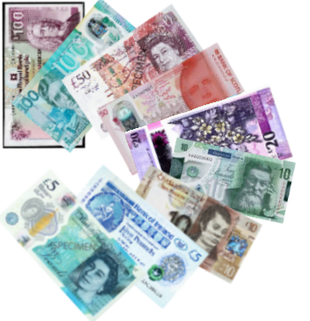
The Bank of England is the central bank for sterling, issuing its own banknotes and regulating issuance of banknotes by private banks such as the Bank of Scotland and Clydesdale Bank in Scotland, and Danske Bank in Northern Ireland. Sterling banknotes issued by other jurisdictions are not regulated by the Bank of England; their governments guarantee convertibility at par. Historically, sterling was also used to varying degrees by the colonies and territories of the British Empire.
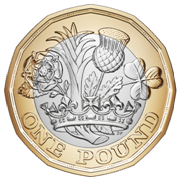
Names
Etymology
The basic unit of currency in medieval England was the silver penny or sterling, weighing about 1⁄240 of a tower pound. Two hundred and forty of these coins made a "pound of sterlings". This term (shortened to "pound sterling" in later usage) continued to be used in accounting even after the sterling had ceased to circulate. The earliest known instances of the term occur in Orderic Vitalis's 12th-century Historia Ecclesiastica, which makes mention of librae sterilensium.
The origin of the word sterling itself is unclear. It first appears in the 11th and 12th centuries, suggesting that it was coined to describe the new, heavier penny introduced by the Normans. According to the Oxford English Dictionary, the most plausible theory is that it represents Old English *steorling, meaning "coin with a star" (a pair of stars having appeared on certain Norman pennies). The numismatist Philip Grierson rejects this, however, noting that the starred penny was only minted between 1077 and 1080 and formed a tiny fraction of the total coinage issued by the Normans. Grierson suggests instead that the first element is *stēre, meaning "stout" or "strong". In support of this theory, he notes that the Roman solidus had a name with a very similar meaning and was also introduced to replace a lighter coin.
An old theory that the sterling was so named because it was introduced to England by Easterlings, i.e. Hanseatic merchants, is untenable on historical and phonological grounds.
Symbol
The currency sign for the pound unit of sterling is £, which (depending on typeface) may be drawn with one or two bars: the Bank of England has exclusively used the single bar variant since 1975. Historically, a simple capital L (in the historic black-letter typeface,
{\displaystyle {\mathfrak {L}}}
) placed before the numerals, or an italic l. after them, was used in newspapers, books and letters. The Royal Mint was still using this style of notation as late as 1939. Use of the letter ⟨L⟩ for pound derives from medieval Latin documents: "L" was the abbreviation for libra, the Roman pound (weight), which in time became an English unit of weight defined as the tower pound. A "pound sterling" was literally a tower pound (weight) of sterling silver. In the British pre-decimal (duodecimal) currency system, the term £sd (or Lsd) for pounds, shillings and pence referred to the Roman libra, solidus, and denarius.

Notable style guides recommend that the pound sign be used without any abbreviation or qualification to indicate sterling (e.g., £12,000). The ISO 4217 code "GBP" (e.g., GBP 12,000) may also be seen should disambiguation become necessary.
Currency code
The ISO 4217 currency code for sterling is "GBP", formed from the ISO 3166-1 alpha-2 code for the United Kingdom ("GB") and the first letter of "pound".
In historical sources and some specialist banking uses, the abbreviation stg (in various styles) has been used to indicate sterling. Many stocks on the London Stock Exchange are quoted in penny sterling, using the unofficial code "GBX".

Cable
The exchange rate of sterling against the US dollar is referred to as "cable" in the wholesale foreign exchange markets. The origins of this term are attributed to the fact that from the mid-19th century, the sterling/dollar exchange rate was transmitted via transatlantic cable.
Slang terms
Historically almost every British coin had a widely recognised nickname, such as "tanner" for the sixpence and "bob" for the shilling. Since decimalisation these have mostly fallen out of use except as parts of proverbs.
A common slang term for the pound unit is "quid" (singular and plural, except in the common phrase "quids in"). Its origin is unknown: possible derivations include scudo, the name for a number of currency units used in Italy until the 19th century, introduced by Italian immigrants; or from Latin quid via the common phrase quid pro quo, literally, "what for what", or, figuratively, "An equal exchange or substitution". The term "nicker" (also both singular and plural) may also refer to the pound.

Crown Dependencies and British Overseas Territories
The currency of all the Crown Dependencies (Guernsey, Jersey, Isle of Man) and a third of British Overseas Territories (British Antarctic Territory; Falkland Islands and South Georgia and the South Sandwich Islands; Gibraltar; and Saint Helena, Ascension and Tristan da Cunha) is either sterling or pegged to sterling at par.
The other British Overseas Territories have a local currency that is pegged to the U.S. dollar or the New Zealand dollar. The Sovereign Base Areas of Akrotiri and Dhekelia (in Cyprus) use the euro.
Subdivisions and other units
Decimal coinage
Since decimalisation on Decimal Day in 1971, the pound has been divided into 100 pence (denoted on coinage, until 1981, as "new pence"). The symbol for the penny is "p"; hence an amount such as 50p (£0.50) properly pronounced "fifty pence" is often pronounced "fifty pee" /fɪfti piː/. The old sign d was not reused for the new penny in order to avoid confusion between the two units. A decimal halfpenny (1/2p, worth 1.2 old pennies) was issued until 1984 but was withdrawn due to inflation.
Pre-decimal
Before decimalisation in 1971, the pound was divided into 20 shillings, and each shilling into 12 pence, making 240 pence to the pound. The symbol for the shilling was "s." – not from the first letter of "shilling", but from the Latin solidus. The symbol for the penny was "d.", from the French denier, from the Latin denarius (the solidus and denarius were Roman coins). A mixed sum of shillings and pence, such as 3 shillings and 6 pence, was written as "3/6" or "3s. 6d." and spoken as "three and six" or "three and sixpence" except for "1/1", "2/1" etc., which were spoken as "one and a penny", "two and a penny", etc. Five shillings, for example, was written as "5s." or, more commonly, "5/–" (five shillings, no pence).
Various coin denominations had, and in some cases continue to have, special names, such as florin (2/–), crown (5/–), farthing (1⁄4d), sovereign (£1) and guinea (21s, 21/–, £1–1–0 or £1.05 in decimal notation).
By the 1950s, the coins of kings George III, George IV and William IV had disappeared from circulation, but coins (at least the penny) bearing the head of every British monarch from Queen Victoria onwards could be found in circulation. Silver coins were replaced by those in cupro-nickel in 1947, and by the 1960s the silver coins were rarely seen. Silver/cupro-nickel sixpences, shillings (from any period after 1816) and florins (2 shillings) remained legal tender after decimalisation (as 2½p, 5p and 10p respectively) until 1980, 1990 and 1993 respectively, but are now officially demonetised.
History (600–1945)
The pound sterling emerged after the adoption of the Carolingian monetary system in England c. 800. Here is a summary of changes to its value in terms of silver or gold until 1816.
Anglo-Saxon
The pound was a unit of account in Anglo-Saxon England. By the ninth century it was equal to 240 silver pence.
The accounting system of dividing one pound into twenty shillings, a shilling into twelve pence, and a penny into four farthings was adopted from the livre carolingienne system introduced by Charlemagne to the Frankish Empire. The penny was abbreviated to "d" – from denarius, the Roman equivalent of the penny; the shilling to "s" – from solidus (written with a long s, ſ, later evolving into a simple slash, /), another Roman coin; and the pound to "L" (subsequently £) – from Libra, the Roman pound weight.
The origins of sterling lie in the reign of King Offa of Mercia (757–796), who introduced a "sterling" coin made by physically dividing a Tower pound (5,400 grains, 349.9 grams) of silver into 240 parts. In practice, the weights of the coins were not consistent, 240 of them seldom added up to a full pound; there were no shilling or pound coins and these units were used only as an accounting convenience.
Halfpennies and farthings worth 1⁄2 and 1⁄4 penny respectively were also minted, but small change was more commonly produced by cutting up a whole penny.
Medieval, 1158
The early pennies were struck from fine silver (as pure as was available). In 1158, a new coinage was introduced by King Henry II (known as the Tealby penny), with a Tower Pound (5,400 grains, 349.9 g) of 92.5% silver minted into 240 pennies, each penny containing 20.82 grains (1.349 g) of fine silver. Called sterling silver, the alloy is harder than the 99.9% fine silver that was traditionally used, and sterling silver coins did not wear down as rapidly as fine silver ones.
The introduction of the larger French gros tournois coins in 1266, and their subsequent popularity, led to additional denominations in the form of groats worth four pence and half groats worth two pence. A gold penny weighing twice the silver penny and valued at 20 silver pence was also issued in 1257 but was not successful.
The English penny remained nearly unchanged from 800 and was a prominent exception in the progressive debasements of coinage which occurred in the rest of Europe. The Tower Pound, originally divided into 240 pence, devalued to 243 pence by 1279.
Edward III, 1351
During the reign of King Edward III, the introduction of gold coins received from Flanders as payment for English wool provided substantial economic and trade opportunities but also unsettled the currency for the next 200 years. The first monetary changes in 1344 consisted of
English pennies reduced to 20+1⁄4 grains (1.312 g; 0.042 ozt) of sterling silver (or 20.25gr @ 0.925 fine = 18.73 gr pure silver) and
Gold double florins weighing 108 gr (6.998 g; 0.225 ozt) and valued at 6 shillings (or 72 pence). (or 108gr @ 0.9948 fine = 107.44 gr pure gold).
The resulting gold-silver ratio of 1:12.55 was much higher than the ratio of 1:11 prevailing in the Continent, draining England of its silver coinage and requiring a more permanent remedy in 1351 in the form of
Pennies reduced further to 18 gr (1.2 g; 0.038 ozt) of sterling silver (or 18 @ 0.925 fine = 15.73 gr pure silver) and
New gold nobles weighing 120 grains (7.776 grams; 0.250 troy ounces) of the finest gold possible at the time (191/192 or 99.48% fine), (meaning 120gr @ 0.9948 fine = 119.38 gr pure gold) and valued at 6 shillings and 8 pence (80 pence, or 1⁄3rd of a pound). The pure gold-silver ratio was thus 1:(80 × 15.73 / 119.38) = 1:10.5.
These gold nobles, together with half-nobles (40 pence) and farthings or quarter-nobles (20 pence), became the first English gold coins produced in quantity.
Henry IV, 1412
The exigencies of the Hundred Years' War during the reign of King Henry IV resulted in further debasements toward the end of his reign, with the English penny reduced to 15 grains sterling silver (0.899 g fine silver) and the half-noble reduced to 54 grains (3.481 g fine gold). The gold-silver ratio went down to 40 × 0.899 / 3.481 = 10.3.
After the French monetary reform of 1425, the gold half-noble (1⁄6th pound, 40 pence) was worth close to one Livre Parisis (French pound) or 20 sols, while the silver half-groat (2 pence, fine silver 1.798 g) was worth close to 1 sol parisis (1.912 g). Also, after the Flemish monetary reform of 1434, the new Dutch florin was valued close to 40 pence while the Dutch stuiver (shilling) of 1.63 g fine silver was valued close to 2 pence sterling at 1.8 g. This approximate pairing of English half-nobles and half-groats to Continental livres and sols persisted up to the 1560s.
Great slump, 1464
The Great Bullion Famine and the Great Slump of the mid-15th century resulted in another reduction in the English penny to 12 grains sterling silver (0.719 g fine silver) and the introduction of a new half-angel gold coin of 40 grains (2.578 g), worth 1⁄6th pound or 40 pence. The gold-silver ratio rose again to 40 × 0.719⁄2.578 = 11.2. The reduction in the English penny approximately matched those with the French sol Parisis and the Flemish stuiver; furthermore, from 1469 to 1475 an agreement between England and the Burgundian Netherlands made the English groat (4-pence) mutually exchangeable with the Burgundian double patard (or 2-stuiver) minted under Charles the Bold.
40 pence or 1⁄6th pound sterling made one Troy ounce (480 grains, 31.1035 g) of sterling silver. It was approximately on a par with France's livre parisis of one French ounce (30.594 g), and in 1524 it would also be the model for a standardised German currency in the form of the Guldengroschen, which also weighed 1 German ounce of silver or 29.232 g (0.9398 ozt).
Tudor, 1551
The last significant depreciation in sterling's silver standard occurred amidst the 16th century influx of precious metals from the Americas arriving through the Habsburg Netherlands. Enforcement of monetary standards amongst its constituent provinces was loose, spending under King Henry VIII was extravagant, and England loosened the importation of cheaper continental coins for exchange into full-valued English coins. All these contributed to the Great Debasement which resulted in a significant 1⁄3rd reduction in the bullion content of each pound sterling in 1551.
The troy ounce of sterling silver was henceforth raised in price by 50% from 40 to 60 silver pennies (each penny weighing 8 grains sterling silver and containing 0.4795 g (0.01542 ozt) fine silver). The gold half-angel of 40 grains (2.578 g (0.0829 ozt) fine gold) was raised in price from 40 pence to 60 pence (5 shillings or 1⁄4 pound) and was henceforth known as the Crown.
Prior to 1551, English coin denominations closely matched with corresponding sol (2d) and livre (40d) denominations in the Continent, namely: