
Portugal, officially the Portuguese Republic, is a country in Southwestern Europe. It is a unitary republic comprising mainland Portugal, located on the southwestern portion of the Iberian Peninsula and bordered by Spain to the north and east, and the archipelagos of Madeira and the Azores in the Atlantic Ocean. The country has a population of over 11.4 million, and Lisbon, its capital, is the largest city. Portugal's internal waters and territorial sea together account for two-fifths of its territory, and its exclusive economic zone is one of Europe's largest, while its terrain contains a diverse range of landscapes and regional climates.
The western Iberian Peninsula has been inhabited since prehistory, with the earliest signs of settlement dating to between 5500 BC and 5300 BC. Portugal was established as a county of the Kingdom of León in 868, and formally as a kingdom in 1179 as a result of the Reconquista against the Muslims, who had occupied the Iberian Peninsula since 711. During the Age of Discovery, the kingdom made several advancements in nautical science and maritime exploration to discover new territories and sea routes, which led to the establishment of the Portuguese Empire. The kingdom became a republic in 1910 and was a dictatorship from 1926 until the dictatorship's overthrow in 1974 enabled the full establishment of democracy in 1976.
Portugal is a semi-presidential constitutional unitary republic and multi-party representative democracy with four separate sovereignty bodies: president, government, parliament, and judiciary. It has a unicameral national legislature known as the Assembly of the Republic. Portugal is divided into two autonomous regions and seven regions on the mainland while it remains highly centralised.

A developed country, Portugal has an advanced economy that chiefly relies upon services, industry, and tourism. Shaped by the various civilisations that have inhabited its territory, Portugal developed a culture with a worldwide influence that allowed Portuguese to become the world's fifth-most spoken native language with more than 250 million native speakers. With a stable foreign policy shaped by its colonial and diplomatic history and location, Portugal is a member of multiple international organisations and forums.
Etymology
The word Portugal derives from Latin Portus Cale, meaning 'port of Cale', itself the origin of Porto, while Cale was a town on the Douro. There is no consensus on the etymology of Cale. It could be an ethnonym derived from the Celtic Gallaeci peoples, who occupied the north-west of the Iberian Peninsula.
Around 136 BC, the Romans, during the Second Punic War, conquered Cale from the Carthaginians and renamed it Portus Cale. During the Middle Ages, the region around Portus Cale became known by the Visigoths as Portucale and by the Suebi as Parochiale. The name Portucale evolved into Portugale; by the 11th and 12th centuries Portugal was referred to the region between the Douro and Minho rivers.
History
Prehistory
The region has been inhabited by humans since approximately 400,000 years ago. Neanderthals roamed the southwestern Iberian peninsula until 37,000 years ago, and a Neanderthal tooth has been found at the Nova da Columbeira Cave in Estremadura. Homo sapiens sapiens arrived in what is now Portugal around 35,000 years ago and spread rapidly. The onset of the Neolithic in the area dates to between 5500 BC and 5300 BC. In southern Portugal, Iron Age inscribed stele have been found, representing an early evidence of writing on the Iberian Peninsula. Pre-Celtic tribes inhabited Portugal and the Lusitanians occupied central, inland regions. Celts inhabited most of the remaining territory of mainland Portugal, leaving lasting traces in the language and culture such as contributing to the formation of Portuguese values and identity, such as saudade.
Antiquity and early Middle Ages
The Mediterranean coast was well known to the Carthaginians, whose close relations with Phoenician-Punic settlements likely gave them considerable political and economic influence there from the 6th or 5th century BC. After Carthage's defeat by Rome in the First Punic War, it sought new western territories, culminating in the Barcid conquest of the Iberian Peninsula in 237 BC.
Romans invaded the Iberian Peninsula in 218 BC. The Carthaginians were expelled from the peninsula in 206 BC after the Battle of Ilipa. Within 200 years, mainland Portugal, together with the rest of the Iberian Peninsula had been annexed by the Romans despite resistance from local tribes such as the Lusitanians under the leadership of various leaders such as Viriathus.
In 409, with the decline of the Western Roman Empire, the Iberian Peninsula was invaded by Germanic tribes. Western Iberia was integrated into the Suebian Kingdom, with its capital in or near Braga. The Visigoths defeated the Suebi and ruled the peninsula until the early 8th century.
In 711, the Iberian Peninsula was invaded from the south by the Umayyad Caliphate, which expanded rapidly and by 716 most of the peninsula was part of al-Andalus. The Umayyads ruled al-Andalus until it fragmented into small states, with the caliphate being abolished in 1031, and most of what is now central and southern Portugal falling under the Taifa of Badajoz. These were conquered by the Almoravids, who were in turn followed by the Almohads. Northern incursions also occurred during this period, with Viking raids recorded from 844 into the 11th century.
Reconquista and independence
The Reconquista was a series of military and cultural campaigns by northern Iberian Christian polities against the Muslim-ruled al-Andalus. It could have begun with the defeat of Umayyad forces at the Battle of Covadonga by Pelagius, a Visigothic nobleman, although the historicity of both Pelagius and the event remains unestablished. In 868, the region between the Minho and the Douro rivers was secured from the Moors and constituted as the County of Portugal under Vímara Peres. The first county of Portugal lasted until it was abolished following the Battle of Pedroso, in 1071. In 1096, Alfonso VI of León refounded the county and bestowed it on Henry of Burgundy, who married Alfonso's illegitimate daughter, Teresa of León.

After Count Henry's death in 1112, Teresa ruled the county as regent for her son Afonso Henriques. Her close association from 1121 with Fernão Peres de Trava, a Galician noble, displeased the local nobility, who sided with Afonso Henriques and defeated her, Fernão Peres de Trava, and their supporters at the Battle of São Mamede in 1128. The following year, Afonso claimed sole authority over the entire county, free from foreign influence. According to legend, he won the Battle of Ourique and took the title of King in 1139. Afonso's claim is documented as having been recognized by Alfonso VII of León at the Conference of Zamora in 1143, and by Pope Alexander III in 1179 through the papal bull Manifestis Probatum.
With the support of north-European crusaders and Christian military orders, Afonso Henriques and his successors continued pushing south until the capture of Algarve which was recognised as Portuguese territory in 1267. With minor readjustments, Portugal's borders have largely remained the same since the signing of the Treaty of Alcañices in 1297. Between the 14th and early 15th century, Portugal was strucked by several outbreaks of the plague, civil wars, invasions, famines, and natural disasters that led to a population decrease, labour shortages, and rise in antisemitism. In 1386, during the reign of King John I, Portugal cemented its alliance with England with the signing of the Treaty of Windsor, making it the oldest standing alliance in the world.
Age of Discovery
The unpopularity of Leonor Teles, regent for her daughter Beatrice, wife of John I of Castile, triggered a crisis in 1383 compounded by fears that the marriage could lead to the loss of Portugal's independence. John of Aviz led a revolt against him and defeated the Castilians in the Battle of Aljubarrota, with the House of Aviz becoming the ruling house and created the conditions for Portugal's maritime explorations, elevating the country in European politics and culture . Portugal acquired its first colonies by conquering Ceuta in 1415. The country led the Age of Discovery under the sponsorship of Prince Henry the Navigator, and made several advancements in nautical science.

Portugal was the first and the last colonial power in the era of modern European colonialism, and by the mid-16th century it controlled a network of possessions stretching from Lisbon to Japan and Timor through Brazil. Throughout the 15th and 16th centuries, Portuguese explorers sailed the coast of Africa, establishing trading posts for commodities especially gold and slaves, explored the Indian Ocean and eastern Asia, established trade routes in most of southern Asia taxing most trade criss-crossing the Indian Ocean. The 1494 Treaty of Tordesillas divided newly encountered non-European territories between Portugal and Spain along a meridian west of Cape Verde, while the 1529 Treaty of Zaragoza extended this partition to the Pacific Ocean. In 1498, Vasco da Gama reached India by sea, and two years later Pedro Álvares Cabral landed in Brazil and claimed it for Portugal. Between 1519 and 1522, Ferdinand Magellan organised a Spanish expedition to the East Indies that completed the first circumnavigation of the globe. During the 15th century, Portugal established the transatlantic slave-trade circuits and, by the mid-19th century, had become one of the longest-active and a significant participant in the Atlantic slave trade.
Iberian Union and Restoration
The 1578 death of King Sebastian in battle and the subsequent 1580 death of King Henry without a named heir, precipitated a succession crisis. Philip II of Spain, whose mother was Isabella of Portugal, was one of the candidates for the throne. In 1581 he was acclaimed king of Portugal, creating a personal union between the two kingdoms. This deprived Portugal of an independent foreign policy and led to the Dutch-Portuguese War.
On 15 December 1640, John, Duke of Braganza, was proclaimed king following an uprising led by some nobles on 1 December, ending the Iberian Union under the House of Habsburg, and beginning the rule of the House of Braganza. Following the Portuguese Restoration War, Spain recognised Afonso VI as king of Portugal. During the reign of John V, the large influx of Brazilian gold into the royal treasury, chiefly through the royal fifth, produced a resource curse that weakened industry and cereal production, created a gold rush from Portugal to Brazil, and led to prolonged economic stagnation, permanent reduction of income growth, and the interruption of the institutional and economic progress achieved in the 17th century.

After the depletion of gold revenues, Portugal was left with a weak industrial base and backward institutional and educational structures, a condition exacerbated by Sebastião José de Carvalho e Melo, 1st Marquis of Pombal, who emerged as the country's de facto ruler in the aftermath of the 1755 earthquake and tsunami, a natural disaster that shook the kingdom and recognized as one of the worst to ever occur. Pombal's failed industrialisation efforts, education policies that weakened human-capital formation, and expulsion of the Jesuits, reducing student numbers and contributing to Portugal's decline in literacy. Pombal's instrumentalisation of the Inquisition for political purposes, helping to entrench an extractive system that outlasted his rule. The nature of the existing political institutions contributed to Portugal's sustained divergence from Western Europe despite comparable family values and high state capacity, with partial recovery beginning around the mid-20th century.
Constitutional monarchy
In 1807, Portugal refused Napoleon's demand to join the Continental System of embargo against the United Kingdom; an invasion led by French General Junot followed, and Lisbon was captured in 1807. During the Napoleonic invasions, the Portuguese royal family transferred the court to Rio de Janeiro, in Brazil, making it the capital between 1808 and 1821. British intervention in the Peninsular War helped support Portuguese independence, and all French troops were expelled by 1812.
In 1820, an uprising in Porto sought to establish a constitution for Portugal and led to the return of King John VI and his court to mainland Portugal in 1821. Although the 1822 Constitution was adopted, the process was marked by compromise and efforts at consensus, which allowed absolutist forces to regain strength, culminating in Miguelist counter-revolts against liberalism, prompting Prince Miguel's exile. After John VI's death in 1826, his eldest son, Pedro I of Brazil, briefly reigned as Pedro IV of Portugal, granted the 1826 Charter, and abdicated in favour of his minor daughter, Maria da Glória, on the condition that she marry Miguel, who was appointed regent. Although Miguel's return was under the condition of swearing allegiance to the Charter, he soon dismantled liberal institutions and was proclaimed king in 1828, leading to the Liberal Wars, after which Pedro forced Miguel's abdication in favour of Maria and his exile causing absolutist ideology to wane. Under the constitutional monarchy, the country faced economic crises, political instability, and several coups d'état. At the same time it expanded its colonies in Africa, but this culminated in the 1890 British Ultimatum, which thwarted Portugal's imperialist ambitions and represented a devastating blow to the monarchy.
First Republic and Estado Novo
In 1908, King Carlos I and Luís Filipe, Prince Royal, were assassinated by republican sympathizers. In 1910, the monarchy was replaced with a republic. During World War I, Portugal fought for the Allies. However, the war increased political instability and deepened the economic crisis creating further chaos and unrest during the First Republic. These conditions led to the overthrow of the Republic in 1926 and the establishment of the Ditadura Nacional, which eventually evolved into the right-wing dictatorship of the Estado Novo, under António de Oliveira Salazar, in 1933.
During the Estado Novo, Portugal remained neutral in World War II, after which the postwar decline of colonial legitimacy and the growth of African independence movements increasingly challenged Portuguese rule overseas. The regime introduced reforms intended to strengthen ties between the metropole and the colonies, yet the empire was no unified customs and economic area. Indigenous peoples already second-class citizens, saw limited improvements in living conditions further fuelled nationalist movements, ultimately leading to the Portuguese Colonial War from 1961 to 1974.
Return to democracy
On 25 April 1974, the Carnation Revolution overthrew the Estado Novo regime, initiating the transition to democracy and also the dissolution of the Portuguese empire, from the independence of the African colonies to the Handover of Macau in 1999. During the Ongoing Revolutionary Process (PREC), Portugal was governed by a succession of unstable provisional governments amid significant social and political tension, until the failed coup of 25 November 1975 cleared the way for the approval of a new constitution and the holding of new elections.
After the transition to democracy, in the late 1970s and throughout the 1980s, under the influence by new economic insights, Portugal set about dismantling socialist policies from that period and moving towards neoliberalism. In 1986, Portugal joined the European Economic Community (EEC), which led to a considerable growth of its economy. The 2010–2014 Portuguese financial crisis resulted in an international bailout and intense austerity policies, causing lasting social impacts.
Geography
Portugal's territory comprises mainland Portugal and the Azores and Madeira archipelagos. The mainland, commonly referred to as Continental Portugal, is located in the southwest of the Iberian Peninsula in Southwestern Europe, while Madeira and the Azores lie in the Atlantic Ocean. The country's land area is 92,225 km2 (35,608 sq mi), although Portuguese law defines the country's size as 156,597 km2 (60,462 sq mi) which includes about 64,000 km2 (24,711 sq mi) of ocean waters. Portugal's exclusive economic zone extends 1,727,408 km2 (666,956 mi2), making it one of the largest in the European Union. The country is over two-thirds wilderness, almost one-fourth agricultural, and the remainder human settlements. Its highest point is the summit of Mount Pico, located on Pico Island in the Azores, which rises to an elevation of 2,351 m (7,713 ft) above sea level. Portugal can be divided into four morphostructural units: the Hesperian Massif, which occupies most of mainland Portugal; the sedimentary borderlands of the massif, forming the Lusitanian and Algarve basins; the Lower Tagus and Alvalade sedimentary basins; and the volcanic submarine ranges that form the Azores and Madeira. Its geological and geomorphological features are largely the product of the Variscan, responsible for the formation of the Hesperian Massif, and later the Tethys–Atlantic cycle, responsible for the remaining units. Regional tectonic processes affected mainland Portugal's morphostructural units differently, producing relief variations that subdivide the territory into ten regional geomorphological units shaped by the different regional impacts of the Cenozoic tectonics, regional asymmetries of climate in the Paleogene, Neogene, and Quaternary, and the varied response of different lithologies to tectonic activity and climatic variability.
Continental Portugal is predominantly low-altitude, with over 70% of the territory lying below 400 m (1,300 ft) and less than 12% rising above 700 m (2,300 ft) of elevation. Its geography is structured by the Tagus River, which enters from Spain and flows into the Tagus Estuary, as 95% of areas exceeding 400 m (1,300 ft) are situated to the north of the river while the regions south of the Tagus, encompassing Alentejo and the Algarve, have 62% of the lands below 200 m (660 ft). The territory north of the Tagus is marked by mountains and plateaus incised by river valleys, whereas the south is distinguished by rolling plains.
The Madeira archipelago comprises the islands of Madeira and Porto Santo, together with the Desertas and Savage Islands, all of which are of volcanic origin. Approximately one-third of Madeira Island lies above 1,000 metres (3,300 ft) in elevation, and its landscape is characterised by a dense network of deep valleys with slopes rising several hundred metres, as well as streams that originate in the island's centre and diverge towards the coast, sustained by abundant rainfall. The steep gradient and very high rainfall is a cause of flash floods with high sediment transport.
The Azores is an archipelago composed of nine volcanic islands which, from west to east, are Flores, Corvo, Faial, Pico, São Jorge, Graciosa, Terceira, São Miguel, and Santa Maria. The islands retain much of their volcanic landforms, most visibly in volcanic cones and in the lakes that shape the scenery of the islands especially São Miguel, Flores, Terceira, Pico, and Corvo. Although rainfall is abundant, most streams in the Azores are temporary. The small size of the catchments, the slopes' steepness, and deforestation accentuates the torrential regime of the rivers during periods of intense precipitation causing erosion problems and floods.
Climate
The climate of mainland Portugal and Madeira, together with their surrounding waters, is Mediterranean, whereas the Azores and its adjacent waters mainly have a temperate oceanic climate. Portugal's terrain has a diverse variety of regional climates for its size. The high altitude zones of the Azorean islands have a temperate maritime climate while the western Azores have a humid subtropical climate. In parts of Beja and on Porto Santo Island the climate is semi-arid. In the Savage Islands the climate is that of a hot desert. The average temperature in Portugal varies from 4–20 °C (39.2–68.0 °F) in the mainland, around 18 °C (64.4 °F) in the Azores, and 9–19 °C (48.2–66.2 °F) in Madeira.
The Iberian Peninsula is located at the southern margin of the temperate zone and at the northern margin of the subtropical high-pressure zone. Additionally, Portugal's climate is influenced by the seasonal latitudinal shift of the jet stream, which directly impacts the trajectory of the polar front. Typically in the winter, the jet stream moves southwards and Portugal comes under the influence of the polar front, producing colder temperatures. When the polar front moves northward, Portugal comes under the influence of the Azores High bringing atmospheric stability during the summer.
Wildfires remain a serious challenge in Portugal, with nearly 30% of those recorded in 2024 having an undetermined origin and arson accounting for almost five-sixths of the total burned area. Between 2014 and 2024, Portugal recorded an annual average of 12,496 fires and 112,455 ha (434 sq mi) burned, making it the European Union country with both the highest average number of wildfires and the greatest average burned area over that period. Climate change is projected to raise average temperatures in Portugal by as much as 3–4 °C (37.4–39.2 °F) by 2100 relative to the 1990s–2010s average, with impacts in water, ecosystem, agriculture, health, and security.
Biodiversity
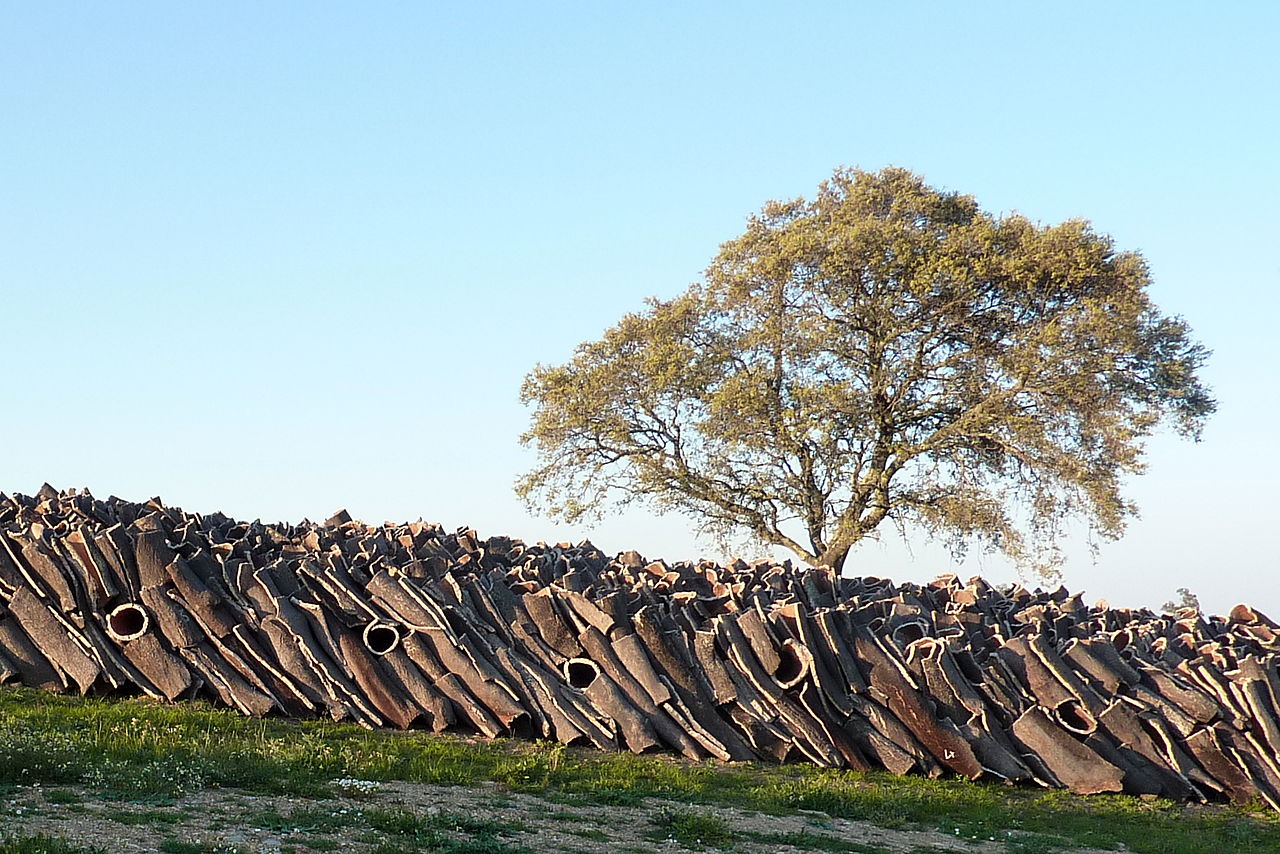
Portugal is located on the Mediterranean basin, a biodiversity hotspot. It is home to six terrestrial ecoregions - Azores temperate mixed forests, Cantabrian mixed forests, Madeira evergreen forests, Iberian sclerophyllous and semi-deciduous forests, Northwest Iberian montane forests, and Southwest Iberian Mediterranean sclerophyllous and mixed forests. Almost a quarter of its land area is included in the Natura 2000 network. Native species such as holm oak, cork oak, stone pine, and maritime pine make up 72% of the total forested area of continental Portugal.
The Portuguese west coast is part of the four major Eastern Boundary Upwelling Systems of the ocean. Portugal and Spain together have a high proportion of endemism among freshwater fish, with 73% of the freshwater fish species being endemic. Among Portugal's protected areas are the Southwest Alentejo and Vicentine Coast Natural Park, one of Europe's last remaining stretches of wild coastline, and Montesinho Natural Park, which preserves one of the few thriving Mediterranean mountain landscapes.
Geographical and climatic conditions facilitate the introduction of exotic species that later turn out to be invasive to the native habitats. Over one-fourth of extant plant species in continental Portugal are exotic. Portugal has one of the highest numbers of threatened animal and plant species in Europe. The country as a whole is an important stopover for migratory bird species. The mammalian species of Portugal such as red deer, Iberian ibex, wild boar, red fox, Iberian wolf, and Iberian lynx were once widespread throughout the country, but intense hunting, habitat degradation, and growing pressure from agriculture and livestock largely reduced their populations in the 19th and 20th centuries. Others species, such as the Portuguese ibex, became extinct, but some mammalian species, such as the red deer, have been re-expanding their native range.
Government and politics
Portugal has been a semi-presidential representative democratic republic since the ratification of the Constitution of 1976. The Constitution makes for a separation of powers among four sovereignty bodies: the president, the government, the Assembly of the Republic, and the courts. There is universal suffrage for adults over 18 years of age, with a secret ballot for all elected offices.
The head of state of Portugal is the president who is elected to a five-year term by direct, universal adult suffrage. The president exercises representative functions, carries supervisory and reserve powers, and shapes political opinions and agendas; in addition, the office includes supreme command of the armed forces and is advised by the Council of State. The current president of Portugal is António José Seguro; he took office after winning the runoff vote of the 2026 Portuguese presidential election.
Portugal's legislative body is the Assembly of the Republic, a unicameral parliament. It consists of a single chamber with a minimum of 180 seats and a maximum of 230, elected by popular vote every four years or when dissolved. The members of parliament represent the whole country and not the constituencies for which they are elected. As the head of government, the prime minister directs government policy, leads the Council of Ministers which includes ministers and junior ministers that execute government policy, and is appointed by the president in light of electoral results after consulting with the parties with seats in the Assembly of the Republic. Portugal's current prime minister is Luís Montenegro, who took office after the AD – PSD/CDS Coalition won enough seats to form a minority government following the 2024 Portuguese legislative election. Portugal operates a multi-party system of competitive legislatures at the national, regional, and local levels. The Assembly of the Republic is dominated by three political parties, the Social Democratic Party (PSD), Chega (CH), and the Socialist Party (PS), while the PSD and PS continue to be the dominant parties in the regional parliaments and at the local level. There have been recent trends towards autocratisation.
Portugal has a civil law system based on Roman law and on Canon Law and influenced by German civil law. The Constitution is the supreme law of Portugal. In the Portuguese legal system, private civil law and criminal law are codified in the Código Civil and the Código Penal respectively. Portugal's court system is organised into judicial, administrative, and fiscal branches with three levels of jurisdiction and separate courts of last appeal, while the Constitutional Court is responsible for constitutional review and oversight of elections, referendums and political parties.
Administrative divisions
Portugal is a highly centralised unitary state comprising two autonomous regions, as well as seven regions on the mainland. Subnational government in Portugal is currently organised through municipalities (concelhos), civil parishes (freguesias), and intermunicipal communities (comunidades intermunicipais). In the following table, the intermunicipal communities are grouped by region:
Foreign relations
A member state of the United Nations since 1955, Portugal is a member of almost all major international organisations, and is among the countries that founded NATO in 1949, the OECD in 1961, EFTA in 1960, and the Community of Portuguese Language Countries (CPLP) in 1996, an international organisation of countries with Portuguese as an official language.
Portugal has a stable foreign policy that is the result of its history, geography, and specific foreign policy choices. It is structured around six principal regional and policy priorities: Europe, NATO and relations with the United Kingdom and with the United States, the Portuguese-speaking world, the importance of and support for Portuguese communities abroad, the internationalization of the national economy, and the strengthening of multilateralism. Portugal regards the success of European integration as paramount and is prepared, where a consensus exists among European Union member states, to endorse policies that go against with the country's national interests; it also supports general disarmament, the dismantling of political-military blocs, and the creation of a collective security system aimed at establishing an international order grounded in peace and justice among peoples.
Portugal has two territorial disputes, both of which are with Spain: the Spanish town of Olivenza which has been claimed by Portugal since the 19th century, and the surrounding waters of the Portuguese Savage Islands which have been claimed by Spain since the 15th century. Despite causing moments of tension between the two countries, the relationship between the two countries remains excellent.
Military
The Portuguese Armed Forces consist of three branches commanded by the Estado-Maior-General das Forças Armadas (Armed Forces General Staff) – Marinha (Navy), Exército (Army), and Força Aérea (Air Force). In addition to the three branches of the armed forces, there is the Guarda Nacional Republicana (National Republican Guard), a gendarmerie, comprising 23,042 personnel in 2025, under the authority of both the Defence and the Home Affairs ministries. The Portuguese military serves as a self-defence force, takes part in humanitarian and peace missions undertaken by the international organisations to which Portugal belongs, and cooperates in civil defence missions. In recent years, the Portuguese military have carried out several NATO and European Union missions worldwide. The Portuguese military budget in 2025 was estimated at more than $6 billion, representing 2% of GDP.