
Joseph Philippe Pierre Yves Elliott Trudeau (October 18, 1919 – September 28, 2000) was a Canadian politician, lawyer, jurist, academic, author, and journalist who served as the 15th prime minister of Canada from 1968 to 1979 and from 1980 to 1984. Between his non-consecutive terms as prime minister from 1979 to 1980, he served as the leader of the Opposition.
Trudeau was born and raised in Outremont, Quebec, and studied politics and law. In 1950, he co-founded Cité Libre and rose to prominence as a labour activist in Quebec politics by opposing the conservative Union Nationale government. Trudeau was also an associate professor of law at the Université de Montréal. He was originally part of the social democratic New Democratic Party (NDP), but then joined the Liberal Party in 1965 on the belief that the NDP could not achieve power. In the election that year, he was elected to the House of Commons, and was quickly appointed as prime minister Lester B. Pearson's parliamentary secretary. Trudeau was minister of justice and attorney general from 1967 to 1968, during which time he liberalized divorce and abortion laws and decriminalized homosexuality. His outgoing personality and charisma caused a sensation, termed "Trudeaumania", which helped him win the leadership of the Liberal Party in 1968. He then succeeded Pearson and became prime minister of Canada.
From the late 1960s until the mid-1980s, Trudeau dominated the Canadian political scene. After his appointment as prime minister, he led the Liberals to victory in the 1968, 1972, and 1974 federal elections, before narrowly losing in 1979. He won a fourth election victory shortly afterwards, in 1980. Trudeau is the most recent prime minister to win four federal elections (having won three majority governments and one minority government) and to serve non-consecutive terms. His tenure of 15 years and 164 days makes him the third longest-serving prime minister in Canadian history, behind John A. Macdonald and William Lyon Mackenzie King.

As prime minister, Trudeau pioneered official bilingualism and multiculturalism. Amid the Quebec sovereignty movement, he invoked the War Measures Act in response to the 1970 October Crisis and later led the federalist campaign to victory in the 1980 Quebec sovereignty-association referendum. In economic policy, he introduced the capital gains tax, expanded social programs, sharply increased deficit spending, and enacted the Anti-Inflation Act in response to the 1970s recession. In a bid to move the Liberal Party towards economic nationalism, Trudeau established Petro-Canada and launched the National Energy Program, both of which generated significant controversy in oil-rich Western Canada and led to a rise in what was called "Western alienation". Trudeau's government also converted Canada to the metric system, created Via Rail, and enacted the Access to Information Act and the Canada Health Act. In foreign policy, Trudeau reduced alignment with the United States, maintained cordial relations with the Soviet Union, and developed strong ties with China and Cuban leader Fidel Castro, which put him at odds with other Western capitalist states. He also oversaw Canada's entry into the G7 forum. In 1982, Trudeau patriated the Constitution of Canada and established the Canadian Charter of Rights and Freedoms with the Constitution Act, 1982, which achieved full Canadian sovereignty.
Trudeau retired from politics shortly before the 1984 federal election. In his retirement, he practised law at the Montreal law firm of Heenan Blaikie. He also spoke out against the Meech Lake and Charlottetown accords (which proposed granting Quebec certain concessions), arguing they would strengthen Quebec nationalism. Trudeau died in 2000, aged 80. He is ranked highly among scholars in historical rankings of Canadian prime ministers, but remains a divisive figure in Canadian politics. Critics accused him of arrogance, economic mismanagement, and unduly centralizing Canadian decision-making to the detriment of the culture of Quebec and the economy of the Prairies, while admirers praised what they considered to be the force of his intellect and his political acumen which maintained national unity throughout the Quebec sovereignty movement. Trudeau's eldest son, Justin Trudeau, served as prime minister of Canada from 2015 to 2025, and was the first prime minister to be the child of a previous prime minister.
Early life
The Trudeau family can be traced to Marcillac-Lanville in France in the 16th century and to a Robert Truteau (1544–1589). In 1659, the first Trudeau to arrive in Canada was Étienne Trudeau or Truteau (1641–1712), a carpenter and home builder from La Rochelle.
Pierre Trudeau was born at home in Outremont, Quebec, on October 18, 1919, to Charles-Émile "Charley" Trudeau (1887–1935), a French-Canadian businessman and lawyer, and Grace Elliott, who was of mixed Scottish and French-Canadian descent. He had an older sister named Suzette and a younger brother named Charles Jr. Trudeau remained close to both siblings for his entire life. Trudeau's paternal grandparents were French-speaking Quebec farmers. His father had acquired the B&A gas station chain (now defunct), some "profitable mines, the Belmont amusement park in Montreal and the Montreal Royals, the city's minor-league baseball team", by the time Trudeau was fifteen. When his father died in Orlando, Florida, on April 10, 1935, Trudeau and each of his siblings inherited $5,000 (equivalent to $110,000 in 2025), a considerable sum at that time, which meant that he was financially secure and independent. His mother, Grace, "doted on Pierre" and he remained close to her throughout her long life. After her husband died, she left the management of her inheritance to others and spent a lot of her time working for the Roman Catholic Church and various charities, travelling frequently to New York City, Florida, Europe, and Maine, sometimes with her children. Already in his late teens, Trudeau was "directly involved in managing a large inheritance".
Early education
From the age of six until twelve, Trudeau attended the primary school Académie Querbes, in Outremont, where he became immersed in the Catholic religion. The school, which was for both English and French Catholics, was an exclusive school with very small classes and he excelled in mathematics and religion. From his earliest years, Trudeau was fluently bilingual, which would later prove to be a "big asset for a politician in bilingual Canada." As a teenager, he attended the Jesuit French-language Collège Jean-de-Brébeuf, a prestigious secondary school known for educating elite francophone families in Quebec.
In his seventh and final academic year, 1939–1940, Trudeau focused on winning a Rhodes Scholarship. In his application, he wrote that he had prepared for public office by studying public speaking and publishing many articles in Brébeuf. His letters of recommendations praised him highly. Father Boulin, who was the head of the college, said that during Trudeau's seven years at the college (1933–1940), he had won a "hundred prizes and honourable mentions" and "performed with distinction in all fields". Trudeau graduated from Collège Jean-de-Brébeuf in 1940 at the age of twenty-one.

Trudeau did not win the Rhodes Scholarship. He consulted several people on his options, including Henri Bourassa, the economist Edmond Montpetit, and Father Robert Bernier, a Franco-Manitoban. Following their advice, he chose a career in politics and a degree in law at the Université de Montréal.
Second World War
In its obituary, The Economist described Trudeau as "parochial as a young man", who "dismissed" the Second World War "as a squabble between the big powers, although he later regretted 'missing one of the major events of the century'." In his 1993 Memoir, Trudeau wrote that the outbreak of the Second World War in September 1939 and his father's death were the two "great bombshells" that marked his teenage years. In his first year at university, the prime topics of conversation were the Battle of France, the Battle of Britain, and the London blitz. He wrote that in the early 1940s, when he was in his early twenties, he thought, "So there was a war? Tough. It wouldn't stop me from concentrating on my studies so long as that was possible...[I]f you were a French Canadian in Montreal [at that time], you did not automatically believe that this was a just war. In Montreal in the early 1940s, we still knew nothing about the Holocaust and we tended to think of this war as a settling of scores among the superpowers."
Young Trudeau opposed conscription for overseas service, and in 1942 he campaigned for the anti-conscription candidate Jean Drapeau (later the mayor of Montreal) in Outremont. Trudeau described a speech he heard in Montreal by Ernest Lapointe, minister of justice and Prime Minister William Lyon Mackenzie King's Quebec lieutenant. Lapointe had been a Liberal MP during the 1917 Conscription Crisis, in which the Canadian government had deployed up to 1,200 soldiers to suppress the anti-conscription Easter Riots in Quebec City in March and April 1918. In a final and bloody conflict, armed rioters fired on the troops, and the soldiers returned fire. At least five men were killed by gunfire and there were over 150 casualties and $300,000 in damage. In 1939, it was Lapointe who helped draft the Liberals' policy against conscription for service overseas. Lapointe was aware that a new conscription crisis would destroy the national unity that Mackenzie King had been trying to build since the end of the First World War. Trudeau believed Lapointe had lied and broken his promise. His criticisms of King's wartime policies, such as "suspension of habeas corpus", the "farce of bilingualism and French-Canadian advancement in the army," and the "forced 'voluntary' enrolment", were scathing.

As a university student, Trudeau joined the Canadian Officers' Training Corps (COTC), which trained at the local armoury in Montreal during the school term and undertook further training at Camp Farnham each summer. Although the National Resources Mobilization Act, enacted in 1940, originally provided that conscripts could not be required to serve outside of Canada, Parliament amended the act and removed that restriction in 1942. The Conscription Crisis of 1944 arose in response to the Allied invasion of Normandy in June 1944.
Education
Trudeau continued his full-time studies in law at the Université de Montréal while in the COTC from 1940 until his graduation in 1943. Following his graduation, he articled for a year and, in late 1944, began his master's degree in political economy at Harvard University's Graduate School of Public Administration (now the John F. Kennedy School of Government). In his Memoir, he admitted that it was at Harvard's "super-informed environment" that he realized the "historic importance" of the war and that he had "missed one of the major events of the century in which [he] was living. Harvard had become a major intellectual centre, as fascism in Europe led to a great migration of intellectuals to the United States.
Trudeau's Harvard dissertation was on the topic of communism and Christianity. At Harvard, an American and predominantly Protestant university, Trudeau, a French Canadian Catholic living outside the province of Quebec for the first time, felt like an outsider. As his sense of isolation deepened, he decided in 1947 to continue his work on his Harvard dissertation in Paris, where he studied at the Institut d'Études Politiques de Paris (Sciences Po). The Harvard dissertation remained unfinished when Trudeau briefly entered a doctoral program to study under the socialist economist Harold Laski at the London School of Economics (LSE). This cemented Trudeau's belief that Keynesian economics and social sciences were essential to the creation of the "good life" in a democratic society. Over a five-week period he attended many lectures and became a follower of personalism after being influenced most notably by Emmanuel Mounier. He also was influenced by Nikolai Berdyaev, particularly his book Slavery and Freedom. Max and Monique Nemni argue that Berdyaev's book influenced Trudeau's rejection of nationalism and separatism.

In mid 1948, Trudeau embarked on world travels to find a sense of purpose. At the age of twenty-eight, he travelled to Poland where he visited Auschwitz, then Czechoslovakia, Austria, Hungary, Yugoslavia, Bulgaria, and the Middle East, including Turkey, Jordan and southern Iraq. Although he was wealthy, Trudeau travelled with a backpack in "self-imposed hardship". He used his British passport instead of his Canadian passport in his travels through Pakistan, India, China, and Japan, often wearing local clothing to blend in. According to The Economist, when Trudeau returned to Canada in 1949 after an absence of five months, his mind was "seemingly broadened" from his studies at Harvard, Sciences Po, and the LSE, as well as his travels. He was "appalled at the narrow nationalism in his native French-speaking Quebec, and the authoritarianism of the province's government".
Quiet Revolution
Beginning while Trudeau was travelling overseas, several events took place in Quebec that were precursors to the Quiet Revolution. These included the 1948 release of the anti-establishment manifesto Refus global, the publication of Les insolences du Frère Untel, the 1949 Asbestos Strike, and the 1955 Richard Riot. Artists and intellectuals in Quebec signed the Refus global on August 9, 1948, in opposition to the repressive rule of Quebec Premier Maurice Duplessis and the decadent "social establishment" in Quebec, including the Catholic Church. When he returned to Montreal in 1949, Trudeau quickly became a leading figure opposing Duplessis's rule. He actively supported the workers in the Asbestos strike which opposed Duplessis in 1949. Trudeau was the co-founder and editor of Cité Libre, a dissident journal that helped provide the intellectual basis for the Quiet Revolution. In 1956, he edited an important book on the subject, La grève de l'amiante, which argued that the asbestos miners' strike of 1949 was a seminal event in Quebec's history, marking the beginning of resistance to the conservative, Francophone clerical establishment and Anglophone business class that had long ruled the province.
Career
Because of Trudeau's labour union activities in Asbestos, Duplessis blacklisted him, and he was unable to teach law at the Université de Montréal. He surprised his closest friends in Quebec when he became a civil servant in Ottawa in 1949. Until 1951, he worked in the Privy Council Office of the Liberal Prime Minister Louis St. Laurent as an economic policy advisor. He wrote in his memoirs that he found this period very useful when he entered politics later on, and that senior civil servant Norman Robertson tried unsuccessfully to persuade him to stay on.

Trudeau's progressive values and his close ties with Co-operative Commonwealth Federation (CCF) intellectuals (including F. R. Scott, Eugene Forsey, Michael Kelway Oliver and Charles Taylor) led to his support of and membership in the party throughout the 1950s.
An associate professor of law at the Université de Montréal from 1961 to 1965, Trudeau's views evolved towards a liberal position in favour of individual rights counter to the state and made him an opponent of Quebec nationalism. He admired labour unions, which were tied to the Cooperative Commonwealth Federation (CCF), and tried to infuse his Liberal Party with some of their reformist zeal. By the late 1950s, Trudeau began to reject social democratic and labour parties, arguing that they should put their narrow goals aside and join forces with Liberals to fight for democracy first. In economic theory, he was influenced by professors Joseph Schumpeter and John Kenneth Galbraith while he was at Harvard. In 1963, Trudeau criticized the Liberal Party of Lester B. Pearson when it supported arming Bomarc missiles in Canada with nuclear warheads.
During his time as a professor at the Université de Montréal, he was featured in Denis Héroux's 1964 student film Over My Head (Jusqu'au cou), appearing as himself in a political debate.
Trudeau was offered a position at Queen's University teaching political science by James Corry, who later became Principal of Queen's, but turned it down because he preferred to teach in Quebec.
Early political career (1965–1967)
In 1965, Trudeau joined the Liberal Party, along with his friends Gérard Pelletier and Jean Marchand. Dubbed the "three wise men" by the media, they ran successfully for the Liberals in the 1965 election. Trudeau himself was elected in the safe Liberal riding of Mount Royal in Montreal. He would hold this seat until his retirement from politics in 1984, winning each election with large majorities. His decision to join the Liberals rather than the CCF's successor, the New Democratic Party (NDP), was partly based on his belief that the federal NDP could not achieve power. He also doubted the feasibility of the NDP's centralizing policies and felt that the party leadership tended toward a "deux nations" approach he could not support.
Upon arrival in Ottawa, Trudeau was appointed as parliamentary secretary to Prime Minister Lester B. Pearson and spent much of the next year travelling abroad, representing Canada at international meetings and bodies, including the United Nations. In 1967, he was appointed to Pearson's Cabinet as Minister of Justice and Attorney General.
Minister of Justice and Attorney General (1967–1968)
As Justice Minister and Attorney General, Trudeau was responsible for introducing the landmark Criminal Law Amendment Act, an omnibus bill whose provisions included, among other things, the decriminalization of homosexual acts between consenting adults, new gun ownership restrictions and the legalization of contraception, abortion and lotteries, as well as the authorization of breathalyzer tests on suspected drunk drivers. Trudeau famously defended the segment of the bill decriminalizing homosexual acts by telling reporters that "there's no place for the state in the bedrooms of the nation", adding that "what's done in private between adults doesn't concern the Criminal Code". Trudeau paraphrased the term from Martin O'Malley's editorial piece in The Globe and Mail on December 12, 1967. Trudeau also liberalized divorce laws, and clashed with Quebec Premier Daniel Johnson, Sr. during constitutional negotiations.
Liberal leadership convention (1968)
At the end of Canada's centennial year in 1967, Pearson announced his intention to step down, and Trudeau entered the race to succeed him as party leader and Prime Minister. His energetic campaign attracted widespread media attention and mobilized many young people, who saw Trudeau as a symbol of generational change. However, many Liberals still had reservations, given that he had only joined the party in 1965. During the convention, prominent Cabinet Minister Judy LaMarsh was caught on television profanely stating that Trudeau was not a Liberal.
Nevertheless, at the April 1968 Liberal leadership convention, Trudeau was elected leader on the fourth ballot, with the support of 51 percent of the delegates. He defeated several prominent and long-serving Liberals, including Paul Martin Sr., Robert Winters and Paul Hellyer.
First premiership (1968–1979)
Swearing-in and subsequent election
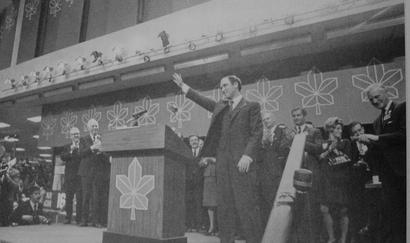
As the new leader of the governing Liberals, Trudeau was sworn in as prime minister on April 20. He became the third French Canadian prime minister of Canada after Wilfrid Laurier and Louis St. Laurent. Although the term of the Parliament was not due to expire until November 1970, Pearson's government had almost fallen before the leadership contest could even take place after a tax bill was voted down in Parliament, leading to much confusion over whether this counted as a matter of confidence in the government. Governor General Roland Michener ultimately ruled that it did not, and the government subsequently won an actual confidence motion, but the incident made it clear that the minority government Trudeau had inherited would not realistically last the full parliamentary term, and that he would soon need to call an early election in order to win a parliamentary majority. Trudeau eventually called this election for June 25, 1968.
Trudeau's campaign benefited from an unprecedented wave of personal popularity called "Trudeaumania", which saw him mobbed by throngs of youths. His main national opponents were PC leader Robert Stanfield and NDP leader Tommy Douglas, both popular figures who had been premiers of Nova Scotia and Saskatchewan respectively (albeit in Trudeau's native Quebec, the main competition to the Liberals was from the Ralliement créditiste, led by Réal Caouette). As a candidate, Trudeau espoused participatory democracy as a means of making Canada a "Just Society". He vigorously defended the newly implemented universal health care and regional development programs, as well as the recent reforms found in the Omnibus bill.
On the eve of the election, during the annual Saint-Jean-Baptiste Day parade in Montreal, rioting Quebec sovereigntists threw rocks and bottles at the grandstand where Trudeau was seated, chanting "Trudeau au poteau!" ("Trudeau to the stake!"). Rejecting the pleas of aides that he take cover, Trudeau stayed in his seat, facing the rioters, without any sign of fear. The image of the defiant Prime Minister impressed the public. The next day, Trudeau handily won the 1968 election with a strong majority government; this was the Liberals' first majority since 1953.
Social policy
Bilingualism and multiculturalism
Trudeau's first major legislative push was implementing the majority of recommendations from Pearson's Royal Commission on Bilingualism and Biculturalism via the Official Languages Act, which made French and English the co-equal official languages of the federal government. More controversial than the declaration (which was backed by the NDP and, with some opposition in caucus, the PCs) was the implementation of the Act's principles: between 1966 and 1976, the francophone proportion of the civil service and military doubled, causing alarm in some sections of anglophone Canada who felt they were being disadvantaged.
Trudeau's Cabinet fulfilled Part IV of the Royal Commission's report by announcing a "Multiculturalism Policy" on October 8, 1971. It was the first of its kind in the world, subsequently being emulated by several provinces such as Alberta, Saskatchewan, and Manitoba; even other countries, most notably Australia, which has had a similar history and immigration pattern, emulated the policy. Beyond the specifics of the policy itself, this action signalled an openness to the world and coincided with a more open immigration policy that Pearson had brought in. The policy recognized that while Canada was a country of two official languages, it recognized a plurality of cultures – "a multicultural policy within a bilingual framework". This annoyed public opinion in Quebec, which believed that it challenged Quebec's claim of Canada being a country of two nations.
Immigration
During Pierre Trudeau's time as Prime Minister, Canada's immigration levels were much lower and more stable, with total arrivals often in the tens of thousands annually. The period between 1968 and 1975 averaged over 165,000 newcomers annually, with a peak of 218,500 immigrants in 1974. Due to a weakening economy, the numbers declined, averaging around 114,000 newcomers from 1976 to 1984. The government introduced official immigration quotas in the mid-1970s, with a target of 100,000 in 1979.
Following the Vietnam War, a refugee crisis was caused by the flight of the boat people from Vietnam, as thousands of people, mostly ethnic Chinese, fled the country in makeshift boats across the South China Sea, usually to the British colony of Hong Kong. The Trudeau government was generous in granting asylum to the refugees. By 1980, Canada had accepted about 44,000 boat people, making it one of the top destinations for them.
Indigenous issues
In 1969, Trudeau, along with his then-Minister of Indian Affairs Jean Chrétien, proposed the 1969 White Paper (officially entitled "Statement of the Government of Canada on Indian policy"). The Paper proposed the general assimilation of First Nations into the Canadian body politic through the elimination of the Indian Act and Indian status, the parcelling of reserve land to private owners, and the elimination of the Department of Indian and Northern Affairs. The White Paper was widely seen as racist and an attack on Canada's indigenous peoples, and prompted the first major national mobilization of indigenous activists against the federal government's proposal, leading Trudeau to set aside the legislation.
Death penalty
On July 14, 1976, after a long and emotional debate, Bill C-84 was passed by the House of Commons by a vote of 130 to 124, abolishing the death penalty for all criminal offences (other than military offences) and instituting a life sentence without parole for 25 years for first-degree murder.
Quebec
October Crisis
Trudeau's first serious test as Prime Minister came during the October Crisis of 1970, when a Marxist-influenced Quebec separatist group, the Front de libération du Québec (FLQ), kidnapped British Trade Consul James Cross at his residence on October 5. Five days later, the group also kidnapped Quebec Labour Minister Pierre Laporte. Trudeau, with the acquiescence of Quebec Premier Robert Bourassa, responded by invoking the War Measures Act, which gave the government sweeping powers of arrest and detention without trial. Trudeau presented a determined public stance during the crisis; when questioned by CBC Television journalist Tim Ralfe regarding how far he would go to stop the violence, Trudeau answered, "Just watch me". Laporte was found dead on October 17 in the trunk of a car. Five of the FLQ members were flown to Cuba in 1970 as part of a deal in exchange for James Cross' life, although they eventually returned to Canada years later, where they served time in prison.
Although Trudeau's response is still controversial and was opposed at the time as excessive by parliamentarians like Tommy Douglas and David Lewis, it was met with only limited objections from the public.
Quebec provincial affairs
After consultations with the provincial premiers, Trudeau agreed to attend a conference called by British Columbia Premier W. A. C. Bennett to attempt to finally patriate the Canadian constitution. Negotiations between the provinces and Justice Minister John Turner created a draft agreement, known as the Victoria Charter, that entrenched a charter of rights, bilingualism, and a guarantee of a veto of constitutional amendments for Ontario and Quebec, as well as regional vetoes for Western Canada and Atlantic Canada, within the new constitution. The agreement was acceptable to the nine predominantly-English speaking provinces, but Quebec's premier Robert Bourassa requested two weeks to consult with his cabinet. After a strong backlash of popular opinion against the agreement in Quebec, Bourassa stated that Quebec would not accept it.
Trudeau faced increasing challenges in Quebec, starting with bitter relations with Bourassa and his Quebec Liberal government. Following a rise in the polls after the rejection of the Victoria Charter, the Quebec Liberals had taken a more confrontational approach with the federal government on the constitution, French language laws, and the language of air traffic control in Quebec. Trudeau responded with increasing anger at what he saw as nationalist provocations against Ottawa's bilingualism and constitutional initiatives, at times expressing his personal contempt for Bourassa.
Partially in an attempt to shore up his support, Bourassa called a surprise election in 1976 that resulted in René Lévesque and the sovereigntist Parti Québécois (PQ) winning a majority government. The PQ had chiefly campaigned on a "good government" platform, but promised a referendum on independence to be held within their first mandate. Trudeau and Lévesque had been personal rivals, with Trudeau's intellectualism contrasting with Lévesque's more working-class image. While Trudeau claimed to welcome the "clarity" provided by the PQ victory, the unexpected rise of the Quebec sovereignty movement became, in his view, his biggest challenge.