
Patrice Émery Lumumba ( pə-TREESS luu-MUUM-bə; born Isaïe Tasumbu Tawosa; 2 July 1925 – 17 January 1961) was a Congolese politician, independence leader and revolutionary who served as the first prime minister of the First Congolese Republic (modern day Democratic Republic of the Congo) from June until September 1960, following his party's success in the May 1960 election. Lumumba was the leader of the Congolese National Movement (MNC) from 1958 until his assassination in 1961. Ideologically an African nationalist and pan-Africanist, he played a significant role in the transformation of the Congo from a colony of Belgium into an independent republic.
Shortly after Congolese independence in June 1960, an army mutiny marked the beginning of the Congo Crisis. Both Katanga and South Kasai declared independence, which Lumumba responded to by sending the Congolese army to put down the secessions. This created a political crisis that resulted in then President Joseph Kasa-Vubu dismissing Lumumba and his government. This was followed by a coup led by Joseph-Désiré Mobutu. Lumumba then attempted to escape to Stanleyville to join his supporters who had established a new anti-Mobutu state called the Free Republic of the Congo, but he was captured by state authorities under Mobutu, and sent to Elisabethville in Katanga. He was tortured and later executed by the separatist Katangan authorities of Moïse Tshombe, alongside Belgian mercenaries. His body was later dissolved in acid. In 2002, Belgium formally apologised for its role in the execution, admitting "moral responsibility". In 2022, Lumumba's tooth was returned by the Belgian government to his family.
Lumumba is widely seen as a martyr for anti-colonial liberation and the pan-African movement.

Early life and career
Patrice Lumumba was born on 2 July 1925 as Isaïe Tasumbu Tawosa to Julienne Wamato Lomendja and her husband, François Tolenga Otetshima, a farmer, in Onalua, in the Katakokombe region of the Kasaï province of the Belgian Congo. He was a member of the Tetela ethnic group, where he was referred to with the name Élias Okit'Asombo. His original surname means "heir of the cursed" and is derived from the Tetela words okitá/okitɔ́ ('heir', 'successor') and asombó ('cursed or bewitched people who will die quickly'). He had three brothers (Charles Lokolonga, Émile Kalema, and Louis Onema Pene Lumumba) and one half-brother (Jean Tolenga). Raised in a Catholic family, he was educated at a Protestant primary school, a Catholic missionary school, and finally the government post office training school, where he passed the one-year course with distinction. He was known for being a vocal, precocious young man, regularly pointing out the errors of his teachers in front of his peers. This outspoken nature would come to define his life and career. Lumumba spoke Tetela, French, Lingala, Swahili, and Tshiluba.
Outside of his regular studies, Lumumba took an interest in the Enlightenment ideals of Jean-Jacques Rousseau and Voltaire. He was also fond of Molière and Victor Hugo. He wrote poetry, and many of his works had anti-imperialist themes. He worked as a travelling beer salesman in Léopoldville and as a postal clerk in Stanleyville for eleven years. Lumumba married three times. He married his first wife Henriette Maletaua a year after arriving in Stanleyville in 1945; they divorced in 1947. In the same year, he married Hortense Sombosia, but this relationship also fell apart and they divorced in 1951. He began an affair with Pauline Kie while still married to Hortense. While he had no children with his first two wives, his relationship with Kie resulted in a son, François Lumumba. Though he remained close with Kie until his death, Lumumba ultimately ended their affair to marry Pauline Opangu in 1951, who was 14 years old at the time.
In the period following World War II, young leaders across Africa increasingly worked for national goals and independence from the colonial powers. In 1952 he was hired to work as a personal assistant for French sociologist Pierre Clément, who was performing a study of Stanleyville. That year he also co-founded and subsequently became president of a Stanleyville chapter of the Association des Anciens élèves des pères de Scheut (ADAPÉS), an alumni association for former students at Scheut schools, even though he had never attended one. In 1955, Lumumba became regional head of the Cercles of Stanleyville and joined the Liberal Party of Belgium. He edited and distributed party literature. Between 1956 and 1957 he wrote his autobiography (which was published posthumously in 1962). After a study tour in Belgium in 1956, he was arrested on charges of embezzlement of $2500 from the post office. He was convicted and sentenced one year later to 12 months' imprisonment and a fine.

Leader of the MNC
After his release, Lumumba helped found the Mouvement National Congolais (MNC) party in 1958 and quickly became the organisation's leader. The MNC, unlike other Congolese parties developing at the time, did not draw on a particular ethnic base. It promoted a platform that included independence, gradual Africanisation of the government, state-led economic development, and neutrality in foreign affairs. Lumumba had a large popular following and as a result, he had more political autonomy than contemporaries who were more dependent on Belgian connections. Lumumba was one of the delegates who represented the MNC at the All-African Peoples' Conference in Accra, Ghana, in December 1958. At this international conference, hosted by Ghanaian president Kwame Nkrumah, Lumumba further solidified his pan-Africanist credentials. Nkrumah was personally impressed by Lumumba's intelligence and ability.
In 1959, the MNC split into the majority MNC-L, led by Lumumba, and the more radical and federalist MNC-K. In late October 1959, Lumumba, as leader of the MNC, was arrested for inciting an anti-colonial riot in Stanleyville during which 30 people were killed. He was sentenced to six months in prison. The trial's start date of 18 January 1960 was the first day of the Congolese Round Table Conference in Brussels, intended to make a plan for the future of the Congo. Despite Lumumba's imprisonment, the MNC won a convincing majority in the December local elections in the Congo. As a result of strong pressure from delegates upset by Lumumba's trial, he was released and allowed to attend the Brussels conference.
Independence and election as prime minister
The conference culminated on 27 January 1960 with a declaration of Congolese independence. It set 30 June 1960 as the independence date with national elections to be held from 11 to 25 May 1960. The MNC won a plurality in the election. Six weeks before the date of independence, Walter Ganshof van der Meersch was appointed as the Belgian Minister of African Affairs. He lived in Léopoldville, in effect becoming Belgium's de facto resident minister in the Congo, administering it jointly with Governor-general Hendrik Cornelis. He was charged with advising King Baudouin on the selection of a formateur.

On 8 June 1960, Ganshof flew to Brussels to meet with Baudouin. He made three suggestions for formateur: Lumumba, as the winner of the elections; Joseph Kasa-Vubu, the only figure with a reliable national reputation who was associated with the coalescing opposition; or some to-be-determined third individual who could unite the competing blocs. Ganshof returned to the Congo on 12 June 1960. The following day he appointed Lumumba to serve as the delegate (informateur) tasked with investigating the possibility of forming a national unity government that included politicians with a wide range of views, with 16 June 1960 as his deadline.
The same day as Lumumba's appointment, the parliamentary opposition coalition, the Cartel d'Union Nationale, was announced. Though Kasa-Vubu was aligned with their beliefs, he remained distanced from them. The MNC-L was also having trouble securing the allegiances of the PSA, CEREA (Centre de Regroupement Africain), and BALUBAKAT (Association Générale des Baluba du Katanga). Initially, Lumumba was unable to establish contact with members of the cartel. Eventually, several leaders were appointed to meet with him, but their positions remained entrenched. On 16 June 1960, Lumumba reported his difficulties to Ganshof, who extended the deadline and promised to act as an intermediary between the MNC-L leader and the opposition. Once Ganshof had made contact with the cartel leadership, he was impressed by their obstinacy and assurances of a strong anti-Lumumba polity. By evening, Lumumba's mission was showing even less chance of succeeding. Ganshof considered extending the role of informateur to Cyrille Adoula and Kasa-Vubu, but faced increasing pressure from Belgian and moderate Congolese advisers to end Lumumba's assignment.
The following day, on 17 June 1960, Ganshof declared that Lumumba had failed and terminated his mission. Acting on Ganshof's advice, Baudouin then named Kasa-Vubu formateur. Lumumba responded by threatening to form his own government and present it to parliament without official approval. He called a meeting at the OK Bar in Léopoldville, where he announced the creation of a "popular" government with the support of Pierre Mulele of the PSA. Meanwhile, Kasa-Vubu, like Lumumba, was unable to communicate with his political opponents.
He assumed that he would secure the presidency, so he began looking for someone to serve as his prime minister. Most of the candidates he considered were friends who had foreign support similar to his own, including Albert Kalonji, Joseph Iléo, Cyrille Adoula, and Justin Bomboko. Kasa-Vubu was slow to come to a final decision. On 18 June 1960, Kasa-Vubu announced that he had completed his government with all parties except the MNC-L. That afternoon Jason Sendwe, Antoine Gizenga, and Anicet Kashamura announced in the presence of Lumumba that their respective parties were not committed to the government. The next day, on 19 June 1960, Ganshof summoned Kasa-Vubu and Lumumba to a meeting so they could forge a compromise. This failed when Lumumba flatly refused the position of prime minister in a Kasa-Vubu government.
The following day, on 20 June 1960, the two rivals met in the presence of Adoula and diplomats from Israel and Ghana, but no agreement was reached. Most party leaders refused to support a government that did not include Lumumba. The decision to make Kasa-Vubu the formateur was a catalyst that rallied the PSA, CEREA, and BALUBAKAT to Lumumba, making it unlikely that Kasa-Vubu could form a government that would survive a vote of confidence. When the chamber met, on 21 June 1960, to select its officers, Joseph Kasongo of the MNC-L was elected president with 74 votes (a majority), while the two vice presidencies were secured by the PSA and CEREA candidates, both of whom had the support of Lumumba. With time running out before independence, Baudouin took new advice from Ganshof and appointed Lumumba as formateur.
Once it was apparent that Lumumba's bloc controlled parliament, several members of the opposition became eager to negotiate for a coalition government in order to share power. By 22 June 1960, Lumumba had a government list, but negotiations continued with Jean Bolikango, Albert Delvaux, and Kasa-Vubu. Lumumba reportedly offered the Alliance of Bakongo (ABAKO) the ministerial positions for foreign affairs and middle classes, but Kasa-Vubu instead demanded the ministry of finance, a minister of state, the secretary of state for the interior, and a written pledge of support from the MNC-L and its allies for his presidential candidacy. Kalonji was presented with the agriculture portfolio by Lumumba, which he rejected, although he was suitable due to his experience as an agricultural engineer. Adoula was also offered a ministerial position, but refused to accept it.

By the morning of 23 June 1960, the government was, in the words of Lumumba, "practically formed". At noon, he made a counteroffer to Kasa-Vubu, who instead responded with a letter demanding the creation of a seventh province for the Bakongo. Lumumba refused to comply and instead pledged to support Jean Bolikango in his bid for the presidency. At 14:45, Lumumba presented his proposed government before the press. Neither the ABAKO nor the MNC-Kalonji (MNC-K) were represented among the ministers, and the only PSA members were from Gizenga's wing of the party. The Bakongo of Léopoldville were deeply upset by their exclusion from Lumumba's cabinet. They subsequently demanded the removal of the PSA-dominated provincial government and called for a general strike to begin the following morning. At 16:00, Lumumba and Kasa-Vubu resumed negotiations. Kasa-Vubu eventually agreed to Lumumba's earlier offer, though Lumumba informed him that he could not give him a guarantee of support in his presidential candidacy.
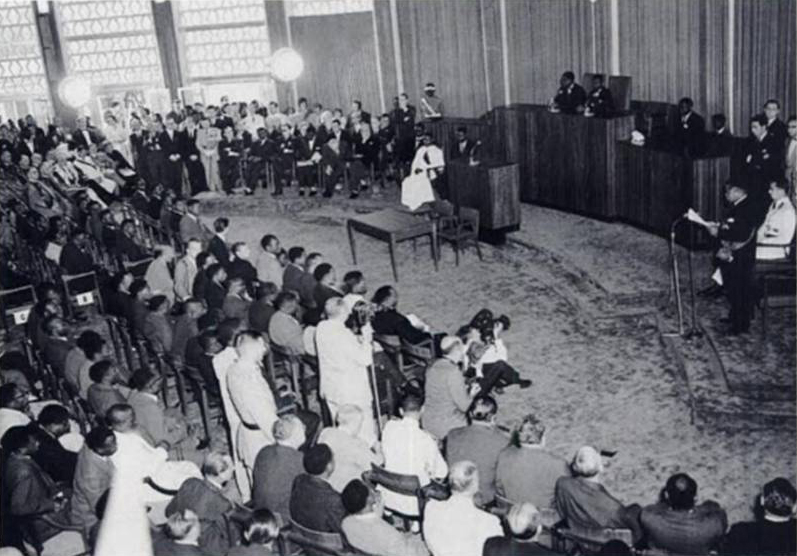
The resulting 37-strong Lumumba government was very diverse, with its members coming from different classes, different tribes, and holding varied political beliefs. Though many had questionable loyalty to Lumumba, most did not openly contradict him out of political considerations or fear of reprisal. At 22:40 on 23 June 1960, the Chamber of Deputies convened in the Palais de la Nation to vote on Lumumba's government. After Kasongo opened the session, Lumumba delivered his main speech, promising to maintain national unity, abide by the will of the people, and pursue a neutralist foreign policy. It was warmly received by most deputies and observers.
The chamber proceeded to engage in a heated debate. Though the government contained members from parties that held 120 of the 137 seats, reaching a majority was not a straightforward task. While several leaders of the opposition had been involved in the formative negotiations, their parties as a whole had not been consulted. Furthermore, some individuals were upset that they had not been included in the government and sought to personally prevent its investiture. In the subsequent arguments, multiple deputies expressed dissatisfaction at the lack of representation of their respective provinces and/or parties, with several threatening secession. Among them was Kalonji, who said he would encourage people of Kasaï to refrain from participating in the central government and form their own autonomous state. One Katangese deputy objected to the same person being appointed as premier and as head of the defence portfolio.

When a vote was finally taken, only 80 of the 137 members of the chamber were present. Of these, 74 voted in favour of the government, five against, and one abstained. The 57 absences were almost all voluntary. Though the government had earned just as many votes as when Kasongo won the presidency of the chamber, the support was not congruent; members of Cléophas Kamitatu's wing of the PSA had voted against the government while a few members of the PNP, PUNA, and ABAKO voted in favour of it. Overall, the vote was a disappointment for the MNC-L coalition.
The session was adjourned at 02:05 on 24 June 1960. The Senate convened that day to vote on the government. There was another heated debate, in which Iléo and Adoula expressed their strong dissatisfaction with its composition. Confederation of Tribal Associations of Katanga (CONAKAT) members abstained from voting. When arguments concluded, a decisive vote of approval was taken on the government: 60 voted in favour, 12 against, while eight abstained. All dissident arguments for alternative cabinets, particularly Kalonji's demand for a new administration, were rendered impotent, and the Lumumba government was officially invested. With the institution of a broad coalition, the parliamentary opposition was officially reduced to only the MNC-K and some individuals.
At the onset of his premiership, Lumumba had two main goals: to ensure that independence would bring a legitimate improvement in the quality of life for the Congolese and to unify the country as a centralised state by eliminating tribalism and regionalism. He was worried that opposition to his government would appear rapidly and would have to be managed quickly and decisively.
To achieve the first aim, Lumumba believed that a comprehensive "Africanisation" of the administration, in spite of its risks, would be necessary. The Belgians were opposed to such an idea, as it would create inefficiency in the Congo's bureaucracy and lead to a mass exodus of unemployed civil servants to Belgium, whom they would be unable to absorb into the government there. It was too late for Lumumba to enact Africanisation before independence. Seeking another gesture that might excite the Congolese people, Lumumba proposed to the Belgian government a reduction in sentences for all prisoners and an amnesty for those serving a term of three years or less. Ganshof feared that such an action would jeopardise law and order, and he evaded taking any action until it was too late to fulfill the request. Lumumba's opinion of the Belgians was soured by this affair, which contributed to his fear that independence would not appear "real" to the average Congolese.
In seeking to eliminate tribalism and regionalism in the Congo, Lumumba was deeply inspired by the personality and undertakings of Kwame Nkrumah and by Ghanaian ideas of the leadership necessary in post-colonial Africa. He worked to seek such changes through the MNC. Lumumba intended to combine it with its parliamentary allies—CEREA, the PSA, and possibly BALUBAKAT—to form one national party, and to build a following in each province. He hoped it would absorb other parties and become a unifying force for the country.
Independence Day was celebrated on 30 June 1960 in a ceremony attended by many dignitaries, including King Baudouin of Belgium and the foreign press. Baudouin's speech praised developments under colonialism, his reference to the "genius" of his great-granduncle Leopold II of Belgium, glossing over atrocities committed during his reign over the Congo Free State. The King continued, "Don't compromise the future with hasty reforms, and don't replace the structures that Belgium hands over to you until you are sure you can do better. Don't be afraid to come to us. We will remain by your side, give you advice."
Lumumba, who had not been scheduled to speak, delivered an impromptu speech that reminded the audience that the independence of the Congo had not been granted magnanimously by Belgium:
For this independence of the Congo, although being proclaimed today by agreement with Belgium, an amicable country, with which we are on equal terms, no Congolese worthy of the name will ever be able to forget that it was by fighting that it has been won, a day-to-day fight, an ardent and idealistic fight, a fight in which we were spared neither privation nor suffering, and for which we gave our strength and our blood. We are proud of this struggle, of tears, of fire, and of blood, to the depths of our being, for it was a noble and just struggle, and indispensable to put an end to the humiliating slavery which was imposed upon us by force.
Most European journalists were shocked by the stridency of Lumumba's speech. The Western media criticised him. Time magazine characterised his speech as a "vicious attack".
Prime minister
Independence
Independence Day and the three days that followed it were declared a national holiday. The Congolese were preoccupied by the festivities, which were conducted in relative peace. Meanwhile, Lumumba's office was overtaken by a flurry of activity. A diverse group of individuals, Congolese and European, some friends and relatives, hurried about their work. Some undertook specific missions on his behalf, sometimes without direct permission. Numerous Congolese citizens showed up at the office at whim for various reasons. Lumumba, for his part, was mostly preoccupied with a lengthy itinerary of receptions and ceremonies. On 3 July Lumumba declared a general amnesty for prisoners, but it was never implemented. The following morning he convened the Council of Ministers to discuss the unrest among the troops of the Force Publique.
Many soldiers hoped that independence would result in immediate promotions and material gains, but were disappointed by Lumumba's slow pace of reform. The rank-and-file felt that the Congolese political class—particularly ministers in the new government—were enriching themselves while failing to improve the troops' situation. Many of the soldiers were also fatigued from maintaining order during the elections and participating in independence celebrations. The ministers decided to establish four committees to study, respectively, the reorganisation of the administration, the judiciary, and the army, and the enactment of a new statute for state employees. All were to devote special attention to ending racial discrimination. Parliament assembled for the first time since independence and took its first official legislative action by voting to increase the salaries of its members to FC 500,000. Lumumba, fearing the repercussions the raise would have on the budget, was among the few to object, dubbing it a "ruinous folly".
Outbreak of the Congo Crisis
On the morning of 5 July 1960, General Émile Janssens, commander of the Force Publique, in response to increasing excitement among the Congolese ranks, summoned all troops on duty at Camp Léopold II. He demanded that the army maintain its discipline and wrote "before independence = after independence" on a blackboard for emphasis. That evening the Congolese sacked the canteen in protest of Janssens. He alerted the reserve garrison of Camp Hardy, 95 miles away in Thysville. The officers tried to organise a convoy to send to Camp Léopold II to restore order, but the men mutinied and seized the armoury. The crisis which followed came to dominate the tenure of the Lumumba government. The next day Lumumba dismissed Janssens and promoted all Congolese soldiers one grade, but mutinies spread out into the Lower Congo.
Although the trouble was highly localised, the country seemed to be overrun by gangs of soldiers and looters. The media reported that Europeans were fleeing the country. In response, Lumumba announced over the radio, "Thoroughgoing reforms are planned in all sectors. My government will make every possible effort to see that our country has a different face in a few months, a few weeks." In spite of government efforts, the mutinies continued. Mutineers in Leopoldville and Thysville surrendered only upon the personal intervention of Lumumba and President Kasa-Vubu.
On 8 July, Lumumba renamed the Force Publique as the "Armée Nationale Congolaise" (ANC). He Africanised the force by appointing Sergeant Major Victor Lundula as general and commander-in-chief, and chose junior minister and former soldier Joseph Mobutu as colonel and Army chief of staff. These promotions were made in spite of Lundula's inexperience and rumours about Mobutu's ties to Belgian and US intelligence services. All European officers in the army were replaced with Africans, with a few retained as advisers. By the next day, the mutinies had spread throughout the entire country. Five Europeans, including the Italian vice-consul, were ambushed and killed by machine gun fire in Élisabethville, and nearly the entire European population of Luluabourg barricaded itself in an office building for safety. An estimated two dozen Europeans were murdered in the mutiny. Lumumba and Kasa-Vubu embarked on a tour across the country to promote peace and appoint new army commanders.
Belgium intervened on 10 July, dispatching 6,000 troops to the Congo, ostensibly to protect its citizens from the violence. Most Europeans went to Katanga Province, which possessed much of the Congo's natural resources. Though personally angered, Lumumba condoned the action on 11 July, provided that the Belgian forces acted only to protect their citizens, followed the direction of the Congolese armed forces, and ceased their activities once order was restored. The same day the Belgian Navy bombarded Matadi after it had evacuated its citizens, killing 19 Congolese civilians. This greatly inflamed tensions, leading to renewed Congolese attacks on Europeans. Shortly thereafter Belgian forces moved to occupy cities throughout the country, including the capital, where they clashed with Congolese soldiers. On the whole, the Belgian intervention made the situation worse for the armed forces.
The State of Katanga declared independence under regional premier Moïse Tshombe on 11 July, with support from the Belgian government and mining companies such as Union Minière. Lumumba and Kasa-Vubu were denied use of Élisabethville's airstrip the following day and returned to the capital, only to be accosted by fleeing Belgians. They sent a protest of the Belgian deployment to the United Nations, requesting that they withdraw and be replaced by an international peacekeeping force. The UN Security Council passed United Nations Security Council Resolution 143, calling for the immediate removal of Belgian forces and establishment of the United Nations Operation in the Congo (ONUC). Despite the arrival of UN troops, unrest continued. Lumumba requested UN troops to suppress the rebellion in Katanga, but the UN forces were not authorised to do so under their mandate. On 14 July Lumumba and Kasa-Vubu broke off diplomatic relations with Belgium. Frustrated at dealing with the West, they sent a telegram to Soviet Premier Nikita Khrushchev, requesting that he closely monitor the situation in the Congo.
Visit to the United States
Lumumba decided to travel to New York City in order to personally express the position of his government to the United Nations. Shortly before his departure, he announced that he had signed an economic agreement with a US businessman who had created the Congo International Management Corporation (CIMCO). According to the contract (which had yet to be ratified by parliament), CIMCO was to form a development corporation to invest in and manage certain sectors of the economy. He also declared his approval of the second security council resolution, adding that "[Soviet] aid was no longer necessary" and announced his intention to seek technical assistance from the United States. On 22 July, Lumumba left the Congo for New York City. He and his entourage reached the United States two days later after brief stops in Accra and London. There they rendezvoused with his UN delegation at the Barclay Hotel to prepare for meetings with UN officials. Lumumba was focused on discussing the withdrawal of Belgian troops and various options for technical assistance with Dag Hammarskjöld.
African diplomats were keen that the meetings would be successful; they convinced Lumumba to wait until the Congo was more stable before reaching any more major economic agreements (such as the CIMCO arrangement). Lumumba saw Hammarskjöld and other staff of the UN Secretariat over three days on 24, 25, and 26 July. Though Lumumba and Hammarskjöld were restrained towards one another, their discussions went smoothly. In a press conference, Lumumba reaffirmed his government's commitment to "positive neutralism".
On 27 July, Lumumba went to Washington, D.C. to meet with the US Secretary of State and appeal for financial and technical assistance. The US government informed Lumumba that it would offer aid only through the UN. The following day he received a telegram from Gizenga detailing a clash at Kolwezi between Belgian and Congolese forces. Lumumba felt that the UN was hampering his attempts to expel the Belgian troops and defeat the Katangan rebels. On 29 July, Lumumba went to Ottawa, the capital of Canada, to request help. The Canadians rebuffed a request for technicians and said that they would channel their assistance through the UN. Frustrated, Lumumba met with the Soviet ambassador in Ottawa and discussed a donation of military equipment. When he returned to New York the following evening, he was restrained towards the UN. The United States government's attitude had become more negative, due to reports of the rapes and violence committed by ANC soldiers, and scrutiny from Belgium. The latter was chagrined that Lumumba had received a high-level reception in Washington. The Belgian government regarded Lumumba as communist, anti-white, and anti-Western. Given their experiences in the Congo, many other Western governments agreed with the Belgian view.
Frustrated with the UN's apparent inaction towards Katanga as he departed the US, Lumumba decided to delay his return to the Congo. He visited several African states. This was apparently done to put pressure on Hammarskjöld and, failing that, to seek guarantees of bilateral military support to suppress Katanga. Between 2 and 8 August, Lumumba toured Tunisia, Morocco, Guinea, Ghana, Liberia, and Togo. He was well received in each country and issued joint communiques with their respective heads of state. Guinea and Ghana pledged independent military support, while the others expressed their desire to work through the United Nations to resolve the Katangan secession. In Ghana, Lumumba signed a secret agreement with President Nkrumah providing for a "Union of African States". Centred in Léopoldville, it was to be a federation with a republican government. They agreed to hold a summit of African states in Léopoldville between 25 and 30 August to further discuss the issue. Lumumba returned to the Congo, apparently confident that he could now depend upon African military assistance. He also believed that he could procure African bilateral technical aid, which placed him at odds with Hammarskjöld's goal of funnelling support through ONUC. Lumumba and some ministers were wary of the UN option, as it would supply them with functionaries who would not be directly under their authority.
Attempts at re-consolidation
On 9 August, Lumumba proclaimed a state of emergency throughout the Congo. He subsequently issued several orders in an attempt to reassert his dominance on the political scene. The first outlawed the formation of associations without government sanction. A second asserted the government's right to ban publications that produced material likely to bring the administration into disrepute. On 11 August the Courrier d'Afrique printed an editorial which declared that the Congolese did not want to fall "under a second kind of slavery". The editor was summarily arrested and four days later publication of the daily ceased. Shortly afterward, the government shut down the Belga and Agence France-Presse wire services. The press restrictions garnered a wave of harsh criticism from the Belgian media.
Lumumba decreed the nationalisation of local Belga offices, creating the Agence Congolaise de Presse, as a means of eliminating what he considered a centre of biased reporting, as well as creating a service through which the government's platform could be more easily communicated to the public. Another order stipulated that official approval had to be obtained six days in advance of public gatherings. On 16 August Lumumba announced the installation of a régime militaire spécial for the duration of six months.
Throughout August, Lumumba increasingly withdrew from his full cabinet and instead consulted with officials and ministers he trusted, such as Maurice Mpolo, Joseph Mbuyi, Kashamura, Gizenga, and Antoine Kiwewa. Lumumba's office was in disarray, and few members of his staff did any work. His chef de cabinet, Damien Kandolo, was often absent and acted as a spy on behalf of the Belgian government. Lumumba was constantly being delivered rumours from informants and the Sûreté, encouraging him to grow deeply suspicious of others. In an attempt to keep him informed, Serge Michel, his press secretary, enlisted the assistance of three Belgian telex operators, who supplied him with copies of all outgoing journalistic dispatches.
Lumumba used Congolese troops in August to attempt to put down a secessionist
rebellion in South Kasai, which was home to strategic rail links necessary for a campaign against rebels in Katanga. The operation had successes but devolved into ethnic violence. The army was involved in massacres of Luba civilians. Amid international approbation, the army was withdrawn in September, and its secession was not quashed until the following year.
The people and politicians of South Kasai held Lumumba personally responsible for the actions of the army. Kasa-Vubu publicly announced that only a federalist government could bring peace and stability to the Congo. This broke his tenuous political alliance with Lumumba and tilted the political favour in the country away from Lumumba's unitary state. Ethnic tensions rose against him (especially around Leopoldville), and the Catholic Church, still powerful in the country, openly criticised his government. Even with South Kasai subdued, the Congo lacked the military force needed to retake Katanga. Lumumba held an African conference in Leopoldville from 25 to 31 August, but no foreign heads of state appeared and no country pledged military support. Lumumba demanded once again that UN peacekeeping soldiers assist in suppressing the revolt, threatening to bring in Soviet troops if they refused. The UN subsequently denied Lumumba the use of its forces. The possibility of a direct Soviet intervention was thought increasingly likely.
Dismissal
Kasa-Vubu's revocation order
President Kasa-Vubu began fearing a Lumumbist coup d'état would take place. On the evening of 5 September, Kasa-Vubu announced over radio that he had dismissed Lumumba and six of his ministers from the government for the massacres in South Kasai and for involving the Soviets in the Congo. Upon hearing the broadcast, Lumumba went to the national radio station, which was under UN guard. Though they had been ordered to bar Lumumba's entry, the UN troops allowed the prime minister in, as they had no specific instructions to use force against him. Lumumba denounced his dismissal over the radio as illegitimate, and in turn labelled Kasa-Vubu a traitor and declared him deposed. Kasa-Vubu had not declared the approval of any responsible ministers of his decision, making his action legally invalid. Lumumba noted this in a letter to Hammarskjöld and a radio broadcast at 05:30 on 6 September. Later that day Kasa-Vubu managed to secure the countersignatures to his order of Albert Delvaux, Minister Resident in Belgium, and Justin Marie Bomboko, Minister of Foreign Affairs. With them, he announced his dismissal of Lumumba and six other ministers at 16:00 over Brazzaville radio.
Lumumba and the ministers who remained loyal to him ordered the arrest of Delvaux and Bomboko for countersigning the dismissal order. Bomboko sought refuge in the presidential palace (which was guarded by UN peacekeepers). Early in the morning of 7 September, Delvaux was detained and confined in the Prime Minister's residence.
Meanwhile, the Chamber of Deputies convened to discuss Kasa-Vubu's dismissal order and hear Lumumba's reply. Delvaux made an unexpected appearance and took to the dais to denounce his arrest and declare his resignation from the government. He was enthusiastically applauded by the opposition.
Lumumba then delivered his speech. Instead of directly attacking Kasa-Vubu ad hominem, Lumumba accused obstructionist politicians and ABAKO of using the presidency as a front for disguising their activities. He noted that Kasa-Vubu had never before offered any criticism of the government and portrayed their relationship as one of cooperation. He lambasted Delvaux and Minister of Finance Pascal Nkayi for their role in the UN Geneva negotiations and for their failure to consult the rest of the government. Lumumba followed his arguments with an analysis of the Loi Fondemental and finished by asking Parliament to assemble a "commission of sages" to examine the Congo's troubles.
The Chamber, at the suggestion of its presiding officer, voted to annul both Kasa-Vubu's and Lumumba's declarations of dismissal, 60 to 19. The following day Lumumba delivered a similar speech before the Senate, which subsequently delivered the government a vote of confidence, 49 to zero with seven abstentions. According to Article 51, Parliament was granted the "exclusive privilege" to interpret the constitution. In cases of doubt and controversy, the Congolese were originally supposed to appeal constitutional questions to the Belgian Conseil d'État. With the rupture of relations in July this was no longer possible, so no authoritative interpretation or mediation was available to bring a legal resolution to the dispute. Numerous African diplomats and newly appointed ONUC head Rajeshwar Dayal attempted to get the president and prime minister to reconcile their differences, but failed. On 13 September, the Parliament held a joint session between the Chamber of Deputies and the Senate. Though several members short of a quorum, they voted to grant Lumumba emergency powers.
Mobutu's coup
On 14 September, Mobutu announced over the radio that he was launching a "peaceful revolution" to break the political impasse and therefore neutralising the President, Lumumba's and Iléo's respective governments, and Parliament until 31 December. He stated that "technicians" would run the administration while the politicians sorted out their differences. In a subsequent press conference, he clarified that Congolese university graduates would be asked to form a government, and further declared that all Eastern Bloc countries should close their embassies. Lumumba was surprised by the coup and that evening he travelled to Camp Leopold II in search of Mobutu to try and change his mind. He spent the night there but was attacked in the morning by Luba soldiers, who blamed him for the atrocities in South Kasaï. A Ghanaian ONUC contingent managed to extricate him, but his briefcase was left behind. Some of his political opponents recovered it and published documents it supposedly contained, including letters from Nkrumah, appeals for support addressed to the Soviet Union and the People's Republic of China, a memorandum dated 16 September declaring the presence of Soviet troops within one week, and a letter dated 15 September from Lumumba to the provincial presidents (Tshombe excepted) entitled "Measures to be applied during the first stages of the dictatorship". Some of these papers were genuine, while others, especially the memorandum and the letter to the provincial presidents, were almost certainly forgeries.