
The Paris Commune (French: Commune de Paris, pronounced [kɔ.myn də pa.ʁi]) was a French revolutionary government that seized power in Paris on 18 March 1871 and controlled parts of the city until 28 May 1871. During the Franco-Prussian War of 1870–1871, the French National Guard had defended Paris, and working class radicalism grew among its soldiers. Following the establishment of the French Third Republic in September 1870 (under French chief-executive Adolphe Thiers from February 1871) and the complete defeat of the French Army by the Germans by March 1871, soldiers of the National Guard seized control of the city on 18 March. The Communards killed two French Army generals and refused to accept the authority of the Third Republic; instead, the radicals set about establishing their own independent government.
The Commune governed Paris for two months, promoting policies that tended toward a progressive, anti-religious system, which was an eclectic mix of many 19th-century schools of thought. These policies included the separation of church and state, self-policing, the remission of rent, the abolition of child labor, and the right of employees to take over an enterprise deserted by its owner. The Commune closed all Catholic churches and schools in Paris. Feminist, communist, old-style social democracy (a mix of reformism and revolutionism), and anarchist/Proudhonist currents, among other socialist schools, played important roles in the Commune.
The various Communards had little more than two months to achieve their respective goals before the national French Army suppressed the Commune during the semaine sanglante ("bloody week") beginning on 21 May 1871. The national forces still loyal to the Third Republic government either killed in battle or executed an estimated 10,000 to 15,000 Communards, though one unconfirmed estimate from 1876 put the toll as high as 20,000. In its final days, the Commune executed the Archbishop of Paris, Georges Darboy, and about one hundred hostages, mostly gendarmes and priests.

National army forces took 43,522 Communards as prisoners, including 1,054 women. More than half of the prisoners had not fought, and were released immediately. The Third Republic tried around 15,000 in court, 13,500 of whom were found guilty, 95 were sentenced to death, 251 to forced labor, and 1,169 to deportation (mostly to New Caledonia). Many other Commune supporters, including several of the leaders, fled abroad, mostly to England, Belgium or Switzerland. All the surviving prisoners and exiles received pardons in 1880 and could return home, where some resumed political careers.
Debates over the policies and result of the Commune had significant influence on the ideas of Karl Marx and Friedrich Engels, who described the régime in Paris as the first example of the dictatorship of the proletariat. Engels wrote: "Of late, the Social-Democratic philistine has once more been filled with wholesome terror at the words: Dictatorship of the Proletariat. Well and good, gentlemen, do you want to know what this dictatorship looks like? Look at the Paris Commune. That was the Dictatorship of the Proletariat."
Prelude
On 2 September 1870, France was defeated in the Battle of Sedan, and Emperor Napoleon III was captured. When the news reached Paris the next day, shocked and angry crowds came out into the streets. Empress Eugénie, the acting Regent, fled the city, and the government of the Second Empire swiftly collapsed. Republican and radical deputies of the National Assembly proclaimed the new French Republic, and formed a Government of National Defence with the intention of continuing the war. The Prussian army marched swiftly toward Paris.
Demographics
In 1871, France was deeply divided between the large rural, Catholic, and conservative population of the French countryside and the more republican and radical cities of Paris, Marseille, Lyon and a few others. In the first round of the 1869 parliamentary elections held under the French Empire, 4,438,000 had voted for the Bonapartist candidates supporting Napoleon III, while 3,350,000 had voted for the republicans or the legitimists. In Paris, however, the republican candidates dominated, winning 234,000 votes against 77,000 for the Bonapartists.
Of the two million people in Paris in 1869, according to the official census, there were about 500,000 industrial workers, or fifteen percent of all the industrial workers in France, plus another 300,000–400,000 workers in other enterprises. Only about 40,000 were employed in factories and large enterprises; most were employed in small industries in textiles, furniture, and construction. There were also 115,000 servants and 45,000 concierges. In addition to the native French population, there were about 100,000 immigrant workers and political refugees, the largest number being from Italy and Poland.
During the war and the Siege of Paris, various members of the middle and upper classes departed the city. At the same time, there was an influx of refugees from parts of France occupied by the Germans. The working class and immigrants suffered the most from the lack of industrial activity due to the war and the siege; they formed the bedrock of the Commune's popular support.

Radicalisation of the Paris workers
The Commune resulted in part from growing discontent among the Paris workers. This discontent can be traced to the first worker uprisings, the Canut revolts (a canut was a Lyonnais silk worker, often working on Jacquard looms), in Lyon and Paris in the 1830s. Many Parisians, especially workers and the lower-middle classes, supported a democratic republic. A specific demand was that Paris should be self-governing with its own elected council, something enjoyed by smaller French towns but denied to Paris by a national government wary of the capital's unruly populace.
Socialist movements, such as the First International, had been growing in influence with hundreds of societies affiliated to it across France. In early 1867, Parisian employers of bronze-workers attempted to de-unionise their workers. This was defeated by a strike organised by the International. Later in 1867, a public demonstration in Paris was answered by the dissolution of its executive committee and the leadership being fined. Tensions escalated: Internationalists elected a new committee and put forth a more radical programme, the authorities imprisoned their leaders, and a more revolutionary perspective was taken to the International's 1868 Brussels Congress. The International had considerable influence even among unaffiliated French workers, particularly in Paris and the large cities.
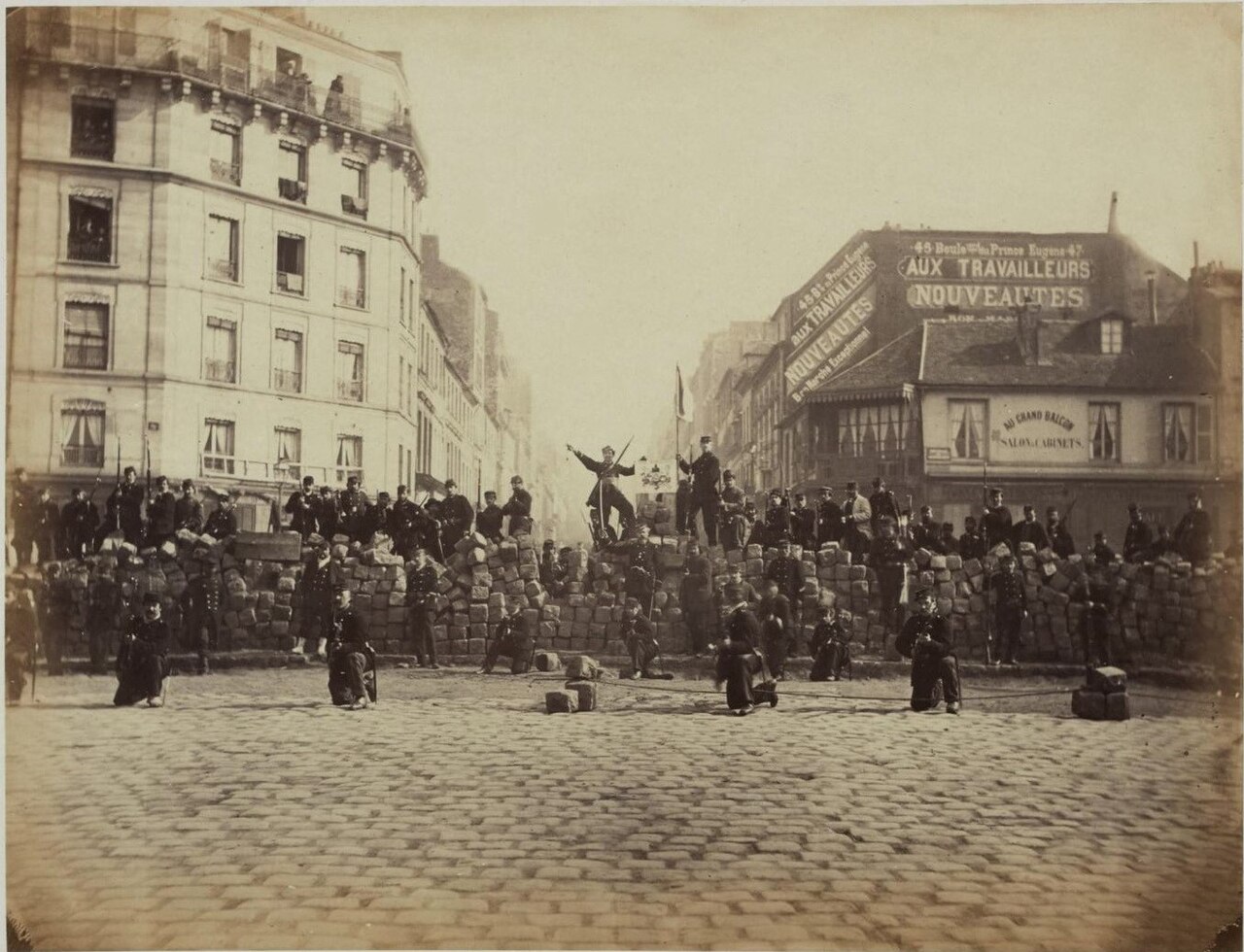
The killing of journalist Victor Noir incensed Parisians, and the arrests of journalists critical of the Emperor did nothing to quiet the city. The German military attaché, Alfred von Waldersee, wrote in his diary in February:"Every night, isolated barricades were thrown up, constructed for the most part out of disused conveyances, especially omnibuses, a few shots were fired at random, and scenes of disorder were taken part in by a few hundreds of persons, mostly quite young".He noted, however, that "working-men, as a class, took no part in the proceedings." A coup was attempted in early 1870, but tensions eased significantly after the plebiscite in May. The war with Prussia, initiated by Napoleon III in July, was initially met with patriotic fervour.

Radicals and revolutionaries
Paris was the traditional home of French radical movements. Revolutionaries had gone into the streets and overthrown their governments during the popular uprisings of July 1830 and the French Revolution of 1848, as well as subsequent failed attempts such as the 1832 June Rebellion and the uprising of June 1848.
Of the radical and revolutionary groups in Paris at the time of the Commune, the most conservative were the "radical republicans". This group included the young doctor and future prime minister Georges Clemenceau, who was a member of the National Assembly and Mayor of the 18th arrondissement. Clemenceau tried to negotiate a compromise between the Commune and the government, but neither side trusted him. He was considered extremely radical by the provincial deputies of rural France, but too moderate by the leaders of the Commune.
The most extreme revolutionaries in Paris were the followers of Louis Auguste Blanqui, a charismatic professional revolutionary who had spent most of his adult life in prison. He had about a thousand followers, many of them armed and organized into cells of ten persons each. Each cell operated independently and was unaware of the members of the other groups, communicating only with their leaders by code. Blanqui had written a manual on revolution, Instructions for an Armed Uprising, to give guidance to his followers. Though their numbers were small, the Blanquists provided many of the most disciplined soldiers and several of the senior leaders of the Commune.

Defenders of Paris
By 20 September 1870, the Imperial German Army had surrounded Paris and was camped just 2,000 metres (6,600 ft) from the French front lines. The regular French Army in Paris, under General Trochu's command, had only 50,000 professional soldiers of the line; the majority of the French first-line soldiers were prisoners of war, or trapped in Metz, surrounded by the Germans. The regulars were thus supported by around 5,000 firemen, 3,000 gendarmes, and 15,000 sailors. The regulars were also supported by the Garde Mobile, new recruits with little training or experience. 17,000 of them were Parisian, and 73,000 from the provinces. These included twenty battalions of men from Brittany, who spoke little French.
The largest armed force in Paris was the National Guard, numbering about 300,000 men. They also had very little training or experience. They were organised by neighbourhoods. Those from the upper- and middle-class arrondissements tended to support the national government, while those from the working-class neighbourhoods were far more radical and politicised. Guardsmen from many units were known for their lack of discipline; some units refused to wear uniforms, often refused to obey orders without discussing them, and demanded the right to elect their own officers. The members of the National Guard from working-class neighbourhoods became the main armed force of the Commune.
Siege of Paris; first demonstrations
As the Germans surrounded the city, radical groups saw that the Government of National Defence had few soldiers to defend itself, and launched the first demonstrations against it. On 19 September, National Guard units from the main working-class neighbourhoods—Belleville, Ménilmontant, La Villette, Montrouge, the Faubourg Saint-Antoine, and the Faubourg du Temple—marched to the centre of the city and demanded that a new government, a Commune, be elected. They were met by regular army units loyal to the Government of National Defence, and the demonstrators eventually dispersed peacefully. On 5 October, 5,000 protesters marched from Belleville to the Hôtel de Ville, demanding immediate municipal elections and rifles. On 8 October, several thousand soldiers from the National Guard, led by Eugène Varlin of the First International, marched to the centre chanting 'Long Live the Commune!", but they also dispersed without incident.

Later in October, General Louis-Jules Trochu launched a series of armed attacks to break the German siege, with heavy losses and no success. The telegraph line connecting Paris with the rest of France had been cut by the Germans on 27 September. On 6 October, Defense Minister Léon Gambetta departed the city by balloon to try to organise national resistance against the Germans.
Uprising of 31 October
On 28 October, the news arrived in Paris that the 160,000 soldiers of the French army at Metz, which had been surrounded by the Germans since August, had surrendered. The news arrived the same day of the failure of another attempt by the French army to break the siege of Paris at Le Bourget, with heavy losses. On 31 October, the leaders of the main revolutionary groups in Paris, including Blanqui, Félix Pyat and Louis Charles Delescluze, called new demonstrations at the Hôtel de Ville against General Trochu and the government. Fifteen thousand demonstrators, some of them armed, gathered in front of the Hôtel de Ville in pouring rain, calling for the resignation of Trochu and the proclamation of a commune. Shots were fired from the Hôtel de Ville, one narrowly missing Trochu, and the demonstrators crowded into the building, demanding the creation of a new government, and making lists of its proposed members.
Blanqui, the leader of the most radical faction, established his own headquarters at the nearby Prefecture of the Seine, issuing orders and decrees to his followers, intent upon establishing his own government. While the formation of the new government was taking place inside the Hôtel de Ville, however, units of the National Guard and the Garde Mobile loyal to General Trochu arrived and recaptured the building without violence. By three o'clock, the demonstrators had been given safe passage and left, and the brief uprising was over.
On 3 November, city authorities organized a plebiscite of Parisian voters, asking if they had confidence in the Government of National Defence. "Yes" votes totalled 557,996, while 62,638 voted "no". Two days later, municipal councils in each of the twenty arrondissements of Paris voted to elect mayors; five councils elected radical opposition candidates, including Delescluze and a young Montmartrean doctor, Georges Clemenceau.
Negotiations with the Germans; continued war
In September and October, Adolphe Thiers, the leader of the National Assembly conservatives, had toured Europe, consulting with the foreign ministers of Britain, Russia, and Austria-Hungary, and found that none of them were willing to support France against the Germans. He reported to the government that there was no alternative to negotiating an armistice. He travelled to German-occupied Tours and met with Otto von Bismarck on 1 November. The German Chancellor demanded the cession of all of Alsace, parts of Lorraine, and enormous reparations. The Government of National Defence decided to continue the war and raise a new army to fight the Germans. The newly organized French armies won a single victory at Coulmiers on 10 November, but an attempt by General Auguste-Alexandre Ducrot on 29 November at Villiers to break out of Paris was defeated with a loss of 4,000 soldiers, compared with 1,700 German casualties.
Everyday life for Parisians became increasingly difficult during the siege. In December, temperatures dropped to −15 °C (5 °F), and the Seine froze for three weeks. Parisians suffered shortages of food, firewood, coal and medicine. The city was almost completely dark at night. The only communication with the outside world was by balloon, carrier pigeon, or letters packed in iron balls floated down the Seine. Rumours and conspiracy theories abounded. Because supplies of ordinary food ran out, starving denizens ate most of the city zoo's animals, then resorted to feeding on rats.
By early January 1871, Bismarck and the Germans themselves were tired of the prolonged siege. They installed seventy-two 120- and 150-mm artillery pieces in the forts around Paris and on 5 January began to bombard the city day and night. Between 300 and 600 shells hit the city centre every day.
Uprising and armistice
Between 11 and 19 January 1871, the French armies had been defeated on four fronts and Paris was facing a famine. General Trochu received reports from the prefect of Paris that agitation against the government and military leaders was increasing in the political clubs and in the National Guard of the working-class neighbourhoods of Belleville, La Chapelle, Montmartre, and Gros-Caillou.
At midday on 22 January, three or four hundred National Guards and members of radical groups—mostly Blanquists—gathered outside the Hôtel de Ville. A Garde Mobile battalion from Brittany was inside the building to defend it in case of an assault. The demonstrators presented their demands that the military be placed under civil control, and that there be an immediate election of a commune. The atmosphere was tense, and in the middle of the afternoon, gunfire broke out between the two sides; each side blamed the other for firing first. Six demonstrators were killed, and the army cleared the square. The government quickly banned two publications, Delescluze's Le Reveil and Pyat's Le Combat, and arrested 83 revolutionaries.
At the same time as the demonstration in Paris, the leaders of the Government of National Defence in Bordeaux had concluded that the war could not continue. On 26 January, they signed a ceasefire and armistice, with special conditions for Paris. The city would not be occupied by the Germans. Regular soldiers would give up their arms, but would not be taken into captivity. Paris would pay an indemnity of 200 million francs. At Jules Favre's request, Bismarck agreed not to disarm the National Guard, so that order could be maintained in the city.
Adolphe Thiers; parliamentary elections of 1871
The national government in Bordeaux called for national elections at the end of January, held just ten days later on 8 February. Most electors in France were rural, Catholic and conservative, and this was reflected in the results; of the 645 deputies assembled in Bordeaux on February, about 400 favoured a constitutional monarchy under either Henri, Count of Chambord (grandson of Charles X) or Prince Philippe, Count of Paris (grandson of Louis Philippe).
Of the 200 republicans in the new parliament, 80 were former Orléanists (Philippe's supporters) and moderately conservative. They were led by Adolphe Thiers, who was elected in 26 departments, the most of any candidate. There were an equal number of more radical republicans, including Jules Favre and Jules Ferry, who wanted a republic without a monarch, and who felt that signing the peace treaty was unavoidable. Finally, on the extreme left, there were the radical republicans and socialists, a group that included Louis Blanc, Léon Gambetta and Georges Clemenceau. This group was dominant in Paris, where they won 37 of the 42 seats.
On 17 February the new parliament elected the 74-year-old Thiers as chief executive of the Third Republic. He was considered to be the candidate most likely to bring peace and to restore order. Long an opponent of the Prussian war, Thiers persuaded parliament that peace was necessary. He travelled to Versailles, where Bismarck and the German Emperor were waiting, and on 24 February the armistice was signed.
Establishment
Dispute over cannons of Paris
At the end of the war, 400 obsolete muzzle-loading bronze cannons, paid for by the Paris public via a subscription, remained in the city. The new Central Committee of the National Guard, now dominated by radicals, decided to put the cannons in parks in the working-class neighborhoods of Belleville, Buttes-Chaumont and Montmartre, to keep them away from the regular army and to defend the city against any attack by the national government. Thiers was equally determined to bring the cannons under national-government control.
Clemenceau, a friend of several revolutionaries, tried to negotiate a compromise; some cannons would remain in Paris and the rest go to the army. However, neither Thiers nor the National Assembly accepted his proposals. The chief executive wanted to restore order and national authority in Paris as quickly as possible, and the cannons became a symbol of that authority. The Assembly also refused to prolong the moratorium on debt collections imposed during the war; and suspended two radical newspapers, Le Cri du Peuple of Jules Vallès and Le Mot d'Ordre of Henri Rochefort, which further inflamed Parisian radical opinion. Thiers also decided to move the National Assembly and government from Bordeaux to Versailles, rather than to Paris, to be farther away from the pressure of demonstrations, which further enraged the National Guard and the radical political clubs.
On 17 March 1871, there was a meeting of Thiers and his cabinet, who were joined by Paris mayor Jules Ferry, National Guard commander General Louis d'Aurelle de Paladines and General Joseph Vinoy, commander of the regular army units in Paris. Thiers announced a plan to send the army the next day to take charge of the cannons. The plan was initially opposed by War Minister Adolphe Le Flô, d'Aurelle de Paladines, and Vinoy, who argued that the move was premature, because the army had too few soldiers and was undisciplined and demoralized and many units had become politicized and were unreliable. Vinoy urged that they wait until Germany had released the French prisoners of war, and the army returned to full strength. Thiers insisted that the planned operation must go ahead as quickly as possible, to have the element of surprise. If the seizure of the cannon was not successful, the government would withdraw from the centre of Paris, build up its forces, and then attack with overwhelming force, as they had done during the uprising of June 1848. The Council accepted his decision, and Vinoy gave orders for the operation to begin the next day.
Failed seizure attempt and government retreat
Early in the morning of 18 March, two brigades of soldiers climbed the butte of Montmartre, where the largest collection of cannons, 170 in number, were located. A small group of revolutionary national guardsmen were already there, and there was a brief confrontation between the brigade led by General Claude Lecomte, and the National Guard; one guardsman, named Turpin, was shot, later dying. Word of the shooting spread quickly, and members of the National Guard from all over the neighbourhood, along with others including Clemenceau, hurried to the site to confront the soldiers.
While the Army had succeeded in securing the cannons at Belleville and Buttes-Chaumont and other strategic points, at Montmartre a crowd gathered and continued to grow, and the situation grew increasingly tense. The horses that were needed to take the cannon away did not arrive, and the army units were immobilized. As the soldiers were surrounded, they began to break ranks and join the crowd. General Lecomte tried to withdraw, and then ordered his soldiers to load their weapons and fix bayonets. He thrice ordered them to fire, but the soldiers refused. Some of the officers were disarmed and taken to the city hall of Montmartre, under the protection of Clemenceau. General Lecomte and his staff officers were seized by the guardsmen and his mutinous soldiers and taken to the local headquarters of the National Guard under the command of captain Simon Charles Mayer at the ballroom of the Château Rouge. The officers were pelted with rocks, struck, threatened, and insulted by the crowd. In the middle of the afternoon, Lecomte and the other officers were taken to 6 rue des Rosiers by members of a group calling themselves the Committee of Vigilance of the 18th arrondissement, who demanded that they be tried and executed.
At 5:00 in the afternoon, the National Guard had captured another important prisoner: General Jacques Leon Clément-Thomas. An ardent republican and fierce disciplinarian, he had helped suppress the armed uprising of June 1848 against the Second Republic. Because of his republican beliefs, he had been arrested by Napoleon III and exiled, and had only returned to France after the downfall of the Empire. He was particularly hated by the national guardsmen of Montmartre and Belleville because of the severe discipline he imposed during the siege of Paris. Earlier that day, dressed in civilian clothes, he had been trying to find out what was going on, when he was recognized by a soldier and arrested, and brought to the building at rue des Rosiers. At about 5:30 on 18 March, the angry crowd of national guardsmen and deserters from Lecomte's regiment at rue des Rosiers seized Clément-Thomas, beat him with rifle butts, pushed him into the garden, and shot him repeatedly. A few minutes later, they did the same to General Lecomte. Doctor Jean Casimir Félix Guyon, who examined the bodies shortly afterwards, found forty bullets in Clément-Thomas's body and nine in Lecomte's back. By late morning, the operation to recapture the cannons had failed, and crowds and barricades were appearing in all the working-class neighborhoods of Paris. General Vinoy ordered the army to pull back to the Seine, and Thiers began to organise a withdrawal to Versailles, where he could gather enough troops to take back Paris.
On the afternoon of 18 March, following the government's failed attempt to seize the cannons at Montmartre, the Central Committee of the National Guard ordered the three battalions to seize the Hôtel de Ville, where they believed the government was located. They were not aware that Thiers, the government, and the military commanders were at the Ministry of Foreign Affairs, where the gates were open and there were few guards. They were also unaware that Marshal Patrice de MacMahon, the future commander of the forces against the Commune, had just arrived at his home in Paris, having just been released from imprisonment in Germany. As soon as he heard the news of the uprising, he made his way to the railway station, where national guardsmen were already stopping and checking the identity of departing passengers. A sympathetic station manager hid him in his office and helped him board a train, and he escaped the city. While he was at the railway station, national guardsmen sent by the Central Committee arrived at his house looking for him.
On the advice of General Vinoy, Thiers ordered the evacuation to Versailles of all the regular forces in Paris, some 40,000 soldiers, including those in the fortresses around the city; the regrouping of all the army units in Versailles; and the departure of all government ministries from the city.
National Guard takes power
In February, while the national government had been organising in Bordeaux, a new rival government had been organised in Paris. The National Guard had not been disarmed as per the armistice, and had on paper 260 battalions of 1,500 men each, a total of 390,000 men. Between 15 and 24 February, some 500 delegates elected by the National Guard began meeting in Paris. On 15 March, just before the confrontation between the National Guard and the regular army over the cannons, 1,325 delegates of the federation of organisations created by the National Guard elected a leader, Giuseppe Garibaldi (who was in Italy and respectfully declined the title), and created a Central Committee of 38 members, which made its headquarters in a school on the rue Basfroi, between Place de la Bastille and Rue de la Roquette. The first vote of the new Central Committee was to refuse to recognise the authority of General D'Aurelle de Paladines, the official commander of the National Guard appointed by Thiers, or of General Vinoy, the Military Governor of Paris.
Late on 18 March, when they learned that the regular army was leaving Paris, units of the National Guard moved quickly to take control of the city. The first to take action were the followers of Blanqui, who went quickly to the Latin Quarter and took charge of the gunpowder stored in the Panthéon, and to the Orléans railway station. Four battalions crossed the Seine and captured the prefecture of police, while other units occupied the former headquarters of the National Guard at the Place Vendôme, as well as the Ministry of Justice. That night, the National Guard occupied the offices vacated by the government. They quickly took over the Ministries of Finance, the Interior, and War. At eight in the morning the next day, the Central Committee was meeting in the Hôtel de Ville. By the end of the day, 20,000 national guardsmen camped in triumph in the square in front of the Hôtel de Ville, with several dozen cannons. A red flag was hoisted over the building.
The extreme-left members of the Central Committee, led by the Blanquists, demanded an immediate march on Versailles to disperse the Thiers government and to impose their authority on all of France; but the majority first wanted to establish a more solid base of legal authority in Paris. The Committee officially lifted the state of siege, named commissions to administer the government, and called elections for 23 March. They also sent a delegation of mayors of the Paris arrondissements, led by Clemenceau, to negotiate with Thiers in Versailles to obtain a special independent status for Paris.
On 22 March 1871, demonstrators holding banners declaring them to be "Friends of Peace" were blocked from entering the Place Vendôme by guardsmen who, after being fired on, opened fire on the crowd. At least 12 people were killed and many wounded. The event was labeled the Massacre in the Rue de la Paix.
Council elections
In Paris, hostility was growing between the elected republican mayors, including Clemenceau, who believed that they were legitimate leaders of Paris, and the Central Committee of the National Guard. On 22 March, the day before the elections, the Central Committee declared that it, not the mayors, was the legitimate government of Paris. It declared that Clemenceau was no longer the Mayor of Montmartre, and seized the city hall there, as well as the city halls of the 1st and 2nd arrondissements, which were occupied by more radical national guardsmen. "We are caught between two bands of crazy people," Clemenceau complained, "those sitting in Versailles and those in Paris."
The elections of 26 March elected a Commune council of 92 members, one for every 20,000 residents. Ahead of the elections, the Central Committee and the leaders of the International gave out their lists of candidates, mostly belonging to the extreme left. The candidates had only a few days to campaign. Thiers' government in Versailles urged Parisians to abstain from voting. When the voting was finished, 233,000 Parisians had voted, out of 485,000 registered voters, or forty-eight percent. In upper-class neighborhoods many abstained from voting: 77 percent of voters in the 7th and 8th arrondissements; 68 percent in the 15th, 66 percent in the 16th, and 62 percent in the 6th and 9th. But in the working-class neighborhoods, turnout was high: 76 percent in the 20th arrondissement, 65 percent in the 19th, and 55 to 60 percent in the 10th, 11th, and 12th.