
Pan Am Flight 103 was a regularly scheduled Pan Am transatlantic flight from Frankfurt to Detroit via a stopover in London and another in New York City. Shortly after 19:00 on 21 December 1988, the Boeing 747 Clipper Maid of the Seas was destroyed by a bomb while flying over the Scottish town of Lockerbie, killing all 243 passengers and 16 crew aboard. Large sections of the aircraft crashed in a residential street in Lockerbie, killing 11 residents. With a total of 270 fatalities, the event, which became known as the Lockerbie bombing, is the deadliest terrorist attack in the history of the United Kingdom and one of the deadliest terror attacks in European history.
Following a three-year joint investigation by Dumfries and Galloway Constabulary and the US Federal Bureau of Investigation (FBI), arrest warrants were issued for two Libyan Mukhabarat el-Jamahiriya officers in 1991. After protracted negotiations and United Nations sanctions, in 1999, Libyan leader Muammar Gaddafi handed over the two men for trial at Camp Zeist, the Netherlands. In 2001, Abdelbaset al-Megrahi, was found guilty of 270 counts of murder in connection with the bombing, and was sentenced to life imprisonment. His co-accused, Lamin Khalifah Fhimah, was acquitted. In 2009, Megrahi was released by the Scottish Government on compassionate grounds after being diagnosed with prostate cancer. He died in 2012 as the only person to be convicted for the attack.
In 2003, Gaddafi paid more than US$2 billion in compensation to the families of the victims of the Lockerbie bombing. Although Gaddafi maintained that he had never personally given the order for the attack, acceptance of Megrahi's status as a government employee was used to connect responsibility by Libya with a series of requirements laid out by a UN resolution for sanctions against Libya to be lifted. In 2011, during the First Libyan Civil War, former Minister of Justice Mustafa Abdul Jalil said that Gaddafi personally ordered the bombing.
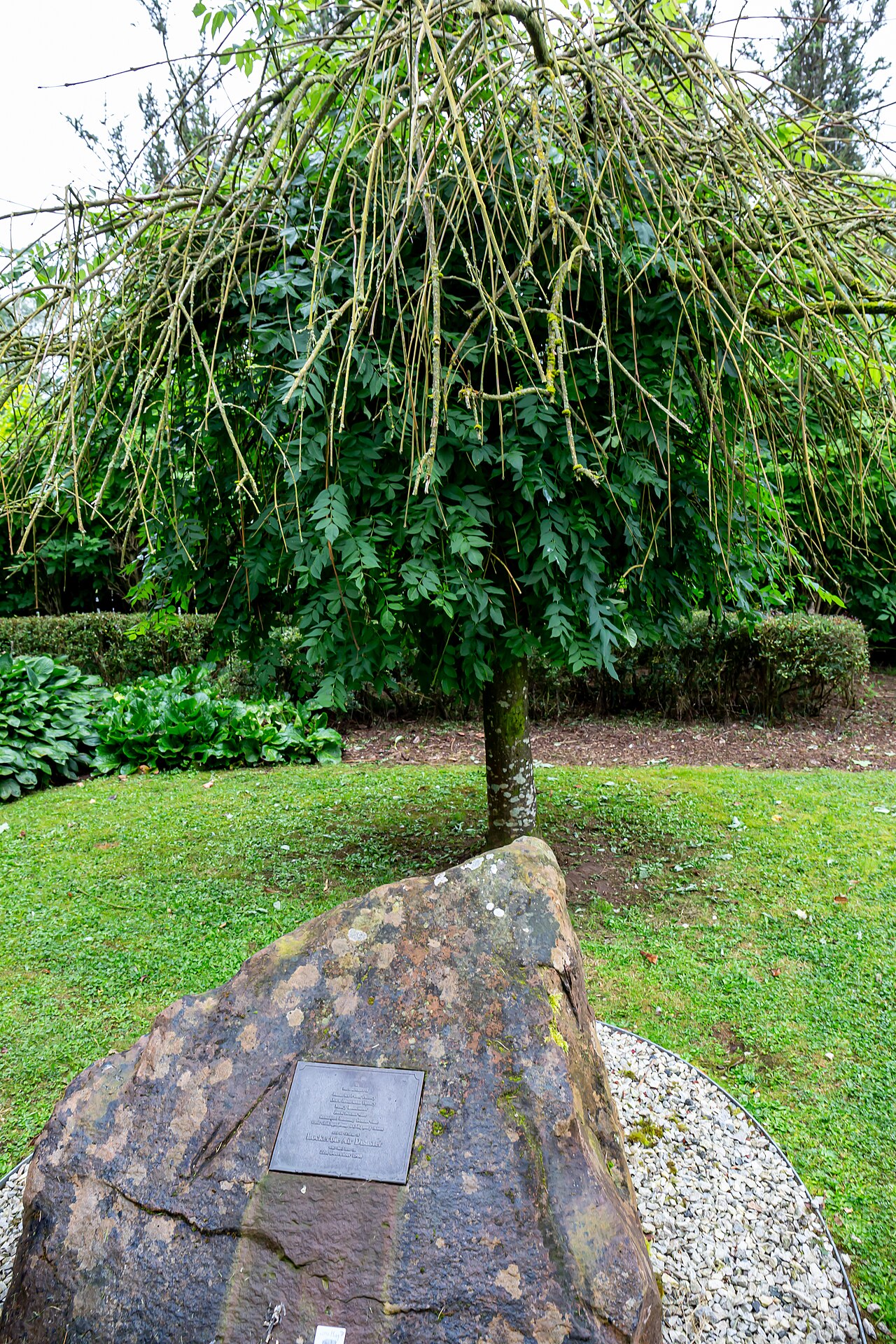
As all the accomplices required for such a complex operation were never identified, or convicted, many conspiracy theories have circulated, such as East German Stasi agents having a possible role in the attack. Some relatives of the dead, including Lockerbie campaigner Jim Swire, believe the bomb was planted at Heathrow Airport and not sent via feeder flights from Malta, as suggested by the US and UK governments.
In 2020, US authorities indicted the Tunisian resident and Libyan national Abu Agila Masud, who was 37 years old at the time of the incident, for participating in the bombing. He was taken into custody in 2022, pleading not guilty in 2023. A federal trial is set for 2026.
Pan Am 103 was the second Boeing 747 which was lost to a mid-air bombing, after Air India 182 in June 1985; while the Pan Am flight was a 747-100, the Air India flight was a 747-200. A previous 747, Pan Am Flight 93, was blown up on the ground in 1970 during the Dawson's Field hijackings, the first hull loss of a 747.

Aircraft
The aircraft operating Pan Am Flight 103 was a Boeing 747-121, MSN 19646, registered as N739PA and named Clipper Maid of the Seas. Before 1979, it had been named Clipper Morning Light. It was the 15th 747 built and had first flown on 25 January 1970. It was delivered to Pan Am on 15 February, one month after the first 747 entered service with Pan Am. In 1978, as Clipper Morning Light, it had appeared in "Conquering the Atlantic", the fourth episode of the BBC Television documentary series Diamonds in the Sky, presented by Julian Pettifer.
Flight
Pan Am 103 originated as a feeder flight at Frankfurt Airport, West Germany, using a Boeing 727 and the flight number PA103-A. Both Pan Am and Trans World Airlines routinely changed the type of aircraft operating different legs of a flight. PA103 was bookable as either a single Frankfurt–New York or a Frankfurt–Detroit itinerary, though a scheduled change of aircraft took place in London's Heathrow Airport.
After the bombing, the flight number was changed, in accordance with standard practice among airlines after disasters. The Frankfurt–London–New York–Detroit route was being served by Pan Am Flight 3 until the company's demise in 1991.

Explosion and impact timeline
Departure
On its arrival at Heathrow Terminal 3 on the day of the disaster, the passengers and their luggage (as well as an unaccompanied suitcase that was part of the interline luggage on the feeder flight) were transferred directly to Clipper Maid of the Seas, a Boeing 747-100 with the registration N739PA whose previous flight had originated from Los Angeles and arrived via San Francisco as flight PA 124, landing at 12 noon and parking at Gate K-14. The plane, which operated the flight's transatlantic leg, pushed back from the terminal at 18:04 and took off from runway 27R at 18:25, bound for New York JFK Airport and then Detroit Metropolitan Wayne County Airport. Contrary to many popular accounts of the disaster (though repeated, with reference, below), the flight, which had a scheduled gate departure time of 18:00, left Heathrow airport on time.
Loss of contact
At 18:58, the aircraft established two-way radio contact with Shanwick Oceanic Area Control in Prestwick, Scotland, on 123.95 MHz. The transmission was made by Captain MacQuarrie. He transmitted, "Good evening, Scottish. Clipper 103. We are level at 310." The controller responded, "103, you are identified."
Clipper Maid of the Seas approached the corner of the Solway Firth at 19:01, and crossed the coast at 19:02 UTC. On scope, the aircraft showed transponder code, or "squawk", 0357 and flight level 310. At this point, the Clipper Maid of the Seas was flying at 31,000 feet (9,400 metres) on a heading of 316° magnetic, and at a speed of 313 kn (580 km/h; 360 mph) calibrated airspeed. Subsequent analysis of the radar returns by RSRE concluded that the aircraft was tracking 321° (grid) and traveling at a ground speed of 803 km/h (499 mph; 434 kn).

At 19:02:44, Alan Topp, the airways controller at Scottish Air Traffic Control Centre (ATC), transmitted its oceanic route clearance on behalf of Shanwick. The aircraft did not acknowledge this message. Clipper Maid of the Seas's "squawk" then flickered off just slightly northeast of the village of Kettleholm. Air traffic control tried to make contact with the flight, with no response. A loud noise was recorded on the cockpit voice recorder (CVR) at 19:02:50. Five radar echoes fanning out appeared, instead of one. Comparison of the CVR to the radar returns showed that, eight seconds after the explosion, the wreckage had a 1-nautical-mile (1.9 km) spread. A British Airways pilot, flying the London–Glasgow shuttle near Carlisle, called Scottish ATC to report that he could see a huge fire on the ground.
Disintegration of aircraft
The explosion punched a 50 cm (20 in) hole on the left side of the fuselage and caused the upper deck walls and roof to rip away from the plane within the first few seconds post-explosion. Investigators from the US Federal Aviation Administration (FAA) concluded that no emergency procedures had been started in the cockpit. The CVR, located in the tail section of the aircraft, was found in a field by police searchers within 24 hours. No distress call was recorded; a 180-millisecond hissing noise could be heard as the explosion destroyed the aircraft's communications center. The explosion in the aircraft hold was magnified by the uncontrolled decompression of the fuselage – a large difference in pressure between the aircraft's interior and exterior. The aircraft's elevator- and rudder-control cables had been disrupted and the fuselage pitched downwards and to the left.
Investigators from the Air Accidents Investigation Branch of the British Department for Transport concluded that the nose of the aircraft was blown off and separated from the main fuselage within three seconds of the explosion. The nose cone was briefly held on by a band of metal, but facing aft, like the lid of a can. It then sheared off, up, and backwards to starboard, striking off the number-three engine and landing some distance outside the town, on a hill in Tundergarth.

Fuselage impact
The fuselage continued moving forward and down until it reached 19,000 ft (5,800 m), when its dive became nearly vertical. Due to the extreme flutter, the vertical stabilizer disintegrated, which in turn produced large yawing movements. As the forward fuselage continued to disintegrate, the flying debris tore off both of the horizontal stabilizers, while the rear fuselage, the remaining three engines, and the fin torque box separated. The rear fuselage, parts of the baggage hold, and three landing gear units landed at Rosebank Crescent. The fuselage consisting of the main wing box structure landed in Sherwood Crescent and exploded, destroying three homes and creating a large impact crater. The 200,000 lb (91,000 kg) of jet fuel ignited by the impact started fires, which destroyed several additional houses. Investigators determined that both wings had landed in the Sherwood Crescent crater, saying, "the total absence of debris from the wing primary structure found remote from the crater confirmed the initial impression that the complete wing box structure had been present at the main impact."
The British Geological Survey 23 kilometres (14 mi) away at Eskdalemuir registered a seismic event at 19:03:36 measuring 1.6 on the moment magnitude scale, which was attributed to the impact. According to the report, the rest of the wreckage composed of "the complete fuselage forward of approximately station 480 to station 380 and incorporating the flight deck and nose landing gear was found as one piece in a field approximately 4 kilometres (2.5 miles) east of Lockerbie." This field, located opposite Tundergarth Church, is where the wreckage most easily identified with images of the incident in the media fell, having fallen "almost flat on its left side, but with a slight nose-down attitude."
Victims
All 243 passengers and sixteen crew members were killed, as were eleven residents of Lockerbie on the ground. Of the 270 total fatalities, 190 were American citizens and forty-three were British citizens. Nineteen other nationalities were represented, with four or fewer passengers per country. The bodies of seventeen victims – ten passengers (six Americans, three Hungarians, and one Canadian) and seven Lockerbie residents – were never found, and were presumed to have been virtually "vaporized" by the fireball of the impact crater.

Crew
Flight 103 was under the command of Captain James B. MacQuarrie (55), a Pan Am pilot since 1964 with almost 11,000 flight hours, of which more than 4,000 had been accrued in 747 aircraft. He previously served three years in the US Navy and five years in the Massachusetts Air National Guard, where he held the rank of major. First Officer Raymond R. Wagner (52), a pilot with Pan Am since 1966 with almost 5,500 hours in the 747 and a total of nearly 12,000 hours, had previously served eight years in the New Jersey National Guard. Flight Engineer Jerry D. Avritt (46), who joined Pan Am in 1980 after 13 years with National Airlines, had more than 8,000 hours of flying time, with nearly 500 hours in the 747. The cockpit crew was based at John F. Kennedy International Airport.
Six of the 13 cabin crew members became naturalized US citizens while working for Pan Am. The cabin crew was based at Heathrow and lived in the London area or commuted from around Europe. All were originally hired by Pan Am and seniority ranged from 9 months to 28 years.
The captain, first officer, flight engineer, a flight attendant and several first-class passengers were found still strapped to their seats inside the nose section when it crashed in Tundergarth. A flight attendant was found alive by a local woman, but died before help could be summoned. Some passengers may also have remained alive briefly after impact; a pathologist's report concluded that at least two of these passengers might have survived if they had received medical attention in time.
Passengers
Syracuse University students
Thirty-five of the passengers were students from Syracuse University, who participated in the university's overseas program named Division of International Programs Abroad (abbreviated as "DIPA Program" and renamed to "Syracuse University Abroad" in 2006) and were returning home for Christmas following a semester in Syracuse's London and European campuses. Ten of these students were from other universities and colleges (including but not limited to Colgate University and University of Colorado) having collaborative relationships with Syracuse. Several of the students were due to connect to Pan Am Express Flight 4919 to Syracuse Hancock International Airport at JFK Airport later that evening.
Many of their bodies were found at Rosebank Crescent, 1⁄2 mi (0.8 km) from Sherwood Crescent. The rear fuselage of the plane, where many of them sat, destroyed one of the houses of Rosebank Crescent, 71 Park Place, the home of Lockerbie resident Ella Ramsden, who survived. The bodies of two of these students were never recovered.
Notable passengers
Prominent among the passenger victims was the 50-year-old UN Commissioner for Namibia (then South West Africa), Bernt Carlsson, who would have attended the signing ceremony of the New York Accords at the UN headquarters the following day. James Fuller, CEO of Volkswagen of America, was returning home together with marketing director Lou Marengo from a meeting with Volkswagen executives in West Germany. Also aboard were Irish Olympic sailor and management consultant Peter Dix, rock musician Paul Jeffreys and his wife.
US government officials
Aboard the flight were Diplomatic Security Service (DSS) Special Agents Daniel Emmett O'Connor and Ronald Albert Lariviere. Matthew Gannon, the Central Intelligence Agency's (CIA) deputy station chief in Beirut, Lebanon, was sitting in seat 14J, which was located in the business class (branded as "Clipper Class") cabin. A group of US intelligence specialists was on board the flight. Their presence gave rise to speculations and conspiracy theories that one or more of them had been targeted.
Lockerbie residents
Eleven Lockerbie residents on Sherwood Crescent were killed when the wing section hit the house at 13 Sherwood Crescent at more than 800 km/h (500 mph) and exploded, creating a crater 47 m (154 ft) long and with a volume of 560 m3 (20,000 cu ft; 730 cu yd). The property was completely destroyed and its two occupants were killed. Their bodies were never found. Several other houses and their foundations were destroyed, and 21 others were damaged beyond repair.
A family of four was killed when their house at 15 Sherwood Crescent exploded. A couple and their daughter were killed by the explosion in their house at 16 Sherwood Crescent. Their son witnessed a fireball engulfing his home from a neighbor's garage, where he had been repairing his sister's bicycle. The other Lockerbie residents who died were two widows aged 82 and 81, who also both lived in Sherwood Crescent; they were the two oldest victims of the disaster.
Patrick Keegans, Lockerbie's Catholic priest, was preparing to visit friends around 7:00 that evening with his mother, having recently been appointed a parish priest of the town. Keegans' house at 1 Sherwood Crescent was the only one on the street that was not either destroyed by the impact or gutted by fire. According to a BBC article on the fire published in 2018, Keegans had gone upstairs to make sure that he had hidden his mother's Christmas present, and recalls, "Immediately after that, there was an enormous explosion". Following this, "the shaking stopped and to his surprise he was uninjured". Keegans' mother was also unharmed, having been shielded from debris by a refrigerator-freezer.
Many of the passengers' relatives, most of them from the US, arrived there within days to identify the dead. Volunteers from Lockerbie set up and staffed canteens which stayed open 24 hours a day and offered relatives, soldiers, police officers, and social workers free sandwiches, hot meals, beverages, and counseling. The people of the town washed, dried, and ironed every piece of clothing that was found once the police had determined they were of no forensic value, so that as many items as possible could be returned to the relatives. The BBC's Scotland correspondent, Andrew Cassell, reported on the 10th anniversary of the bombing that the townspeople had "opened their homes and hearts" to the relatives, bearing their own losses "stoically and with enormous dignity", and that the bonds forged then continue to this day.
Prior alerts
Two alerts were released shortly before the bombing.
Helsinki warning
On 5 December 1988 (16 days prior to the attack), the US Federal Aviation Administration (FAA) issued a security bulletin saying that, on that day, a man with an Arabic accent had telephoned the US Embassy in Helsinki, Finland, and told them that a Pan Am flight from Frankfurt to the United States would be blown up within the next two weeks by someone associated with the Palestinian militant Abu Nidal Organization; he said a Finnish woman would carry the bomb on board as an unwitting courier.
The anonymous warning was taken seriously by the US government and the State Department cabled the bulletin to dozens of embassies. The FAA sent it to all US carriers, including Pan Am, which had charged each of the passengers a $5 security surcharge, promising a "program that will screen passengers, employees, airport facilities, baggage, and aircraft with unrelenting thoroughness"; the security team in Frankfurt found the warning under a pile of papers on a desk the day after the bombing.
PLO's warning
Just days before the bombing, security forces in European countries, including the UK, were put on alert after a warning from the Palestine Liberation Organization (PLO) that extremists might launch terrorist attacks to undermine the then-ongoing dialogue between the United States and the PLO.
Claims of responsibility
On the day of the bombing, the French Directorate-General for External Security was informed by their British counterpart MI6 that the UK suspected the Libyans to be behind the bombing.
According to a CIA analysis dated 22 December 1988, several groups were quick to claim responsibility in telephone calls in the United States and Europe:
A male caller claimed that a group called the "Guardians of the Islamic Revolution" had destroyed the plane in retaliation for Iran Air Flight 655 being shot down by US forces in the Persian Gulf the previous July.
A caller claiming to represent the Islamic Jihad Organization told ABC News in New York that the group had planted the bomb to commemorate Christmas.
Another caller claimed the plane had been downed by Mossad, the Israeli intelligence service.
The list's author noted, "We consider the claims from the Guardians of the Islamic Revolution as the most credible one received so far," but the analysis concluded, "We cannot assign responsibility for this tragedy to any terrorist group at this time. We anticipate that, as often happens, many groups will seek to claim credit."
In 2003, under pressure from international sanctions, Muammar Gaddafi, as leader of his government, paid compensation to the victims' families, while maintaining that he personally had not ordered the attack. On 22 February 2011, during the Libyan Civil War, former Minister of Justice Mustafa Abdul Jalil stated in an interview with the Swedish newspaper Expressen that Gaddafi had personally ordered the bombing. Jalil claimed to possess "documents that prove [his allegations] and [that he is] ready to hand them over to the international criminal court."
Investigation
The original prime suspect in the bombing was the Popular Front for the Liberation of Palestine – General Command (PFLP-GC), a Syria-based group led by Ahmed Jibril. A flood of warnings immediately preceding the disaster had included one that read: 'team of Palestinians not associated with PLO intends to attack US targets in Europe. Time frame is present. Targets specified are Pan Am Airlines and US military bases.' Five weeks before this warning, Jibril's right-hand man, Haffez Dalkamoni, had been arrested in Frankfurt with a known bomb-maker, Marwen Khreesat. "Later US intelligence officials confirmed that members of the group had been monitoring Pan Am's facilities at Frankfurt airport. On Dalkamoni's account bombs made by Khreesat were at large somewhere." A deep-cover CIA agent was told by up to 15 high-level Syrian officials that the PFLP-GC was involved and that officials interacted with Jibril "on a constant basis". In 2014, an Iranian ex-spy asserted that Iran ordered the attack. The Iranian foreign ministry swiftly denied any involvement.