
Oxford ( ) is a cathedral city and non-metropolitan district in Oxfordshire, England, of which it is the county town.
The city is home to the University of Oxford, the oldest university in the English-speaking world; it has buildings in every style of English architecture since late Anglo-Saxon. Oxford's industries include motor manufacturing, education, publishing, science and information technologies. Founded in the eighth century, it was granted city status in 1542. The city is located at the confluence of the rivers Thames (known locally as the Isis) and Cherwell. It had a population of 166,034 in 2024. It lies 56 miles (90 km) north-west of London, 64 miles (103 km) south-east of Birmingham and 61 miles (98 km) north-east of Bristol.
History
The history of Oxford dates back to its original settlement in the Saxon period. The name “Oxford” comes from the Old English Oxenaforda, meaning “ford of the oxen,” referring to a shallow crossing in the river where oxen could pass. The town was of strategic significance, because of the ford and the town's controlling location on the upper reaches of the river Thames at its confluence with the river Cherwell.

After the Norman Conquest in 1066, Norman lord Robert D’Oyly built Oxford Castle in 1071 to secure control of the area. The town grew in national importance during the early Norman period.
Teaching began in the 11th century and by the late 12th century the town was home to the fledgling University of Oxford. Tensions sometimes erupted between the scholastic community and the town; in 1209, after a townsperson hanged two scholars for an alleged murder, a number of Oxford academics fled and founded Cambridge University. Town-and-gown conflicts continued, culminating in the St. Scholastica Day Riot of 1355 – a feuding that lasted days and left around 93 students and townspeople dead.
Oxford was besieged during The Anarchy in 1142. During the Middle Ages, Oxford had an important Jewish community, of which David of Oxford and his wife Licoricia of Winchester were prominent members. The university rose to dominate the town.

A heavily ecclesiastical town, Oxford was greatly affected by the changes of the English Reformation. Its ecclesiastical institutions were dismantled; the city’s monasteries were closed in the 1530s. Religious strife touched Oxford directly during the Marian persecution; the Oxford Martyrs were tried for heresy here. Bishops Hugh Latimer and Nicholas Ridley were burned at the stake in Oxford in October 1555, and the former Archbishop Thomas Cranmer was executed in March 1556. A Victorian-era monument, the Martyrs’ Memorial in St Giles’, now commemorates these events.
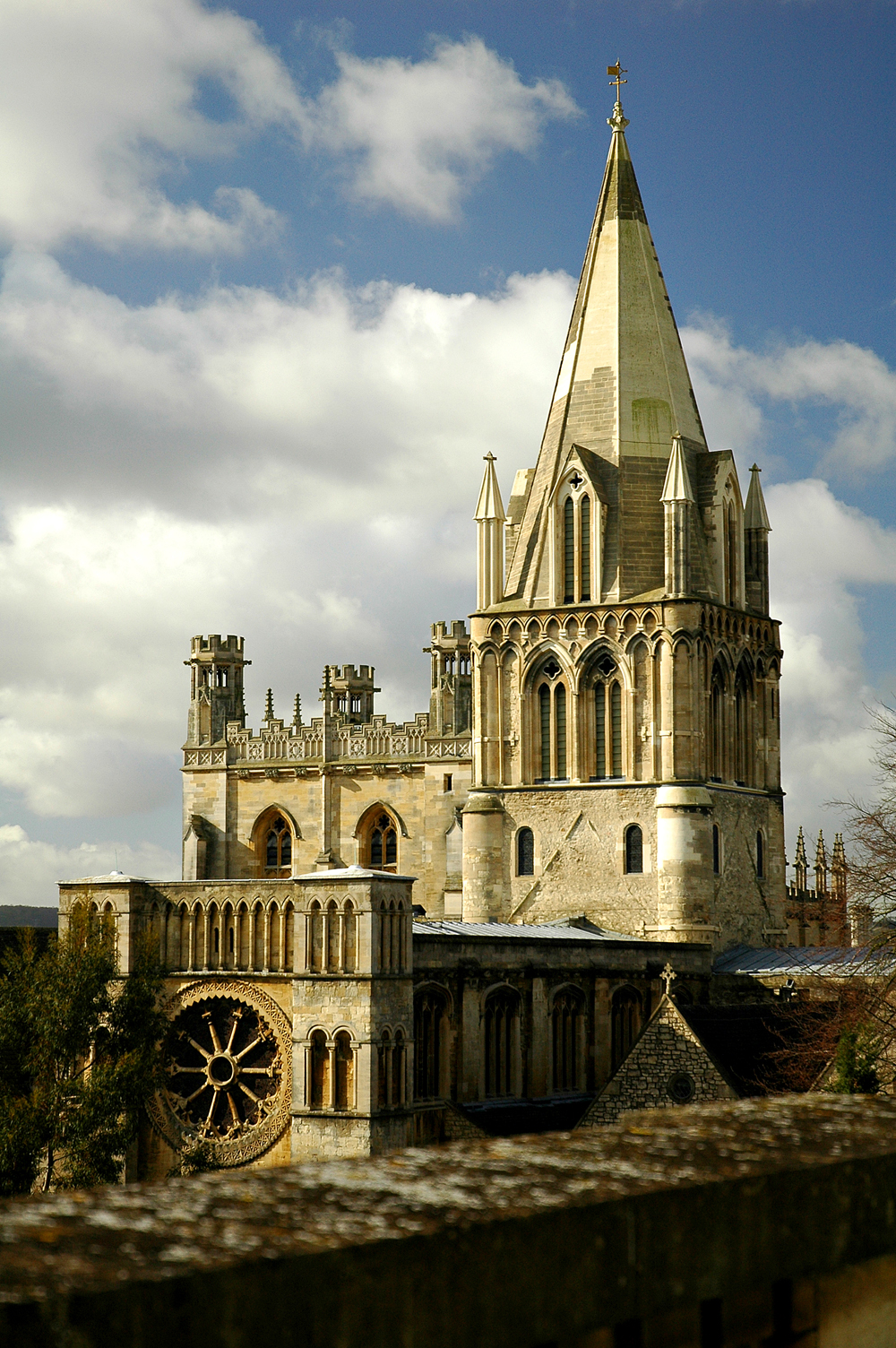
Oxford was elevated from town to city status in 1542 when the Diocese of Oxford was created; Christ Church college chapel was made a cathedral, officially granting its city privileges.
During the English Civil War, Charles I made Oxford his de facto capital (1642–1646); he moved his court to Oxford, using the city as his headquarters after being expelled from London.

The city began to grow industrially during the 19th century and had an industrial boom in the early 20th century. Traditional industries included brewing and publishing; Oxford University Press and other print houses were major employers by the 19th century. In 1910, entrepreneur William Morris (later Lord Nuffield) founded a motor car business in Oxford, opening an assembly plant at Cowley.
The city’s population and economy grew with this industrial boom, diversifying beyond the university.
Transport history
Oxford has had three main railway stations. The first was opened at Grandpont in 1844, but this was a terminus, inconvenient for routes to the north; it was replaced by the present station on Park End Street in 1852 with the opening of the Birmingham route. Another terminus, at Rewley Road, was opened in 1851 to serve the Bletchley route; this station closed in 1951. There have also been a number of local railway stations, all of which are now closed. The present station opened in 1852.

In 1844, the Great Western Railway linked Oxford with London Paddington via Didcot and Reading; in 1851, the London & North Western Railway opened its own route from Oxford to London Euston, via Bicester, Bletchley and Watford Junction; in 1864, a third route, also to Paddington, running via Thame, High Wycombe and Maidenhead, was provided; this was shortened in 1906 by the opening of a direct route between High Wycombe and London Paddington by way of Denham. The distance from Oxford to London was 78 miles (125.5 km) via Bletchley; 63.5 miles (102.2 km) via Didcot and Reading; 63.25 miles (101.8 km) via Thame and Maidenhead; and 55.75 miles (89.7 km) via Denham.
Only the original Didcot route is still in use for its full length, portions of the others remain. There were also routes to the north and west. The line to Banbury was opened in 1850, and was extended to Birmingham Snow Hill in 1852; a route to Worcester Shrub Hill opened in 1853. A branch to Witney was opened in 1862, which was extended to Fairford in 1873. The line to Witney and Fairford closed in 1962, but the others remain open.
The M40 motorway approached Oxford in 1974, leading from London to Waterstock, where the A40 continued to Oxford. When the extension to Birmingham was completed in January 1991, it curved sharply north and a mile of the old motorway became a spur.
Geography
Physical
Location
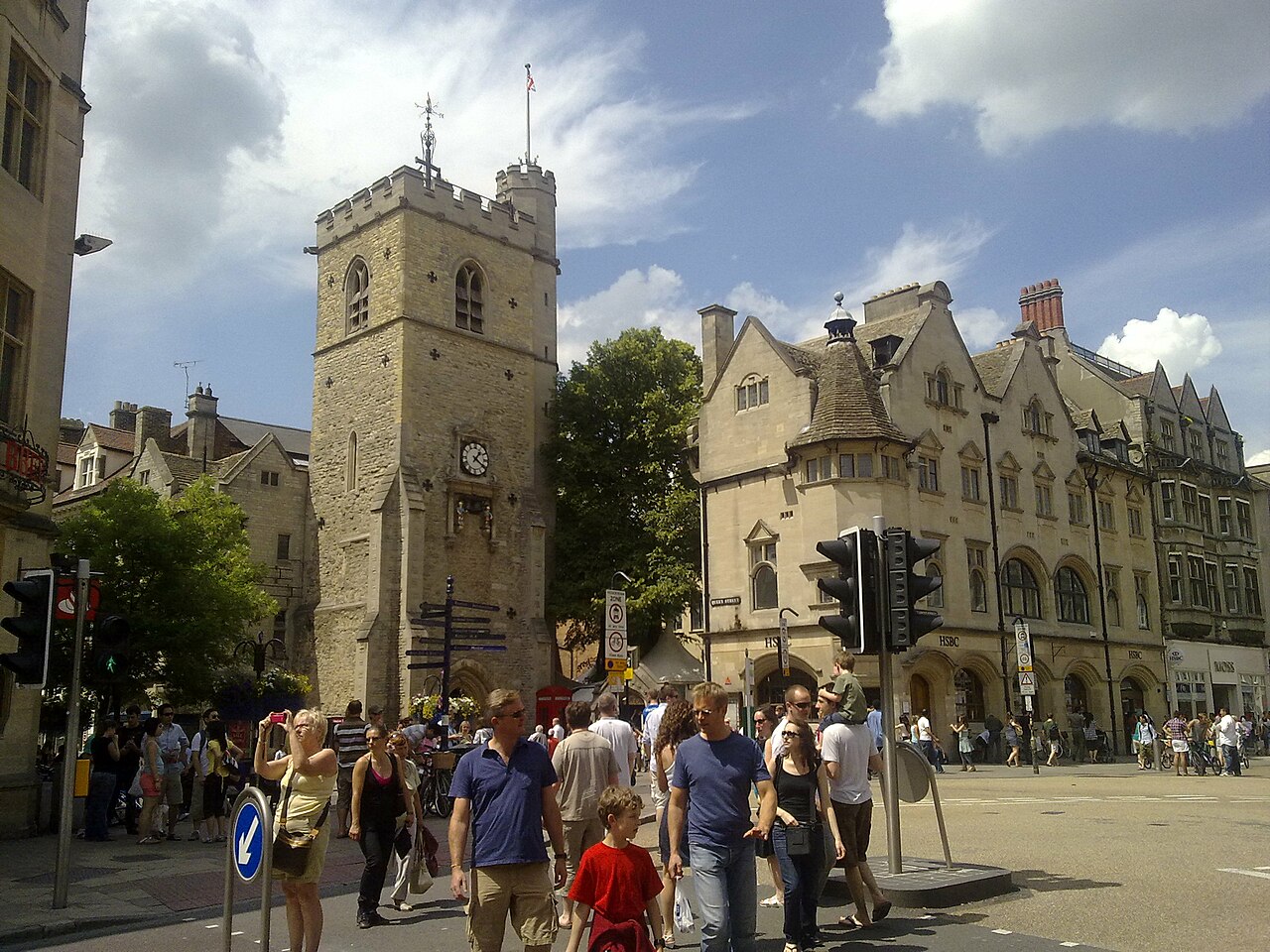
Carfax Tower is usually considered the centre of Oxford. The city lies 24 miles (39 km) north-west of Reading, 26 miles (42 km) north-east of Swindon, 36 miles (58 km) east of Cheltenham, 43 miles (69 km) east of Gloucester, 29 miles (47 km) south-west of Milton Keynes, 38 miles (61 km) south-east of Evesham, 54 miles (87 km) south-east of Worcester, 43 miles (69 km) south of Rugby and 51 miles (82 km) west-north-west of London. The rivers Cherwell and Thames (also known locally as the Isis, supposedly from the Latinised name Thamesis) run through Oxford and meet south of the city centre. These rivers and their flood plains constrain the size of the city centre.
Climate
Oxford has a maritime temperate climate (Köppen: Cfb). Precipitation is uniformly distributed throughout the year and is provided mostly by weather systems that arrive from the Atlantic. The lowest temperature ever recorded in Oxford was −17.8 °C (0.0 °F) on 24 December 1860; the highest was 38.1 °C (101 °F) on 19 July 2022. The average conditions below are from the Radcliffe Meteorological Station. It has the longest series of temperature and rainfall records for one site in Great Britain; these have been continuous from January 1815. Irregular observations of rainfall, cloud cover and temperature exist since 1767.
The city's climate records are:
the driest year on record was 1788, with 336.7 mm (13.26 in) of rainfall
the driest month was April 1817 with 0.5 mm (0.020 in) of rainfall
the wettest year was 2012, with 979.5 mm (38.56 in)
the wettest month was September 1774 with a total fall of 223.9 mm (8.81 in)
the warmest month was July 1983, with an average of 21.1 °C (70 °F)
the coldest month was January 1963, with an average of −3.0 °C (27 °F)
the warmest year was 2022, with an average of 12.1 °C (54 °F)
the coldest year was 1879, with a mean temperature of 7.8 °C (46 °F)
the sunniest month was May 2020, with 331.7 hours
the least sunny was December 1890, with 5.0 hours
the greatest one-day rainfall occurred on 10 July 1968, with a total of 87.9 mm (3.46 in)
the greatest known snow depth was 61.0 cm (24.0 in) in February 1888.
Districts
The city centre
The city centre is relatively small and is centred on Carfax, a crossroads which forms the junction of Cornmarket Street (pedestrianised), Queen Street (mainly pedestrianised), St Aldate's and the High Street ("the High"; blocked for through traffic). Cornmarket Street and Queen Street are home to Oxford's chain stores, as well as a small number of independent retailers; one of the longest established was Boswells, founded in 1738. The store closed in 2020. St Aldate's has few shops but several local government buildings, including the town hall, the city police station and local council offices. The High (the word street is traditionally omitted) is the longest of the four streets and has a number of independent and high-end chain stores, but mostly university and college buildings. The historic buildings mean that the area is often used by film and TV crews.
Suburbs
There are several suburbs and neighbourhoods within the boundary of the city of Oxford, including:
Green belt
The city is at the centre of the Oxford Green Belt, which is an environmental and planning policy that regulates the rural space in Oxfordshire surrounding the city, aiming to prevent urban sprawl and minimise convergence with nearby settlements. The policy has been blamed for the large rise in house prices in Oxford, making it the least affordable city in the United Kingdom outside of London; some estate agents have called for brownfield land inside the green belt to be released for new housing.
The vast majority of the area covered is outside of the city, but there are some green spaces within that which are covered by the designation, such as much of the Thames and Cherwell flood-meadows, and the village of Binsey, along with several smaller portions on the fringes. Other landscape features and places of interest include Cutteslowe Park and the miniature railway attraction, the University Parks, Hogacre Common Eco Park, numerous sports grounds, Aston's Eyot, St Margaret's Church and well, and Wolvercote Common and community orchard.
Governance
There are two tiers of local government covering Oxford, at district and county level: Oxford City Council and Oxfordshire County Council. From 1889 to 1974, the city of Oxford was a county borough, independent from the county council. Oxford City Council meets at the Town Hall on the street called St Aldate's in the city centre. The current building was completed in 1897, on a site which had been occupied by Oxford's guildhall since the 13th century.
Most of Oxford is an unparished area, but there are four civil parishes within the city's boundaries: Blackbird Leys, Littlemore, Old Marston, and Risinghurst and Sandhills.
Economy
Oxford's economy includes manufacturing, publishing and science-based industries, as well as education, sport, entertainment, breweries, research and tourism.
Car production
Oxford has been an important centre of motor manufacturing since Morris Motors was established in the city in 1910. The principal production site for Mini cars, owned by BMW since 2000, is in the Oxford suburb of Cowley. The plant, which survived the turbulent years of British Leyland in the 1970s and was threatened with closure in the early 1990s, also produced cars under the Austin and Rover brands; this followed the demise of the Morris brand in 1984, although the last Morris-badged car was produced there in 1982.
Publishing
Oxford University Press, a department of the University of Oxford, is based in the city, although it no longer operates its own paper mill and printing house. The city is also home to the UK operations of Wiley-Blackwell, Elsevier and several smaller publishing houses.
Science and technology
The presence of the university has given rise to many science and technology based businesses, including Oxford Instruments, Research Machines and Sophos. The university established Isis Innovation in 1987 to promote technology transfer. The Oxford Science Park was established in 1990 and the Begbroke Science Park, owned by the university, lies north of the city. Oxford is increasingly regarded as a centre of digital innovation, exemplified by initiatives such as Digital Oxford. Several startups including Passle, Brainomix, Labstep, and more, are based in Oxford.
Education
The presence of the university has also led to Oxford becoming a centre for the education industry. Companies often draw their teaching staff from the pool of Oxford University students and graduates; especially for EFL education which uses their Oxford location as a selling point.
Tourism
Oxford has numerous major tourist attractions, many belonging to the university and colleges. As well as several famous institutions, the town centre is home to Carfax Tower and the University Church of St Mary the Virgin, both of which offer views over the spires of the city. Many tourists shop at the historic Covered Market. In the summer, punting on the Isis and Cherwell is a common practice. As well as being a major draw for tourists (9.1 million in 2008, similar in 2009), Oxford city centre has many shops, several theatres and an ice rink.
Retail
There are two small shopping centres in the city centre: the Clarendon Centre and the Westgate Oxford. The Westgate Centre is named for the original West Gate in the city wall and is at the west end of Queen Street. A major redevelopment and expansion to 750,000 sq ft (70,000 m2), with a new 230,000 sq ft (21,000 m2) John Lewis department store and a number of new homes, was completed in October 2017. Blackwell's Bookshop claims to have the largest single room devoted to book sales in the whole of Europe, the Norrington Room (10,000 sq ft).