
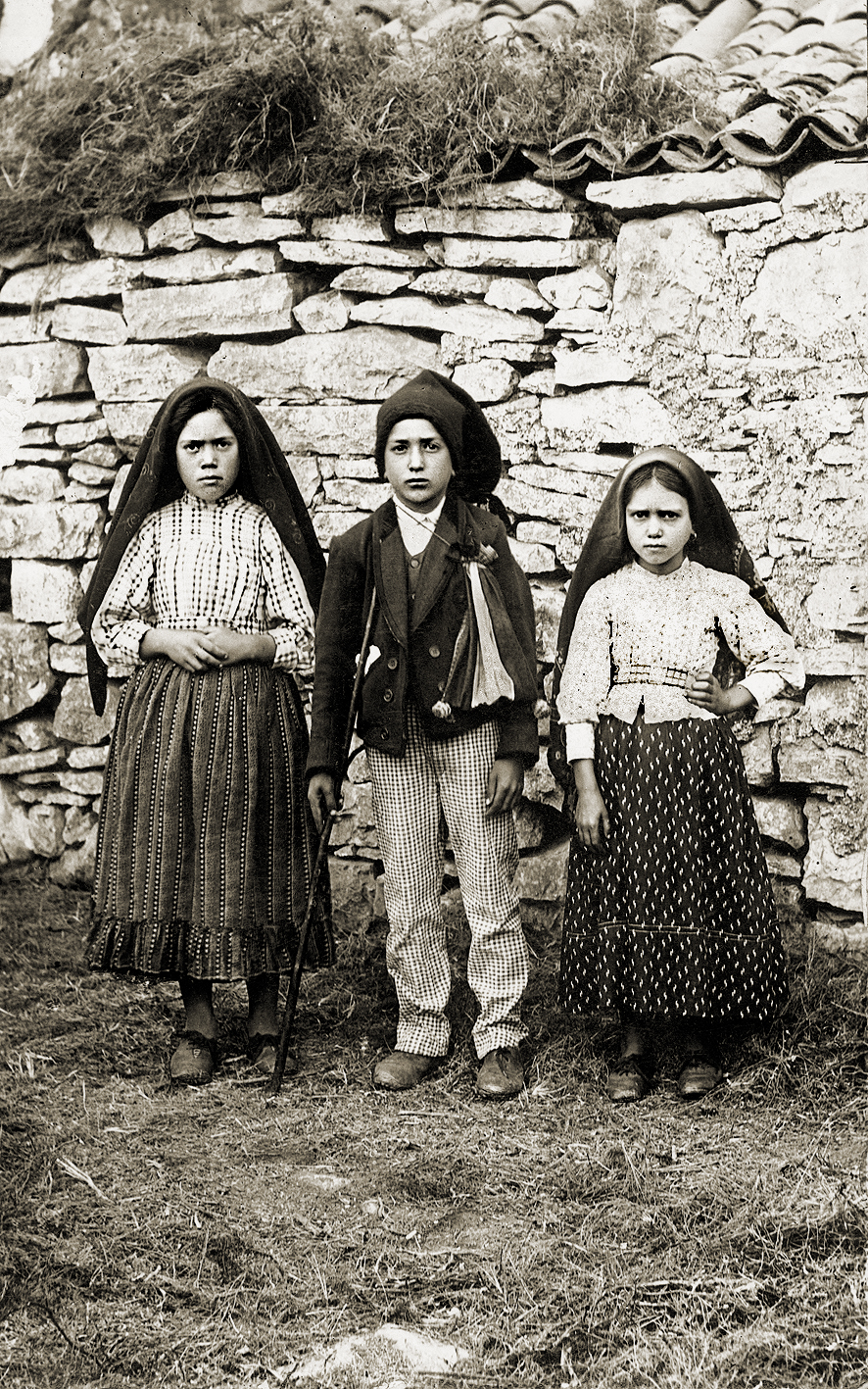
Our Lady of Fátima (Portuguese: Nossa Senhora de Fátima, pronounced [ˈnɔsɐ sɨˈɲɔɾɐ ðɨ ˈfatimɐ]; formally known as Our Lady of the Holy Rosary of Fátima) is a Catholic title of Mary, mother of Jesus, based on the Marian apparitions reported in 1917 by three shepherd children at the Cova da Iria in Fátima, Portugal. The three children were Lúcia dos Santos and her cousins Francisco and Jacinta Marto. José Alves Correia da Silva, Bishop of Leiria, declared the events worthy of belief on 13 October 1930.
Pope Pius XII granted a pontifical decree of canonical coronation via the papal bull Celeberrima solemnia towards the venerated image on 25 April 1946. The designated papal legate, Cardinal Benedetto Aloisi Masella, carried out the coronation on 13 May 1946, now permanently enshrined at the Chapel of the Apparitions of Fátima. The same Roman Pontiff also raised the Sanctuary of Fátima to the status of a minor basilica by the apostolic letter Luce superna on 11 November 1954.
The published memoirs of Sister Lúcia in the 1930s revealed two secrets that she claimed came from the Virgin Mary, while the third secret was to be revealed by the Catholic Church in 1960. The controversial events at Fátima, including the Miracle of the Sun, gained fame due partly to elements of the secrets, prophecy and eschatological revelations allegedly related to the Second World War and possibly more global wars in the future, particularly the Virgin's request for the Consecration of Russia to the Immaculate Heart of Mary.

History
Marian apparitions
Beginning in the spring of 1916, three shepherd children – Lúcia dos Santos, Francisco and Jacinta Marto – reported three apparitions of an Angel in Valinhos. Then, starting on 13 May 1917, in Cova da Iria, six apparitions of the Blessed Virgin Mary were reported. The children described her as "a Lady more brilliant than the Sun". The children reported a prophecy that prayer would lead to an end to the Great War, and that on 13 October that year the Lady would reveal her identity and perform a miracle "so that all may believe." Newspapers reported the prophecies, and many pilgrims began visiting the area. The children's accounts were deeply controversial, drawing intense criticism from both local secular and religious authorities. A provincial administrator briefly took the children into custody, believing the prophecies were politically motivated in opposition to the officially secular First Portuguese Republic established in 1910.
On 13 May 1917, the shepherd children reported seeing a woman "brighter than the sun, shedding rays of light clearer and stronger than a crystal goblet filled with the most sparkling water and pierced by the burning rays of the sun." The woman wore a white mantle edged with gold and held a rosary in her hand. She asked them to devote themselves to the Holy Trinity and to pray "the Rosary every day, to bring peace to the world and an end to the war". While the children had never told anyone about seeing the angel, Jacinta told her family about seeing the brightly lit woman. Lúcia had earlier said that the three should keep this experience private. Jacinta's disbelieving mother told neighbors about it as a joke, and within a day the whole village knew of the children's vision.
The children said the woman told them to return to the Cova da Iria on 13 June 1917. Lúcia's mother sought counsel from the parish priest, Father Manuel Ferreira, who suggested she allow them to go. He asked to have Lúcia brought to him afterward so that he could question her. The second appearance occurred on 13 June, the feast of Saint Anthony, patron of the local parish church. Lúcia would later report that on this occasion, the lady revealed that Francisco and Jacinta would be taken to Heaven soon, but Lúcia would live longer in order to spread her message and devotion to the Immaculate Heart of Mary.

During the June visit, the children said the Lady told them to say the Holy Rosary daily in honor of Our Lady of the Rosary to obtain peace and the end of the Great War. (Three weeks earlier, on 21 April, the first contingent of Portuguese soldiers had embarked for the front lines of the war.) The lady also purportedly revealed to the children a vision of hell, and entrusted a secret to them, described as "good for some and bad for others". Fr. Ferreira later stated that Lúcia recounted that the lady told her, "I want you to come back on the thirteenth and to learn to read in order to understand what I want of you. ...I don't want more."
In the following months, thousands of people flocked to Fátima and nearby Aljustrel, drawn by reports of visions and miracles. On 13 August 1917, the provincial administrator Artur Santos (no relation to Lúcia dos Santos) intervened. He believed that these events were politically disruptive in the conservative country. He took the children into custody, jailing them before they could reach the Cova da Iria. Santos interrogated and threatened the children to get them to divulge the contents of the secrets. Lúcia's mother hoped the officials could persuade the children to end the affair and admit that they had lied. Lúcia told Santos everything short of the secrets and offered to ask the woman for permission to tell the official the secrets.
That month, instead of the usual apparition in the Cova da Iria on 13 August, the children reported that they saw Mary on 19 August, a Sunday, at nearby Valinhos. She asked them again to pray the rosary daily, spoke about the miracle coming in October, and asked them "to pray a lot, a lot for the sinners and sacrifice a lot [Mortification in Catholic theology], as many souls perish in hell because nobody is praying or [Acts of Reparation] making sacrifices for them."

The three children claimed to have seen Mary in a total of six apparitions between 13 May and 13 October 1917. Lúcia also reported a seventh Marian apparition at Cova da Iria. The year 2017 marked the 100th anniversary of the apparitions, and it was celebrated with the visit of Pope Francis to the Sanctuary of Fátima.
Messages
The words allegedly spoken by the Mary to the three children include:
13 May 1917
Do not be afraid. I will do you no harm. I am from Heaven. I came to ask you to come here on the thirteenth day for six months at this same time, and then I will tell you who I am and what I want. And afterwards, I will return here a seventh time. Yes, you [Lúcia] will [go to heaven]. She [Jacinta] also [will go to heaven]. Yes [Francisco will go to heaven], but first he must say many rosaries. Would you like to offer yourselves to God to accept all the sufferings which He may send to you in reparation for the countless sins by which He is offended and in supplication for the conversion of sinners? Then you will have much to suffer, but the grace of God will be your comfort.

13 June 1917
I want you to come on the thirteenth day of next month and to pray the Rosary every day and I want you to learn to read. If she [sick woman] is converted, she will be cured within a year. Yes, I will take Francisco and Jacinta soon [to heaven], but you must remain on earth for some time. Jesus wishes to use you to make me better known and loved. He wishes to establish in the world devotion to my Immaculate Heart. No, my child [you will not be alone], and would that make you suffer? Do not be disheartened. My Immaculate Heart will never abandon you, but will be your refuge and the way that will lead you to God.
13 July 1917
I want you to come on the thirteenth day of next month and to continue to pray the Rosary every day in honor of Our Lady of the Rosary, in order to obtain peace for the world and the end of the war for she alone can help. Continue to come here every month. In October I will tell you who I am and what I want. And I will perform a miracle so that everyone may see and believe. Sacrifice yourselves for sinners and say often, especially when you make some sacrifice, 'O my Jesus, this is for love of You, for the conversion of sinners, and in reparation for the offenses committed against the Immaculate Heart of Mary.' [A vision of hell] You saw Hell where the souls of poor sinners go. In order to save them, God wishes to establish in the world devotion to my Immaculate Heart. If people do what I ask, many souls will be saved and there will be peace. The war is going to end. But if people do not stop offending God, another, even worse one will begin in the reign of Pius XI. When you shall see a night illuminated by an unknown light know that this is the great sign that God gives you that He is going to punish the world for its many crimes by means of war, hunger, and persecution of the Church and the Holy Father. To prevent it, I shall come to ask for the consecration of Russia to my Immaculate Heart and the Communion of reparation on the first Saturdays. If people attend to my requests, Russia will be converted and the world will have peace. If not, she [Russia] will scatter her errors throughout the world, provoking wars and persecutions of the Church. The good will be martyred, the Holy Father will have much to suffer, and various nations will be destroyed. In the end my Immaculate Heart will triumph. The Holy Father will consecrate Russia to me; it will be converted, and a certain period of peace will be granted to the world. In Portugal the dogmas of the Faith will always be kept. [A vision of the Pope suffering and being martyred] Do not tell this to anyone. Francisco ... yes, you may tell him" [Lúcia and Jacinta both saw and heard Our Lady but Francisco only saw the apparitions]. When you say the Rosary, say after each mystery: O my Jesus, forgive us our sins, save us from the fires of Hell and lead all souls to Heaven, especially those most in need.
19 August 1917
Pray, pray a great deal and make many sacrifices, for many souls go to Hell because they have no one to make sacrifices and to pray for them. St. Joseph too will come with the Holy Child to bring peace to the world. Our Lord will also come to bless the people. Our Lady of the Rosary and Our Lady of Sorrows will come too.
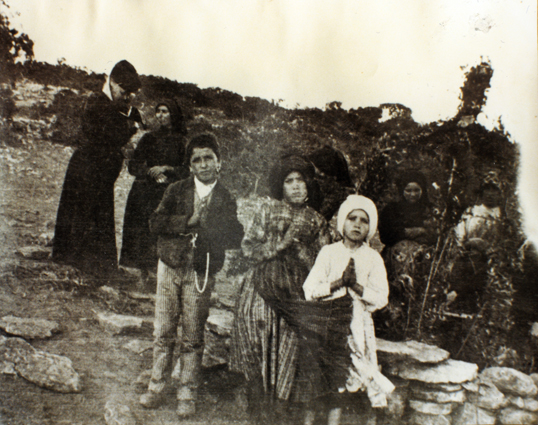
13 September 1917
You must pray! Continue to pray the Rosary every day in order to obtain the end of the war. In October Our Lord will come, and Our Lady of Sorrows and of Mount Carmel and St. Joseph with the Child Jesus to bless the world. God is pleased with your sacrifices, but He does not want you to sleep with the rope on; wear it only during the day. [Regarding miraculous cures] Some I will cure, others not. In October I shall perform a miracle so that everyone may believe.
13 October 1917
I am the Lady of the Rosary, I have come to warn the faithful to amend their lives and ask for pardon for their sins. They must not offend Our Lord any more, for He is already too grievously offended by the sins of men. People must say the Rosary. Let them continue saying it every day. I would like a chapel built here in my honor. The war will end soon.
Miracle of the Sun
After some newspapers reported that the Virgin Mary had promised a miracle for the last of her apparitions on 13 October, a huge crowd, possibly between 30,000 and 100,000, including reporters and photographers, gathered at Cova da Iria. What happened then became known as the "Miracle of the Sun".
Various claims have been made as to what actually happened during the event. The three children who originally claimed to have seen Our Lady of Fátima reported seeing a panorama of visions during the event, including those of Jesus, Our Lady of Sorrows, Our Lady of Mount Carmel, and of Saint Joseph blessing the people. Father John De Marchi, an Italian Catholic priest and researcher, wrote several books on the subject, which included descriptions by witnesses who believed they had seen a miracle created by Mary. According to accounts, after a period of rain, the dark clouds broke, and the Sun appeared as an opaque, spinning disc in the sky. It was said to be significantly duller than normal and to cast multicolored lights across the landscape, the people, and the surrounding clouds. The Sun was then reported to have careened towards the Earth before zig-zagging back to its normal position. Witnesses reported that their previously wet clothes became "suddenly and completely dry, as well as the wet and muddy ground that had been previously soaked because of the rain that had been falling".
Not all witnesses reported seeing the Sun "dance". Some people only saw the radiant colors, and others, including some believers, saw nothing at all. No unusual phenomenon of the Sun was observed by scientists at the time. Skeptics have offered alternative explanations that include psychological suggestibility of the witnesses, temporary retinal distortion caused by staring at the intense light of the Sun, and optical effects caused by natural meteorological phenomena.
In De Marchi's account, he describes Manuel Nunes Formigão, the priest who interviewed the children during the apparitions, as alarmed by a discrepancy between a prophecy the children reported and the current circumstances. According to the children, their apparition predicted that the First World War would end on 13 October 1917. "But listen Lúcia," De Marchi reports Formigão saying, "The war is still going on. The papers give news of battles after the 13th. How can you explain that if our Lady said the war would end that day?" Lúcia replied, "I don't know; I only know that I heard her say that the war would end on that day [...] I said exactly what our Lady had said." Jacinta, the youngest child, was interrogated separately and said the same: "She [Mary] said that we were to say the Rosary every day and that the war would end today." World War I ended a little over a year later on Armistice Day, 11 November 1918.
De Marchi documented that in the two years before the deaths of Francisco and Jacinta Marto in the 1918 Spanish flu pandemic, the three children periodically refused food and water, or else drank dirty water such as from a laundry pond, as a penance; De Marchi noted that Jacinta's mother had forbidden drinking from the pond due to the risk of illness. De Marchi wrote, "In the scorching sun of the serra, when through the bright hours of the day the heat hangs like a hot stove everywhere, they abstained from taking any water through one spell of thirty days, and at another time for nine." and described Jacinta as being hospitalized for severe bronchial illness, after which she confided to her older cousin that she was still abstaining: "I was thirsty, Lúcia, and I didn't drink, and so I offered it to Jesus for sinners." Lúcia wrote in her 1936 and 1941 memoirs that the Virgin Mary predicted the deaths of Francisco and Jacinta during the second apparition on 13 June 1917.
In one of several memoirs, Lúcia wrote that the children tied "penitence cords" so tightly around their waists that the ropes became blood-stained, and that the apparition of 13 September 1917, told her, "God is pleased with your sacrifices, but He does not want you to sleep with the rope on; only wear it during the day." Late in life, Lúcia also wrote about doubts she expressed as a child regarding the authenticity of the apparition. She wrote, "I began then to have doubts as to whether these manifestations might be from the devil [...] truly, ever since I had started seeing these things, our home was no longer the same, for joy and peace had fled. What anguish I felt!" She also describes a vivid nightmare she experienced during this time period wherein "the devil was laughing at having deceived me." De Marchi states that Lúcia told her cousin prior to traveling to Cova da Iria in anticipation of the 13 July 1917 apparition, "If she [the Lady] asks for me, Jacinta, you tell her why I'm not there. Because I am afraid it is the Devil who sends her to us!" Lúcia wrote in her memoir that on the following day, she was overtaken by a certainty that she should go, despite her earlier dread: "...when it was nearly time to leave, I suddenly felt I had to go, impelled by a strange force that I could hardly resist." According to De Marchi, "Lúcia's doubts were mercifully dissolved".
Later years of the children
Francisco and Jacinta Marto died in the global flu pandemic that began in 1918 and swept the world for two years. Francisco Marto died at home on 4 April 1919, at the age of ten. Jacinta died at the age of nine in Queen Stephanie's Children's Hospital in Lisbon on 20 February 1920. Their mother Olímpia Marto said that her children had predicted their deaths many times to her and to curious pilgrims in the brief period after the Marian apparitions. They are now buried at the Sanctuary of Fátima. They were beatified by Pope John Paul II on 13 May 2000 and canonized by Pope Francis on 13 May 2017.
On 17 June 1921, at the age of fourteen, Lúcia was admitted as a boarder at the Sisters of Saint Dorothy (Dorothean) school in Vilar, a suburb of Porto, Portugal. In 1925, at the age of eighteen, she began her novitiate at the convent of the Sisters of Saint Dorothy in Tui, Spain, near the border with Portugal. Lúcia continued to report in her memoir private visions periodically throughout her life.
On 10 December 1925, she reported a vision of the Virgin Mary, accompanied by the Child Jesus on a luminous cloud, while residing at the convent in Pontevedra, Spain. The Virgin Mary defined the conditions for the First Saturdays devotion and asked her to propagate the devotion. Later, on 15 February 1926, she reported a subsequent vision of the Christ Child reiterating this request. On 13 June 1929, Lúcia reported a vision of the Holy Trinity and the Virgin Mary, who repeated her request for the Consecration of Russia to her Immaculate Heart. She also reported a 1931 apparition in Rianxo, Galicia, in which she said Jesus visited her, taught her two prayers, and gave a message addressed to the Catholic Church's hierarchy.
In 1936 and again in 1941, Sister Lúcia said that the Virgin Mary had predicted the deaths of her two cousins during the second apparition on 13 June 1917. According to Lúcia's 1941 account, on 13 June, Lúcia asked the Virgin if the three children would go to heaven when they died. She said that she heard Mary reply, "Yes, I shall take Francisco and Jacinta soon, but you will remain a little longer, since Jesus wishes you to make me known and loved on Earth. He wishes also for you to establish devotion in the world to my Immaculate Heart."
In 1947, Sister Lúcia left the Dorothean Order and joined the Discalced Carmelite Order in a monastery in Coimbra, Portugal. Lúcia died on 13 February 2005, at the age of 97. Her cell was sealed off by the order of the Congregation for the Doctrine of the Faith as part of examination for her canonization, due to the revelations that Sister Lúcia still had after the events at Fátima.
Pilgrimage
The widely reported Miracle of the Sun quickly made Fátima a major pilgrimage centre. Two million pilgrims visited the site in the decade following the events of 1917. A small chapel – the Capelinha – was built by locals on the exact site of the Marian apparitions, where the holm oak stood.
On 13 May 1920, pilgrims defied government troops and enshrined a statue of the Virgin Mary in the chapel. Mass was first officially celebrated there in January 1924. A hostel for the sick was begun in that year. In 1927, the first rector of the sanctuary was appointed, and a set of Stations of the Cross were erected on the mountain road. The foundation stone for the Basilica of Our Lady of the Rosary was laid nearby the next year.
In 1930, the Catholic Church officially recognised the apparition events as "worthy of belief" and granted a papal indulgence to pilgrims visiting Fátima. In 1935, the bodies of the child visionaries, Francisco and Jacinta, were reinterred in the new basilica. Pope Pius XII granted a Canonical Coronation of the statue of Our Lady of Fátima on 13 May 1946. This event drew such large crowds that the entrance to the site had to be barred.
In the 21st century, pilgrimages to the site occur year-round. Additional chapels, hospitals and other facilities have been constructed at the site. The principal pilgrimages take place on the thirteenth day of each month from May to October, on the anniversaries of the original apparitions. The largest crowds gather on 13 May and 13 October, when up to a million pilgrims pray and witness processions of the statue of Our Lady of Fátima, both in the day and by the light of tens of thousands of candles at night.
Official position of the Church
The reported visions at Fátima gathered widespread attention as numerous pilgrims began to visit the site. After a canonical inquiry, the Bishop of Leiria-Fátima officially declared the visions of Fátima as "worthy of belief" in October 1930, officially permitting the belief of Our Lady of Fátima.
Political aspects
At the time of the apparitions, Portugal was undergoing tensions between the secularizing Republican government and more conservative elements in society. The First Republic had begun with the revolution of 1910, overthrowing the constitutional monarch. It was intensely anticlerical and provoked a strong conservative reaction, ultimately leading to the military coup of 1926. Later in Spain during the 1920s and 1930s, as the forces of the Second Republic gathered strength, armies of faithful Catholics carried images of the Virgin Mary, as protest and protection against groups they called godless.
During the Spanish Second Republic, apparitions of the Virgin Mary were seen on Spanish soil at Ezquioga. Ramona Olazabal said that Mary had marked the palms of her hands with a sword. The visions at Ezquioga were widely covered in the press, as were sixteen other visitations of the Virgin reported in 1931 in Spain. These visions gained much credence in Integrist and Carlist circles and conservative elements in the Spanish Catholic Church actively encouraged the Fátima devotion as a way of countering the threat of atheistic Communism. In Portugal and its former colony of Brazil, conservative groups were sometimes associated with the veneration of Fátima.
The original apparitions took place during the six months immediately preceding the Bolshevik Revolution in Russia, and the children related that the Lady talked to them about the need to pray for Russia. Lúcia admitted later that the children initially thought she meant prayers for a girl named "Russia". In the first edition of Sister Lúcia's memoirs, published after the outbreak of World War II, she focused on the issue of Russia. The warning by the Lady that "if Russia was not consecrated to God, it would spread errors throughout the world" was often seized upon as an anti-Communist rallying cry.
The Blue Army of Our Lady of Fátima, for instance, has always been strongly anti-Communist and its members often associated the Fátima story in the context of the Cold War. The Blue Army is made up of Catholics and non-Catholics who believe that by dedicating themselves to daily prayer (specifically recitation of the Rosary), they can help to achieve world peace and end to the error of Communism. Organizations such as the Blue Army (now called the World Apostolate of Fátima) have gained the approval of the Catholic Church.
Memoirs of Sister Lúcia
The Fátima story developed in two parts: that which was reported in 1917 and 1922, and information later mentioned in Sister Lúcia's memoirs, which she wrote years later, after the church ruled that the events in Fátima were "worthy of belief." Some scholars argue that her memoir was not subject to the same scrutiny. The early messages focused on the need to pray the rosary for peace and the end to World War I.
The alleged supernatural events in Fátima were not widely known outside Portugal and Spain until Lúcia published her memoirs, starting in the late 1930s. Between 1935 and 1993, she wrote six memoirs. The first four, written between 1935 and 1941 during World War II, were published under the title Fatima in Lucia's Own Words (1976). The fifth and sixth memoirs, written in 1989 and 1993, are published as Fatima in Lucia's Own Words II.
In the mid-1930s the Bishop of Leiria encouraged Lúcia (at that time named Sister Maria Lúcia das Dores) to write her memoirs, so that she might reveal further details of the 1917 apparitions. In her first memoir, published in 1935, Sister Lúcia focused on the holiness of her cousin, Jacinta Marto. The deceased girl was by then, popularly considered a saint. In her second memoir, published in 1937, Lúcia wrote more about her own life, the apparition of 13 June 1917, and first reveals the earlier apparitions of the Angel of Peace.
Finding herself inundated with constantly repeated questions concerning the Marian apparitions that occurred in Fátima, Portugal, and the visionaries, the message they received and the reason for some of the requests contained in that message, and feeling that it was beyond her to reply individually to each questioner, Sister Lúcia asked the Holy See for permission to write a text in which she could reply in general to the many questions that had been put to her. This permission was granted and in December 2000, a new book was published entitled Calls from the Message of Fatima.
Three Secrets of Fátima
In her third memoir of 1941, Sister Lúcia described three secrets. She said these had been entrusted to the children during the apparitions of 1917.
First Secret
This was a vision of Hell, which Lúcia said they experienced on 4 July 1917.