
Nigeria, officially the Federal Republic of Nigeria, is a country in West Africa between the Sahel to the north and the Gulf of Guinea in the Atlantic Ocean to the south. It covers an area of 923,769 square kilometres (356,669 mi2). With a population of more than 242 million, it is the most populous country in Africa, and the world's sixth-most populous country. Nigeria borders Niger in the north, Chad in the northeast, Cameroon in the east, and Benin in the west. Nigeria is a federal republic comprising 36 states and the Federal Capital Territory, where its capital, Abuja, is located. The largest city in Nigeria by population is Lagos, one of the largest metropolitan areas in the world and the second largest in Africa.
Nigeria has been home to several indigenous material cultures, pre-colonial states and kingdoms since the second millennium BC. The Nok culture, c. 1500 BC, marks one of the earliest known civilisations in the region. The Hausa Kingdoms inhabited the north, with the Edo Kingdom of Benin in the south, Igbo Kingdom of Nri in the southeast and in the southwest, the Yoruba Empire of Oyo. The present day territory of Nigeria was home to a vast array of city-states. In the early 19th century the migrating Fulani Jihadis culminated in the Sokoto Caliphate. The modern state originated with British colonialization in the 19th century, taking its present territorial shape with the merging of the Southern Nigeria Protectorate and the Northern Nigeria Protectorate in 1914. The British set up administrative and legal structures and incorporated traditional monarchs as a form of indirect rule. Nigeria became a formally independent federation on 1 October 1960. It experienced a civil war from 1967 to 1970, followed by a succession of military dictatorships and democratically elected civilian governments until achieving a stable government in the 1999 Nigerian presidential election.
Nigeria is a multinational state inhabited by more than 250 ethnic groups speaking 500 distinct languages, all identifying with a wide variety of cultures. The three largest ethnic groups are the Hausa, Yoruba, and Igbo together constituting over 60% of the total population. The official language is English, chosen to facilitate linguistic unity at the national level. Nigeria's constitution ensures de jure freedom of religion, and it is home to some of the world's largest Muslim and Christian populations. Nigeria is divided roughly in half between Muslims, who live mostly in the north part of the country, and Christians, who live mostly in the south; indigenous religions, such as those native to the Igbo and Yoruba ethnicities, are in the minority.

Nigeria is a regional power in Africa and a middle power in international affairs. Nigeria's economy is the fourth-largest in Africa, the 52nd-largest in the world by nominal GDP, and 19th-largest by PPP. Nigeria is often referred to as the Giant of Africa by its citizens due to its large population and economy, and is considered to be an emerging market by the World Bank. Nigeria is a founding member of the African Union and a member of many international organisations, including the United Nations, the Commonwealth of Nations, NAM, the Economic Community of West African States, Organisation of Islamic Cooperation and OPEC. It is one of the Next Eleven economies, and also a member, along with Mexico, Indonesia, and Turkey, of the MINT group.
Etymology
The name Nigeria derives from the Niger River running through the country. This name was coined on 8 January 1897, by the British journalist Flora Shaw. The neighbouring Republic of Niger takes its name from the same river. The origin of the name Niger, which originally applied to only the middle reaches of the Niger River, is uncertain. The word is likely an alteration of the Tuareg name egerew n-igerewen ("river of rivers") used by inhabitants along the middle reaches of the river around Timbuktu before 19th-century European colonialism. Before Flora Shaw suggested the name Nigeria, other proposed names included Royal Niger Company Territories, Central Sudan, Niger Empire, Niger Sudan, and Hausa Territories.
History
Prehistory
Kainji Dam excavations showed ironworking by the 2nd century BC. The transition from Neolithic times to the Iron Age was accomplished without intermediate bronze production. Some have suggested the technology moved west from the Nile Valley. But the Iron Age in the Niger River valley and the forest region appears to predate the introduction of metallurgy in the upper savanna by more than 800 years, as well as predating it in the Nile Valley. More recent research suggests that iron metallurgy was developed independently in Africa.
The Nok civilisation thrived between 1500 BC and 200 AD. It produced life-sized terracotta figures that are some of the earliest known sculptures in Africa and independently invented iron smelting by about 550 BC and possibly a few centuries earlier. Evidence of iron smelting has also been excavated at sites in the Nsukka region of southeast Nigeria: dating to 2000 BC at the site of Lejja and to 750 BC at the site of Opi.
Early history
The Kano Chronicle highlights an ancient history dating to around 999 AD of the Hausa city state of Kano, with other major Hausa cities (or Hausa Bakwai) of Daura, Biram, Katsina, Kingdom of Zazzau, Rano, and Gobir all having recorded histories dating back to the 10th century.
The Kingdom of Nri of the Igbo people consolidated in the 10th century and continued until it lost its sovereignty to the British in 1911. Nri was ruled by the Eze Nri, and the city of Nri is considered to be the foundation of Igbo culture. Nri and Aguleri, where the Igbo creation myth originates, are in the territory of the Umeuri clan. Members of the clan trace their lineages back to the patriarchal king-figure Eri. In West Africa, the oldest bronzes made using the lost wax process were from Igbo-Ukwu, a city under Nri influence.

The Yoruba had developed one of the earliest city-states in Africa by the 8th century known as Ile Ife, which would become the heart of the later Ife Empire while Oyo and other Yoruba states became more prominent in the 12th and 14th centuries, respectively. The oldest signs of human settlement at Ife's current site date back to the 9th century, and its material culture includes Terracotta and Bronze figures.
Written documentation of Nigerian history from native sources dates back to at least the 14th century. In the 1390s, sultan Biri III Uthman, king of Bornu in northeastern Nigeria, wrote a letter to Barquq, sultan of Egypt at the time. He complained about slave raids on the local Muslim population by Judham Arabs, who he described as polytheists who deviated from true religion.
Pre-colonial era
In the 16th century, Portuguese explorers were the first Europeans to begin important, direct trade with the peoples of southern Nigeria, at the port they named Lagos (formerly Eko) in Yoruba land and in Calabar along the region Slave Coast. Europeans traded goods with peoples at the coast; coastal trade with Europeans also marked the beginnings of the Atlantic slave trade. The port of Calabar on the historical Bight of Biafra (now commonly referred to as the Bight of Bonny) became one of the largest slave-trading posts in West Africa in this era. Other major slaving ports were located in Badagry, Lagos on the Bight of Benin, and Bonny Island on the Bight of Biafra. The majority of those taken to these ports were captured in raids and wars. Usually, the captives were taken back to the conquerors' territory as forced labour; they were sometimes gradually acculturated and absorbed into the conquerors' society. Slave routes were established throughout Nigeria linking the hinterland areas with the major coastal ports. Several kingdoms that directly or indirectly participated in the Atlantic slave trade were associated with the Benin Empire in the south, Oyo Empire in the southwest, and the Aro Confederacy in the southeast. In contrast, the kingdoms associated with the Trans-Saharan slave trade were linked to the Hausa states, as well as the Kanuri-led Kanem-Bornu Empire. Benin's power lasted between the 15th and 19th centuries. Oyo, at its territorial zenith in the late 17th to early 18th centuries, extended its influence from western Nigeria to modern-day Togo.

In the north, the incessant fighting amongst the Hausa city-states and the decline of the Bornu Empire allowed the Fulani people to gain headway into the region. Until this point, the Fulani, a nomadic foreign ethnic group, primarily traversed the semi-desert region with cattle. They largely avoided engaging in trade, agriculture, state-building, and other activities common among other West African peoples. At the beginning of the 19th century, Usman dan Fodio led a successful jihad against the Hausa Kingdoms, He accused the Hausa of not being true Muslims and subsequently established the Sokoto Caliphate. The Sokoto Caliphate relied heavily on slavery, with large-scale plantation slavery, concubinage, and domestic servitude. While the primary source of new slaves were the newly conquered Hausa peoples, raids on non-Muslim communities and other ethnic groups accused of not being true Muslims persisted. The caliphate as a whole became one of the largest slave societies in 19th-century Africa. This empire, grew rapidly under his rule and that of his descendants, who sent out invading armies in every direction. The Sokoto Caliphate sought to link the eastern and western Sudan regions while attempting to expand southward into the Yoruba country. It conquered parts of the old Oyo Empire (modern-day Kwara), and attempted to penetrate deeper into the heart of Yorubaland. However, the Yoruba forces of Ibadan delivered a decisive defeat to the invaders at the Battle of Osogbo, halting their jihad and successfully protecting the sovereign integrity of Yoruba territory. The sultan sent out emirs to establish suzerainty over the previous conquered territories and promote Islamic civilisation; the emirs in turn became increasingly rich and powerful through trade and slavery. By the 1890s, the largest slave population, about two million, was concentrated in the territories of the Sokoto Caliphate. The use of slave labour was extensive, especially in agriculture. By the time of its break-up in 1903 into various European colonies, the Sokoto Caliphate was one of the largest pre-colonial African states.
A changing legal imperative (the outlawing of the Atlantic slave trade in 1807) and economic imperative (a desire for political and social stability) led most European powers to support the widespread cultivation of agricultural products, such as the palm, for use in European industry. The slave trade continued after the ban, as illegal smugglers purchased slaves along the coast from native slavers. Britain's West Africa Squadron sought to intercept the smugglers at sea. The rescued slaves were taken to Freetown, a colony in West Africa originally established for the resettlement of slaves freed by Britain.
British colonisation and independence
Britain intervened in the Lagos kingship power struggle by bombarding Lagos in 1851, deposing the slave-trade-friendly Oba Kosoko, helping to install the amenable Oba Akitoye and signing the Treaty between Great Britain and Lagos on 1 January 1852. Britain annexed Lagos as a crown colony in August 1861 with the Lagos Treaty of Cession. British missionaries expanded their operations and travelled further inland. In 1864, Samuel Ajayi Crowther became the first African bishop of the Anglican Church. In 1885, British claims to a West African sphere of influence received recognition from other European nations at the Berlin Conference. The following year, it chartered the Royal Niger Company under the leadership of Sir George Taubman Goldie. By the late 19th and early 20th centuries, the company had vastly succeeded in subjugating the independent southern kingdoms along the Niger River, the British conquered Benin in 1897, and, in the Anglo-Aro War (1901–1902), defeated other opponents. The defeat of these states opened up the Niger area to British rule. In 1900, the company's territory came under the direct control of the British government and established the Southern Nigeria Protectorate as a British protectorate and part of the British Empire.
By 1902, the British had begun plans to move north into the Sokoto Caliphate. British General Lord Frederick Lugard was tasked by the Colonial Office to implement the agenda. Lugard used rivalries between many of the emirs in the southern reach of the caliphate and the central Sokoto administration to prevent any defence as he worked towards the capital. As the British approached the city of Sokoto, Sultan Muhammadu Attahiru I organised a quick defence of the city and fought the advancing British-led forces. The British force quickly won, sending Attahiru I and thousands of followers on a Mahdist hijra. In the northeast, the decline of the Bornu Empire gave rise to the British-controlled Borno Emirate, which established Abubakar Garbai of Borno as ruler.
In 1903, the British victory in the Battle of Kano gave them a logistical edge in pacifying the heartland of the Sokoto Caliphate and parts of the former Bornu Empire. On 13 March 1903, at the grand market square of Sokoto, the last vizier of the caliphate officially conceded to British rule. The British appointed Muhammadu Attahiru II as the new caliph. Lugard abolished the caliphate but retained the title sultan as a symbolic position in the newly organised Northern Nigeria Protectorate. This remnant became known as "Sokoto Sultanate Council". In June 1903, the British defeated the remaining northern forces of Attahiru. The caliphate forces in the south continued to resist the British and Germans in the Adamawa Wars. By 1907, resistance to European rule in the area had been quelled.
On 1 January 1914, the British formally united the Southern Nigeria Protectorate and the Northern Nigeria Protectorate into the Colony and Protectorate of Nigeria. Administratively, Nigeria remained divided into the Northern and Southern Protectorates and Lagos Colony. Inhabitants of the southern region sustained more interaction, economic and cultural, with the British and other Europeans owing to the coastal economy. Christian missions established Western educational institutions in the protectorates. Under Britain's policy of indirect rule and validation of Islamic legitimist tradition, the Crown did not encourage the operation of Christian missions in the northern, Islamic part of the country.
By the mid-20th century following World War II, a wave for independence was sweeping across Africa. In response to the growth of Nigerian nationalism and demands for independence, successive constitutions legislated by the British government moved Nigeria toward self-government on a representative and increasingly federal basis. By the eve of independence in 1960, regional differences in modern educational access were marked. The legacy, though less pronounced, continues to the present day. The balance between north and south was also expressed in Nigeria's political life. For instance, northern Nigeria did not outlaw slavery until 1936 whilst in other parts of Nigeria, slavery was abolished soon after colonialism.
Nigeria gained a degree of self-rule in 1954, and full independence from the United Kingdom on 1 October 1960, as the Federation of Nigeria with Abubakar Tafawa Balewa as its Prime Minister, while retaining the Monarch of Nigeria, Elizabeth II, as nominal head of state and Queen of Nigeria. Nnamdi Azikiwe replaced the colonial governor-general in November 1960. At independence, the cultural and political differences were sharp among Nigeria's dominant ethnic groups: the Hausa in the north, Igbo in the east, and Yoruba in the west. The Westminster system of government was retained, and thus the President's powers were generally ceremonial. The parliamentary system of government had Abubakar Tafawa Balewa as Prime Minister and Nnamdi Azikiwe as the ceremonial president. The founding government was a coalition of conservative parties: the Northern People's Congress led by Sir Ahmadu Bello, a party dominated by Muslim northerners, and the Igbo and Christian-dominated National Council of Nigeria and the Cameroons led by Nnamdi Azikiwe. The opposition consisted of the comparatively liberal Action Group, which was largely dominated by the Yoruba and led by Obafemi Awolowo. An imbalance was created in the polity as a result of the 1961 plebiscite. Southern Cameroons opted to join the Republic of Cameroon while Northern Cameroons chose to join Nigeria. The northern part of the country became larger than the southern part.
Early republic and civil war
At Nigeria's independence in 1960, the British colonial authorities, distrustful of the Yoruba and Igbo peoples, handed disproportionate power to the Northern elites . In large this was due to the fact that the British had enjoyed far greater cooperation through indirect rule with the Hausa-Fulani aristocracy, who had been far more submissive and offered significantly less resistance than the leaders of the Yoruba and Igbo peoples collectively. The Northern Region gained more seats in parliament than the southerner Eastern and Western regions combined—this would cement Northern dominance in Nigerian politics for years to come. Resentment among southern politicians precipitated into political chaos in the country. Obafemi Awolowo, Premier of Western Region, was accused of attempting to overthrow the government. This followed a period of conflict between the AG regional government and the central government. In spite of the flimsiness of the evidence presented by the government's prosecutors, he was convicted. With incarceration of Awolowo, Samuel Akintola took over as the premier of Western Region. Because Akintola was an ally of Ahmadu Bello, the undisputed strong man of Nigeria, Akintola was criticised as being a tool of the North. As premier of the West, Akintola presided over the most chaotic era in Western Region—one which earned it the nickname "the Wild-Wild West". However, as late as Thursday, 13 January 1966, Balewa had announced that the federal government was not going to intervene in the West. However, the very next day, Akintola, premier of the West met with his ally Ahmadu Bello, the Sardauna of Sokoto, premier of the North and party boss of NPC party to which Balewa belonged. At the same time a top-level security conference in Lagos was taking place which was attended by most of the country's senior army officers. All of this activity created rumours that the Balewa government would be forced to crack down on lawlessness in the West using military might.
The disequilibrium and perceived corruption of the electoral and political process led to two military coups in 1966. The first coup was in January 1966 and was led mostly by soldiers under Majors Emmanuel Ifeajuna (of the Igbo tribe), Chukwuma Kaduna Nzeogwu (Northerner of Eastern extraction) and Adewale Ademoyega (a Yoruba from the West). The coup plotters succeeded in assassinating Sir Ahmadu Bello and Sir Abubakar Tafawa Balewa alongside prominent leaders of the Northern Region and Premier Samuel Akintola of the Western Region, but the plotters struggled to form a central government. Senate President Nwafor Orizu handed over government control to the Army, under the command of another Igbo officer, Major General Johnson Aguiyi-Ironsi. Later, the counter-coup of 1966, supported primarily by Northern military officers, facilitated the rise of Yakubu Gowon as military head of state. Tension rose between north and south; Igbos in northern cities suffered persecution and many fled to the Eastern Region.
In May 1967, Governor of the Eastern Region Lt. Colonel Emeka Ojukwu declared the region independent from the federation as a state called the Republic of Biafra as a result of the continuous and systematically planned attacks against Igbos and those of Eastern extraction, popularly known as the 1966 pogroms. This declaration precipitated the Nigerian Civil War which began as the official Nigerian government side attacked Biafra on 6 July 1967, at Garkem. The 30-month war, with a long blockade of Biafra and its isolation from trade and international relief, ended in January 1970. Estimates of the number of dead in the former Eastern Region during the 30-month civil war range from one to three million. The UK and Soviet Union were the main military backers of the Nigerian government, with Nigeria utilising air support from Egyptian pilots provided by Gamal Abdel Nasser, while France and Israel aided the Biafrans. The Congolese government under President Joseph-Désiré Mobutu took an early stand on the Biafran secession, voicing strong support for the Nigerian federal government and deploying thousands of troops to fight against the secessionists.
Following the war, Nigeria enjoyed an oil boom in the 1970s, during which the country joined OPEC and received huge oil revenues. Despite these revenues, the military government did little to improve the standard of living, help small and medium businesses, or invest in infrastructure. As oil revenues fuelled the rise of federal subsidies to states, the federal government became the centre of political struggle and the threshold of power in the country. As oil production and revenue rose, the Nigerian government became increasingly dependent on oil revenues and international commodity markets for budgetary and economic concerns.
The coup in July 1975, led by Generals Shehu Musa Yar'Adua and Joseph Garba, ousted Gowon, who fled to Britain. The coup plotters wanted to replace Gowon's autocratic rule with a triumvirate of three brigadier generals whose decisions could be vetoed by a Supreme Military Council. For this triumvirate, they convinced General Murtala Muhammed to become military head of state, with General Olusegun Obasanjo as his second-in-command, and General Theophilus Danjuma as the third. Together, the triumvirate introduced austerity measures to stem inflation, established a Corrupt Practices Investigation Bureau, replaced all military governors with new officers, and launched "Operation Deadwood" through which they fired 11,000 officials from the civil service.
Colonel Buka Suka Dimka launched a February 1976 coup attempt, during which General Murtala Muhammed was assassinated. Dimka lacked widespread support among the military, and his coup failed, forcing him to flee. After the coup attempt, General Olusegun Obasanjo was appointed military head of state. Obasanjo vowed to continue Murtala's policies. Aware of the danger of alienating northern Nigerians, Obasanjo brought General Shehu Yar'Adua as his replacement and second-in-command as Chief of Staff, Supreme Headquarters completing the military triumvirate, with Obasanjo as head of state and General Theophilus Danjuma as Chief of Army Staff, the three went on to re-establish control over the military regime and organised the military's transfer of power programme: states creation and national delimitation, local government reforms and the constitutional drafting committee for a new republic.
Military dictatorship and coups
The military carefully planned the return to civilian rule putting in place measures to ensure that political parties had broader support than witnessed during the first republic. In 1979, five political parties competed in a series of elections in which Alhaji Shehu Shagari of the National Party of Nigeria (NPN) was elected president. All five parties won representation in the National Assembly. On 1 October 1979, Shehu Shagari was sworn in as the first President and Commander-in-Chief of the Federal Republic of Nigeria. Obasanjo peacefully transferred power to Shagari, becoming the first head of state in Nigerian history to willingly step down.In August 1983, Shagari and the NPN were returned to power in a landslide victory, with a majority of seats in the National Assembly and control of 12 state governments. However, the elections were marred by violence, and allegations of widespread vote-rigging and electoral malfeasance led to legal battles over the results. There were also uncertainties, such as in the first republic, that political leaders may be unable to govern properly.
The 1983 military coup d'état was coordinated by key officers of the Nigerian military and led to the overthrow of the government and the installation of Major General Muhammadu Buhari as head of state. The military coup of Muhammadu Buhari shortly after the regime's re-election in 1984 was generally viewed as a positive development. Ibrahim Babangida overthrew Buhari in the coup d'état of 1985. Babangida established the Nigerian Political Bureau in 1986 which made recommendations for the transition to the Third Nigerian Republic. In 1989, Babangida started making plans for the transition to the Third Nigerian Republic. Babangida survived the 1990 Nigerian coup d'état attempt, then postponed a promised return to democracy to 1992.Babangida legalised the formation of political parties and formed the two-party system with the Social Democratic Party and National Republican Convention ahead of the 1992 general elections. He urged all Nigerians to join either of the parties, which Chief Bola Ige referred to as "two leper hands". The 1993 presidential election held on 12 June was the first since the military coup of 1983. The results, though not officially declared by the National Electoral Commission, showed the duo of Moshood Abiola and Baba Gana Kingibe of the Social Democratic Party defeated Bashir Tofa and Sylvester Ugoh of the National Republican Convention by over 2.3 million votes. However, Babangida annulled the elections, leading to massive civilian protests that effectively shut down the country for weeks. In August 1993, Babangida finally kept his promise to relinquish power to a civilian government but not before appointing Ernest Shonekan head of an interim national government. Babangida's regime has been considered the most corrupt and responsible for creating a culture of corruption in Nigeria.
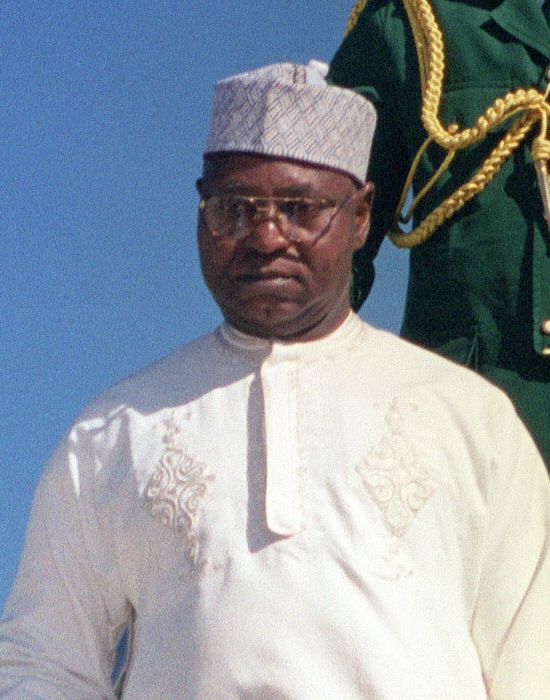
Shonekan's interim government, the shortest in the political history of the country, was overthrown in a coup d'état of 1993 led by General Sani Abacha, who used military force on a wide scale to end the crisis of the Third Republic. In 1995, Abacha's regime hanged environmentalist Ken Saro-Wiwa on trumped-up charges in the deaths of four Ogoni elders, which caused Nigerian's suspension from the Commonwealth. Lawsuits under the American Alien Tort Statute against Royal Dutch Shell and Brian Anderson, the head of Shell's Nigerian operation, settled out of court. Several hundred million dollars in accounts traced to Abacha were discovered in 1999. The regime came to an end in 1998 when the dictator died in the villa. Abacha looted money to offshore accounts in Western European banks and maintained his grip on power through arrests and bribing generals and politicians. His successor, General Abdulsalami Abubakar, adopted a new constitution on 5 May 1999, which provided for multiparty elections.
1999–present
On 29 May 1999, Abubakar handed over power to the winner of the 1999 presidential election, former military ruler General Olusegun Obasanjo, as President of Nigeria. Obasanjo had been in prison under the dictatorship of Abacha. Obasanjo's inauguration heralded the beginning of the Fourth Nigerian Republic, ending a 39-year period of short-lived democracies, civil war and military dictatorship. Although the elections that brought Obasanjo to power and allowed him to run for a second term in the 2003 presidential elections were condemned as unfree and unfair, Nigeria made significant progress in democratisation under Obasanjo.
In the 2007 general elections, Umaru Yar'Adua of the People's Democratic Party came to power. The international community, which had observed the Nigerian elections to promote a free and fair process, condemned these elections as seriously flawed. Yar'Adua died on 5 May 2010, and Vice President Goodluck Jonathan had been sworn in by the Senate three months earlier as acting president to succeed Yar'Adua. Jonathan won the 2011 presidential election; the polls went smoothly and with relatively little violence or electoral fraud. Jonathan's tenure saw an economic recovery that made Nigeria the leading economic power in Africa. The Jonathan administration also saw an unparalleled increase in corruption, with as many as 20 billion US dollars said to have been lost to the Nigerian state through the national oil company. Above all, however, Jonathan's tenure saw the emergence of a wave of terror by the Boko Haram insurgency, including the Gwoza massacre and Chibok schoolgirls kidnapping in 2014.
Ahead of the general election of 2015, a merger of the biggest opposition parties in Nigeria – the Action Congress of Nigeria, the Congress for Progressive Change, the All Nigeria Peoples Party, a faction of the All Progressives Grand Alliance and the new PDP (a faction of serving governors of the ruling People's Democratic Party) – formed the All Progressives Congress led by current president Bola Ahmed Tinubu. At the time, it was the most expensive election ever to be held on the African continent (being surpassed only by the elections of 2019 and 2023). The new mega-opposition party chose as their candidate for the election former military dictator Muhammadu Buhari. Buhari's campaign in 2015 was popular and built around his image as a staunch anti-corruption fighter—he won the election by over two million votes. Observers generally praised the election as being fair. The election marked the first time an incumbent president had lost re-election in Nigeria. Insecurity heightened drastically under Buhari with banditry, insurgency and separatist agitations increasingly widespread. The economy also experienced two recessions and global oil shocks as a result of the COVID-19 pandemic. Buhari was elected in the 2019 presidential election, he died two years after leaving office.
Four major candidates, amongst other less popular candidates, vied for the presidency in the 2023 presidential election. For the first time since the return of democracy, no former military ruler ran for president, marking a strengthening of democracy and faith in the multiparty constitution. The election also saw the rise of metonymic supporters of the new candidates, the Obidient movement of Peter Obi, previously governor of Anambra State, widely appealed to young, urban voters and has his core base in the Southeast; and the Kwankwassiya of Rabiu Kwankwaso, former governor of Kano State in the Northwest.
Bola Tinubu of the ruling party won the disputed election with 36.61% of the vote, though both runners-up claimed victory and litigation continued in an election tribunal. Tinubu was inaugurated on 29 May 2023. His government faced ongoing domestic challenges, including widespread kidnapping in Nigeria. On 29 May 2024, Tinubu signed a law reinstating Nigeria, We Hail Thee, the national anthem from 1960 to 1978, replacing Arise, O Compatriots. The United States carried out a strike against Islamic State militants in northwest Nigeria on 25 December 2025 at the request of Tinubu's government, marking the first foreign military intervention in post-independence Nigeria. U.S. President Donald Trump stated the strike was to protect against alleged violence against Christians in the north.
Geography
Nigeria is located in western Africa on the Gulf of Guinea and has a total area of 923,768 km2 (356,669 mi2), making it the world's 32nd-largest country. Its borders span 4,047 kilometres (2,515 mi), and it shares borders with Benin (773 km or 480 mi), Niger (1,497 km or 930 mi), Chad (87 km or 54 mi), and Cameroon (including the separatist Ambazonia) 1,690 km or 1,050 mi. Its coastline is at least 853 km (530 mi). Nigeria lies between latitudes 4° and 14°N, and longitudes 2° and 15°E. The highest point in Nigeria is Chappal Waddi at 2,419 m (7,936 ft). The main rivers are the Niger and the Benue, which converge and empty into the Niger Delta. This is one of the world's largest river deltas and the location of a large area of Central African mangroves.
Nigeria's most expansive topographical region is that of the valleys of the Niger and Benue river valleys (which merge and form a Y-shape). To the southwest of the Niger is a "rugged" highland. To the southeast of the Benue are hills and mountains, which form the Mambilla Plateau, the highest plateau in Nigeria. This plateau extends through the border with Cameroon, where the montane land is part of the Bamenda Highlands of Cameroon.
The far south is defined by its tropical rainforest climate, where annual rainfall is 1,500 to 2,000 millimetres (60 to 80 in) per year. In the southeast stands the Obudu Plateau. Coastal plains are found in both the southwest and the southeast. Mangrove swamps are found along the coast.
The area near the border with Cameroon close to the coast is rich rainforest and part of the Cross-Sanaga-Bioko coastal forests ecoregion, an important centre for biodiversity. It is a habitat for the drill primate, which is found in the wild only in this area and across the border in Cameroon. The areas surrounding Calabar, Cross River State, also in this forest, are believed to contain the world's largest diversity of butterflies. The area of southern Nigeria between the Niger and the Cross Rivers has lost most of its forest because of development and harvesting by increased population and has been replaced by grassland.
Everything in between the far south and the far north is savannah (insignificant tree cover, with grasses and flowers located between trees). Rainfall is more limited to between 500 and 1,500 millimetres (20 and 60 in) per year. The savannah zone's three categories are Guinean forest-savanna mosaic, Sudan savannah, and Sahel savannah. Guinean forest-savanna mosaic is plains of tall grass interrupted by trees. Sudan savannah is similar but with shorter grasses and shorter trees. Sahel savannah consists of patches of grass and sand, found in the northeast.
Hydrology
Nigeria is divided into two main catchment areas – that of Lake Chad and that of the Niger. The Niger catchment area covers about 63% of the country. The main tributary of the Niger is the Benue, whose tributaries extend beyond Cameroon into Cameroon into Chad and the Sharie catchment area. In the Sahel region, rain is less than 500 millimetres (20 in) per year, and the Sahara Desert is encroaching. In the dry northeast corner of the country lies Lake Chad, on a shared water boundary delimitation with Niger, Chad and Cameroon.
The Chad Basin is fed from the north-eastern quarter of Nigeria. The Bauchi Plateau forms the watershed between the Niger/Benue and Komadugu Yobe river systems. The flat plains of north-eastern Nigeria are geographically part of the Chad Basin, where the course of the El Beid River forms the border with Cameroon, from the Mandara Mountains to Lake Chad. The Komadugu Yobe river system gives rise to the internationally important Hadejia-Nguru wetlands and Ox-bow lakes around Lake Nguru in the rainy season. Other rivers of the northeast include the Ngadda and the Yedseram, both of which flow through the Sambisa swamps, thus forming a river system. The river system of the northeast is also a major river system. In addition, Nigeria has numerous coastal rivers.
Over the last million years, Lake Chad in the far north-east of Nigeria has dried up several times for a few thousand years and just as often growing to many times its current size. In recent decades its surface area has been reduced considerably, which may also be due to humans taking water from the inlets to irrigate agricultural land.
Vegetation
Nigeria is covered by three types of vegetation: forests (where there is significant tree cover), savannahs (insignificant tree cover, with grasses and flowers located between trees), and montane land (least common and mainly found in the mountains near the Cameroon border). Both the forest zone and the savannah zone are divided into three parts.
Some of the forest zone's most southerly portion, especially around the Niger River and Cross River deltas, is mangrove swamp. North of this is a freshwater swamp, containing different vegetation from the saltwater mangrove swamps, and north of that is a rainforest.
The savannah zone's three categories are divided into Guinean forest-savanna mosaic, made up of plains of tall grass which are interrupted by trees, the most common across the country; Sudan savannah, with short grasses and short trees; and Sahel savannah patches of grass and sand, found in the northeast.
Environmental issues
Waste management including sewage treatment, the linked processes of deforestation and soil degradation, and climate change are the major environmental problems in Nigeria.
Climate change