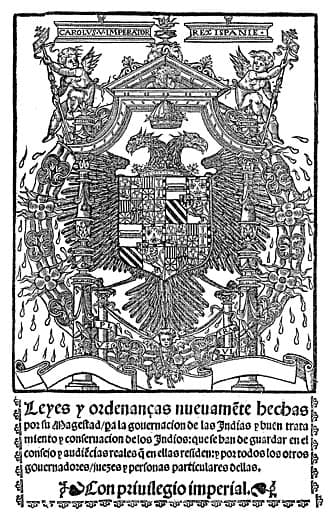
The New Laws (Spanish: Leyes Nuevas), also known as the New Laws of the Indies for the Good Treatment and Preservation of the Indians, were issued on November 20, 1542, by Charles V, Holy Roman Emperor (King Charles I of Spain) and regard the Spanish colonization of the Americas. Following denunciations and calls for reform from individuals, such as the Dominican friar Bartolomé de Las Casas, these laws were intended to prevent the exploitation and mistreatment of the indigenous peoples of the Americas by the encomenderos, by limiting their power and dominion over groups of natives.
Blasco Núñez Vela, the first Viceroy of Peru, enforced the New Laws. He was opposed by a revolt of encomenderos and was killed in 1546 by the landowning faction led by Gonzalo Pizarro. Pizarro wanted to maintain a political structure built upon the Incan model the Spanish found in place. Although the New Laws were only partly successful, due to the opposition of colonists, they did result in the liberation of thousands of indigenous workers, who had been held in a state of semi-slavery.
Origins
The New Laws were the results of a reform movement in reaction to what were considered to be the less effective, decades-old Leyes de Burgos (Laws of Burgos), issued by King Ferdinand II of Aragon on December 27, 1512. These laws were the first intended to regulate relations between the Spanish and the recently conquered indigenous peoples of the New World. These are regarded as the first humanitarian laws in the New World. They were not fully implemented because of opposition by powerful colonists.
While some encomenderos opposed the restrictions imposed by the laws as against their interests, others were opposed because they believed the laws institutionalized the system of forced Indian labor. During the reign of King Charles I, the reformers gained strength. A number of Spanish missionaries argued for stricter rules, including Bartolomé de las Casas and Francisco de Vitoria. Their goal was to protect the Indians against forced labor and expropriation, and to preserve their cultures. Some discussions challenged the very legitimacy of the conquest and colonization.
Eventually, the reformists influenced the King and his court to pass reforms that came to be known as the New Laws.
Contents
Main points
Governors had an obligation to take care of the well-being and preserve Native Americans (referred to as Indians by the law).
That there was no motive to enslave them in the future, not by war, nor due to rebellion, nor to ask for a rescue, nor for any reason or in any way.
That Native Americans currently enslaved must be freed immediately, unless the owner could prove (in Spain, which implied travelling back there) the full juridical legitimacy of such a state.
That the "bad habit" of making Native Americans work as tamames against their will or without fair payment must be ended immediately.
That they must not be taken to remote regions to fish for pearls.