
The Republic of New Afrika (RNA) is a black nationalist organization in the United States founded in 1968 after the civil rights movement. The organization has three goals: creation of an independent socialist country in the heart of the Black Belt in the American South, payment by the U.S. federal government of several billion dollars in reparations to African Americans for the damages inflicted on them through slavery and Jim Crow laws, and a plebiscite of all African Americans to determine their desires for citizenship. Its provisional government claims sovereignty over the states of Louisiana, Mississippi, Alabama, Georgia and South Carolina (with adjoining areas in East Texas and North Florida) as subjugated national territory.
The organization experienced significant decline in the early 1970s primarily due to sustained government repression, including violent raids and mass arrests that imprisoned key leaders and disrupted operations. Efforts to build institutions involved land purchases, but the project encountered severe repression from federal and state authorities.
History
The idea of the RNA arose following the events of the 1967 Detroit riot. It was the first separate nation declared by African Americans in the United States.
The vision for this country was first promulgated by the Malcolm X Society on March 31, 1968, at a Black Government Conference held in Detroit, Michigan. The conference participants drafted a constitution and declaration of independence, and they identified five Southern states Louisiana, Mississippi, Alabama, Georgia and South Carolina (with adjoining areas in East Texas and North Florida) as subjugated national territory.
The Black Government Conference was convened by the Malcolm X Society and the Group on Advanced Leadership (GOAL), two influential Detroit-based black revolutionary organizations with broad followings. The attendees drafted a Declaration of Independence, a constitution, and the framework for a provisional government.
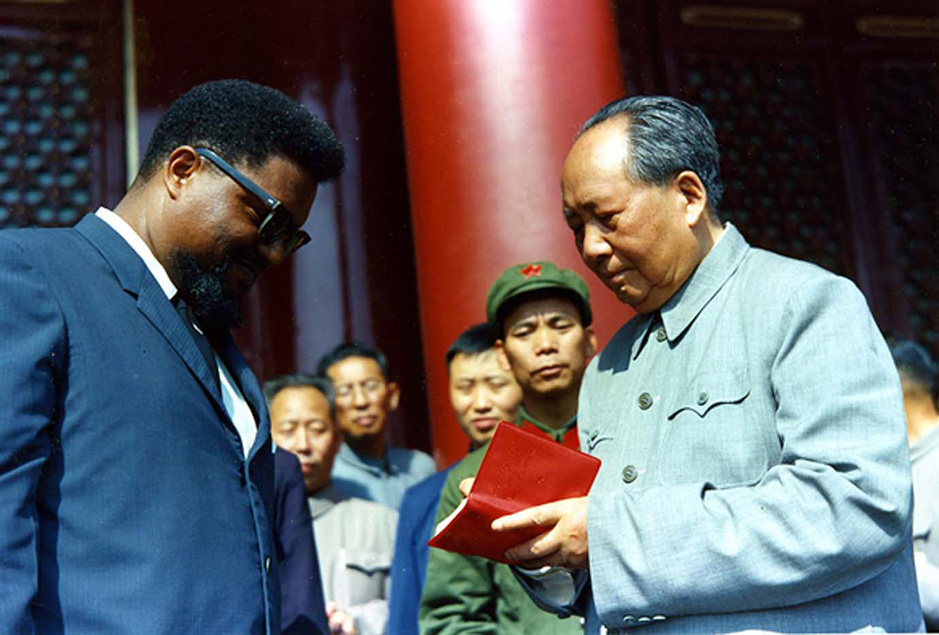
This provisional government gave birth to the Republic of New Afrika. Robert F. Williams, then living in exile in Cuba, was chosen as the first president of the provisional government; attorney Milton Henry (a student of Malcolm X's teachings) was named first vice president; and Betty Shabazz, widow of Malcolm X, served as second vice president. Imari Obadele was its first Minister of Information. An RNA delegation traveled to China to meet Williams in June 1968. Williams accepted the position and proposed diplomatic initiatives for the RNA to undertake.
The Provisional Government of the Republic of New Afrika (PG-RNA) advocated/advocates a form of cooperative economics through the building of New Communities—named after the Ujamaa concept promoted by Tanzanian President Julius Nyerere.
It proposed and created militant self-defense through the building of local people's militias; a standing army to be called the Black Legion.
The organization was involved in numerous controversial issues. For example, it attempted to assist Oceanhill-Brownsville area in Brooklyn to secede from the United States during the 1968 conflict over control of public schools. Additionally, it was involved with shootouts at New Bethel Baptist Church in 1969 (during the one-year anniversary of the founding) and another in Jackson, Mississippi, in 1971. (It had announced that the capital of the Republic would be in Hinds County, Mississippi, located on a member's farm.) In the confrontations, law-enforcement officials were killed and injured. Organization members were prosecuted for the crimes. The members claimed they acted in self defense.
The Republic of New Afrika's influence persisted through publications, such as Imari Obadele's War in America: The Malcom X Doctrine (1977) and Free the land! (1984), and Nkechi Taifa's Reparations Yes (1993). Key figures like Chokwe Lumumba, elected vice president in 1971, became a prominent attorney defending Republic of New Afrika members and later mayor of Jackson, Mississippi (2013-2014), where he advanced cooperative economics before his death.
Notable members
Queen Mother Moore was a founding member. She helped found the group and helped out in the group as much as she could.
Betty Shabazz, widow of Malcolm X, was elected as second vice president of the first administration in 1968, working alongside Williams and Henry.
Chokwe Lumumba, formerly Edwin Finley Taliaferro of Detroit, was elected as second vice president in 1971. He later became an attorney, working in Michigan and Mississippi in public defense. After settling in Jackson, Mississippi, he was elected to the city council there. He was elected as mayor in 2013, dying in office in February 2014 of natural causes.
Safiya Bukhari, former Black Panther Party and Black Liberation Army member, founder of the Jericho Movement for U.S. Political Prisoners and Prisoners of War, and co-founder of the Free Mumia Abdul-Jamal Coalition (NYC) was elected as vice-president.
Sanyika Shakur, former leader of Eight Tray Gangster Crips and author (Monster: The Autobiography of an L.A. Gang Member)
Leaders
Robert F. Williams, President in Exile (1968–1971)
Imari Obadele, President (1971–1991)
Publications
Taifa, Nkechi. 'Black Power, Black Lawyer: My Audacious Quest for Justice' 379p. Washington, DC, House of Songhay II, 2020.
RNA links
Provisional Government – Republic of New Afrika (Official Web Site)
The Republic of New Afrika
New Afrika (Online Blog)
Archives
RNA documents in the Freedom Now! archival project at Brown University – Tougaloo College archives.
The Republic of New Africa vs. the United States, 1967–1974, documents on police surveillance and repression of the RNA as well as protest by the organization at the Radical Information Project.
Articles and reports
Firing Line: The Republic of New Africa] William F. Buckley interviews Milton Henry, President of the Republic of New Afrika. Program number 126. Taped on Nov 18, 1968 (New York City, NY). 50 minutes. Available from the Hoover Institution. The first 5 minutes are accessible in streaming RealAudio.
Understanding Covert Repressive Action: The Case of the US Government Against the Republic of New Africa by Christian Davenport, Professor of Peace Studies and Political Science at the Kroc Institute, University of Notre Dame.
The Real Republic of New Africa Archived 2007-09-27 at the Wayback Machine By Dennis Smith, News Director. February 3, 2005. Accessed April 1, 2005
Taifa, Nkechi (2015). "Republic of New Afrika". In Shujaa, Mwalimu J.; Shujaa, Kenya J. (eds.). The SAGE Encyclopedia of African Cultural Heritage in North America. SAGE Publications, Inc. doi:10.4135/9781483346373. ISBN 9781483346373.