
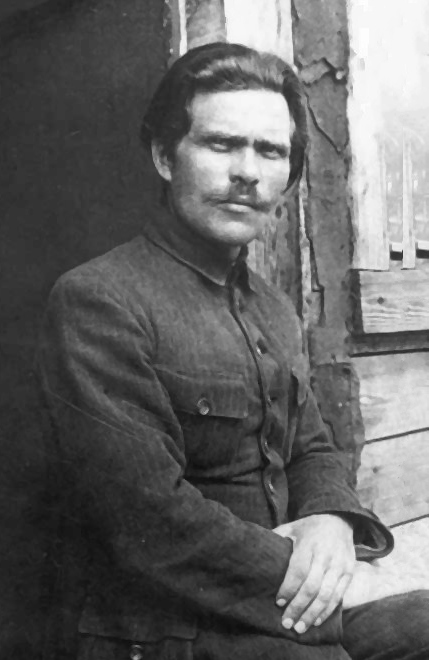
Nestor Ivanovych Makhno (Ukrainian: Не́стор Іва́нович Махно́, pronounced [ˈnɛstor iˈwɑnowɪtʃ mɐxˈnɔ]; Russian: Не́стор Ива́нович Махно́; 7 November 1888 – 25 July 1934), also known as Bat'ko Makhno (Ukrainian: Ба́тько Махно́ [ˈbɑtʲko mɐxˈnɔ], lit. 'Father Makhno'), was a Ukrainian anarchist revolutionary and the commander of the Revolutionary Insurgent Army of Ukraine during the Ukrainian War of Independence. He established the Makhnovshchina (loosely translated as "Makhno movement"), a mass movement by the Ukrainian peasantry to establish anarchist communism in the country between 1918 and 1921. Initially centered around Makhno's home province of Katerynoslav and hometown of Huliaipole, it came to exert a strong influence over large areas of southern Ukraine, specifically in what is now the Zaporizhzhia Oblast of Ukraine. Anarchists have cited him as an inspiration during his life and into today.
Raised by a peasant family and coming of age amid the fervor around the 1905 revolution against the autocratic rule of Russian Emperor Nicholas II, Makhno was a member of the Union of Poor Peasants, a local anarchist group, and spent seven years imprisoned for that. With his release during the 1917 Revolution, Makhno became a local revolutionary leader in his hometown and oversaw the expropriation and redistribution of large estates to the peasantry. In the Russian Civil War, Makhno sided with the Soviet Russian Bolsheviks against the Ukrainian nationalists and White movement, but his alliances with the Bolsheviks did not last. He rallied Bolshevik support to lead an insurgency, defeating the Central Powers' occupation forces at the Battle of Dibrivka and establishing the Makhnovshchina. Makhno's troops briefly integrated with the Bolshevik Red Army in the 1919 Soviet invasion of Ukraine, but split over differences on the movement's autonomy. Makhno rebuilt his army from the remains of Nykyfor Hryhoriv's forces in western Ukraine, routed the White Army at the Battle of Perehonivka, and captured most of southern and eastern Ukraine, where they again attempted to establish anarchist communism.
Makhno's army fought the Bolshevik re-invasion of Ukraine in 1920 until a White Army offensive forced a short-lived Bolshevik–Makhnovist alliance that drove the Whites out of Crimea and ended the Southern Front of the Russian Civil War. The Bolsheviks immediately turned on Makhno, wounding him and driving him westward in August 1921 to Romanian internment camps, Poland, and Europe, before he settled in Paris with his wife and daughter. Makhno wrote memoirs and articles for radical newspapers, playing a role in the development of platformism.

He later became alienated from the French anarchist movement. His family continued to be persecuted in the decades following his death of tuberculosis at the age of 45.
Early life
Nestor Ivanovych Makhno was born on 7 November [O.S. 26 October] 1888 into a poor peasant family in Huliaipole, a town then in the Katerynoslav Governorate of the Russian Empire and now in Ukraine. He was the youngest of five children born to Ivan and Evdokia Mikhnenko, former serfs who had been emancipated in 1861. After Makhno's birth, Ivan went to work as a coachman for a wealthy industrialist when the family's small plot of land could not feed them. He died when Makhno was only ten months old, leaving behind his impoverished family.
Makhno was briefly fostered by a more well-off peasant couple. Unhappy with them, he returned to his family of birth. At only seven years old, he was put to work tending livestock. Makhno started to attend a local secular school when he turned eight years old. He was a good student at first but grew to skip school to play games and ice skate. Makhno worked at a local estate in the summer after his first school year. His brothers also worked as farmhands to support the family.
Makhno attended one more year of school before his family's extreme poverty forced the ten-year-old to work the fields full-time, which led him to develop a "sort of rage, resentment, even hatred for the wealthy property-owner". His aversion to the landlords grew, nurtured by Evdokia's stories of her time in serfdom. In 1902, he observed a farm manager and the landlord's sons physically beating a young farmhand. He quickly alerted Bat'ko Ivan, an older stable hand who attacked the assailants and led a spontaneous workers' revolt against the landlord. After the affair was settled, Ivan left Makhno with words that would inspire a rebellious spirit within him: "if one of your masters should ever strike you, pick up the first pitchfork you lay hands on and let him have it..." The following year, Makhno quit working in the fields and found a job in a foundry. By this time, most of his brothers had left home and started their own families. Makhno rapidly moved between jobs, focusing most of his work on Evdokia's land while occasionally returning to employment to help provide for his brothers.
Revolutionary activity
When the 1905 revolution broke out, the sixteen-year-old Makhno quickly joined the revolutionary movement. He distributed propaganda for the Social Democratic Labor Party before affiliating with his home town's local anarchist communist group, the Union of Poor Peasants. Despite increased political repression against revolutionaries, the Union continued to meet weekly, and inspired Makhno to devote himself to the revolution. Makhno was initially distrusted by other members of the group due to his apparent penchant for drinking and getting into fights. After six months in the Union of Poor Peasants, Makhno had thoroughly educated himself on the principles of libertarian communism and became a formal member.
A series of agrarian reforms disempowered the traditional peasant communes by creating a wealthier land-owning class and growing private estates. In response, the Union of Poor Peasants initiated a campaign of "Black Terror" against the large landowners and the local Tsarist police. The group carried out a series of expropriations against local businessmen, using the money they stole to print propaganda that attacked the recent reforms. Suspected of being involved in these attacks, with Nazarii Zuichenko naming him as a participant in an attack on a post office cart, Makhno was arrested in September 1907 but was eventually released without charges due to a lack of evidence. As the rest of the group's members had been declared outlaws by the Tsarist authorities, Makhno founded another anarchist study group in a neighboring village, where two dozen members gathered on a weekly basis to discuss anarchist theory. But after the assassination of a police informant by the Union of Poor Peasants, the police launched a crackdown against the group and arrested many of its members, including Makhno in August 1909.

Imprisonment
On 26 March 1910, a Katerynoslav district court-martial sentenced Makhno to be hanged. Although he had refused to appeal, Makhno's sentence was commuted to a life sentence of hard labor, due to his young age. While in prison, Makhno contracted a near-fatal bout of typhoid fever but eventually recovered. He was moved several times: to the Luhansk prison, where family briefly visited him, to the Katerynoslav prison, and in August 1911, to Butyrka prison in Moscow, where over 3,000 political prisoners were being held. Through the other prisoners he learned Russian history and political theory, taking a particular interest in Mutual Aid: A Factor of Evolution (1902) by the Russian anarchist communist theorist Peter Kropotkin. Makhno's frequent boasting in prison earned him the nickname "Modest". He sometimes even antagonized the guards, which landed him in solitary confinement. Due to prison conditions, Makhno quickly fell sick again and was diagnosed with tuberculosis. He spent many periods in the prison hospital throughout his sentence.
In Butyrka prison, Makhno met the anarchist communist politician Peter Arshinov, who took the young anarchist on as a student. Makhno also became disillusioned with intellectualism during this time after seeing the prejudice with which guards treated prisoners of different social classes. As the years passed, Makhno began to write his own works and to distribute them among his fellow prisoners, starting off with a poem titled "Summons" that called for a libertarian communist revolution. Prison did not break his desire for revolution, as Makhno swore that he would "contribute to the free re-birth of his country". Although exposed to the ideas of Ukrainian nationalism in prison, Makhno nevertheless remained hostile to all forms of nationalism, adopting an internationalist position during World War I and even circulating an anti-war petition around the prison. When political prisoners were released during the February Revolution of 1917, Makhno's shackles were removed for the first time in eight years. He found himself physically off-balance without the chains weighing him down and in need of sunglasses after years in dark prison cells. He remained in Moscow for three weeks, briefly joining an anarchist group in Moscow's Lefortovo District until late March, when his mother and his old anarchist communist comrades convinced him to return to Huliaipole.
Agrarian activism
In March 1917, the 28-year-old Makhno returned to Huliaipole, where he was reunited with his mother and elder brothers. At the station, he was greeted by many of the town's peasants, who were curious to see the return of the famous political exile, as well as surviving members from the now-defunct Union of Poor Peasants. Clashing with many of the group's former members, who wanted to focus on propaganda, Makhno proposed that anarchists take clear leadership of the masses to ignite peasant mass action. The Huliaipole anarchists did not agree. He instead led the establishment of a local Peasants' Union on 29 March and was elected as its chairman. The union quickly came to represent the majority of Huliaipole's peasantry and even those from the surrounding region. Carpenters and metalworkers also formed their own industrial unions and elected Makhno as their chairman. By April, Huliaipole's Public Committee, the local organ of the Provisional Government, had been brought under the control of the town's peasantry and anarchist communist activists. Makhno met Nastia Vasetska, who would become his first wife, during this period but his activism left little time for his marriage.

Makhno quickly became a leading figure in Huliaipole's revolutionary movement, sidelining any political parties that sought to control the workers' organizations. He justified his leadership as only a temporary responsibility. As a union leader, Makhno led workers in strike actions against their employers, demanding doubled wages and vowing continued work stoppages if refused. This resulted in full workers' control over all Huliaipole industry. As Huliaipole's delegate to the regional peasant congress in Oleksandrivsk, he called for the expropriation of large estates from landowners and their transfer to communal ownership by the peasants that worked them. He quickly became disillusioned with the long debates and party politics that dominated the congress, considering Huliaipole to have "advanced beyond what the congresses were merely talking about, without the constant wrangling and jockeying for position." Makhno and his supporters subsequently disarmed and minimized the powers of local law enforcement, before seizing property from local landlords and equally redistributing the lands to the peasantry, in open defiance of the Russian Provisional Government and its officials in Oleksandrivsk. Local peasants compared him to the Cossack rebel leaders Stenka Razin and Yemelyan Pugachev. Huliaipole rallied around the slogan, "Land and Liberty".
Despite Makhno's success at home, the wider anarchist movement's general disorganization disappointed him. Despite its growing size, the anarchist movement found itself unable to compete with the established political parties, as it had yet to establish a coordinated organization capable of playing a leading role in the revolutionary movement. Makhno criticized the movement for largely dedicating itself to propaganda activities. Following news of Lavr Kornilov's attempted coup against the Provisional Government, Makhno led the establishment of a "Committee for the Defense of the Revolution", which organized armed peasant detachments against the Huliaipole landlords, bourgeoisie, and kulaks. He called for disarming the local bourgeoisie, expropriating their property, and bringing all private enterprise under workers' control. Peasants withheld rent and took control of the lands they worked; large estates were collectivized and transformed into agrarian communes. Makhno personally organized communes on former Mennonite estates. He and Nastia lived together on a commune and Makhno himself worked two days per week, helping with the farming and occasionally fixing machines.
Following the 1917 October Revolution, Makhno witnessed the rising hostilities between the Ukrainian nationalists and the Bolsheviks. With the outbreak of the Soviet–Ukrainian War, Makhno advised anarchists to take up arms alongside the Red Guards against the forces of the Ukrainian nationalists and the White movement. Makhno dispatched his brother Savelii to Oleksandrivsk at the head of an armed anarchist detachment to assist the Bolsheviks in retaking the city from the Nationalists. The city was taken and Makhno was chosen as the anarchists' representative to the Oleksandrivsk Revolutionary Committee. He was also elected chairman of a commission, which reviewed the cases of accused counter-revolutionary military prisoners, and oversaw the release of still imprisoned workers and peasants. During this period Makhno participated in Oleksandrivsk's successful defence against an assault by Don and Kuban Cossacks. Makhno thereafter returned to Huliaipole, where he organized the town bank's expropriation to fund the local anarchist movement's revolutionary activities.

Journey to Moscow
In February 1918, representatives from the Ukrainian People's Republic (UPR) signed a peace treaty with the Central Powers, inviting the forces of the German Empire and Austria-Hungary to invade and occupy Ukraine. In response, Makhno formed a volunteer detachment to resist the occupation. They joined the Bolshevik Red Guards in Oleksandrivsk. Makhno was personally summoned to the train of Bolshevik Commander Alexander Yegorov but failed to link up with Yegorov who was in fast retreat. In Makhno's absence, Ukrainian nationalists seized control of Huliaipole and invited Austro-Hungarian Army forces to occupy the town in April 1918. Unable to return home, Makhno retreated to Taganrog, where he held a conference of Huliaipole's exiled anarchists. Makhno left to rally Russian support for the Ukrainian anarchist cause with plans to retake Huliaipole in July 1918. In early May, Makhno visited Rostov-on-Don, Tikhoretsk, and Tsaritsyn, where he was briefly reunited with Nastia and some of his Huliaipole comrades.
On his travels, Makhno witnessed the newly established Bolshevik secret police – the Cheka – confront, disarm, and kill revolutionary partisans who disobeyed their decrees, causing Makhno to question whether "institutional revolutionaries" would extinguish the revolution. In Astrakhan, Makhno found himself working for the local soviet's propaganda department and giving speeches to Red soldiers bound for the front. While traveling by rail to Moscow near the end of May, Makhno used the armored train's artillery to impede the Don Cossacks in pursuit of Makhno and the Red Guards in his company.
After passing through the Volga region, Makhno finally arrived in Moscow. He pejoratively dubbed the city "the capital of the paper revolution" after its local anarchist intellectuals, whom Makhno considered more inclined to slogans and manifestos than action. Here he reunited with Peter Arshinov and others in the Muscovite anarchist movement, many of whom were under surveillance by the Bolshevik authorities. He also met the Left Socialist-Revolutionaries, who at this time were beginning to turn against the Bolsheviks. Makhno discussed the situation in Ukraine with Peter Kropotkin.

Satisfied with his time in Moscow, Makhno applied to the Kremlin for forged identity papers so that he could cross the Ukrainian border. Yakov Sverdlov immediately arranged for Makhno to meet Vladimir Lenin, who believed that anarchism had "contaminated" the peasantry and questioned Makhno extensively. Makhno staunchly defended the Ukrainian anarchist movement from charges of "counter-revolution", criticizing the Red Guards for sticking to the railways while peasant partisans fought on the front lines. Lenin expressed his admiration for Makhno and admitted he had made mistakes in his analysis of the revolutionary conditions in Ukraine, where anarchists had already become the predominant revolutionary force. Lenin passed Makhno to Volodymyr Zatonsky, who fulfilled his request for a false passport. Makhno finally departed for the border in late June 1918, content that he had taken "the temperature of the revolution".
Leader of the Makhnovist movement
Return to Ukraine
In late April 1918, during Makhno's absence from Ukraine, the Austrian and German occupation forces orchestrated a coup against their former allies within the Ukrainian People's Republic, removing the UPR's Central Council and installing Pavlo Skoropadskyi as Hetman of a new conservative client state.
Carrying a fake passport and disguised as a Ukrainian officer, Makhno crossed the Ukrainian border in July 1918. He learned that the forces occupying Huliaipole had shot, tortured, and arrested many of the town's revolutionaries. His brother Savelii had been arrested, and his brother Omelian, a disabled war veteran, executed. Their mother's house was also destroyed by the occupation forces. Makhno himself was forced to take precautions to evade capture. To avoid recognition while aboard the crowded train carriages, he changed at Kharkiv and Synelnykove, and ultimately decided to walk the final 27 kilometers to Rozhdestvenka after his train was searched by police. Through correspondence, Makhno's comrades in Huliaipole discouraged him from returning, fearing he would be caught by the authorities.
After weeks in hiding, Makhno clandestinely returned to Huliaipole. In secret meetings, he began to lay plans for an insurrection and started to organize peasant partisans. He advocated coordinated attacks on the estates of large landowners, advised against individual acts of terrorism, and forbade anti-semitic pogroms. From the outset, Makhno emphasized tactical and theoretical unity, patiently awaiting favorable conditions for a general insurrection.
The authorities discovered Makhno's presence and placed a bounty on his head, forcing him to retreat from Huliaipole. In Ternivka, Makhno revealed himself to the local population and established a peasant detachment to lead attacks against the occupation and Hetmanate government. In coordination with partisans in Rozhdestvenka, Makhno resolved to reoccupy and establish Huliaipole as the insurgency's permanent headquarters. He raided Austrian positions, seizing weapons and money, which led to the insurrection's intensification in the region. While disguised as a woman, Makhno even briefly returned to Huliaipole, where he planned to blow up the local command center of the occupation forces. According to Makhno's account, he called off the attack to avoid civilian casualties.
Insurgent actions
In September 1918, Makhno briefly reoccupied Huliaipole. The German occupation forces had spread misinformation about him there, claiming he had robbed the local peasantry and ran away with the money to buy a dacha in Moscow. After defeating Austrian units in the nearby village of Marfopil, Makhno produced a letter that was translated into the German language, encouraging the conscripted occupation troops to mutiny, return home and launch revolutions of their own. While his comrades scattered themselves throughout the region to rouse the peasants to revolt, Makhno prepared proclamations to announce the region was under insurgent control. When the occupation forces counterattacked, Makhno was forced to evacuate Huliaipole.
Makhno's detachment withdrew north, where it sought refuge in the Dibrivka forest, neighboring the village of Velykomykhailivka. There they joined forces with another small insurgent detachment led by Fedir Shchus. When Austrian units surrounded the insurgents in their forest encampment, to break the encirclement, Makhno launched a surprise counterattack against the troops in the village. Led by Makhno and Shchus, the insurgents' gamble succeeded in forcing the Austrians into retreat. For his role in their victory, the insurgents bestowed Makhno with the title Bat'ko (English: Father), which remained his moniker throughout the war.
Makhno's victory in the battle of Dibrivka provoked a retaliation from the occupation forces. Austrian troops attacked Velykomykhailovka, reinforced by National Guard and German colonist units. The village was set on fire, killing many inhabitants and destroying some 600 houses. Makhno, in turn, led a campaign of retributive attacks against the occupation forces and their collaborators, including much of the region's Mennonite population. Makhno also focused much of his energies on agitating among the peasantry, gathering much support in the region through impassioned impromptu village speeches against his enemies.
By November 1918, the insurgents definitively recaptured Huliaipole. At a regional insurgent conference, Makhno proposed that they open up a war on four simultaneous fronts against the Hetmanate, Central Powers, Don Cossacks, and nascent White movement. He argued that to prosecute such a conflict, it would be necessary to organize a Revolutionary Insurgent Army of Ukraine according to a federal model, directly answerable to him as commander-in-chief.
Integration into the Red Army
The Central Powers' defeat in World War I saw their withdrawal from Ukraine, resulting in the overthrow of the Hetmanate government by the Directorate, which established a new nationalist government in Kyiv under the leadership of Symon Petliura. At the same time, the Bolsheviks invaded Ukraine from the north, while the Makhnovshchina faced pressure from a growing White Army in the south. Caught between these forces, Makhno proposed an alliance with the Red Army.
During a joint Insurgent-Bolshevik attack against the nationalist-held city of Katerynoslav, Makhno was appointed as commander-in-chief of the combined Soviet forces in the province. After capturing the city, Makhno oversaw the establishment of a revolutionary committee equally representing Bolsheviks, Socialist Revolutionaries (SRs), and anarchists. When a nationalist counteroffensive forced Makhno to retreat to Huliaipole, he undertook a complete reorganization of insurgent forces on every front, culminating in the January 1919 integration of Makhnovist units into the Ukrainian Soviet Army. In this 3rd Trans-Dnieper Brigade, Makhno was subordinate to Pavel Dybenko's command. The next month, Makhno extricated himself from the front to attend the movement's second regional congress in Huliaipole. He was elected honorary chairman, but rejected official chairmanship as the front required his attention. At the congress, he declared his support for "non-party soviets" in open defiance of his Bolshevik commanders.
Makhno justified the integration of the insurgent forces into the Red Army as a matter of placing the "revolution's interests above ideological differences". He was, nevertheless, open about his contempt for the new order of political commissars. Bolshevik interference in front-line operations even led to Makhno arresting a Cheka detachment, which had directly obstructed his command. Despite his hostility towards the Bolsheviks, Makhno authorized Bolshevik newspapers to be distributed in Huliaipole, Berdiansk, and Mariupol, even as their pages denounced the Makhnovists.
By April 1919, the newspaper Pravda was publishing glowing reports of Makhno's activities, praising his opposition to Ukrainian nationalism, his successful assault against Katerynoslav, and his continued successes against the White movement. These reports also detailed Makhno's widespread support among the Ukrainian peasantry. This did not stop Dybenko from declaring the insurgents' subsequent regional congresses to be "counter-revolutionary", outlawing their participants, and ordering Makhno to prevent future congresses. The Makhnovist Military Revolutionary Council issued an excoriating reply to Dybenko rejecting his demands.
To resolve the dispute, Makhno invited Ukrainian Soviet Army Commander-in-Chief Vladimir Antonov-Ovseenko to visit Huliaipole, which impressed him and allayed his doubts about Makhno's command. Upon his return, Antonov-Ovseenko openly praised Makhno and the insurgents, criticizing the Bolshevik press for publishing misinformation about Makhno and requesting the Makhnovists be supplied with the necessary equipment. His reports quickly attracted Politburo member Lev Kamenev to himself visit Huliaipole the very next week. Kamenev too was greeted by Makhno and his new wife Halyna Kuzmenko, who gave the Bolshevik functionary a tour of the town, making sure to show off a tree where Makhno had personally lynched a White army officer. Despite disagreements between the two over the autonomy of the insurgent movement, Kamenev bade farewell to Makhno with an embrace and warm words. Kamenev immediately published an open letter to Makhno, praising him as an "honest and courageous fighter" in the war against the White movement.
Dealings with Hryhoriv
In May 1919, the powerful otaman Nykyfor Hryhoriv led an uprising against the Bolsheviks, seizing part of Kherson province. Kamenev of the Politburo telegrammed Makhno to condemn Hryhoriv or else face a declaration of war. (Hryhoriv had previously attempted to ally with Makhno against the Bolsheviks, unsuccessfully.) In reply to Kamenev, Makhno reaffirmed his commitment to fight the White movement, worried that open conflict with Hryhoriv would endanger that commitment, declared his loyalty to the revolution, but also stated that he would continue to oppose the Cheka and any other "organs of oppression and violence". In an insurgent military congress in May, Makhno expanded on this anti-authoritarian position with a denunciation of the Bolsheviks, their implementation of bureaucratic collectivism, and their political repression, which he compared to the Tsarist autocracy. After Makhnovist emissaries uncovered evidence of Hryhoriv's participation in pogroms, Makhno openly denounced him for his displays of antisemitism and Ukrainian nationalism, going on to blame the Bolsheviks for the rise of Hryhoriv, claiming it was their political repression that had caused the uprising.
As the Donbas front collapsed, the Red Army high command began to blame Makhno for their defeat and attempted to rein in his influence over his detachment. Makhno's Red Army superior Commander Anatoly Skachko even declared that "he is to be liquidated". By the end of May 1919, the Bolshevik Revolutionary Military Council pronounced Makhno to be an outlaw, issuing a warrant for his arrest and for him to be tried before a revolutionary tribunal. On 2 June, Leon Trotsky published a diatribe attacking Makhno for his anarchist ideology and labeling him a kulak.
A few days later, while preoccupied at the front, Makhno learned that the Kuban Cossacks had captured Huliaipole. This forced him to retreat from his positions. In an attempt to appease Trotsky, Makhno resigned his command of the insurgent army so that the insurgents would not be caught in a pincer between the Red and White armies. Despite a rebuff from Trotsky, he again attempted to offer the Bolsheviks his resignation on 9 June, reaffirming his commitment to the Revolution and his belief in the "inalienable right of workers and peasants". Makhno relinquished command of the 7th Ukrainian Soviet Division and declared his intention to wage a guerrilla war against the Whites from the rear. Trotsky then ordered Kliment Voroshilov to arrest Makhno, but sympathetic officers reported the order to him, preventing his capture by the Cheka. Despite having broken with the Red Army, Makhno still considered the White movement to be the Makhnovists' "main enemy" and insisted that they could settle their scores with Bolsheviks after the Whites were defeated.
Makhno's small sotnia then linked up with other insurgent detachments that had mutinied against the Red Army. In early July 1919, Makhno fell back into Kherson province, where he met with Hryhoriv's green army. Initially Makhno sought to form a strategic alliance with the latter due to Hryhoriv's popularity among the local peasantry. But revelations of Hryhoriv's antisemitism, extensive pogroms, and connections with the White movement led the Makhnovists to openly denounce the otaman at a public meeting. When Hryhoriv reached for his revolver, he was gunned down by Oleksiy Chubenko.
In the assassination's aftermath, Makhno quickly rebuilt his army. A portion of Hryhoriv's army was integrated into the Makhnovist forces, which numbered as high as 20,000 insurgents at this time. By August, Makhno was also attracting many Red Army deserters who joined him as the Bolsheviks once again retreated from Ukrainian territory in the face of Anton Denikin's White Army. Red Army mutinies became so bad that the Ukrainian Bolshevik leader Nikolai Golubenko even telephoned Makhno, begging him to subordinate himself again to Bolshevik command, which Makhno refused.
Against the White Army
By September 1919, the Bolsheviks had largely retreated from Ukraine, leaving the Makhnovists to face the White Army alone. Reports by the White commander Yakov Slashchov depicted Makhno as a formidable adversary with tactical ability and disciplinary command over his troops. The insurgents launched several effective attacks behind White lines, Makhno himself commanding a cavalry assault against Mykolaivka that resulted in the capture of sorely needed munitions. His brother Hryhorii died during one of these attacks.
The White offensive eventually pushed the insurgents back as far as Uman, the last stronghold of the Ukrainian People's Republic. There Makhno negotiated a temporary truce with Petliura, the commander-in-chief of the Ukrainian People's Army (UPA), to allow wounded insurgents to recuperate on neutral ground before launching a counteroffensive. During the Battle of Perehonivka, the tide of the battle turned in the insurgents' favor when Makhno led his sotnia in a flank against the White positions, charging the much larger enemy force and engaging in close-quarters combat that forced the Whites to retreat. Makhno led the pursuit of the retreating Whites, decisively routing the enemy forces.
The Makhnovists split up to capitalize on their victory and capture as much territory as possible. Makhno himself led his sotnia in the capture of Katerynoslav from the Whites on 20 October. With southern Ukraine brought almost entirely under insurgent control, the White supply lines were broken and the advance on Moscow was halted. The insurgent advance also attacked the region's Mennonites, including the Eichenfeld massacre. Mennonite historiography has held Makhno himself directly responsible for the massacres, as commander-in-chief of the perpetrating forces, and Makhnovist historiography has attributed the violence to class conflict, the result of deep-seated resentments between the native Ukrainians and Mennonite colonists.
Bolsheviks in Katerynoslav attempted to establish a revolutionary committee to control the city, proposing to Makhno that he confine himself exclusively to military activity. But Makhno no longer held any sympathy for the Bolsheviks, who he described as "parasites upon the workers' lives". He quickly ordered the revolutionary committee be shut down and forbade their activities under penalty of death, telling the Bolshevik officials to "take up a more honest trade". At a regional congress in Oleksandrivsk, Makhno presented the Draft Declaration of the Revolutionary Insurgent Army of Ukraine, which called for the establishment of "free soviets" outside of political party control. Mensheviks and Socialist Revolutionary Party delegates objected, believing instead in the legitimacy of the dissolved Constituent Assembly. Makhno denounced them as "counter-revolutionaries", causing them to walk out in protest.
When he returned to Katerynoslav in November 1919, the local railway workers looked to Makhno to pay their wages, which they had gone without for two months. He responded by proposing the workers self-manage the railways and levy payment for their services directly from the customers. By December, Makhnovist control of Katerynoslav began to slip under increasing attacks from the White Cossacks. On 5 December, Makhno survived an assassination attempt by the Bolsheviks, who had planned to poison him and seize control of the city. After the plot was uncovered, the conspirators were shot.
Alliance with the Bolsheviks
Renewed White attacks forced the Makhnovists to abandon Katerynoslav and retreat towards Oleksandrivsk and Nikopol. During this period, many of the insurgents were beset by epidemic typhus. Makhno himself contracted the disease. In January 1920, the Red Army returned to Ukraine, filling a power vacuum that had been left in the wake of the White retreat. Makhnovist and Red forces greeted each other in Oleksandrivsk, but negotiations between the two sides collapsed when the Red command ordered Makhno to the Polish front. Makhno refused and the All-Ukrainian Central Executive Committee declared him to be an outlaw.
In response, the Makhnovists fled to Huliaipole, initiating a nine-month period of hostilities with the Bolsheviks. At this time, Makhno's typhus worsened, and he slipped into prolonged coma, during which local peasants provided him refuge and hid him from the Cheka. Once Makhno recovered, he immediately began to lead a campaign of guerrilla warfare against the Cheka and requisitioning units. Makhno also implemented a discriminatory policy for dealing with captured Red Army units: commanding officers and political commissars would be immediately shot, and the rank-and-file soldiers would be given the choice to either join the insurgent army or be stripped of their uniforms and sent home. With increased Makhnovist attacks Bolshevik positions and Red Army defections to the insurgents, the two factions considered alliance proposals.
Though initially sceptical of a proposed Bolshevik alliance in June, Makhno grew amenable and left the decision to his army, which narrowly voted in favor in August. Their Starobilsk agreement extended freedoms to Ukrainian anarchists while again integrating the insurgents into the Red Army command structure. Despite these outcomes, Makhno reaffirmed his distrust for his "irreconcilable enemies" in the Bolshevik Party, stating that the necessity of a military alliance with them should not be confused with a recognition of their political authority. Makhno still hoped that victory over the Whites would oblige the Bolsheviks to honor his desire for soviet democracy and civil liberties in Ukraine. He would later consider this to be a "grave error" on his part.
Under the terms of the pact, Makhno was able to seek treatment from the medical corps of the Red Army, physicians and surgeons seeing to a wound in his ankle, where he had been hit by an expanding bullet. He was also visited by the Hungarian communist leader Béla Kun, who gave him gifts, including over 100 photographs and postcards depicting the Executive Committee of the Communist International. In October, the insurgents successfully reoccupied Huliaipole, driving the Whites out of the city for the last time.
Back in his hometown, Makhno's request for three days of rest and recuperation was rejected by the Bolshevik command, which ordered the insurgents to continue their offensive, under penalty of nullifying their alliance. The still-wounded Makhno stayed behind in Huliaipole anyway, along with his black guard, while dispatching Semen Karetnyk to lead the Makhnovist offensive against the Army of Wrangel. Makhno once again turned his attention towards reconstructing his vision of anarchist communism, overseeing the reestablishment of the local soviet and other anarchist projects.
Anti-Bolshevik rebellion
After the combined Bolshevik-Makhnovist forces defeated Pyotr Wrangel in Crimea and ended the Russian Civil War's Southern Front, the Bolsheviks once again turned on their anarchist allies. In late November 1920, the Red Army launched a surprise attack against the insurgent forces, putting the Makhnovist capital of Huliaipole under siege. Caught unprepared, Makhno rallied together 150 Black Guards to defend the town. After spotting a gap in the Red lines, he escaped with his detachment and led a counterattack that pushed the Red forces back to Novouspenivka. His own forces regrouped and gained some defecting Red soldiers before recapturing Huliaipole a week later. The Red Army command justified the attacks against the Makhnovists on grounds that Makhno had refused orders and intended to betray them, though the Red Army had planned to break the alliance with the Makhnovists even before the beginning of the offensive against Wrangel's White Army.