
Nayib Armando Bukele Ortez (born 24 July 1981) is a Salvadoran politician and businessman who has served as the 43rd president of El Salvador since 2019.
In 1999, Bukele established an advertising company and worked at another owned by his father, Armando Bukele Kattán. Both companies advertised election campaigns for the Farabundo Martí National Liberation Front (FMLN) political party. Bukele entered politics in 2011. In 2012, he joined the FMLN and was elected mayor of Nuevo Cuscatlán. Bukele served until his 2015 election as Mayor of San Salvador, where he served until 2018. In 2017, Bukele was ousted from the FMLN. He founded the Nuevas Ideas political party shortly afterward and pursued a presidential campaign in 2019. After the Supreme Electoral Court (TSE) refused to register his party, Bukele ran for president with the Grand Alliance for National Unity (GANA) and won with 53 percent of the vote.
In July 2019, Bukele implemented the Territorial Control Plan to reduce El Salvador's 2019 homicide rate of 38 per 100,000 people. Homicides fell by 50 percent during Bukele's first year in office. After 87 people were killed by gangs over one weekend in March 2022, Bukele initiated a nationwide crackdown on gangs, resulting in the arrests of over 85,000 people with alleged gang affiliations by December 2024. El Salvador's homicide rate decreased to 1.9 homicides per 100,000 in 2024, one of the lowest in the Americas. Bukele passed a law in 2021 that made bitcoin legal tender in El Salvador and promoted plans to build Bitcoin City. In June 2023, the Legislative Assembly approved Bukele's proposals to reduce the number of municipalities from 262 to 44 and the number of seats in the legislature from 84 to 60. He ran for re-election in the 2024 presidential election and won with 85 percent of the vote after the Supreme Court of Justice reinterpreted the constitution's ban on consecutive re-election.
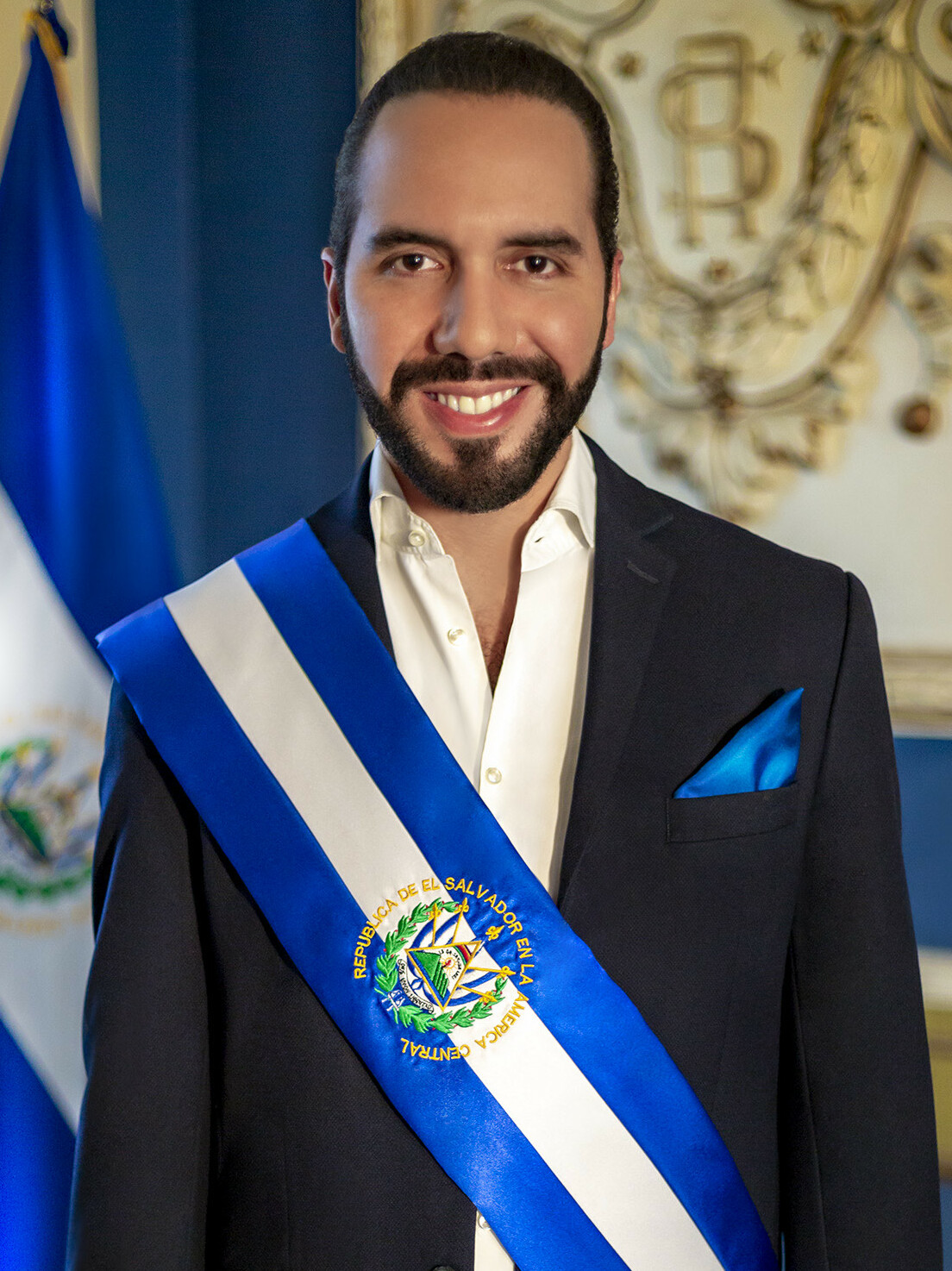
Bukele is highly popular in El Salvador and throughout Latin America. He holds an average approval rating of 88.6% during his entire presidency with approval ratings never having fallen below 75%. El Salvador has experienced democratic backsliding under Bukele's leadership, falling 61 places in the World Press Freedom Index between 2019 to 2025 and 24 places in the Economist Intelligence Unit's Democracy Index, which now classifies El Salvador as a hybrid regime. In February 2020, Bukele ordered 40 soldiers into the Legislative Assembly building to intimidate lawmakers into approving a US$109 million loan for the Territorial Control Plan, an event that triggered a political crisis and was described by the opposition as a self-coup. After Nuevas Ideas won a supermajority in the 2021 legislative election, Bukele's allies in the legislature voted to replace the attorney general and all five justices of the Supreme Court of Justice's Constitutional Chamber. Bukele has criticized journalists and news outlets, and has furthered press censorship. Following a controversial constitutional amendment on 31 July 2025, the Legislative Assembly enabled indefinite reelection, extended presidential terms from five to six years, and eliminated the two-round system.
Early life
Nayib Armando Bukele Ortez was born on 24 July 1981 in San Salvador, El Salvador. His father was Armando Bukele Kattán, a businessman and industrial chemist, and his mother is Olga Marina Ortez. Bukele's father died in 2015. Bukele was the couple's first child. He has three younger brothers, Karim, Yusef, and Ibrajim, and has four paternal half-sisters and two paternal half-brothers. Bukele's father converted from Christianity to Islam in the 1980s, became an imam, and founded four mosques in El Salvador. Bukele's mother is Catholic. Bukele's paternal grandparents were Palestinian Christians who emigrated to El Salvador from Jerusalem and Bethlehem in 1921. His maternal grandfather was Greek Orthodox, and his maternal grandmother was Catholic.
Bukele completed his secondary education at the Escuela Panamericana in 1999 at age 18. Bukele enrolled at Central American University in San Salvador to study legal sciences, aspiring to become a lawyer, but dropped out to work for the Nölck advertising agency, one of his father's businesses. Nölck campaigned for the Farabundo Martí National Liberation Front (FMLN), a left-wing Salvadoran political party.

In 1999, Bukele founded the marketing company Obermet, also known as 4am Saatchi & Saatchi El Salvador, and was its president from 1999 to 2006 and from 2010 to 2012. The company ran political advertising for the FMLN presidential campaigns of Schafik Hándal in 2004 and Mauricio Funes in 2009. Bukele was president of Yamaha Motors El Salvador, a company that sells and distributes Yamaha products in El Salvador, from 2009 to 2012. During Bukele's business career, he called himself a "businessman with a great future" ("empresario con gran futuro").
Early political career
Mayor of Nuevo Cuscatlán
In 2011, Bukele announced that he would enter politics as a member of the FMLN to break out of "his comfort zone" ("su zona de confort") as a businessman. Officially joining the party in 2012, he campaigned for the mayoralty of Nuevo Cuscatlán, a municipality in the department of La Libertad, part of the San Salvador metropolitan area. Bukele's campaign was supported by the Democratic Change party. He was elected mayor of Nuevo Cuscatlán in March 2012 with 51.67 percent of the vote, defeating primary challenger Tomás Rodríguez of the Nationalist Republican Alliance (ARENA). Bukele took office on 1 May 2012 as the country's youngest mayor.
Bukele created a scholarship program for youths in the municipality, donating his $2,000 salary to fund the program. In August 2014, Bukele launched Sphere PM, a project that launched a high-altitude balloon to an altitude of 100,000 feet (30,000 m) and took pictures of El Salvador. He stated that Sphere PM's goal was to promote education in science and technology to dissuade the municipality's youth from crime. Bukele spoke at United Nations headquarters about projects he had undertaken as mayor of Nuevo Cuscatlán as part of the November 2014 World Cities Day. In January 2015, he inaugurated a $1.7 million boulevard connecting Nuevo Cuscatlán with Huizúcar and Antiguo Cuscatlán. Bukele did much of his mayoral work with funding from ALBA Petróleos, owned by the Venezuelan oil company PDVSA.

Mayor of San Salvador
In August 2014, Bukele announced that he would seek election as mayor of San Salvador in the 2015 elections. His candidacy was confirmed by FMLN secretary-general Medardo González on 19 August 2014. Bukele delegated administration of Nuevo Cuscatlán to council member Michelle Sol in February 2015 to focus on his campaign. During his campaign, which was supported by the Salvadoran Progressive Party, FMLN party leadership called Bukele the party's "crown jewel" ("joya de la corona"). Bukele's campaign used catchphrases such as "we have to change history" ("tenemos que cambiar la historia") and "together we will go forward" ("juntos saldremos adelante") to rally support from young voters.
His primary opponent was Edwin Zamora, a businessman and Legislative Assembly deputy from ARENA. Bukele led Zamora in opinion polls before the election. He defeated Zamora with 50.38 percent of the vote on 1 March 2015, and took office on 1 May. Bukele appointed a cousin, Hassan, and his half-brother Yamil to administrative positions on the San Salvador municipal council. The appointments were criticized by ARENA and FMLN politicians.
As mayor, Bukele began a "reordering" ("reordenamiento") to revitalize the city's historic downtown area and combat crime. On the day Bukele took office, he reverted the names of two streets in San Salvador (Calle Mayor Roberto D'Aubuisson and Boulevard Coronel José Arturo Castellanos) to Calle San Antonio Abad and Boulevard Venezuela, respectively. Both names had been changed by Bukele's predecessor, Norman Quijano. Zamora, who had become a member of San Salvador's municipal council, stated that the names were reverted due to flaws in the initial renaming process. He added that another street would be named in honor of Castellanos, who provided fake Salvadoran passports to 40,000 Central European Jews to help them escape the Holocaust. Bukele renamed 89 Avenida Norte in honor of Castellanos in June 2016.

In December 2016, Bukele inaugurated the Cuscatlán Market to encourage street vendors to relocate their businesses. Many vendors refused to move, despite the market. Political opponents and investigative journalists accused him of negotiating with gangs to organize its construction, since it was located in gang-controlled territory. In January 2016, Bukele began a "San Salvador 100% Illuminated" campaign to "have a light on every corner of San Salvador" to combat crime in the city. The campaign was completed by May 2016. He also installed video-surveillance cameras in parts of San Salvador that were severely affected by crime. Bukele inaugurated the renovated downtown Gerardo Barrios Plaza in October 2017, and the new downtown Lineal Plaza in April 2018.
Bukele created a scholarship program, known as the Dalton Project and funded by his salary, for youth in San Salvador to prevent them from joining gangs. Bukele also created the My New School project to modernize San Salvador's primary schools. In May 2015, he signed an agreement with Panama City mayor José Blandón to establish a sister city relationship between San Salvador and Panama City. In November 2015, Bukele signed an agreement with the Spanish National League of Professional Football to promote sports for San Salvador's youth.
In September 2016, Bukele visited Washington, D.C. and met with Mayor Muriel Bowser to discuss the implementation of urban-development projects. Bukele received the keys to the city of Gaithersburg, Maryland, and 11 September was designated the "Day of Mayor Nayib Bukele" ("Día del alcalde Nayib Bukele"). He visited Taipei in February 2017 and met with Taiwanese president Tsai Ing-wen to enhance the sister-city relationship between San Salvador and Taipei. In February 2018, Bukele attended the 32nd International Mayors Conference in Jerusalem and prayed at the Western Wall.

Troll Center case
In January 2016, the El Diario de Hoy and La Prensa Gráfica newspapers reported that the Búnker digital-programming company had created mirror sites of the newspapers in June 2015 and posted false information in an attempt to damage their reputations; the newspapers described the incident as a cyberattack. In a subsequent investigation by the office of the attorney general (FGR), Bukele allegedly instructed a Twitter user to create the mirror sites. Bukele denied involvement in the creation of the mirror sites. The incident became known as the "Troll Center" case. Five people were charged in relation to the case, but the charges were dropped in December 2017.
On 4 July 2017, Bukele sued La Prensa Gráfica for $6 million, alleging that the newspaper had defamed and slandered him in its reporting of the cyberattacks by "falsely" ("falsamente") connecting him to the Troll Center case and "damag[ing] [Bukele's] image" ("dañó la imagen del señor alcalde"). Later that month, a court dismissed Bukele's lawsuit and three other courts rejected his appeals. In December 2018, the FGR stated that it had reviewed information supposedly linking Bukele's cell phone to the cyberattacks.
Expulsion from the FMLN
Bukele's relationship with the FMLN began to deteriorate after he became mayor of San Salvador. He clashed with other party members on Twitter, and frequently resisted FMLN party leadership. Bukele became a strong critic of Salvador Sánchez Cerén, the FMLN president of El Salvador who was elected in 2014. He threatened to leave the party in 2015 if the FMLN-led government reappointed Luis Martínez as the country's attorney general, describing Martínez as "a gangster, very corrupt, [and] the worst of the worst". The FMLN relented and replaced Martínez, and Bukele later admitted that his threat to leave the party "was a bluff".

In September 2017, San Salvador FMLN member Xóchitl Marchelli alleged that Bukele had thrown an apple at her, calling her a "damn traitor" ("maldita traidora") and a "witch" ("bruja"). Bukele did not attend an FMLN ethics tribunal on 7 October 2017, saying that the tribunal was biased in favor of Marchelli. On 10 October 2017, he was expelled from the party after the tribunal determined that he had engaged in "defamatory acts" ("actos difamatorios") against the party, showed "disrespect" ("irrespeto") for women's rights and the party's statutes, and made "disqualifying comments" ("comentarios descalificadores") to party members.
Marchelli sued Bukele through the Specialized Investigative Court, but sent a letter to the court in October 2018 saying that she would no longer pursue the matter for health reasons. Despite Marchelli's withdrawal, the FGR proceeded with the case. On 29 March 2019, the Specialized Sentencing Court acquitted Bukele.
In the 2018 legislative and municipal elections, where Bukele was favored to win re-election before his expulsion, the FMLN had its worst performance since 1994, the party's first election. It lost six seats in the Legislative Assembly, and 16 municipalities. During the election, Bukele called on his supporters nationwide to spoil their vote or stay home on election day rather than support the FMLN. In February 2019, FMLN presidential communications secretary Roberto Lorenzana stated that Bukele's expulsion was a mistake that cost the party votes. In 2025, Bukele remarked that he was "mistaken" ("equivocado") for having previously voted for the FMLN.
2019 presidential election
Bukele's popularity as mayor of San Salvador led some journalists to believe that he would run for president in 2019, but he denied that he would. He eventually expressed interest in running for president with the FMLN, but the party did not consider him as its vice-presidential nominee. He wrote on social media that the FMLN had purged him, and portrayed himself as an independent politician who rejected the country's political system.
On 15 October 2017, Bukele announced his intention to run for president in 2019 and form a new political party. He announced the establishment of the Nuevas Ideas party on 25 October 2017 on social media, saying that Nuevas Ideas would seek to remove ARENA and the FMLN from power. During his presidential campaign, Bukele and a network of YouTubers, bloggers, and internet trolls attempted to discredit ARENA and the FMLN. Bukele tried to associate the two parties with the governments of previous presidents that were marred by corruption, using slogans such as "There's enough money when nobody steals" and "Return what was stolen". His campaign promises included the creation of an international commission to combat corruption, the development of a trans-national railroad and a new airport, job opportunities for Salvadorans, and reduced crime.
For Bukele to run for president with Nuevas Ideas, he was required to register the party with the Supreme Electoral Court (TSE). Although Nuevas Ideas had enough signatures to register, Bukele believed that the TSE would not register the party before the 29 July 2018 presidential nomination deadline.
Bukele registered as a member of Democratic Change and sought the party's presidential nomination before the deadline, but the TSE canceled the party's registration four days before the deadline because Democratic Change failed to receive over 50,000 votes during the 2015 legislative elections. On 29 July 2018, Bukele registered with the right-wing Grand Alliance for National Unity (GANA) and received the party's presidential nomination. He selected Félix Ulloa, a lawyer, as his vice-presidential candidate.
Bukele used social media such as Facebook, Instagram, and Twitter extensively throughout his campaign to communicate with his supporters. He did not attend either of the two presidential debates, in December 2018 and January 2019, despite saying that he would attend, claiming that the debate rules were not explained to him. Bukele was the election's front-runner, leading virtually every poll by a substantial margin. His three opponents were ARENA's Carlos Calleja, a businessman who owned the Super Selectos supermarket chain; the FMLN's former minister of foreign affairs Hugo Martínez, and Vamos' Josué Alvarado, a businessman. On election day, 3 February 2019, Bukele defeated Calleja, Martínez, and Alvarado with 53.1 percent of the vote. He was the first presidential candidate to be elected since José Napoleón Duarte (1984–1989) who was not a member of ARENA or the FMLN.
Presidency
Inaugurations
Bukele's first presidential inauguration was held on 1 June 2019. He became the 43rd president of El Salvador as well as the country's youngest president at the age of 37. Bukele held the inauguration ceremony at the National Palace due to its location in Gerardo Barrios Plaza (renovated by Bukele as mayor of San Salvador) instead of in the Blue Room (meeting room) of the Legislative Assembly in an effort to portray his presidency as focusing on the people. Bukele's supporters booed and jeered at the Legislative Assembly deputies as they were introduced. He announced a sixteen-person cabinet composed of eight men and eight women.
Bukele's second presidential inauguration was held on 1 June 2024, again at the National Palace. During the inauguration, the Armed Forces of El Salvador (FAES) staged a military parade as a show of force and Bukele wore a Napoleonic-cut jacket with gold trim to evoke the image of Venezuelan liberator Simón Bolívar. He described his second inauguration as "the most important moment in our recent history" ("el momento más importante de nuestra historia reciente").
Crime and prisons
During Bukele's presidential campaign, he promised to bring an end to gang violence in El Salvador; El Salvador was considered one of the world's most dangerous countries due to its gang violence. Most of El Salvador's violent crimes were committed by MS-13 and the 18th Street gang (Barrio 18). Although they are El Salvador's largest gangs, both originated in Los Angeles. MS-13 was formed in the 1980s by Salvadoran refugees fleeing El Salvador's civil war. The 18th Street gang was formed in the 1960s by Mexican immigrants. Much of the gang violence stemmed from income inequality, poverty, poor schools, a lack of job opportunities, and high urbanization.
El Salvador's homicide rate peaked at 107 homicides per 100,000 people in 2015. El Salvador's homicide rate had decreased to 38 homicides per 100,000 people by 2019, still one of the world's highest. Gangs controlled parts of El Salvador, and ordered business owners to pay renta (extortion) for protection or face violence. In early 2019, there were an estimated 67,000 gang members in El Salvador. During his presidency, Bukele enacted tough-on-crime policies that scholars have characterized as successfully reducing gang activity and violent crime, at the cost of arbitrary arrest and alleged widespread human rights abuses.
Territorial Control Plan
On 19 June 2019, Bukele announced that his government would implement a seven-phase security Territorial Control Plan that sought to disrupt gang finances. The plan began that night at midnight. Phase one, known as "preparation", called for members of the country's security forces — the Armed Forces of El Salvador and the National Civil Police (PNC) — to be stationed in 12 of the country's 262 municipalities at locations where gangs were known to collect renta. The government also implemented a temporary state of emergency in El Salvador's 28 prisons, putting them on lockdown and banning visitors.
Phase two of the plan, known as "Opportunity", began in July 2019 and called for the creation of programs and initiatives to prevent youths predisposed to crime from engaging in criminal activity. The programs and initiatives included creating scholarships, building schools and sports centers, and improving healthcare. Bukele established the Social Fabric Revitalization Unit to implement the phase. Phase three, known as "Modernization", began in August 2019 and called for the improvement of equipment used by the country's security forces; it included issuing new weapons, gear, helicopters, and drones to the security forces. Phase four, known as "Incursion", began in July 2021 when the security forces began patrolling areas with a high gang presence that were considered difficult to access.
Phase five, known as "extraction", began in November 2022. Security forces were ordered to "surround large cities and extract the terrorists [gang members] who [were] hiding within the communities, without giving them the slightest possibility of escape". Phase six, known as "integration", began in September 2023, when Bukele established the National Integration Directory to combat poverty and unemployment. Details about phase seven, which has not yet been implemented, are not publicly known.
El Salvador's homicide rate has decreased every year of Bukele's presidency, a downward trend that began in 2016. According to the Salvadoran government, the country's homicide rate was 38 per 100,000 people in 2019; 19.7 per 100,000 in 2020; 17.6 per 100,000 in 2021; 7.8 per 100,000 in 2022; 2.4 per 100,000 in 2023; and 1.9 per 100,000 in 2024. Bukele has attributed the decline to his security policies.
According to Celia Medrano, a human-rights lawyer and former general coordinator of the Commission for the Defense of Human Rights of Central America, it is "impossible" ("imposible") to verify the Salvadoran government's homicide figures because there is "no public access" ("no hay acceso público") to a daily homicide registry. Medrano stated that deaths in custody are not registered as homicides. Bodies found in mass graves, missing persons, and people killed in police encounters are not included in the government's homicide statistics. In July 2024, then former United States president Donald Trump falsely accused Bukele's government of "exporting" criminals to the United States to lower El Salvador's crime rate.
Alleged gang negotiations
In July 2020, the International Crisis Group (ICG) published an analysis saying that the reason for the decrease in homicides during Bukele's first year in office hypothesized that "quiet, informal understandings" between the government and the gangs. The Salvadoran government denied the ICG's allegations, and the ICG stated that it had no evidence to support the claim.
In September 2020, the Salvadoran digital newspaper El Faro accused Bukele's government of conducting secret negotiations with MS-13. According to the El Faro report, the government agreed to grant MS-13 more freedom in prison in exchange for a reduction in homicides it would commit and support for Nuevas Ideas during the 2021 legislative elections. Bukele denied El Faro's allegations, posting photos on Twitter of gang members rounded up in cramped conditions from an April 2020 prison crackdown.
On 8 December 2021, the United States Department of the Treasury accused Bukele's government of secretly negotiating with MS-13 and Barrio 18 to lower the country's homicide rate. The department stated that Bukele's government "provided financial incentives" to both gangs to ensure that they would reduce the country's homicide rate and support Nuevas Ideas in the election held earlier that year, echoing El Faro's allegations the year before, and sanctioned Osiris Luna Meza (the general director of penal centers and vice-minister of justice) and Social Fabric Revitalization Unit chair Carlos Marroquín Chica for negotiating with the gangs.
Bukele denied the department's accusations, saying that the United States sought "absolute submission" from El Salvador rather than cooperation. The United States Department of Justice also accused Bukele's government of releasing gang leaders between 2019 and 2021 as a part of the negotiations, including Élmer "El Crook" Canales Rivera who was released in February 2021 despite having an active Interpol arrest warrant against him.
In June 2025, ProPublica reported that U.S. extradition requests of MS-13 leaders considered potential witnesses had been blocked by Bukele's government. The outlet also reported that a U.S. multiagency law enforcement team, Joint Task Force Vulcan, had previously gathered evidence that United States Agency for International Development (USAID) funds to El Salvador had been laundered and used to pay key MS-13 leaders.
Gang crackdown
From 25 to 27 March 2022, gangs in El Salvador committed 87 homicides; 62 were committed on 26 March alone, the deadliest day in Salvadoran history since the end of the Salvadoran Civil War (1979–1992). Florida International University research director José Miguel Cruz attributed the killings to a breakdown in a secret truce between the government and the gangs, a truce that Bukele has denied. Cruz believed that the killings were a message from the gangs to the government for more concessions as a part of the secret truce.
On 27 March 2022, the Legislative Assembly declared a 30-day state of emergency, formally known as a "state of exception" ("régimen de excepción") and sometimes known as the "war on gangs". The state of emergency suspended constitutional rights that included freedom of assembly, freedom of association, the right to privacy in communication, the right to be informed of the reason for arrest, the right to remain silent, and the right to legal representation. The requirement for any arrested individual to see a judge within 72 hours of arrest was also suspended.
The military was mobilized in neighborhoods controlled by gangs in an effort to reassert government control, and made large-scale arrests of suspected gang members across the country. On several occasions, Bukele ordered security forces to blockade certain municipalities to capture all gang members within them. By October 2024, blockades were implemented twice in Apopa, Cabañas, Comasagua, Nuevo Concepción, San Marcos, southern Chalatenango, and Soyapango.
Bukele has threatened incarcerated gang members. At the beginning of the crackdown, he tweeted that the government had seized incarcerated gang members' belongings, removed their mattresses, and rationed their food. Bukele also posted a video of prisoners sleeping on floors and complaining about a lack of food and sanitation. He threatened to deprive them of food entirely in April 2022 if the gangs attempted to retaliate against the crackdown, citing rumors about revenge killings.
After members of Barrio 18 killed three police officers in Santa Ana in June 2022, Bukele said at a press conference that the gangs were "going to pay dearly" for the "ambush" against the police. The government began destroying gravestones belonging to deceased gang members in November 2022 to prevent them from becoming "shrines" and Bukele compared the gravestone destructions to denazification in post-World War II Germany. He warned Salvadoran parents to keep their children away from gangs, since they would lead to "prison or death".
Shortly after the crackdown began, Bukele called for the construction of a new 20,000-inmate prison. He announced the construction in July 2022 of the 40,000-inmate Terrorism Confinement Center (CECOT) in Tecoluca, that would be one of the world's largest prisons. In February 2023, Bukele posted a video on Twitter of him and members of his cabinet touring the prison. It is staffed by 250 police officers and 600 soldiers, and covers 410 acres (170 ha). Bukele posted a video on Twitter on 24 February 2023 of the transfer of the prison's first 2,000 prisoners, and posted a similar video the following month of the transfer of 2,000 more prisoners. By 11 June 2024, CECOT had at least 14,532 inmates. At least 427 people have died in Salvadoran prisons since Bukele's declaration of a state of emergency.
In July 2023, Bukele's government passed a law formalizing the judicial system's existing practice of mass trials by judge, allowing up to 900 people to be convicted in the same trial, without a jury. In March 2026, the Legislative Assembly approved a constitutional amendment to permit life imprisonment for individuals convicted of murder, rape, or terrorism. Before the amendment was passed, Bukele wrote on social media that "we will see who supports this reform and who will dare to argue that the constitution should continue to prohibit murderers and rapists from remaining in prison".