
Narendra Damodardas Modi (born 17 September 1950) is an Indian politician who has served as the prime minister of India since 26 May 2014. Modi was the chief minister of Gujarat from 2001 to 2014 and is the Member of Parliament (MP) for Varanasi. He is a member of the Bharatiya Janata Party (BJP) and of the Rashtriya Swayamsevak Sangh (RSS), a right-wing Hindutva paramilitary volunteer organisation. He is India's third-longest-serving prime minister, and the longest-serving prime minister outside the Indian National Congress.
Modi was born and raised in Vadnagar, where he completed his secondary education. He was introduced to the RSS at the age of eight, becoming a full-time worker for the organisation in Gujarat in 1971. Assigned by the RSS to the BJP in 1985, he rose through the party hierarchy and became general secretary in 1998. In 2001, Modi was appointed chief minister of Gujarat and elected to the legislative assembly soon after. His administration is considered complicit in the 2002 Gujarat violence in which over 1,000 people, mostly Muslims, were killed, with many others raped or mutilated. An investigation authorised by the Supreme Court found no evidence to prosecute Modi. While his policies as chief minister were credited for encouraging economic growth, his administration was criticised for failing to significantly improve health, poverty and education indices in the state.
In the 2014 Indian general election, Modi led the BJP to a parliamentary majority, the first for a party since 1984. His administration increased direct foreign investment and reduced spending on healthcare, education, and social welfare. Modi began a high-profile sanitation campaign, introduced the Goods and Services Tax, and weakened or abolished environmental and labour laws. His demonetisation of banknotes in 2016 sparked controversy. A 2019 airstrike against an alleged terrorist camp in Pakistan failed to hit targets of significance but had nationalist appeal.

After winning a second term in 2019, Modi's administration revoked the special status of Jammu and Kashmir. The same year it introduced the Citizenship Amendment Act, prompting widespread protests and spurring the 2020 Delhi riots in which Muslims were targeted by Hindu mobs. Three controversial farm laws led to widespread protests by farmers, eventually causing their repeal. Modi oversaw India's response to the COVID-19 pandemic which, according to the WHO, killed 4.7 million Indians. In the 2024 general election, the BJP lost its majority in the lower house of Parliament and formed a government leading a coalition. In Modi's third term, a terrorist attack in Pahalgam led to a military conflict with Pakistan, which resulted in a ceasefire.
Under Modi's tenure, India has experienced democratic backsliding, or the weakening of democratic institutions, individual rights, and freedom of expression. As prime minister, he has received consistently high approval ratings. Modi has been described as engineering a political realignment towards right-wing politics. He remains a controversial figure domestically and internationally, over his Hindu nationalist beliefs and handling of the Gujarat violence, which have been cited as evidence of a majoritarian and exclusionary social agenda.
Early life and education
Narendra Damodardas Modi was born on 17 September 1950 to a Gujarati family of Other Backward Class (OBC) background and Hindu faith in Vadnagar, Mehsana district, Bombay State (present-day Gujarat). He was the third of six children born to Damodardas Mulchand Modi (c. 1915–1989) and Hiraben Modi (1923–2022). According to Modi and his neighbours, he worked infrequently in his father's tea stall in the Vadnagar railway station.

Modi completed his higher secondary education in Vadnagar in 1967; his teachers described him as an average student and a keen, gifted debater with an interest in theatre. He preferred playing larger-than-life characters in theatrical productions, which has influenced his political image.
When Modi was eight years old, he was introduced to the Rashtriya Swayamsevak Sangh (RSS) and began attending its local shakhas (training sessions). There, he met Lakshmanrao Inamdar, who inducted Modi as a balswayamsevak (junior cadet) in the RSS and became his political mentor. While Modi was training with the RSS, he also met Vasant Gajendragadkar and Nathalal Jaghda, Bharatiya Jana Sangh leaders who in 1980 helped found the BJP's Gujarat unit. As a teenager, he was enrolled in the National Cadet Corps.
In a custom traditional to Narendra Modi's caste, his family arranged a betrothal to Jashodaben Chimanlal Modi, leading to their marriage when she was 17 and he was 18. The marriage was never consummated, and Modi soon abandoned his wife, and left home. The couple never divorced but the marriage was not in his public pronouncements for many decades. In April 2014, shortly before the national election in which he gained power, Modi publicly affirmed he was married and that his spouse was Jashodaben. A biographer wrote that Modi kept the marriage a secret because he would not have been able to become a pracharak in the RSS, for which celibacy had once been a requirement.
Modi spent the following two years travelling across northern and north-eastern India. In mid 1968, Modi reached Belur Math but was turned away, after which he visited Calcutta, West Bengal and Assam, stopping in Siliguri and Guwahati. He then went to the Ramakrishna Ashram in Almora, where he was again rejected, before returning to Gujarat via Delhi and Rajasthan in 1968 to 1969. In either late 1969 or early 1970, he returned to Vadnagar for a brief visit before leaving again for Ahmedabad, where he lived with his uncle and worked in his uncle's canteen at Gujarat State Road Transport Corporation. Swami Vivekananda has had a large influence in Modi's life.
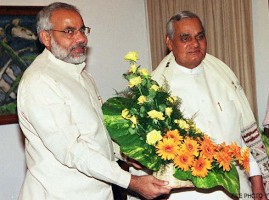
In Ahmedabad, Modi renewed his acquaintance with Inamdar. Modi's first-known political activity as an adult was in 1971 when he joined a Jana Sangh satyagraha in Delhi led by Atal Bihari Vajpayee to enlist to fight in the Bangladesh Liberation War. The Indira Gandhi-led central government prohibited open support for the Mukti Bahini; according to Modi, he was briefly held in Tihar Jail. After the Indo-Pakistani War of 1971, Modi left his uncle's employment and became a full-time pracharak (campaigner) for the RSS, working under Inamdar. Shortly before the war, Modi took part in a non-violent protest in New Delhi against the Indian government, for which he was arrested; because of this arrest, Inamdar decided to mentor Modi. According to Modi, he was part of a satyagraha supporting the independence of Bangladesh.
In 1978, Modi received a Bachelor of Arts (BA) degree in political science from the School of Open Learning at the Delhi University. In 1983, he received a Master of Arts (MA) degree in political science from Gujarat University, graduating with a first class as an external distance learning student. There is controversy surrounding the authenticity of his BA and MA degrees.

Early political career
In June 1975, Prime Minister Indira Gandhi declared a state of emergency in India that lasted until 1977. During this period, known as "the Emergency", many of her political opponents were jailed and opposition groups were banned. Modi was appointed general secretary of the "Gujarat Lok Sangharsh Samiti", an RSS committee coordinating opposition to the Emergency in Gujarat. Shortly afterwards, the RSS was banned. Modi was forced to go underground in Gujarat and frequently travelled in disguise to avoid arrest, once dressing as a monk and once as a Sikh. He became involved in the printing of pamphlets opposing the government, sending them to Delhi and organising demonstrations. He was also involved with creating a network of safe houses for individuals who were wanted by the government, and in raising funds for political refugees and activists. During this period, Modi wrote a Gujarati-language book titled Sangharsh Ma Gujarat (In the Struggles of Gujarat), which describes events during the Emergency. While in this role, Modi met trade unionist and socialist activist George Fernandes and several other national political figures.
Modi became an RSS sambhag pracharak (regional organiser) in 1978, overseeing activities in Surat and Vadodara, and in 1979, he went to work for the RSS in Delhi, where he researched and wrote the RSS's history of the Emergency. Shortly after, he returned to Gujarat and in 1985, the RSS assigned him to the BJP. In 1987, Modi helped organise the BJP's campaign in the Ahmedabad municipal election, which the party won comfortably; according to biographers, Modi's planning was responsible for the win. After L. K. Advani became president of the BJP in 1986, the RSS decided to place its members in important positions within the party; Modi's work during the Ahmedabad election led to his selection for this role. Modi was elected organising secretary of the BJP's Gujarat unit later in 1987.
Modi rose within the party and was named a member of its National Election Committee in 1990, helping organise Advani's Ram Rath Yatra in 1990 and Murli Manohar Joshi's 1991–1992 Ekta Yatra (Journey for Unity). Modi took a brief break from politics in 1992 to establish a school in Ahmedabad, and due to friction with Shankersinh Vaghela, a BJP MP from Gujarat. Modi returned to electoral politics in 1994, partly at the insistence of Advani; as party secretary, Modi's electoral strategy was considered central to the BJP victory in the 1995 state assembly election. In November of that year, Modi was appointed BJP national secretary and transferred to New Delhi, where he assumed responsibility for party activities in Haryana and Himachal Pradesh. The following year, Shankersinh Vaghela, a prominent BJP leader from Gujarat, defected to the Indian National Congress after losing his parliamentary seat in the Lok Sabha election. Modi, who was on the selection committee for the 1998 Gujarat Legislative Assembly election, favoured supporters of BJP leader Keshubhai Patel over those supporting Vaghela to end factional division in the party. His strategy was credited as central to the BJP winning an overall majority in the 1998 election, and Modi was promoted to BJP general secretary (organisation) in May of that year.

Chief Minister of Gujarat (2001–2014)
Taking office
In 2001, Keshubhai Patel's health was failing, and the BJP lost a few state assembly seats in by-elections. Allegations of abuse of power, corruption and poor administration were made, and Patel's standing had been damaged by his administration's handling of the earthquake in Bhuj in 2001. The BJP national leadership sought a new candidate for the chief ministership, and Modi, who had expressed misgivings about Patel's administration, was chosen as a replacement. Advani did not want to ostracise Patel and was concerned about Modi's lack of experience in government. Modi declined an offer to become Patel's deputy chief minister, telling Advani and Atal Bihari Vajpayee he was "going to be fully responsible for Gujarat or not at all". On 3 October 2001, Modi replaced Patel as Chief Minister of Gujarat with the responsibility of preparing the BJP for the upcoming December 2002 election. On 7 October, Modi was sworn in and he entered the Gujarat state legislature on 24 February 2002 after winning a by-election in the Rajkot II constituency, defeating Ashwin Mehta of the INC after Vajubhai Vala vacated his seat.
2002 Gujarat violence
On 27 February 2002, a train with several hundred passengers burned near Godhra, killing approximately 60 people. The train carried a large number of Hindu pilgrims who were returning from Ayodhya after a religious ceremony at the site of the demolished Babri Masjid. In a public statement, Modi said local Muslims were responsible for the incident. The next day, the Vishwa Hindu Parishad called for a bandh (general strike) across the state. Riots began during the bandh and anti-Muslim violence spread through Gujarat. The government's decision to move the bodies of the train victims from Godhra to Ahmedabad further inflamed the violence. The state government later stated 790 Muslims and 254 Hindus were killed during the riots; independent sources put the death toll at over 2,000, the vast majority of them Muslims. Approximately 150,000 people were driven to refugee camps. Numerous women and children were among the victims; the violence included mass rapes and mutilation of women.
Scholars consider the Government of Gujarat to have been complicit in the riots, and it has received much criticism for its handling of the situation; some scholars explicitly blame Modi. The Modi government imposed a curfew in 26 major cities, issued shoot-at-sight orders and called for the army to patrol the streets; these measures failed to prevent the violence from escalating. The president of the state unit of the BJP expressed support for the bandh despite such actions being illegal at the time. State officials later prevented riot victims from leaving the refugee camps, which were often unable to meet the needs of those living there. Muslim victims of the riots were subjected to further discrimination when the state government announced their compensation would be half that offered to Hindu victims; this decision was later reversed after the issue was taken to court. During the riots, police officers often did not intervene in situations where they were able. Several scholars have described the violence as a pogrom and others have called it an example of state terrorism. According to Martha Nussbaum, "There is by now a broad consensus that the Gujarat violence was a form of ethnic cleansing, that in many ways it was premeditated, and that it was carried out with the complicity of the state government and officers of the law".

Modi's personal involvement in the 2002 events has continued to be debated. During the riots, he said, "What is happening is a chain of action and reaction". Later in 2002, Modi said the way in which he had handled the media was his only regret regarding the episode. In March 2008, the Supreme Court of India reopened several cases related to the riots, including that of the Gulbarg Society massacre, and established a Special Investigation Team (SIT) to look into the issue. In response to a petition from Zakia Jafri, the widow of Ehsan Jafri, who was killed in the Gulbarg Society massacre, in April 2009, the court also asked the SIT to investigate Modi's complicity in the killings. The SIT questioned Modi in March 2010; in May, it presented to the court a report finding no evidence against him, causing widespread anger and disbelief among the country's Muslim communities. In July 2011, the court-appointed amicus curiae Raju Ramachandran submitted his final report to the court. Contrary to the SIT's position, Ramachandran said Modi could be prosecuted based on the available evidence. The Supreme Court sent the matter to the magistrate's court. The SIT examined Ramachandran's report, and in March 2012 submitted its final report, asking for the case to be closed. Zakia Jafri filed a protest petition in response. In December 2013, the magistrate's court rejected the protest petition, accepting the SIT's finding there was no evidence against Modi. In 2022, the Supreme Court dismissed a petition by Zakia Jafri in which she challenged Modi's exoneration regarding the riots by the SIT, and upheld previous rulings that no evidence against him was found.
Later terms as chief minister
Following the violence, calls for Modi to resign as chief minister were made from politicians within and outside the state, including leaders of Janata Dal (United) and the Telugu Desam Party—partners in the BJP-led National Democratic Alliance coalition—and opposition parties stalled Parliament over the issue. Modi submitted his resignation at the April 2002 BJP national executive meeting in Goa but it was not accepted. Despite opposition from the election commissioner, who said a number of voters were still displaced, Modi succeeded in advancing the election to December 2002. In the election, the BJP won 127 seats in the 182-member assembly. Modi made significant use of anti-Muslim rhetoric during his campaign, and the BJP profited from religious polarisation among voters. Modi framed the criticism of his government for human rights violations as an attack upon Gujarati pride, a strategy that led to the BJP winning 127 of the 182 seats—a two-thirds majority—in the state assembly. He won Maninagar constituency, defeating Congress candidate Yatin Oza. On 22 December 2002, Modi was sworn in for a second term.
During Modi's second term, the government's rhetoric shifted from Hindutva to Gujarat's economic development. He curtailed the influence of Sangh Parivar organisations such as Bharatiya Kisan Sangh (BKS) and Vishva Hindu Parishad (VHP). When the BKS staged a farmers' demonstration, Modi ordered the BKS's eviction from state-provided houses, and his decision to demolish 200 illegal temples in Gandhinagar deepened the rift with the VHP. Modi retained connections with some Hindu nationalists. He wrote a foreword to a 2014 textbook by Dinanath Batra, which made the unscientific claim that ancient India possessed technologies including test-tube babies.
Modi's relationship with Muslims continued to attract criticism. Prime Minister Atal Bihari Vajpayee distanced himself, reaching out to North Indian Muslims before the 2004 Indian general election, following which, Vajpayee called the violence in Gujarat a reason for the BJP's electoral defeat and said it had been a mistake to leave Modi in office after the riots. Western nations also raised questions about Modi's relationship with Muslims: the US State Department barred him from entering the United States in accordance with the recommendations of that country's Commission on International Religious Freedom, the only person to be denied a US visa under this law. The UK and the European Union (EU) refused to admit Modi because of what they saw as his role in the riots. As Modi rose to prominence in India, the UK and the EU lifted their bans in October 2012 and March 2013, respectively, and after his election as prime minister in 2014, the US lifted its ban and invited him to Washington, D.C.
During the run-up to the 2007 Gujarat Legislative Assembly election and the 2009 Indian general election, the BJP intensified its rhetoric on terrorism. Modi criticised Prime Minister Manmohan Singh "for his reluctance to revive anti-terror legislation" such as the 2002 Prevention of Terrorism Act. In 2007, Modi wrote Karmayog, a 101-page booklet discussing manual scavenging. In it, he said scavenging is a "spiritual experience" for Valmiks, a sub-caste of Dalits. The book was not circulated at that time because of the election code of conduct. After the November 2008 Mumbai attacks, the Gujarat government authorised the deployment of 30 high-speed boats for coastal surveillance. In July 2007, Modi completed 2,063 consecutive days as chief minister of Gujarat, making him the longest-serving holder of that post. The BJP won 122 of 182 state-assembly seats in that year's election.
Despite the BJP's shift away from explicit Hindutva, Modi's campaigns in 2007 and 2012 Gujarat Legislative Assembly elections contained elements of Hindu nationalism. He attended only Hindu religious ceremonies and had prominent associations with Hindu religious leaders. During his 2012 campaign, Modi twice refused to wear skullcaps gifted by Muslim leaders. He did, however, maintain relations with Dawoodi Bohra. Modi's 2012 campaign included references to issues known to cause religious polarisation, including Afzal Guru and the death of Sohrabuddin Sheikh. The BJP did not nominate any Muslim candidates for the 2012 assembly election. During the 2012 campaign, Modi attempted to identify himself with the state of Gujarat, a strategy similar to that used by Indira Gandhi during the Emergency, and projected himself as protecting Gujarat against persecution by the rest of India. While campaigning for the 2012 Gujarat Legislative Assembly election, Modi made extensive use of holograms and other technologies, allowing him to reach a large number of people, something he repeated in the 2014 general election. Modi won the constituency of Maninagar, defeating Shweta Bhatt of the INC. The BJP won 115 of the 182 seats, continuing its majority during his tenure. After his election as Prime Minister of India, Modi resigned as the Gujarat chief minister and as MLA for Maninagar. Anandiben Patel succeeded Modi as chief minister.
Development projects
As chief minister, Modi favoured privatisation and small government, which was at odds with the philosophy of the RSS, which is usually described as anti-privatisation and anti-globalisation. Modi's policies during his second term were credited with reducing corruption in Gujarat. He established financial and technology parks in the state and during the 2007 Vibrant Gujarat summit, real-estate investment deals worth ₹6.6 trillion (equivalent to ₹20 trillion or US$210 billion in 2023) were signed.
The governments led by Patel and Modi supported NGOs and communities in the creation of large scale groundwater-conservation projects, which commentators credited with helping about half of the tehsils with depleted groundwater recharge their aquifers. As a result, the state's production of genetically modified cotton increased to become the largest in India. The boom in cotton production and its semi-arid land use led to Gujarat's agricultural sector growing at an average rate of 9.6 per cent from 2001 to 2007. Public irrigation measures in central and southern Gujarat, such as the Sardar Sarovar Dam, were less successful. The Sardar Sarovar project irrigated only 4–6% of the area intended. In 2008, Modi offered land in Gujarat to Tata Motors to set up a plant manufacturing the Nano car after popular agitation had forced the company to move out of West Bengal. Following Tata, several other companies relocated to Gujarat.
The Modi government finished the process of taking electricity to every village in Gujarat its predecessor had almost completed. Modi significantly changed the state's system of power distribution, greatly impacting farmers. Gujarat expanded the Jyotigram Yojana scheme, in which agricultural electricity was separated from other rural electricity; the agricultural electricity was rationed to fit scheduled irrigation demands, reducing its cost. Early protests by farmers ended when those who benefitted found their electricity supply had stabilised but, according to an assessment study, corporations and large farmers benefited from the policy at the expense of small farmers and labourers.
Development debate
A contentious debate surrounds the assessment of Gujarat's economic development during Modi's tenure as chief minister. The state's Gross Domestic Product (GDP) growth rate averaged 10% during his tenure, similar to other highly industrialised states, and above that of the country. Gujarat saw strong economic growth before Modi took office; some scholars state that growth did not accelerate during his tenure. Under Modi, Gujarat performed well on measures of ease of doing business. Tax breaks and land for businesses were easier to obtain in Gujarat than in other states. Modi's policies of making Gujarat attractive for investment included the creation of Special Economic Zones in which labour laws were greatly weakened. In the later years of Modi's government, Gujarat's economic growth was frequently used as an argument to counter allegations of communalism.
Despite its growth rate, Gujarat had a relatively poor record on human development, poverty relief, nutrition and education during Modi's tenure. Gujarat was ranked poorly within the country on education, and was reported to have a poor record of immunisation of children. Under much of Modi's tenure, Gujarat did not significantly change its rank among Indian states with respect to poverty, female literacy, or infant mortality. The state government's social policies generally did not benefit Muslims, Dalits and Adivasis, and generally increased social inequalities. Development in Gujarat was generally limited to the urban middle class, and citizens in rural areas and those from lower castes were increasingly marginalised. Under Modi, the state government spent less than the national average on education and healthcare.
Premiership campaigns
2014 Indian general election
On 12 September 2013, Modi was named the BJP's candidate for prime minister ahead of the 2014 Lok Sabha election. According to Ram Madhav, Modi "enjoyed the support of the people who wanted change" Several BJP leaders, including BJP founding member L. K. Advani who cited concern with leaders who were "concerned with their personal agendas", expressed opposition to Modi's candidature. Modi played a dominant role in the BJP's 2009 general election campaign. Although initially Swaraj endorsed Modi as prime minister, she later opposed declaring the candidature of Modi as it could be too early. However, despite all the resistance, Rajnath Singh managed to pursue a lot of leaders and ensure that Modi becomes the official PM candidate of BJP. Several people who voted for the BJP stated they would have voted for another party if Modi had not been the prime-ministerial candidate. The focus on Modi as an individual was unusual for a BJP election campaign. The election was described as a referendum on Narendra Modi.
During the campaign, Modi focused on corruption scandals under the previous Congress government, and played on his image as a politician who had created a high rate of GDP growth in Gujarat. He projected himself as a person who could bring about "development" without focusing on specific policies. His message found support among young and middle-class people. The BJP under Modi was able to downplay concerns about the protection of religious minorities and Modi's commitment to secularism, areas in which he had previously received criticism. Prior to the election, Modi's media image had centred around his role in the 2002 Gujarat riots but during the campaign, the BJP focused on Modi's neoliberal ideology and the Gujarat model of development. The BJP sought to identify itself with political leaders who publicly opposed Hindu nationalism, including B. R. Ambedkar, Subhas Chandra Bose and Ram Manohar Lohia. Hindutva remained a part of the campaign; BJP leaders used Hindutva-based rhetoric in several states. Communal tensions were played upon, especially in Uttar Pradesh and Northeast India. A proposal for the controversial Uniform Civil Code was a part of the BJP's election manifesto.
The BJP's campaign was assisted by its wide influence in the media. Modi's campaign blitz cost around ₹50 billion (US$520 million) and the BJP received extensive financial support from corporate donors. Modi made extensive use of social media and addressed more than 1,000 rallies via hologram appearances.
The BJP won 31 per cent of the vote, and more-than-doubled its number of seats in the Lok Sabha to 282, becoming the first party to win a majority of seats on its own since 1984. Voter dissatisfaction with the Congress and with regional parties in North India, and support from the RSS were reasons for the BJP's success. In states such as Uttar Pradesh, where the BJP performed well, it drew exceptionally high support from upper-caste Hindus, and its Muslim vote increased to 10 per cent. The BJP performed particularly well in parts of the country that had recently experienced violence between Hindus and Muslims. The magnitude of the BJP's victory led many commentators to say the election constituted a political realignment away from progressive parties towards the right-wing. Modi's tweet announcing his victory was described as being emblematic of the political realignment away from a secular, socialist state towards capitalism and Hindu cultural nationalism. Modi is the first Indian PM to be born after the country's independence from the British Empire in 1947.
Modi was a candidate for the Lok Sabha constituencies Varanasi and Vadodara. He won in both constituencies, defeating Aam Aadmi Party leader Arvind Kejriwal in Varanasi by 371,784 votes and Madhusudan Mistry of the Congress in Vadodara by 570,128 votes. India's president appointed Modi, who was unanimously elected leader of the BJP, Prime Minister of India. To comply with the law prohibiting MPs from representing more than one constituency, he vacated the Vadodara seat.
A singular first information report (FIR) was registered against Modi during this period, at the direction of the Election Commission. The April 2014 report alleged Modi had displayed his party's election symbol 'Lotus' and made a speech after casting his vote in Gandhinagar, Gujarat. Not much is known publicly about this FIR.
2019 Indian general election
On 13 October 2018, Modi was named the BJP candidate for prime minister in the 2019 general election. The BJP's chief campaigner was its president Amit Shah. Modi launched the party's Main Bhi Chowkidar ("I too am a watchman") campaign ahead of the general election, against the INC's campaign slogan Chowkidar Chor Hai ("The watchman is a thief"). In 2018, the Telugu Desam Party split from the NDA over the campaign for special status for Andhra Pradesh.
Amit Shah launched the BJP's election campaign on 8 April 2019. In the campaign, the opposition targeted Modi on allegations of corruption over the Rafale deal with the Government of France, highlighting the controversy surrounding the deal. Modi's campaign focused on defence and national security, especially after the Pulwama attack and the retaliatory Balakot airstrike, which was counted as an achievement of his administration. Other topics in the campaign were development and good foreign relations in the first premiership.
Modi contested the Lok Sabha election as a candidate for Varanasi; he won the seat by a margin of 479,505 votes, defeating Shalini Yadav of the Samajwadi Party (SP), who stood as a candidate for the SP-BSP alliance. Modi was unanimously appointed prime minister for a second time by the National Democratic Alliance after the alliance won the election for the second time with 353 seats in the Lok Sabha; the BJP alone won 303 seats.
2024 Indian general election
In November 2023, Modi was named the BJP candidate for prime minister in the 2024 general election. The BJP's chief campaigner was its home minister Amit Shah and President J. P. Nadda. Modi launched the party's "Modi Ki Guarantee" ("Modi's assurance") campaign ahead of the general election, against the INC's guarantees campaigns, that led to the party's enormous victories in the assembly elections of Karnataka and Telangana.
Modi contested the Lok Sabha election as a candidate for Varanasi for the third consecutive time; he won the seat by a margin of 152,513 votes, defeating Ajay Rai of the INC, who contested as a candidate for the SP-INC alliance. His victory margin was the second lowest ever (in percentage points) for a sitting prime minister in India after Chandra Sekhar. The National Democratic Alliance secured a total of 292 seats, 20 seats ahead of simple majority, and the BJP solely winning 240 seats. Modi thanked the voters for reposing faith in his government for the 3rd consecutive time.
In the 2025 Indian electoral controversy, Rahul Gandhi, leader of the opposition in Lok Sabha, claimed widespread electoral fraud and accused the Election Commission of India (ECI) of collusion with the ruling BJP during the 2024 general election.
Prime Minister of India (2014–present)
Governance and other initiatives
Modi's first year as PM saw significant centralisation of power. Modi, who initially lacked a majority in the Rajya Sabha, the upper house of Indian Parliament, passed a number of ordinances to enact his policies, leading to further centralisation of power. His administration enacted a bill to increase its control over the appointment of judges and reducing that of the judiciary. In December 2014, he abolished the Planning Commission, replacing it with the National Institution for Transforming India (NITI Aayog), concentrating the power previously with the planning commission in the person of the PM. The Planning Commission had in previous years been criticised for creating inefficiency in the government and of not fulfilling its role of improving social welfare but since the economic liberalisation of the 1990s, it had been the major government body responsible for measures related to social justice.
In its first year of administration, the Modi government launched investigations through the Intelligence Bureau into numerous civil society organisations and foreign non-governmental organisations (NGOs) on the grounds these organisations were slowing economic growth. The investigations were criticised as a witch hunt. International humanitarian aid organisation Medecins Sans Frontieres, and environmental nonprofit organisation Sierra Club and Avaaz were among the groups that were investigated. Cases of sedition and terrorism laws were filed against individuals who criticised the government. This led to discontent within the BJP about his style of functioning and drew comparisons to the governing style of Indira Gandhi.
Modi repealed 1,200 obsolete laws in first three years as prime minister; 1,301 such laws had been repealed by previous governments in the previous 64 years. Modi launched the Digital India programme with the goal of ensuring government services are available electronically, build infrastructure to provide high-speed Internet access to rural areas, boost manufacturing of electronic goods in the country, and promote digital literacy.
In 2019, a law to reserve 10 per cent of educational admission and government jobs for economically disadvantaged individuals was passed. In 2016, Modi's administration launched the Ujjwala scheme to provide free liquefied petroleum gas (LPG) connections to rural households. The scheme led to an additional 24% of Indian households having access to LPG in 2019 as compared to 2014. In 2022, the government eliminated LPG subsidies for all citizens except those covered by the Ujjwala programme.
Tensions between ethnic groups in Manipur flared into violent clashes in May 2023. In the first month of violence, nearly 100 were killed and more than 36,000 people were displaced. Modi was criticised for his lack of reaction towards the violence.