
The Muscogee (English: məss-KOH-ghee), Mvskoke or Mvskokvlke (Mvskokvlke, pronounced [mə̀skóːɡə̂lɡì] in the Muscogee language), also known as Muscogee Creek or just Creek, are a group of related Indigenous peoples of the Southeastern Woodlands in the United States. Their historical homelands are in what now comprises southern Tennessee, much of Alabama, western Georgia and parts of northern Florida.
Most of the Muscogee people were forcibly removed to Indian Territory (now Oklahoma) by the federal government in the 1830s during the Trail of Tears. A small group of the Muscogee Creek Confederacy remained in Alabama, and their descendants formed the federally recognized Poarch Band of Creek Indians. Another Muscogee group moved into Florida between roughly 1767 and 1821, trying to evade European encroachment, and intermarried with local tribes to form the Seminole. Through ethnogenesis, the Seminole emerged with a separate identity from the rest of the Muscogee Creek Confederacy. The great majority of Seminole were forcibly relocated to Indian Territory in the late 1830s, where their descendants later formed federally recognized tribes. Some of the Seminole moved south with the Miccosukee into the Everglades, resisting removal. These two tribes gained federal recognition in the 20th century and remain in Florida.
The respective languages of all of these modern-day branches, bands, and tribes, except one, are closely related variants called Muscogee, Mvskoke and Hitchiti-Mikasuki, all of which belong to the Eastern Muskogean branch of the Muscogean language family. These languages are mostly mutually intelligible. The Yuchi people today are part of the Muscogee (Creek) Nation, but their Yuchi language is a linguistic isolate, unrelated to any other language.

The ancestors of the Muscogee people were part of the Mississippian Ideological Interaction Sphere, also known as Mississippian cultures. Between 800 and 1600 CE, they built complex cities with earthwork mounds with surrounding networks of satellite towns and farmsteads. Muscogee confederated town networks were based on a 900-year-old history of complex and well-organized farming and town layouts around plazas, ballparks, and square ceremonial dance grounds.
The Muscogee Creek are associated with large moundbuilding polities, such as the Ocmulgee, Etowah Indian Mounds, and Moundville sites. Precontact Muscogee polities shared agriculture, transcontinental trade, craft specialization, hunting, and religion. Early Spanish explorers encountered ancestors of the Muscogee in the mid-16th century.
The Muscogee were the first Native Americans officially considered by the early United States government to be "civilized" under George Washington's civilization plan. In the 19th century, the Muscogee were known as one of the "Five Civilized Tribes", because they were said to have integrated numerous cultural and technological practices of their more recent European American neighbors.
Influenced by Tenskwatawa's interpretations of the 1811 comet and the New Madrid earthquakes, the Upper Towns of the Muscogee, supported by the Shawnee leader Tecumseh, actively resisted European-American encroachment. Internal divisions with the Lower Towns led to the Red Stick War (Creek War, 1813–1814). Begun as a civil war within Muscogee factions, it enmeshed the Northern Muscogee bands as British allies in the War of 1812 against the United States, while the Southern Muscogee remained US allies. Once the northern Muscogee Creek rebellion had been put down by General Andrew Jackson with the aid of the Southern Muscogee Creek, the Muscogee nation was forced to sign the Treaty of Fort Jackson, which ceded 22,000,000 acres of land to the US, including land belonging to the Southern Muscogee who had fought alongside Jackson. The result was a weakening of the Muscogee Creek Confederacy and the forced cession of Muscogee lands to the US.
During the 1830s Indian Removal, most of the Muscogee Confederacy were forcibly relocated to Indian Territory. The Muscogee (Creek) Nation, Alabama-Quassarte Tribal Town, Kialegee Tribal Town, and Thlopthlocco Tribal Town, all based in Oklahoma, are federally recognized tribes. In addition, the Poarch Band of Creek Indians of Alabama, the Coushatta Tribe of Louisiana, and the Alabama-Coushatta Tribe of Texas are federally recognized. Formed in part originally by Muscogee refugees, the Seminole people today have three federally recognized tribes: the Seminole Nation of Oklahoma, Seminole Tribe of Florida, and Miccosukee Tribe of Indians of Florida.
History
Precontact
At least 12,000 years ago, Native Americans or Paleo-Indians lived in what is today the Southern United States. Paleo-Indians in the Southeast were hunter-gatherers who pursued a wide range of animals, including megafauna, which became extinct following the end of the Pleistocene age. During the time known as the Woodland period, from 1000 BC to 1000 AD, locals developed pottery and small-scale horticulture of the Eastern Agricultural Complex.

The Mississippian culture arose as the cultivation of corn (maize) from Mesoamerica led to agricultural surpluses and population growth. Increased population density gave rise to urban centers and regional chiefdoms. Stratified societies developed, with hereditary religious and political elites. This culture flourished in what is now the Midwestern, Eastern, and Southeastern United States from 800 to 1500, especially along the Mississippi River and its major tributaries.
The early historic Muscogee were descendants of the Mississippian culture along the Tennessee River in modern Tennessee, Georgia, and Alabama. They may have been related to the Tama of central Georgia. Muscogee oral history describes a migration from places west of the Mississippi River, in which they eventually settled on the east bank of the Ocmulgee River. Here they waged war against other bands of Native American Indians, such as the Savanna, Ogeeche, Wapoo, Santee, Yamasee, Utina, Icofan, Patican and others, until at length they had overcome them, and absorbed some as confederates into their tribe.
In the mid-16th century, when explorers from the Spanish made their first forays inland from the shores of the Gulf of Mexico, many political centers of the Mississippians were already in decline, or abandoned. The region is best described as a collection of moderately sized native chiefdoms (such as the Coosa chiefdom on the Coosa River), interspersed with completely autonomous villages and tribal groups. The earliest Spanish explorers encountered villages and chiefdoms of the late Mississippian culture, beginning on April 2, 1513, with Juan Ponce de León's landing in Florida. The 1526 Lucas Vázquez de Ayllón expedition in South Carolina also recorded encounters with these peoples.

Muscogee people were gradually influenced by interactions and trade with the Europeans: trading or selling deer hides in exchange for European goods such as muskets, or alcohol. Secondly, the Spanish pressed them to identify leaders for negotiations; they did not understand government by consensus.
Spanish expedition (1540–1543)
After Cabeza de Vaca, a castaway who survived the ill-fated Narváez expedition, returned to Spain in 1537, he told the Court that Hernando de Soto had said that America was the "richest country in the world". Hernando de Soto was a Spanish explorer and conquistador who led the first expedition into the interior of the North American continent. De Soto, convinced of the "riches", wanted Cabeza de Vaca to go on the expedition, but Cabeza de Vaca declined his offer because of a payment dispute.
From 1540 to 1543, de Soto explored through present-day Florida and Georgia, and then westward into the Alabama and Mississippi area. The areas were inhabited by historic Muscogee Native Americans. De Soto brought with him a well-equipped army. He attracted many recruits from a variety of backgrounds who joined his quest for riches in the Americas.

As the de Soto expedition's brutalities became known to the Indigenous peoples, they decided to defend their territory. Chief Tuskaloosa led his people in the Battle of Mabila, where the Native Americans were defeated. The victory came at great cost to the Spanish campaign in loss of supplies, casualties, and morale. The expedition never fully recovered.
Rise of the Muscogee Confederacy
Because of endemic infectious diseases carried unknowingly by the Europeans, but new to the Muscogee, the Spanish expedition resulted in epidemics of smallpox and measles, and a high rate of fatalities among the Indigenous peoples. These losses were exacerbated by the Indian slave trade that colonists conducted in the Southeast during the 17th and 18th centuries. As the survivors and descendants regrouped, the Muscogee Creek Confederacy arose as a loose alliance of Muskogee-speaking peoples.
The Muscogee lived in autonomous villages in river valleys throughout present-day Tennessee, Georgia, and Alabama, speaking several related Muskogean languages. Muskogee was spoken from the Chattahoochee to the Alabama River. Koasati (Coushatta) and Alibamu were spoken in the upper Alabama River basin and along parts of the Tennessee River. Hitchiti was spoken in several towns along the Chattahoochee River and across much of present-day Georgia. The Muscogee were a confederacy of tribes consisting of Yuchi, Koasati, Alabama, Coosa, Tuskegee, Coweta, Cusseta, Chehaw (Chiaha), Hitchiti, Tuckabatchee, Oakfuskee, and many others.
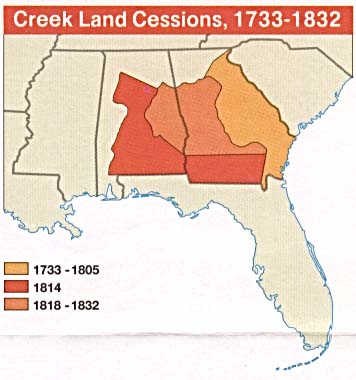
The basic social unit was the town (idalwa). Abihka, Coosa, Tuckabutche, and Coweta are the four "mother towns" of the Muscogee Confederacy. Traditionally, the Cusseta and Coweta bands are considered the earliest members of the Muscogee Nation. The Lower Towns, along the Chattahoochee River (before 1690 and after 1715), and farther east along the Ocmulgee, Oconee, and Savannah River rivers (between 1690 and 1715), were Coweta, Cusseta (Kasihta), Koloni, Tuskegee, Chiaha, Hitchiti, Oconee, Ocmulgee, Apalachicola, and Sawokli.
The Upper Towns, located on the Coosa, Tallapoosa and Alabama rivers, were Tuckabatchee, Abhika, Coosa (Kusa; the dominant people of East Tennessee and North Georgia during the Spanish explorations), Itawa (original inhabitants of the Etowah Indian Mounds), Hothliwahi (Ullibahali), Hilibi, Eufaula, Wakokai, Atasi, Alibamu, Coushatta (Koasati; they had absorbed the Kaski/Casqui and the Tali), and Tuskegee ("Napochi" in the de Luna chronicles).
The most important leader in Muscogee society was the mico or village chief. Micos led warriors in battle and represented their villages, but held authority only insofar as they could persuade others to agree with their decisions. Micos ruled with the assistance of micalgi or lesser chiefs, and various advisers, including a second-in-charge called the heniha, respected village elders, medicine men, and a tustunnuggee or ranking warrior, the principal military adviser. The heles hayv or medicine maker officiated at various rituals, including providing black drink, used in purification ceremonies.
The most important social unit was the clan. Clans organized hunts, distributed lands, arranged marriages, and punished lawbreakers. The authority of the micos was complemented by the clan mothers, mostly women elders. The Muscogee had a matrilineal kinship system, with children considered born into their mother's clan, and inheritance was through the maternal line. The Wind Clan is the first of the clans. The majority of micos have belonged to this clan.
British, French, and Spanish expansion
Britain, France, and Spain all established colonies in the present-day Southeastern woodlands. Spain established Jesuit missions and related settlements to influence Native Americans. The British and the French opted for trade over conversion. In the 17th century, Franciscan friars in Spanish Florida built missions along Apalachee Bay. In 1670, English colonists from Barbados founded Charles Town, modern-day Charleston, the capital of the new colony of Carolina. Traders from Carolina went to Muscogee settlements to exchange firearms, gunpowder, axes, glass beads, cloth and West Indian rum for white-tailed deer pelts (as part of the deerskin trade) and Indian slaves.
The Spanish and their "mission Indians" burned most of the towns along the Chattahoochee after they welcomed Scottish explorer Henry Woodward in 1685. In 1690, English colonists built a trading post on the Ocmulgee River, known as Ochese-hatchee (creek), where a dozen towns relocated to escape the Spanish and acquire English goods. The name "Creek" most likely derived from a shortening of Ocheese Creek (the Hitchiti name for the body of water known today as the Ocmulgee River), and broadly applies to all of the Muscogee Confederacy, including the Yuchi and Natchez.
In 1704, Irish colonial administrator James Moore led the Carolina militia and Ochese Creek and Yamasee warriors on a series of raids against Spanish missions in the Florida interior during Queen Anne's War. These raids captured thousands of Spanish-allied Indians, primarily Apalachee, who were sold into slavery in Carolina and the West Indies. A decade later, tensions between colonists and Indians in the region led to the Yamassee War of 1715–17.
The Ochese Creeks joined the Yamasee, burning trading posts, and raiding back-country settlers, but the revolt ran low on gunpowder and was put down by Carolinian militia and their Cherokee allies. The Yamasee took refuge in Spanish Florida, the Ochese Creeks fled west to the Chattahoochee. In 1702, French Canadian explorers founded Mobile as the first capital of Louisiana. In 1717, they took advantage of the war to build Fort Toulouse at the confluence of the Tallapoosa and Coosa, trading with the Alabama and Coushatta. Fearing they would come under French influence, the British reopened the deerskin trade with the Lower Creeks, antagonizing the Yamasee, now allies of Spain.
The French instigated the Upper Creeks to raid the Lower Creeks. In May 1718, the shrewd Emperor Brim, mico of the powerful Coweta band, invited representatives of Britain, France, and Spain to his village and, in council with Upper and Lower Creek leaders, declared a policy of Muscogee neutrality in their colonial rivalry. In 1718, the Spaniards built the presidio of San Marcos de Apalache on Apalachee Bay. In 1721, the British built Fort King George at the mouth of the Altamaha River. As the three European colonial powers established themselves along the borders of Muscogee lands, the Muscogee strategy of neutrality allowed them to hold the balance of power.
In 1732, the British Province of Georgia was established. In 1733, its first settlement, Savannah, was founded on a river bluff where the Yamacraw, a Yamasee band that remained allies of Britain, allowed John Musgrove to establish a fur-trading post. His wife Mary Musgrove was the daughter of an English trader and a Muscogee woman from the powerful Wind Clan, half-sister of 'Emperor' Brim. She was the principal interpreter for Georgia's founder and first Governor Gen. James Oglethorpe, using her connections to foster peace between the Creek Indians and the new colony. In 1735, Georgia constructed Fort Okfuskee near Oakfuskee to compete with French trade with the Creeks at Fort Toulouse. The deerskin trade grew, and by the 1750s, Savannah exported up to 50,000 deerskins a year.
In 1736, Spanish and British officials established a neutral zone from the Altamaha to the St. Johns River in present-day Florida, guaranteeing Native hunting grounds for the deerskin trade and protecting Spanish Florida from further British encroachment. Ca. 1750 a group of Ochese moved to the neutral zone, after clashing with the Muskogee-speaking towns of the Chattahoochee, where they had fled after the Yamasee War.
Led by Chief Secoffee (Cowkeeper), they became the center of a new tribal confederacy, the Seminole, which grew to include earlier refugees from the Yamasee War, remnants of the 'mission Indians,' and escaped African slaves. Their name comes from the Spanish word cimarrones, which originally referred to a domestic animal that had reverted to the wild. Cimarrones was used by the Spanish and Portuguese to refer to fugitive slaves—"maroon" emerges linguistically from this root as well—and American Indians who fled the Europeans. In the Hitchiti language, which lacked an 'r' sound, it became simanoli, and eventually Seminole.
Intermarriage
Many Muscogee Creek leaders, due to intermarriage, have British names: Alexander McGillivray, Josiah Francis, William McIntosh, Peter McQueen, William Weatherford, William Perryman, and others. These reflect Muscogee women having children with British colonists. For instance, Indian agent Benjamin Hawkins married a Muscogee woman. In Muscogee culture, unmarried Muscogee women had great freedom over their own sexuality compared to European and European-American counterparts.
Under the customs of Muscogee matrilineal society, their children belonged to their mother's clan. With the exception of McGillivray, mixed-raced Muscogee people worked against Muscogee Creek interests, as they understood them. To the contrary, in many cases, they spearheaded resistance to settler encroachment on Muscogee Creek lands. That they usually spoke English as well as Mvskoke, and knew European customs as well, made them community leaders; they "dominated Muskogee politics". As put by Claudio Saunt:
These offspring of mixed marriages occupied a different position in the economy of the Deep South than did most Creeks and Seminoles. They worked as traders and factors. ... By virtue of their ancestry and upbringing, they had greater cultural, social, linguistic, and geographic ties to the colonial settlements, traveling periodically to Pensacola and the Georgia trading posts to unload their skins and pick up more trade goods.
As Andrew Frank writes, "Terms such as mixed-blood and half-breed, which imply racial categories and partial Indianness, betray the ways in which Native peoples determined kinship and identity in the eighteenth- and early-nineteen-century southeast."
American Revolutionary War
With the end of the French and Indian War (also known as the Seven Years' War) in 1763, France lost its North American empire, and British-American settlers moved inland. Indian discontent led to raids against back-country settlers, and the perception that the royal government favored the Indians and the deerskin trade led many back-country white settlers to join the Sons of Liberty. Fears of land-hungry settlers and need for European manufactured goods led the Muscogee to side with the British, but like many tribes, they were divided by factionalism, and, in general, avoided sustained fighting, preferring to protect their sovereignty through cautious participation.
During the American Revolution, the Upper Creeks sided with the British, fighting alongside the Chickamauga (Lower Cherokee) warriors of Dragging Canoe, in the Cherokee–American wars, against white settlers in present-day Tennessee. This alliance was orchestrated by the Coushatta chief Alexander McGillivray, son of Lachlan McGillivray, a wealthy Scottish Loyalist fur-trader and planter, whose properties were confiscated by Georgia. His ex-partner, Scots-Irish Patriot George Galphin, initially persuaded the Lower Creeks to remain neutral, but Loyalist Capt. William McIntosh led a group of pro-British Hitchiti, and most of the Lower Creeks nominally allied with Britain after the 1779 Capture of Savannah.
Muscogee warriors fought on behalf of Britain during the Mobile and Pensacola campaigns of 1780–81, where Spain re-conquered British West Florida. Loyalist leader Thomas Brown raised a division of King's Rangers to contest Patriot control over the Georgia and Carolina interior and instigated Cherokee raids against the North Carolina back-country after the Battle of King's Mountain. He seized Augusta in March 1780, with the aid of an Upper Creek war-party, but reinforcements from the Lower Creeks and local white Loyalists never came. Georgia militia led by Elijah Clarke retook Augusta in 1781. In 1782, an Upper Creek war-party trying to relieve the British garrison at Savannah was routed by Continental Army troops under Gen. 'Mad' Anthony Wayne.
After the war ended in 1783, the Muscogee learned that Britain had ceded their lands to the now independent United States. That year, two Lower Creek chiefs, Hopoithle Miko (Tame King) and Eneah Miko (Fat King), ceded 800 square miles (2,100 km2) of land to the state of Georgia. Alexander McGillivray led pan-Indian resistance to white encroachment, receiving arms from the Spanish in Florida to fight trespassers. The bilingual and bicultural McGillivray worked to create a sense of Muscogee nationalism and centralize political authority, struggling against village leaders who individually sold land to the United States. He became a wealthy landowner and merchant, owning as many as sixty black slaves.
In 1784, he negotiated the Treaty of Pensacola with Spain, recognizing Muscogee control over 3,000,000 acres (12,000 km2) of land claimed by Georgia, and guaranteeing access to the British firm Panton, Leslie & Co. which controlled the deerskin trade, while making himself an official representative of Spain. In 1786, a council in Tuckabatchee decided to wage war against white settlers on Muscogee lands. War parties attacked settlers along the Oconee River, and Georgia mobilized its militia. McGillivray refused to negotiate with the state that had confiscated his father's plantations, but President George Washington sent a special emissary, Col. Marinus Willet, who persuaded him to travel to New York City, then the capital of the U.S., and deal directly with the federal government.
In the summer of 1790, McGillivray and 29 other Muscogee chiefs signed the Treaty of New York, on behalf of the 'Upper, Middle and Lower Creek and Seminole composing the Creek nation of Indians,' ceding a large portion of their lands to the federal government and promising to return fugitive slaves, in return for federal recognition of Muscogee sovereignty and promises to evict white settlers. McGillivray died in 1793, and with the invention of the cotton gin, white settlers on the Southwestern frontier who hoped to become cotton planters clamored for Indian lands. In 1795, Elijah Clarke and several hundred followers defied the Treaty of New York and established the short-lived Trans-Oconee Republic.
Muscogee and Choctaw land dispute (1790)
In 1790, the Muscogee and Choctaw were in conflict over land near the Noxubee River. The two nations agreed to settle the dispute by ball-play. With nearly 10,000 players and bystanders, the two nations prepared for nearly three months. After a day-long struggle, the Muscogee won the game. A fight broke out and the two nations fought until sundown with nearly 500 dead and many more wounded.
State of Muskogee and William Bowles
William Augustus Bowles was born into a wealthy Maryland Tory family, enlisting with the Maryland Loyalists Battalion at age 14 and becoming an ensign in the Royal Navy by age 15. Cashiered for dereliction of duty after returning too late to his ship at Pensacola, Bowles escaped north and found refuge among the Lower Creek towns of the Chattahoochee basin. He married two wives, one Cherokee and the other a daughter of the Hitchiti Muscogee chieftain William Perryman, and later used this union as the basis for his claim to exert political influence among the Creeks.
In 1781, a 17-year-old Bowles led Muscogee forces at the Battle of Pensacola. After seeking refuge in the Bahamas, he travelled to London. He was received by King George III as 'Chief of the Embassy for Creek and Cherokee Nations'. It was with British backing that he returned to train the Muscogee as pirates to attack Spanish ships.
In 1799, Bowles formed the State of Muskogee, with the support of the Chattahoochee Creeks and the Seminoles. He established his capital at Miccosuki, a village on the shores of Lake Miccosukee near present-day Tallahassee. It was ruled by Mico Kanache, his father-in-law and strongest ally. Bowles envisioned the State of Muskogee, with its capital at Miccosuki, encompassing large portions of present-day Florida, Alabama, Georgia, North Carolina, and Tennessee, and incorporating the Cherokee, Upper and Lower Creeks, Chickasaw and Choctaw. Bowles' first act was declaring the 1796 Second Treaty of San Ildefonso, which drew the boundary between the U.S. and West Florida, null and void, because the Indians were not consulted.
He denounced the treaties Alexander McGillivray had negotiated with Spain and the U.S., threatening to declare war on the United States unless it returned Muscogee lands. He issued a death sentence against George Washington's Indian agent Benjamin Hawkins, who won the loyalty of the Lower Creeks. He built a tiny navy, and raided Spanish ships in the Gulf of Mexico. In 1800, he declared war on Spain, briefly capturing the presidio and trading post of San Marcos de Apalache before being forced to retreat.
Although a Spanish force that set out to destroy Mikosuki got lost in the swamps, a second attempt to take San Marcos ended in disaster. After a European armistice led to the loss of British support, Bowles was discredited. The Seminole signed a peace treaty with Spain in August 1802. The following year, he was betrayed by Lower Creek supporters of Hawkins at a tribal council. They turned Bowles over to the Spanish, and he died in prison in Havana, Cuba two years later.
Pre-removal (late 18th–early 19th centuries)
George Washington, the first U.S. president, and Henry Knox, the first U.S. Secretary of War, proposed a cultural transformation of the Native Americans. Washington believed that Native Americans were equals as individuals but that their society was inferior. He formulated a policy to encourage the "civilizing" process, and it was continued under President Thomas Jefferson. Noted historian Robert Remini wrote, "[T]hey presumed that once the Indians adopted the practice of private property, built homes, farmed, educated their children, and embraced Christianity, these Native Americans would win acceptance from white Americans."
Washington's six-point plan included impartial justice toward Indians; regulated buying of Indian lands; promotion of commerce; promotion of experiments to civilize or improve Indian society; presidential authority to give presents; and punishing those who violated Indian rights. The Muscogee would be the first Native Americans to be "civilized" under Washington's six-point plan. Communities within the Cherokee, Chickasaw, Choctaw, and Seminole tribes followed Muscogee efforts to implement Washington's new policy of civilization.
In 1796, Washington appointed Benjamin Hawkins as Principal Temporary Agent for Indian Affairs, dealing with all tribes south of the Ohio River. He personally assumed the role of principal agent to the Muscogee. He moved to the area in Creek country that is now Crawford County in Georgia. He began to teach agricultural practices to the tribe, starting a farm at his home on the Flint River. In time, he brought in slaves and workers, cleared several hundred acres, and established mills and a trading post as well as his farm. The goal was to transform the Natives into "respectable Americans" in the republic, in a way that didn't involve violence.[Needs citation]
One of the ways Hawkins did this was that he worked to change the gender roles that had been established in Creek society long before, to how the new American republic considered gender roles. For example, convincing the men to take up things like ranching and planting, and giving up things like hunting and being warriors, and for the women to leave behind their roles in farms and instead participate in "household manufactures".[Needs citation] Hawkins also tried to convince the men to take over family property and "assume command over their wives and daughters".[Needs citation]