
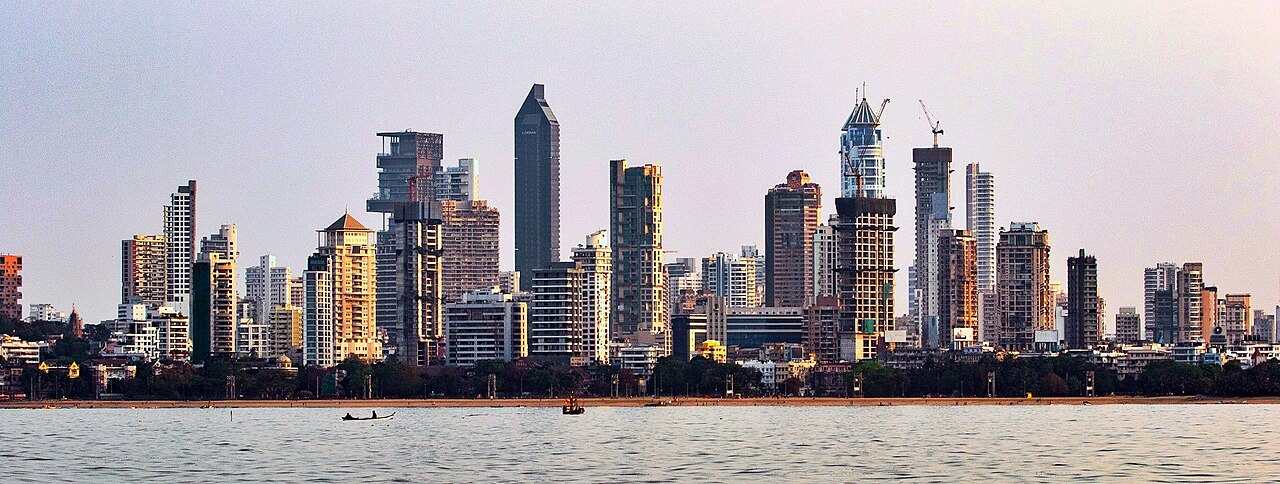
Mumbai ( muum-BY; Marathi: Mumbaī, pronounced [ˈmumbəi] ), also known as Bombay ( bom-BAY; its official name until 1995), is the capital city of the Indian state of Maharashtra. Mumbai is the financial capital and the most populous city proper of India, with an estimated population of 12.5 million (1.25 crore). Mumbai is the centre of the Mumbai Metropolitan Region, which is among the most populous metropolitan areas in the world with a population of over 23 million (2.3 crore). Mumbai lies on the Konkan coast on the west coast of India and has a deep natural harbour. In 2008, Mumbai was named an alpha world city. Mumbai has the highest number of billionaires of any city in Asia.
The seven islands that constitute Mumbai were earlier home to communities of Marathi language–speaking Koli people. For centuries, the seven islands of Bombay were under the control of successive indigenous rulers before being ceded to the Portuguese Empire, and subsequently to the East India Company in 1661, as part of the dowry of Catherine of Braganza in her marriage to Charles II of England. Beginning in 1782, Mumbai was reshaped by the Hornby Vellard project, which undertook reclamation of the area between the seven islands from the Arabian Sea. Along with the construction of major roads and railways, the reclamation project, completed in 1845, transformed Mumbai into a major seaport on the Arabian Sea. Mumbai in the 19th century was characterised by economic and educational development. During the early 20th century, it became a strong base for the Indian independence movement. Upon India's independence in 1947, the city was incorporated into Bombay State. In 1960, following the Samyukta Maharashtra Movement, a new state of Maharashtra was created with Mumbai as the capital.
Mumbai is the financial, commercial, and entertainment capital of India. Mumbai is often compared to New York City, and is home to the Bombay Stock Exchange, situated on Dalal Street. It is also one of the world's top ten centres of commerce in terms of global financial flow, generating 6.16% of India's GDP, and accounting for 25% of the nation's industrial output, 70% of maritime trade in India (via Mumbai Port, Jawaharlal Nehru Port and Dharamtar Port), and 70% of capital transactions to India's economy. The city houses important financial institutions and the corporate headquarters of numerous Indian companies and multinational corporations. The city is also home to some of India's premier scientific and nuclear institutes and the Hindi and Marathi film industries. Mumbai is also the home of Bollywood, also known as Hindi cinema or Bombay cinema, which is considered to be the second-largest film industry after Hollywood. Mumbai's business opportunities attract migrants from all over India.

Etymology
The name Mumbai (Marathi: मुंबई) originated from Mumbā or Mahā-Ambā—the name of the patron Hindu goddess (Kula Devata) Mumbadevi of the native Koli community—and from ā'ī, meaning "mother" in Marathi. By some accounts, the Koli community of Kathiawar and Central Gujarat introduced their deity Mumba from Kathiawar, where her worship continues to this day. However, other sources disagree.
The oldest known names for the city are Kakamuchee and Galajunkja; these are sometimes still used. Portuguese writer Gaspar Correia recorded the name "Bombaim" after 1512 in his Lendas da Índia (Legends of India). Some Anglophone authors have suggested this came from a supposed Galician–Portuguese phrase bom baim, "good little bay", with no scientific basis. In 1516, Portuguese explorer Duarte Barbosa used the name Tana-Maiambu with Tana referring to the adjoining town of Thane and Maiambu referring to Mumbadevi or the neighbouring island of Mahim. The form Bombaim is still commonly used in Portuguese. Many variant names were recorded in the 16th and the 17th centuries. After the English gained possession of the city in the 17th century, the Portuguese name was anglicised to Bombay. Ali Muhammad Khan, imperial dewan or revenue minister of the Gujarat province, in the Mirat-i Ahmedi (1762) called the city Manbai.
The French traveller Louis Rousselet, who visited in 1863 and 1868, stated in 1877 that "Etymologists have wrongly derived this name from the Portuguese Bôa Bahia, or (French: "bonne baie", English: "good bay"), not knowing that the tutelar goddess of this island has been, from remote antiquity, Bomba, or Mumba Devi, and that she still ... possesses a temple". British officer and scholar John Briggs concurred that the name Bombay was a corruption of "Mumby", for a temple to Mumba Devi.

By the late 20th century, the city was called Mumbai or Mambai in Marathi, Konkani, Gujarati, Kannada and Sindhi, and Bambai in Hindi. The Government of India officially changed the English name to Mumbai in November 1995. This came at the insistence of the Marathi nationalist Shiv Sena party, which had just won the Maharashtra state elections, and mirrored similar name changes across India. Shiv Sena argued that the name 'Bombay' echoed British colonial rule. While Mumbai is still called Bombay by some residents and by some Indians from other regions, mention of the city by a name other than Mumbai has become controversial.
People from Mumbai
A resident of Mumbai is called Mumbaikar (pronounced [ˈmumbəikəɾ]) in Marathi, in which the suffix -kar means a 'resident of'. The term had been in use for quite some time, but it gained popularity after the official name change to Mumbai. Older terms such as Bombayite are used infrequently.
History
Early history
Mumbai is built on what was once an archipelago of seven islands: Isle of Bombay, Parel, Mazagaon, Mahim, Colaba, Worli, and Old Woman's Island (also known as Little Colaba). Pleistocene sediments found along the coast near Kandivali suggest that the islands were inhabited since the South Asian Stone Age. In the 3rd century BCE, the islands formed part of the Maurya Empire, ruled by the emperor Ashoka. The islands were perhaps occupied by the Koli fishing community during the beginning of the Common Era.
The Kanheri Caves in Borivali were excavated in the first century CE, and served as a centre of Buddhism in Western India. The Mahakali Caves in Andheri were cut out between the 1st century BCE and the 6th century CE. Greek geographer Ptolemy referred to the islands as Heptanesia (Ancient Greek: A cluster of seven islands) in 150 CE. Between the 2nd century BCE and 9th century CE, the islands came under the control of successive indigenous dynasties–Satavahanas, Western Satraps, Abhira, Vakataka, Kalachuris, Konkan Mauryas, Chalukyas, and Rashtrakutas, before being ruled by the Shilaharas from 810 to 1260 CE. Some of the oldest edifices in the city are the Jogeshwari Caves (between 520 and 525 CE), Elephanta Caves (between 6th to 7th century CE), Walkeshwar Temple (10th century CE), and Banganga Tank (12th century CE).
King Bhima founded his kingdom in the region in the late 13th century CE and established his capital in Mahikawati (present day Mahim). The Pathare Prabhus, among the earliest known settlers of the city, came to Mahikawati from Saurashtra in Gujarat around 1298 CE. The Delhi Sultanate annexed the islands in 1347–48 CE and controlled it until 1407 CE. During this time, the islands were administered by the Muslim governors of Gujarat, appointed by the sultanate. The islands were later governed by the independent Gujarat Sultanate, established in 1407CE. Numerous mosques were built during the period, including the Haji Ali Dargah in Worli, erected in 1431, as a homage to Sufi saint Haji Ali. From 1429 to 1431 CE, the islands were a source of contention between the Gujarat Sultanate and the Bahmani Sultanate of the Deccan. In 1493 CE, Bahadur Khan Gilani of the Bahmani Sultanate attempted to conquer the islands but was repulsed.
Portuguese and British rule
Apprehensive of the power of the Mughal Empire under emperor Humayun, sultan Bahadur Shah of Gujarat signed the Treaty of Bassein with the Portuguese Empire on 23 December 1534. As per the treaty, the seven islands of Bombay, the nearby town of Bassein, and its dependencies were given to the Portuguese on 25 October 1535.

The Portuguese leased the islands to various Portuguese officers during their regime, and assisted the Roman Catholic religious orders. The islands were called by various names, and later took the written form Bombaim. The Portuguese Franciscans and Jesuits built churches in the city, such as the St. Michael's Church at Mahim (1534), St. John the Baptist Church at Andheri (1579), St. Andrew's Church at Bandra (1580), and Gloria Church at Byculla (1632). They also built several fortifications including the Bombay Castle, Castella de Aguada, and Madh Fort. The English vied with the Portuguese for hegemony over Mumbai, recognising its strategic natural harbour and its separation from the main land. On 11 May 1661 CE, the marriage treaty of Charles II of England and Catherine of Braganza, daughter of King John IV of Portugal, gave most of the islands to the English, as part of Catherine's dowry to Charles.
In accordance with the Royal Charter of 27 March 1668, England leased these islands to the English East India Company in 1668 for a sum of £10 per annum. The population quickly rose from 10,000 in 1661 to 60,000 in 1675. The islands were subject to several attacks such as by Yakut Khan, the Muslim Koli admiral of the Mughal Empire, in October 1672, Rickloffe van Goen, the governor-general of Dutch India on 20 February 1673, and Siddi admiral Sambal on 10 October 1673. In 1687, the English East India Company transferred its headquarters from Surat to Mumbai, and the city eventually became the headquarters of the Bombay Presidency. The islands again suffered incursions from Yakut Khan in 1689–90.
The Portuguese presence in the region ended when the Marathas under Peshwa Baji Rao I captured Salsette in 1737, and Bassein in 1739. By the middle of the 18th century, Bombay expanded into a major trading town, receiving a large influx of migrants from across India. The British occupied Salsette on 28 December 1774, and signed the Treaty of Surat (1775), with Raghunathrao, one of the claimants to the Maratha throne, to transfer control of Salsette and Bassein. This resulted in the First Anglo-Maratha War, and the British secured Salsette officially through the Treaty of Purandar (1776), and later through the Treaty of Salbai (1782), signed to settle the outcome of the war.
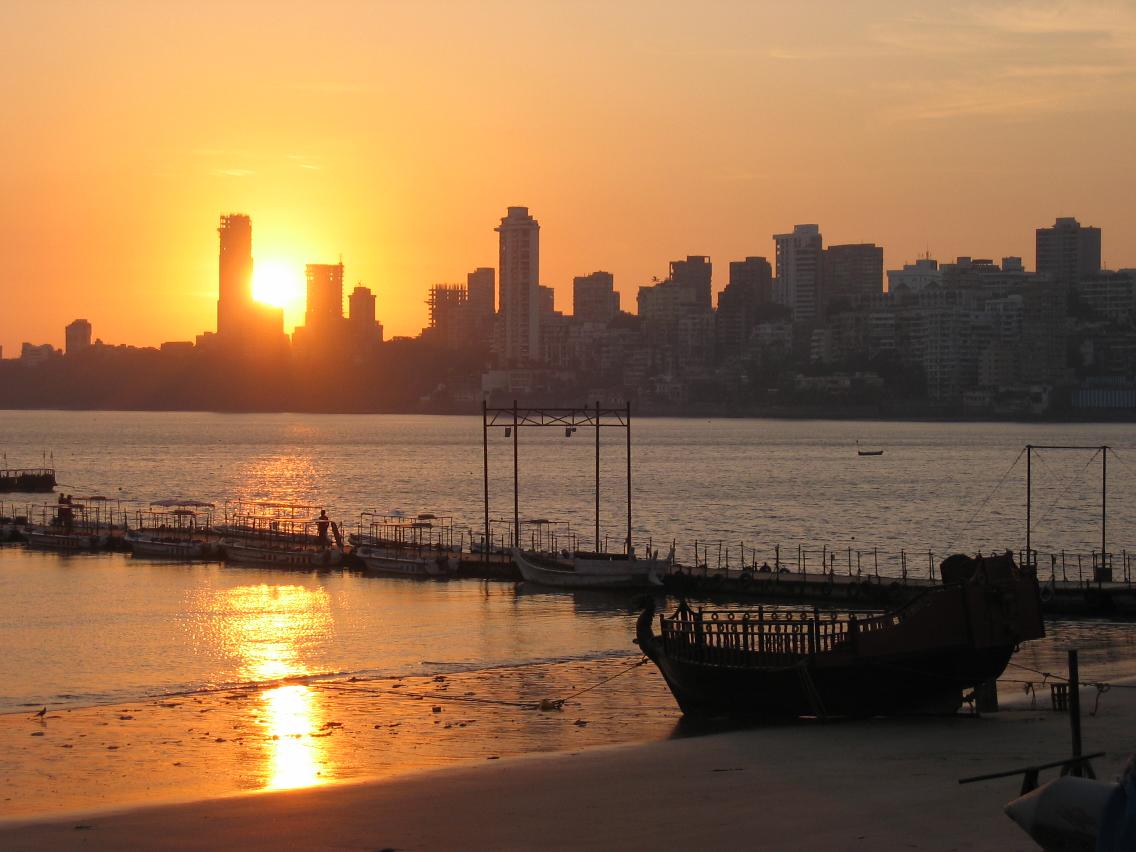
From 1782 onwards, the English undertook large-scale civil engineering projects to merge the seven islands of Bombay into one by means of a causeway, the Hornby Vellard, completed by 1784. In 1817, the English East India Company under Mountstuart Elphinstone defeated Baji Rao II, the last Peshwa of the Marathas in the Battle of Khadki. The success of the campaign marked the end of attacks by native powers, and brought almost the whole of the Deccan Plateau under the British suzerainty and the Bombay Presidency. On 16 April 1853, India's first passenger railway line was established, connecting Bombay to the neighbouring town of Thana. During the American Civil War (1861–1865), the city became the world's chief cotton-trading market, resulting in an economic boom.
The opening of the Suez Canal in 1869 transformed Bombay into one of the largest seaports on the Arabian Sea. In September 1896, the city was hit by a bubonic plague epidemic, which resulted in an over 20,000 people, and a large proportion of the population fleeing the city, harming the textile industry. The Indian independence movement fostered the Quit India Movement in 1942 at the Bombay session of the Indian National Congress and the Royal Indian Navy mutiny in 1946.
Independent India
After India's independence in 1947, the Bombay Presidency was restructured into Bombay State, which was further expanded when several erstwhile princely states were integrated into the Indian union. Subsequently, the city became the capital of Bombay State. In April 1950, municipal limits were expanded by merging the Mumbai suburban and city districts to form the Greater Mumbai Municipal Corporation.

The Samyukta Maharashtra movement to establish a separate Maharashtra state reached its heights in the 1950s. In 1955, during discussions in the Parliament of India, the Congress party demanded that the city be made an autonomous city-state. While the States Reorganisation Committee recommended a bilingual state for Maharashtra–Gujarat with Bombay as its capital in its 1955 report, the Bombay Citizens' Committee, an advocacy group of Gujarati industrialists, lobbied for an independent status for the city. Following several protests in which 105 people died in clashes with the law enforcement agencies, Bombay State was reorganised on linguistic lines into separate states of Maharashtra and Gujarat on 1 May 1960. The Gujarati-speaking areas were separated from Bombay State to form Gujarat. Maharashtra was established with Bombay as its capital was formed with the merger of Marathi-speaking areas of Bombay State, eight districts from Central Provinces and Berar, five districts from Hyderabad State, and numerous princely states. As a memorial to the martyrs of the Samyukta Maharashtra movement, Flora Fountain was renamed as Hutatma Chowk (Martyr's Square) and a memorial was erected.
The following decades saw a massive expansion of the city and its suburbs. In the late 1960s, Nariman Point and Cuffe Parade were reclaimed from the sea and developed. Industrial development began with a focus on the petrochemical, electronic, and automotive sectors. In the 1950s, Hindustan Petroleum and Bharat Petroleum commissioned Mumbai Refinery at Trombay and BPCL Refinery respectively. The Bombay Metropolitan Region Development Authority was established on 26 January 1975 by the Government of Maharashtra to co-ordinate development in the Mumbai metropolitan area. In August 1979, a sister township of New Bombay was established by the City and Industrial Development Corporation spread across the Thane and Raigad districts to accommodate the city's expanding population. The Great Bombay Textile Strike in 1982, which involved nearly 250,000 workers in more than 50 textile mills, resulted in the downfall of the sector. The defunct cotton mills of the city have since become the focus of redevelopment in the 21st century.
The Jawaharlal Nehru Port was commissioned on 26 May 1989 across the creek at Nhava Sheva to de-congest the Mumbai Harbour and to serve as a hub port for the city. The geographical limit of Greater Bombay, was coextensive with its municipal limit. On 1 October 1990, it was bifurcated to form the city and suburban revenue districts, though they continued to be administered by the same municipal administration.
The 1990s and 2000s saw a slew of violence and terrorism incidents. Following the demolition of the Babri Masjid in Ayodhya, the city was rocked by the Hindu-Muslim riots of 1992–93 in which more than 1,000 people were killed. In March 1993, a series of 13 coordinated bombings at city landmarks by Islamic extremists and the Mumbai underworld resulted in 257 deaths and over 700 injuries. In 2006, 209 people were killed and over 700 injured when seven bombs exploded on the city's commuter trains. In 2008, a series of ten coordinated attacks by armed terrorists for three days resulted in 173 deaths, 308 injuries, and severe damage to several heritage landmarks and prestigious hotels. The three coordinated bomb explosions in July 2011 that occurred at the Opera house, Zaveri Bazaar and Dadar were the latest in the series of terrorist attacks in Mumbai which resulted in 26 deaths and 130 injuries.
In the 21st century, Mumbai has become the commercial capital of India and a global financial hub. It is the home of India's main financial services companies and a focus for infrastructure development and private investment. It has become one of South Asia's largest cities and home of the world's most prolific film industry.
Geography
Mumbai is spread over an area of 603 km2 (233 sq mi), and is divided into two districts–Mumbai City and Mumbai Suburban. The suburban district occupies 446 km2 (172 sq mi) and is divided into three tehsils–Andheri, Borivali, and Kurla. The city district-region located to the south is referred to as South Mumbai or "Island City", and occupies an area of 157 km2 (61 sq mi). The Mumbai Metropolitan Region includes portions of Thane, Palghar and Raigad districts in addition to Greater Mumbai, and covers an area of 4,355 km2 (1,681 sq mi).
Mumbai is on a narrow peninsula located on the Salsette Island, which is bound by the Arabian Sea to the west, Thane Creek to the east, and Vasai Creek to the north. It lies at the mouth of the Ulhas River on the western coast of India, in the Konkan region. It shares the Salsette Island, with the Thane district. Navi Mumbai is located to the east of the Thane Creek, and Thane is situated towards the north of the Vasai Creek. Majority of the city lies just above the mean sea level, with elevations ranging from 10 to 15 m (33 to 49 ft), and an average elevation of 14 m (46 ft). Northern Mumbai consists of hilly terrain, with the highest point in the city at 450 m (1,480 ft) in the Powai–Kanheri range. The coastline is indented with creeks and bays, stretching from the Thane creek in the east to Madh Marve on the western front. The eastern coast of the Salsette Island is covered with mangrove swamps, while the western coast is mostly sandy and rocky.
Soil cover in the city region is predominantly sandy. In the suburbs, the soil cover is largely alluvial and loamy. The underlying rock is black Deccan basalt, dating to the late Cretaceous and early Eocene eras. Mumbai sits on a seismically active zone with 23 fault lines. The area is a Seismic Zone III region, which means an earthquake of up to magnitude 6.5 on the Richter magnitude scale could occur.
The Sanjay Gandhi National Park (Borivali National Park) is situated partly in the Mumbai suburban and Thane districts, and covers an area of 103.09 km2 (39.80 sq mi). There are two major lakes in the city– Tulsi Lake and Vihar Lake. The city also draws its water supply from various dams located in Thane district including Bhatsa, Lower Vaitarna, Middle Vaitarna, Tansa, and Upper Vaitarna. The Powai Lake is an artificial lake within the city limits, is used only for agricultural and industrial purposes. The Mithi River is an urban river formed by the tailwater discharges of the Powai and Vihar lakes, and is highly polluted.
Climate
Mumbai has a tropical wet and dry climate, classified as Aw under the Köppen climate classification. However, the central and northern suburbs experience a tropical monsoon climate (Am) with heavier rainfall during the wet season. Mumbai has a nearly rainless stretch from October to May, with its most intense rainfall during July. A cooler season from December to February is followed by a hotter season from March to May. The period from June to the end of September constitutes the southwest monsoon season.
The average annual temperature is 27 °C (81 °F). In the city, the average maximum and minimum temperatures are 31 °C (88 °F) and 24 °C (75 °F) respetively. In the suburbs, the daily mean maximum temperature ranges from 29 °C (84 °F) to 33 °C (91 °F), and the daily mean minimum temperature ranges from 16 °C (61 °F) to 26 °C (79 °F). The record high is 42.2 °C (108.0 °F) set on 14 April 1952, and the record low was 7.4 °C (45.3 °F), set on 27 January 1962. The average annual precipitation is 2,213 mm (87.1 in). The maximum annual rainfall ever recorded was 3,452 mm (136 in) for 1954. The most rainfall recorded in a single day was 944 mm (37 in) on 26 July 2005. The average total annual rainfall is 2,213.4 mm (87 in) in Mumbai City and 2,502.3 mm (99 in) for the suburbs.
Mumbai encounters occasional tropical cyclones. The worst cyclone encountered was on 23 November 1948, with gusts reaching 151 km/h (94 mph), and resulted in 38 deaths and 47 people missing. The city is prone to flooding during monsoons, According to the World Bank, unplanned drainage systems and informal settlements are amongst the key drivers of Mumbai's frequent floods. The 2005 Mumbai floods caused 500-1000 deaths and financial losses of US$ 1.2 billion. To reduce flooding in Mumbai, the Maharashtra government implemented a flood mitigation plan that included restoring the Mithi River, restructuring the drainage system, and moving informal settlements.
Pollution
Air pollution is a major issue in Mumbai. According to the 2016 World Health Organization Global Urban Ambient Air Pollution Database, the annual average PM2.5 concentration in 2013 was 63 μg/m3, which was 6.3 times higher than that recommended by the WHO Air Quality Guideline for annual mean PM2.5. The Central Pollution Control Board of the Government of India monitors and publicly shares real-time air quality data. In December 2019, the Indian Institute of Technology Bombay, in partnership with the McKelvey School of Engineering at Washington University in St. Louis, launched the Aerosol and Air Quality Research Facility at Mumbai to study air pollution in Indian cities. According to the 2016 report of the Central Pollution Control Board, Mumbai is the noisiest city in India.
Demographics
According to the 2011 census, Mumbai had a population of 12,442,373 inhabitants, with an estimated population density of about 20,482/km2 (53,050/sq mi) and averate living space of 4.5 square metres (48 sq ft) per person. The Mumbai Metropolitan Region was home to 18,394,912 people in 2011. The sex ratio as 853 females per 1,000 males, lower than the national average of 914 females per 1,000 males. The child sex ratio was 913 females per 1000 males. The low sex ratio is partly because of the large number of male migrants who come to the city to work. The city had a literacy rate of 89.73%, higher than the national average of 86.7%. There were 4.2 million households in 2008, which was projected to increase to 6.6 million by 2020. The number of households with annual incomes of above 2 million rupees was projected to be about 10%, and households with incomes from 1 to 2 million is estimated to be 15% in 2020.
As per the 2011 census, there were 5,633,709 slum-dwellers living in 1,135,514 households.
Dharavi, located in central Mumbai, is the largest slum and houses about a million people in an area of 2.39 km2 (0.92 sq mi), making it one of the most densely populated areas on Earth. The number of migrants to Mumbai from outside Maharashtra during the 1991–2001 decade was 1.12 million, which amounted to 54.8% of the net addition to the population of Mumbai.
Ethnic groups and religions
As per the 2011 Census, Hinduism is the major religion with nearly two-third of the population adhering to it, followed by Islam, Buddhism, Jainism, Christianity, and Sikhism. The oldest Muslim communities in Mumbai include the Dawoodi Bohras, Ismaili Khojas, and Konkani Muslims. Native Christians include East Indian Catholics, converted by the Portuguese during the 16th century.
Jews settled in Mumbai during the 18th century. The Bene Israeli Jewish community of Mumbai, who migrated from the Konkan villages, south of Mumbai, are believed to be the descendants of the Jews of Israel shipwrecked off the Konkan coast, probably in the year 175 BCE, during the reign of the Greek ruler, Antiochus IV Epiphanes. Mumbai is home to the largest population of Parsi Zoroastrians in the world, numbering about 60,000, however their population is declining rapidly. Parsis migrated to India from Greater Iran following the Muslim conquest of Persia in the seventh century. The ethnic demographics in the Mumbai consists of Maharashtrians (32%), Gujaratis (20%), with the rest hailing from other parts of India.
Language
Marathi is the most spoken language in the state. Hindi is the second–most-spoken language, followed by Urdu and Gujarati. Marathi and English serve as the official languages of the government. English is the principal language of the city's white collar workforce. A colloquial form of Hindi, known as Bombay Hindi is spoken on the streets. Many Hindi speakers are workers from Uttar Pradesh and Bihar who migrate seasonally to Mumbai to work as labourers.
Economy
Mumbai is known as the financial and commercial capital of India, generating about 6.16% of the country's total GDP. In 2023–24, it contributed to 19.8% of the GDP of the state of Maharashtra. In 2017–18, estimates of the economy of the Mumbai Metropolitan Region ranged from $368 billion to $400 billion (PPP & metro GDP), ranking it amongst the top two most-productive metro area of India. In 2006, Mumbai employed 10% of the nation's factory workforce, contributed to 25% of the industrial output, 33% of the income tax collections, 60% of the customs duty collections, 20% of the central excise tax collections, 40% of the foreign trade, and generated ₹40 billion (equivalent to ₹130 billion or US$1.3 billion in 2023) in corporate tax.
Until the 1970s, Mumbai owed its prosperity largely to textile mills and seaport, but the local economy has since then diversified to include finance, engineering, diamond-polishing, healthcare, and information technology. It witnessed an economic boom since the liberalisation of 1991, with the finance sector booming in the mid-nineties, and the information technology (IT), export, services, and outsourcing booming in the 2000s. In the 21st century. the key sectors contributing to the city's economy are: finance, gems & jewellery, leather processing, IT and ITES, textiles, petrochemical, electronics manufacturing, automobiles, and entertainment. The port and shipping industry is well established. Dharavi, in central Mumbai, has a large recycling industry and is home to about 15,000 single-room factories.
The city is home to many of India's conglomerates and five of the Fortune Global 500 companies. It also houses the Reserve Bank of India , the Bombay Stock Exchange (BSE), the National Stock Exchange of India, and financial sector regulators such as the Securities and Exchange Board of India. Nariman Point and Bandra Kurla Complex are Mumbai's major financial centres. The BSE, established in 1875, is the oldest stock exchange in Asia. In 2019, Mumbai was among the world's top ten cities by number of billionaires. With a total wealth of around $960 billion, it is the wealthiest Indian city and one of the richest cities in the world. As of 2008, the Globalization and World Cities Research Network has ranked Mumbai as an "alpha world city", third in its categories of Global cities. Mumbai is the third most expensive office market in the world, and has been ranked among the fastest cities in the country for business startup.
Mumbai is one of the world's most unequal cities in terms of wealth distribution and inclusivity. According to the World Bank, in 2010, the median income was ₹20,000 (equivalent to ₹45,000 or US$470 in 2023) while the average income was ₹40,000 (equivalent to ₹90,000 or US$940 in 2023). The city has a large unskilled and semi-skilled self-employed population, and other blue collar professions, often migrating from other regions. About 41.8% of the city's population live in urban slums, though slums occupy just around seven per cent of the city's total land area. Mumbai's overall per capita residential area is 8.3 m2 (89 sq ft), and in the city's slums, it drops to 2.73 m2 (29.4 sq ft). Dharavi hosts nearly a million people, and is one of the largest slums in the world. The median rental cost of a one-bedroom apartment in Mumbai proper was about ₹30,000 (equivalent to ₹37,000 or US$390 in 2023) in 2019. With available land at a premium, Mumbai residents often endure cramped housing, far from workplaces, with long commutes on crowded mass transits or roads clogged with traffic. Suburban residents spend a significant amount of time commuting southward to the central commercial district.
Government and politics
Civic administration
Greater Mumbai (or Brihanmumbai), an area of 603 km2 (233 mi2), consisting of the Mumbai City and Mumbai Suburban districts, extends from Colaba in the south, to Mulund and Dahisar in the north, and Mankhurd in the east. Its population as per the 2011 census was 12,442,373.
It is administered by the Brihanmumbai Municipal Corporation (BMC) (also referred to as the Municipal Corporation of Greater Mumbai, and formerly known as the Bombay Municipal Corporation). The BMC is in charge of the civic and infrastructure needs of the metropolis. BMC is the richest civic body in India and among the wealthiest in Asia. As per the Ministry of Housing and Urban Affairs, the BMC had a revenue of ₹378.91 billion (US$4.0 billion) and an expenditure of ₹338.25 billion (US$3.5 billion) in 2022–23. Taxes contributed to 17.1% of the revenue, with 51.2% of the income coming from other sources, and 31.8% from government grants.
The BMC is headed by a mayor, who serves for a term of two and a half years, is chosen through an indirect election by the councillors from among themselves. The municipal commissioner is the chief executive officer and head of the executive arm of the municipal corporation. The commissioner, who is an Indian Administrative Service officer appointed by the state government, is responsible for implementing the executive policies. The commissioner is appointed for a fixed term, and the powers of the commissioner are those provided by statute and those delegated by the corporation or the standing committee.
As per a report in 2014, The Brihanmumbai Municipal Corporation was ranked ninth out of 21 cities for best governance & administrative practices in India in 2014, scoring 3.5 out of 10, compared to the national average of 3.3.