
Sir Muhammad Iqbal (9 November 1877 – 21 April 1938) was an Islamic philosopher and poet. His poetry in Urdu is considered to be among the greatest of the 20th century, and his vision of a cultural and political ideal for the Muslims of British India is widely regarded as having animated the impulse for the Pakistan Movement. He is commonly referred to by the honorific Allamah (Persian: علامه, transl. "learned") and widely considered one of the most important and influential Muslim thinkers and Islamic religious philosophers of the 20th century.
Iqbal was born and raised in Sialkot, Punjab, British India and studied at Scotch Mission College in Sialkot and Government College in Lahore. He taught Arabic at the Oriental College, Lahore, from 1899 until 1903, during which time he wrote prolifically. Notable among his Urdu poems from this period are "Parinde Ki Faryad" ("A Bird's Prayer"), an early contemplation on animal rights, and "Tarana-e-Hindi" ("Anthem of the Indians"), a patriotic poem—both composed for children. In 1905, he departed from India to pursue further education in Europe, first in England and later in Germany. In England, he earned a second BA at Trinity College, Cambridge, and subsequently qualified as a barrister at Lincoln's Inn. In Germany, he obtained a PhD in philosophy at the Ludwig-Maximilians-Universität München (LMU), with his thesis focusing on "The Development of Metaphysics in Persia" in 1908. Upon his return to Lahore in 1908, Iqbal established a law practice but primarily focused on producing scholarly works on politics, economics, history, philosophy, and religion. He is most renowned for his poetic compositions, including "Asrar-e-Khudi", "Rumuz-e-Bekhudi", and "Bang-e-Dara". His literary works in the Persian language garnered him recognition in Iran.
An ardent proponent of the political and spiritual revival of the Muslim world, particularly of the Muslims in the Indian subcontinent, the series of lectures Iqbal delivered to this effect were published as The Reconstruction of Religious Thought in Islam in 1930. He was elected to the Punjab Legislative Council in 1927 and held several positions in the All-India Muslim League. In his Allahabad Address, delivered at the League's annual assembly in 1930, he formulated a political framework for the Muslim-majority regions spanning northwestern India, spurring the League's pursuit of the two-nation theory.

In August 1947, nine years after Iqbal's death, the partition of India gave way to the establishment of Pakistan, a newly independent Islamic state in which Iqbal was honoured as the national poet. He is also known in Pakistani society as Hakim ul-Ummat (lit. 'The Wise Man of the Ummah') and as Mufakkir-e-Pakistan (lit. 'The Thinker of Pakistan'). The anniversary of his birth (Youm-e Weladat-e Muḥammad Iqbal), 9 November, is observed as a public holiday in Pakistan.
Early life and family
Iqbal was born on 9 November 1877 in Sialkot, Punjab Province, British India (now in Pakistan). A Punjabi of Kashmiri ancestry, his family traced their ancestry back to the Sapru clan of Kashmiri Pandits who were from a south Kashmiri village in Kulgam and converted to Islam in the 15th-century. Iqbal's mother-tongue was Punjabi, and he conversed mostly in Punjabi and Urdu in his daily life. In the 19th century, when the Sikh Empire was conquering Kashmir, his grandfather's family migrated to Punjab. Iqbal's grandfather was an eighth cousin of Sir Tej Bahadur Sapru, an important lawyer and freedom fighter who would eventually become an admirer of Iqbal. Iqbal often mentioned and commemorated his Kashmiri lineage in his writings. According to scholar Annemarie Schimmel, Iqbal often wrote about his being "a son of Kashmiri-Brahmans but (being) acquainted with the wisdom of Rumi and Tabrizi".
Iqbal's father, Sheikh Noor Muhammad (died 1930), was a tailor, not formally educated, but a religious man. Iqbal's mother Imam Bibi, a Kashmiri from Sambrial, was described as a polite and humble woman who helped the poor and her neighbours with their problems. She died on 9 November 1914 in Sialkot. Iqbal loved his mother, and on her death he expressed his feelings of pathos in an elegy:

Early education
Iqbal was four years old when he was sent to a mosque to receive instruction in reading the Qur'an. He learned the Arabic and Persian languages from his teacher, Syed Mir Hassan, the head of the madrasa and professor of Arabic at Scotch Mission College in Sialkot, where he matriculated in 1893. He stood first in grade one and had started versifying under the pen-name of Iqbal while still in class nine, being published in literary journals as a teenager. He received an intermediate level with the Faculty of Arts diploma in 1895. The same year he enrolled at Government College, Lahore, where in 1897 he obtained his Bachelor of Arts degree in philosophy, English literature, and Arabic, and won the Khan Bahadurddin F.S. Jalaluddin medal for his performance in Arabic. In 1899, he received his Master of Arts degree from the same college and won first place in philosophy in the University of the Punjab.
Marriages
Iqbal married four times under different circumstances.
His first marriage was in 1895 when he was 18 years old. His bride, Karim Bibi, was the daughter of Khan Bahadur Ata Muhammad Khan, a leading civil surgeon and fellow Punjabi-Kashmiri based in Gujrat. Her sister was the mother of director and music composer Khwaja Khurshid Anwar. Their families arranged the marriage, and the couple had two children; a daughter, Miraj Begum (1895–1915), and a son, Aftab Iqbal (1899–1979), who became a barrister. Aftab's son Azad Iqbal is himself a barrister as well a writer and musician, being a singer-composer in both jazz and ghazal genres. Another son is said to have died after birth in 1901.
Iqbal and Karim Bibi separated somewhere between 1910 and 1913. Despite this, he continued to financially support her till his death.
Iqbal's second marriage took place on 26 August 1910 with the niece of Hakim Noor-ud-Din.
Iqbal's third marriage was with Mukhtar Begum, and it was held in December 1914, shortly after the death of Iqbal's mother the previous November. They had a son, but both the mother and son died shortly after birth in 1924.

Later, Iqbal married Sardar Begum, and they became the parents of a son, Javed Iqbal (1924–2015), who became Senior Justice of the Supreme Court of Pakistan, and a daughter, Muneera Bano (born 1930). One of Muneera's sons is the philanthropist-cum-socialite Yousuf Salahuddin.
Higher education in Europe
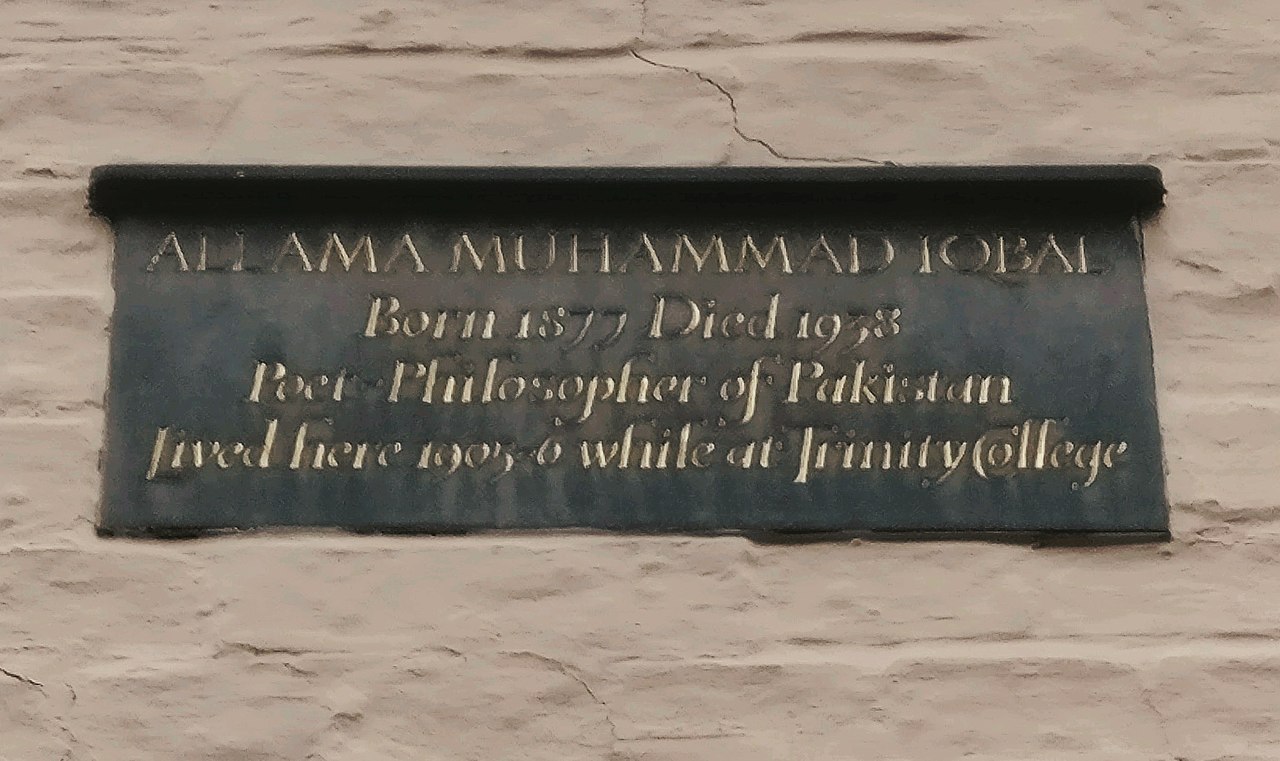
Iqbal was influenced by the teachings of Sir Thomas Arnold, his philosophy teacher at Government College Lahore, to pursue higher education in the West. In 1905, he travelled to England for that purpose, as Sir Thomas Arnold had advised him to specifically study neo-Hegelian philosophy and law at Cambridge. While already acquainted with Friedrich Nietzsche and Henri Bergson, Iqbal would discover Rumi slightly before his departure to England, and he would teach the Masnavi-e-Ma'navi to his friend Swami Rama Tirtha, who in return would teach him Sanskrit. Iqbal was awarded a scholarship at Trinity College, Cambridge, and in 1906 he graduated Bachelor of Arts there. In the same year, he was called to the bar as a barrister (or advocate) from Lincoln's Inn. In 1907, Iqbal moved to Germany to complete his doctoral studies under the supervision of Friedrich Hommel, and on 4 November 1907 he graduated as a Doctor of Philosophy from the Ludwig-Maximilians-Universität München (LMU) with a doctoral thesis entitled The Development of Metaphysics in Persia. This was published in London in 1908. Among his fellow students in Munich was Hans-Hasso von Veltheim, who later happened to visit Iqbal the day before Iqbal died.
In 1907, he had a close friendship with the writer Atiya Fyzee in both Britain and Germany. Atiya would later publish their correspondence. While Iqbal was in Heidelberg in 1907, his German professor Emma Wegenast taught him about Goethe's Faust, Heine and Nietzsche. He mastered German in three months. A street in Heidelberg has been named in his memory, "Iqbal Ufer". During his study in Europe, Iqbal began to write poetry in Persian. He preferred to write in this language because doing so made it easier to express his thoughts. He would write continuously in Persian throughout his life.
Academic career
Iqbal began his career as a reader of Arabic after completing his Master of Arts degree in 1899, at Oriental College and shortly afterward was selected as a junior professor of philosophy at Government College Lahore, where he had also been a student in the past. He worked there until he left for England in 1905. In 1907 he went to Germany for PhD In 1908, he returned from Germany and joined the same college again as a professor of philosophy and English literature. In the same period Iqbal began practising law at the Chief Court of Lahore, but he soon quit law practice and devoted himself to literary works, becoming an active member of Anjuman-e-Himayat-e-Islam. In 1919, he became the general secretary of the same organization. Iqbal's thoughts in his work primarily focus on the spiritual direction and development of human society, centered around experiences from his travels and stays in Western Europe and the Middle East. He was profoundly influenced by Western philosophers such as Nietzsche, Bergson, and Goethe. He also closely worked with Ibrahim Hisham during his stay at the Aligarh Muslim University.
The poetry and philosophy of Rumi strongly influenced Iqbal. Deeply grounded in religion since childhood, Iqbal began concentrating intensely on the study of Islam, the culture and history of Islamic civilization and its political future, while embracing Rumi as "his guide". Iqbal's works focus on reminding his readers of the past glories of Islamic civilization and delivering the message of a pure, spiritual focus on Islam as a source for socio-political liberation and greatness. Iqbal denounced political divisions within and amongst Muslim nations, and frequently alluded to and spoke in terms of the global Muslim community or the Ummah.
Iqbal's poetry was translated into many European languages in the early part of the 20th century. Iqbal's Asrar-i-Khudi and Javed Nama were translated into English by R. A. Nicholson and A. J. Arberry, respectively. Upon the publication of Asrar-i-Khudi, Iqbal was honoured with a British knighthood.
Legal career
Iqbal was not only a prolific writer but also a known advocate. He appeared before the Lahore High Court in both civil and criminal matters. There are more than 100 reported judgements to his name.
Final years and death
In 1933, after returning from a trip to Spain and Afghanistan, Iqbal suffered from a mysterious throat illness. He spent his final years helping Chaudhry Niaz Ali Khan to establish the Dar ul Islam Trust Institute at a Jamalpur, Pakistan estate near Pathankot, where there were plans to subsidize studies in classical Islam and contemporary social science. He also advocated for an independent Muslim state. Iqbal ceased practising law in 1934 and was granted a pension by the Nawab of Bhopal. In his final years, he frequently visited the Dargah of famous Sufi Ali Hujwiri in Lahore for spiritual guidance. After suffering for months from his illness, Iqbal died in Lahore on 21 April 1938. It is maintained that he died listening to a kafi of Bulleh Shah. His tomb is located in Hazuri Bagh, the enclosed garden between the entrance of the Badshahi Mosque and the Lahore Fort, and official guards are provided by the Government of Pakistan.
Efforts and influences
Political
Iqbal first became interested in national affairs in his youth. He received considerable recognition from the Punjabi elite after his return from England in 1908, and he was closely associated with Mian Muhammad Shafi. When the All-India Muslim League was expanded to the provincial level, and Shafi received a significant role in the structural organization of the Punjab Muslim League, Iqbal was made one of the first three joint secretaries along with Shaikh Abdul Aziz and Maulvi Mahbub Alam. While dividing his time between law practice and poetry, Iqbal remained active in the Muslim League. He did not support Indian involvement in World War I and stayed in close touch with Muslim political leaders such as Mohammad Ali Jouhar and Muhammad Ali Jinnah. He was a critic of the mainstream Indian National Congress, which he regarded as dominated by Hindus, and was disappointed with the League when, during the 1920s, it was absorbed in factional divides between the pro-British group led by Shafi and the centrist group led by Jinnah. He was active in the Khilafat Movement, and was among the founding fathers of Jamia Millia Islamia which was established at Aligarh in October 1920. He was also given the offer of being the first vice-chancellor of Jamia Millia Islamia by Mahatma Gandhi, which he refused.
In November 1926, with the encouragement of friends and supporters, Iqbal contested the election for a seat in the Punjab Legislative Assembly from the Muslim district of Lahore, and defeated his opponent by a margin of 3,177 votes. He supported the constitutional proposals presented by Jinnah to guarantee Muslim political rights and influence in a coalition with the Congress and worked with the Aga Khan and other Muslim leaders to mend the factional divisions and achieve unity in the Muslim League. While in Lahore he was a friend of Abdul Sattar Ranjoor.
Iqbal, Jinnah, and the concept of "Pakistan"
Ideologically separated from Congress Muslim leaders, Iqbal had also been disillusioned with the politicians of the Muslim League, owing to the factional conflict that plagued the League in the 1920s. Discontented with factional leaders like Shafi and Fazl-ur-Rahman, Iqbal came to believe that only Jinnah was a political leader capable of preserving unity and fulfilling the League's objectives of Muslim political empowerment. Building a strong, personal correspondence with Jinnah, Iqbal was influential in convincing Jinnah to end his self-imposed exile in London, return to India and take charge of the League. Iqbal firmly believed that Jinnah was the only leader capable of drawing Indian Muslims to the League and maintaining party unity before the British and the Congress:
I know you are a busy man, but I do hope you won't mind my writing to you often, as you are the only Muslim in India today to whom the community has the right to look up to for safe guidance through the storm which is coming to North-West India and, perhaps, to the whole of India.
While Iqbal espoused the idea of Muslim-majority provinces in 1930, Jinnah would continue to hold talks with the Congress through the decade and only officially embraced the goal of Pakistan in 1940. Some historians postulate that Jinnah always remained hopeful for an agreement with the Congress and never fully desired the partition of India. Iqbal's close correspondence with Jinnah is speculated by some historians as having been responsible for Jinnah's embrace of the idea of Pakistan. Iqbal elucidated to Jinnah his vision of a separate Muslim state in a letter sent on 21 June 1937:
A separate federation of Muslim Provinces, reformed on the lines I have suggested above, is the only course by which we can secure a peaceful India and save Muslims from the domination of Non-Muslims. Why should not the Muslims of North-West India and Bengal be considered as nations entitled to self-determination just as other nations in India and outside India are.
Iqbal, serving as president of the Punjab Muslim League, criticized Jinnah's political actions, including a political agreement with Punjabi leader Sikandar Hyat Khan, whom Iqbal saw as a representative of feudal classes and not committed to Islam as the core political philosophy. Nevertheless, Iqbal worked constantly to encourage Muslim leaders and masses to support Jinnah and the League. Speaking about the political future of Muslims in India, Iqbal said:
There is only one way out. Muslims should strengthen Jinnah's hands. They should join the Muslim League. Indian question, as is now being solved, can be countered by our united front against both the Hindus and the English. Without it, our demands are not going to be accepted. People say our demands smack of communalism. This is sheer propaganda. These demands relate to the defense of our national existence. The united front can be formed under the leadership of the Muslim League. And the Muslim League can succeed only on account of Jinnah. Now, none but Jinnah is capable of leading the Muslims.
Madani–Iqbal debate
A famous debate was held between Iqbal and Hussain Ahmad Madani on the question of nationalism in the late 1930s. Madani's position throughout was to insist on the Islamic legitimacy of embracing a culturally plural, secular democracy as the best and the only realistic future for India's Muslims where Iqbal insisted on a religiously defined, homogeneous Muslim society. Madani and Iqbal both appreciated this point and they never advocated the creation of an absolute 'Islamic State'. They differed only in their first step. According to Madani the first step was the freedom of India for which composite nationalism was necessary. According to Iqbal the first step was the creation of a community of Muslims in the Muslim majority land, i.e. a Muslim India within India.
Revival of Islamic policy
Iqbal's six English lectures were published in Lahore in 1930, and then by the Oxford University Press in 1934 in the book The Reconstruction of Religious Thought in Islam. The lectures had been delivered at Madras, Hyderabad and Aligarh. These lectures dwell on the role of Islam as a religion and as a political and legal philosophy in the modern age. In these lectures Iqbal firmly rejects the political attitudes and conduct of Muslim politicians, whom he saw as morally misguided, attached to power and without any standing with the Muslim masses.
Iqbal expressed fears that not only would secularism weaken the spiritual foundations of Islam and Muslim society but that India's Hindu-majority population would crowd out Muslim heritage, culture, and political influence. In his travels to Egypt, Afghanistan, Iran, and Turkey, he promoted ideas of greater Islamic political co-operation and unity, calling for the shedding of nationalist differences. He also speculated on different political arrangements to guarantee Muslim political power; in a dialogue with Dr. B. R. Ambedkar, Iqbal expressed his desire to see Indian provinces as autonomous units under the direct control of the British government and with no central Indian government. He envisaged autonomous Muslim regions in India. Under a single Indian union, he feared for Muslims, who would suffer in many respects, especially concerning their existentially separate entity as Muslims.
Iqbal was elected president of the Muslim League in 1930 at its session in Allahabad in the United Provinces, as well as for the session in Lahore in 1932. In his presidential address on 29 December 1930 he outlined a vision of an independent state for Muslim-majority provinces in north-western India:
I would like to see the Punjab, North-West Frontier Province, Sind and Baluchistan amalgamated into a single state. Self-government within the British Empire, or without the British Empire, the formation of a consolidated Northwest Indian Muslim state appears to me to be the final destiny of the Muslims, at least of Northwest India.
In his speech, Iqbal emphasised that, unlike Christianity, Islam came with "legal concepts" with "civic significance", with its "religious ideals" considered as inseparable from social order: "Therefore, if it means a displacement of the Islamic principle of solidarity, the construction of a policy on national lines, is simply unthinkable to a Muslim." Iqbal thus stressed not only the need for the political unity of Muslim communities but the undesirability of blending the Muslim population into a wider society not based on Islamic principles.
Even as he rejected secularism and nationalism he would not elucidate or specify if his ideal Islamic state would be a theocracy, and criticized the "intellectual attitudes" of Islamic scholars (ulema) as having "reduced the Law of Islam practically to the state of immobility".
The latter part of Iqbal's life was concentrated on political activity. He travelled across Europe and West Asia to garner political and financial support for the League. He reiterated the ideas of his 1932 address, and, during the third Round Table Conference, he opposed the Congress and proposals for transfer of power without considerable autonomy for Muslim provinces.
He would serve as president of the Punjab Muslim League, and would deliver speeches and publish articles in an attempt to rally Muslims across India as a single political entity. Iqbal consistently criticized feudal classes in Punjab as well as Muslim politicians opposed to the League. Many accounts of Iqbal's frustration toward Congress leadership were also pivotal in providing a vision for the two-nation theory.
Patron of Tolu-e-Islam
Iqbal was the first patron of Tolu-e-Islam, an historical, political, religious and cultural journal of the Muslims of British India. For a long time, Iqbal wanted a journal to propagate his ideas and the aims and objectives of the All India Muslim League. In 1935, according to his instructions, Syed Nazeer Niazi initiated and edited the journal, named after Iqbal's poem "Tulu'i Islam". Niazi dedicated the first issue of the journal to Iqbal. The journal would play an important role in the Pakistan movement. Later, the journal was continued by Ghulam Ahmed Pervez, who had contributed many articles in its early editions.
Literary work
Persian
Iqbal's poetic works are written primarily in Persian rather than Urdu. Among his 12,000 verses of poetry, about 7,000 verses are in Persian. In 1915, he published his first collection of poetry, the Asrar-i-Khudi اسرارِ خودی (Secrets of the Self) in Persian, for which he was honoured with a British knighthood upon its publication. The poems emphasise the spirit and self from a religious perspective. Many critics have called this Iqbal's finest poetic work. In Asrar-i-Khudi, Iqbal explains his philosophy of "Khudi", or "Self". Iqbal's use of the term "Khudi" is synonymous with the word "Rooh" used in the Quran for a divine spark which is present in every human being, and was said by Iqbal to be present in Adam, for which God ordered all of the angels to prostrate in front of Adam. Iqbal condemns self-destruction. For him, the aim of life is self-realisation and self-knowledge. He charts the stages through which the "Self" has to pass before finally arriving at its point of perfection, enabling the knower of the "Self" to become a vice-regent of God. When Asrar-i-Khudi was published, its first appearance is said to have taken the younger generation of Hindustani Muslims by storm. 'Iqbal has come amongst us as a Messiah and stirred the dead into life', so wrote R.A.Nicholson, whose prose version and translation of the work first introduced Iqbal's writings to the Western public. The book is divided into eighteen chapters. Several of these attempt to explain the Self, and its relationship with the universe and the creation of God - placing the sacred nature of man at the centre of existence. Two of the chapters cover the importance of devotion and love on the Self:
The remaining chapters go on to enforce further moral and religious ethical lessons through the use of parables, symbols and examples. He uses opposites to draw clear distinctions between the polished Self and the lost, egotistical and hypocritical nature of the Self. In chapter thirteen Iqbal creates a dialogue between a diamond and a coal, and in chapter fourteen the Sheikh and a Brahman are brought together, as well as the Ganges and the Himalaya. In one of the longest chapters, ‘On the true nature of poetry and the reformation of Islamic literature’, Iqbal expresses significant reservations about poetry, and his own role as a poet. In a letter dated 1936, two years before his death he writes: ‘I do not consider myself a poet. If I am presented in this role, I feel embarrassed. My ancestors belonged to the Sapru family of Kashmiri Brahmins who never composed poetry. I have no aptitude for music and painting either. Unfortunately, I had to take refuge in poetry to express my thoughts. Perhaps I would have been more successful in another field’. In his book The Reconstruction of Religious Thought in Islam, he is openly critical of poetry that served only decorative or escapist purposes. He saw much of contemporary poetry, as well as classical, Persian and Urdu poetry as promoting fatalism, passivity, and mythical escapism, which were antithetical to his philosophy of ‘Khudi’ (Selfhood). He believed true art should have a higher purpose. In this sense, he was against poetry as mere entertainment or idle ornamentation. In the introduction to the Secrets of the Self, he writes:
In his Rumuz-i-Bekhudi رموزِ بیخودی (Hints of Selflessness), Iqbal seeks to prove the Islamic way of life is the best code of conduct for a nation's viability. A person must keep his characteristics intact, he asserts, but once this is achieved, he should sacrifice his ambitions for the needs of the nation. Man cannot realize the "Self" outside of society. Published in 1917, this group of poems has as its main themes the ideal community, Islamic ethical and social principles, and the relationship between the individual and society. Although he supports Islam, Iqbal also recognizes the positive aspects of other religions. Rumuz-i-Bekhudi complements the emphasis on the self in Asrar-e-Khudi and the two collections are often put in the same volume under the title Asrar-i-Rumuz (Hinting Secrets). It is addressed to the world's Muslims.
Iqbal's 1924 publication, the Payam-e-Mashriq پیامِ مشرق (The Message of the East), is closely connected to the West-östlicher Diwan by the German poet Goethe. Goethe bemoans the West having become too materialistic in outlook, and expects the East will provide a message of hope to resuscitate spiritual values. Iqbal styles his work as a reminder to the West of the importance of morality, religion, and civilization by underlining the need for cultivating feeling, ardor, and dynamism. He asserts that an individual can never aspire to higher dimensions unless he learns of the nature of spirituality. In his first visit to Afghanistan, he presented Payam-e Mashreq to King Amanullah Khan. In it, he admired the uprising of Afghanistan against the British Empire. In 1933, he was officially invited to Afghanistan to join the meetings regarding the establishment of Kabul University.
The Zabur-e-Ajam زبورِ عجم (Persian Psalms), published in 1927, includes the poems "Gulshan-e-Raz-e-Jadeed" ("Garden of New Secrets") and "Bandagi Nama" ("Book of Slavery"). In "Gulshan-e-Raz-e-Jadeed", Iqbal first poses questions, then answers them with the help of ancient and modern insight. "Bandagi Nama" denounces slavery and attempts to explain the spirit behind the fine arts of enslaved societies. Here, as in other books, Iqbal insists on remembering the past, doing well in the present and preparing for the future, while emphasising love, enthusiasm and energy to fulfill the ideal life.
Iqbal's 1932 work, the Javed Nama جاوید نامہ (Book of Javed), is named after and in a manner addressed to his son, who is featured in the poems. It follows the examples of the works of Ibn Arabi and Dante's The Divine Comedy, through mystical and exaggerated depictions across time. Iqbal depicts himself as Zinda Rud ("A stream full of life") guided by Rumi, "the master", through various heavens and spheres and has the honour of approaching divinity and coming in contact with divine illuminations. In a passage reliving a historical period, Iqbal condemns the Muslims who were instrumental in the defeat and death of Nawab Siraj-ud-Daula of Bengal and Tipu Sultan of Mysore by betraying them for the benefit of the British colonists, and thus delivering their country to the shackles of slavery. In the end, by addressing his son Javed, he speaks to the young people at large, and guides the "new generation".
Pas Chih Bayed Kard Ay Aqwam-e-Sharq پس چہ باید کرد اے اقوامِ شرق includes the poem "Musafir" مسافر ("The Traveller"). Again, Iqbal depicts Rumi as a character and gives an exposition of the mysteries of Islamic laws and Sufi perceptions. Iqbal laments the dissension and disunity among the Indian Muslims as well as Muslim nations. "Musafir" is an account of one of Iqbal's journeys to Afghanistan, in which the Pashtun people are counselled to learn the "secret of Islam" and to "build up the self" within themselves.