
Mohammad Khatami (Persian: محمد خاتمی, romanized: Mohammad Xâtami; born 14 October 1943) is an Iranian politician and Shia cleric who served as the fifth president of Iran from 3 August 1997 to 3 August 2005. He also served as Iran's Minister of Culture from 1982 to 1992. Later, he was critical of the government of subsequent President Mahmoud Ahmadinejad.
Little-known internationally before becoming president, Khatami attracted attention during his first election to the presidency when he received almost 70% of the vote. Khatami had run on a platform of liberalization and reform. During his election campaign, Khatami proposed the idea of Dialogue Among Civilizations as a response to Samuel P. Huntington's 1992 theory of a Clash of Civilizations. The United Nations later proclaimed the year 2001 as the Year of Dialogue Among Civilizations, on Khatami's suggestion. During his two terms as president, Khatami advocated freedom of expression, tolerance and civil society, constructive diplomatic relations with other states, including those in Asia and the European Union, and an economic policy that supported a free market and foreign investment.
On 8 February 2009, Khatami announced that he would run in the 2009 presidential election but withdrew on 16 March in favour of his long-time friend and adviser, former prime minister of Iran Mir-Hossein Mousavi. The Iranian media are forbidden on the orders of Tehran's prosecutor from publishing pictures of Khatami, or quoting his words, on account of his support for the defeated reformist candidates in the disputed 2009 re-election of Mahmoud Ahmadinejad.
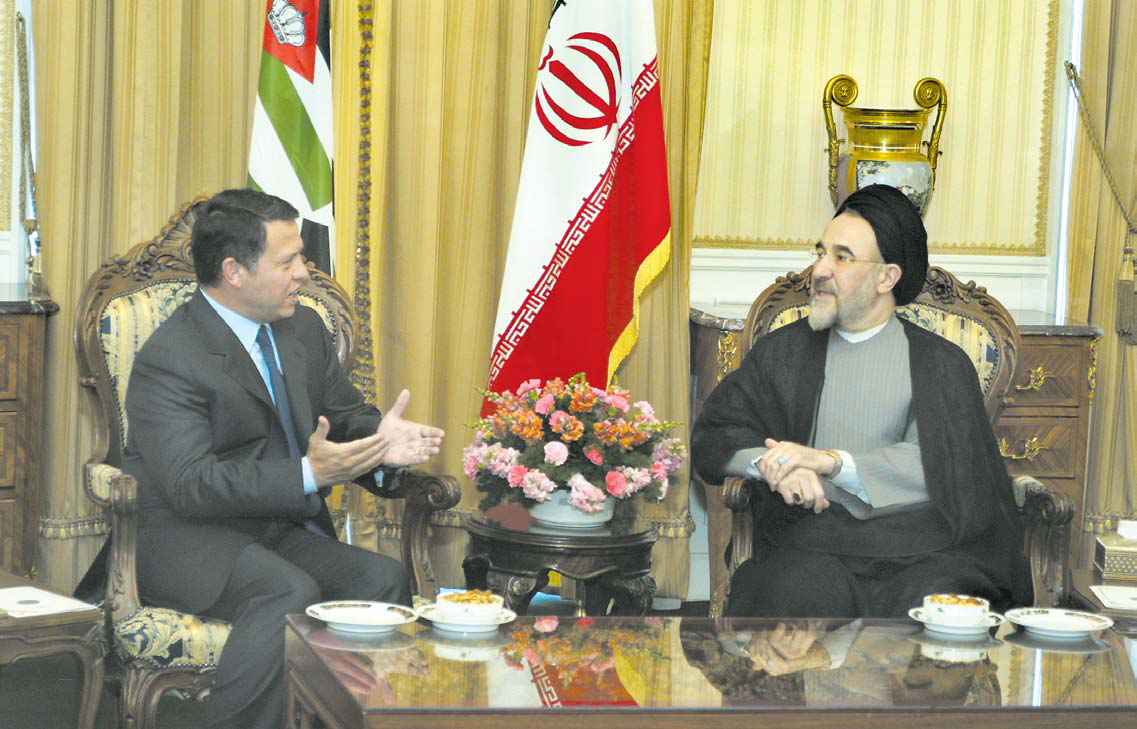
Early life and education
Khatami was born on 14 October 1943, in the small town of Ardakan, in Yazd Province into a sayyid Persian family. He married Zohreh Sadeghi, the daughter of a professor of religious law, and niece of Musa al-Sadr, in 1974 (at the age of 31). The couple have two daughters and one son: Laila (born 1975), Narges (born 1980), and Emad (born 1988).
Khatami's father, Ayatollah Ruhollah Khatami, was a high-ranking cleric and the Khatib (the one who delivers the sermon for Friday prayers) in the city of Yazd in the early years of the Iranian Revolution.
Khatami's brother, Mohammad-Reza Khatami, was elected as Tehran's first member of parliament in the 6th term of parliament, during which he served as deputy speaker of the parliament. He also served as the secretary-general of Islamic Iran Participation Front (Iran's largest reformist party) for several years. Mohammad Reza is married to Zahra Eshraghi, a feminist human rights activist and granddaughter of Ruhollah Khomeini (founder of the Islamic Republic of Iran).

Khatami's other brother, Ali Khatami, a businessman with a master's degree in Industrial Engineering from Polytechnic University in Brooklyn, served as the President's Chief of Staff during President Khatami's second term in office, where he kept an unusually low profile.
Khatami's eldest sister, Fatemeh Khatami, was elected as the first representative of the people of Ardakan (Khatami's hometown) in 1999 city council elections.
Mohammad Khatami is not related to Ahmad Khatami, a hardline cleric and Provisional Friday Prayer Leader of Tehran.

Mohammad Khatami received a BA in Western philosophy at Isfahan University, but left academia while studying for a master's degree in educational sciences at Tehran University and went to Qom to complete his previous studies in Islamic sciences. He studied there for seven years and completed the courses to the highest level, Ijtihad. After that, he briefly settled in Germany to chair the Islamic Centre in Hamburg from 1978 to 1980.
Before serving as president, Khatami was a representative in the parliament from 1980 to 1982, supervisor of the Kayhan Institute, Minister of Culture and Islamic Guidance (1982–1986), and then for a second term from 1989 to 24 May 1992 (when he resigned), the head of the National Library of Iran from 1992 to 1997, and a member of the Supreme Council of Cultural Revolution. He is a member and chairman of the Central Council of the Association of Combatant Clerics. Besides his native language Persian, Khatami speaks Arabic, English, and German.
Presidency (1997–2005)
Running on a reform agenda, Khatami was elected president on 23 May 1997, in what many have described as a remarkable election. Voter turnout was nearly 80%. Despite limited television airtime, most of which went to the conservative Speaker of Parliament and favored candidate Ali Akbar Nategh-Nuri, Khatami received 70 percent of the vote. "Even in Qom, the center of theological training in Iran and a conservative stronghold, 70% of voters cast their ballots for Khatami." He was re-elected on 8 June 2001 for a second term and stepped down on 3 August 2005 after serving his maximum two consecutive terms under the Islamic Republic's constitution.
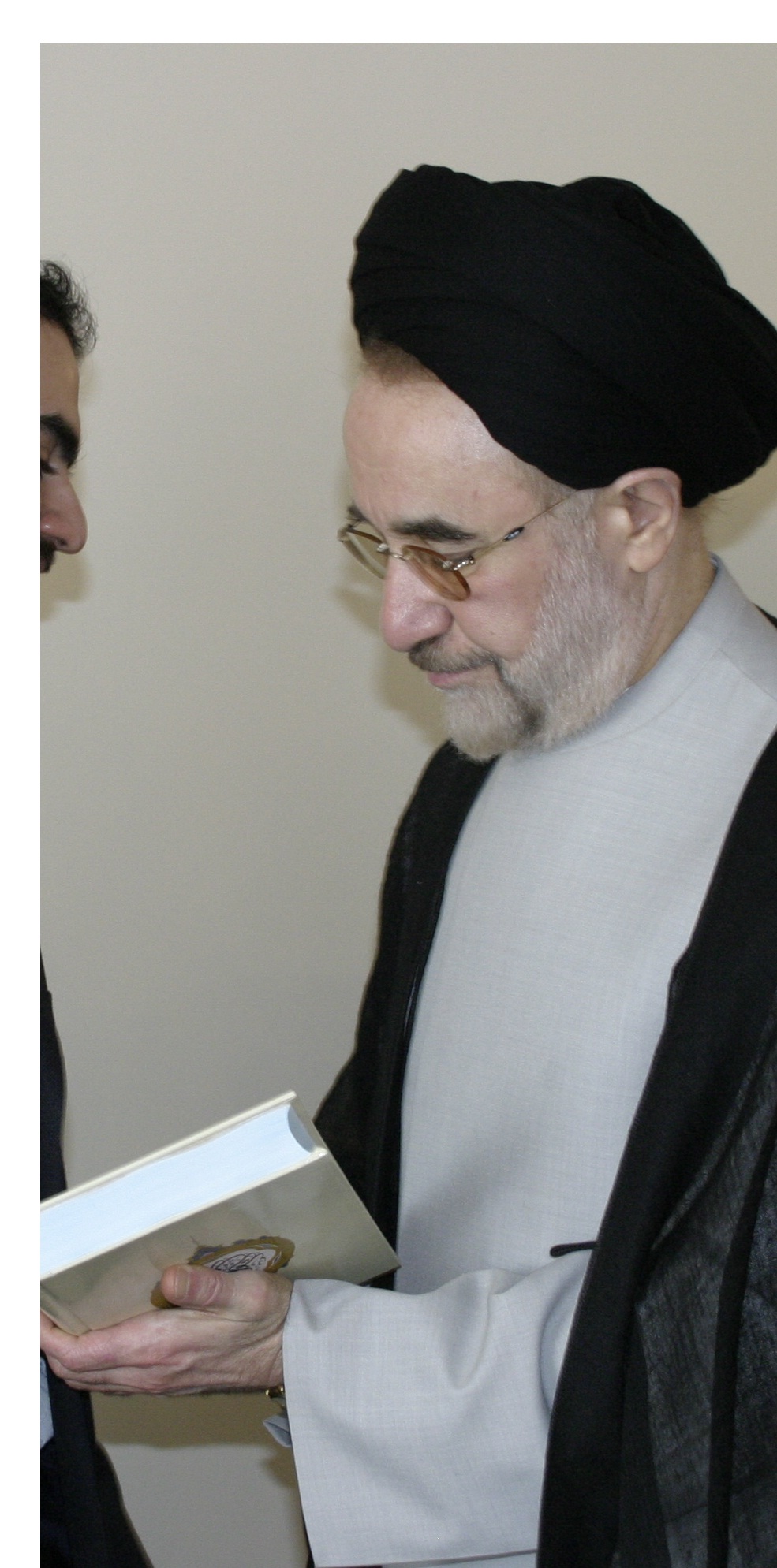
Khatami supporters have been described as a "coalition of strange bedfellows, including traditional leftists, business leaders who wanted the state to open up the economy and allow more foreign investment, and younger voters. Khatami's ascendancy was a prelude to a dynamic reform thrust that injected hope into Iranian society, whipped up a dormant nation after eight years of war with Iraq in the 1980s and the costly post-conflict reconstruction, and incorporated terms in the political lexicon of young Iranians that were not previously embedded in the national discourse, nor did they count as priorities for the majority of the people.
The day of his election, 2 Khordad, 1376, in the Iranian calendar, is regarded as the starting date of "reforms" in Iran. His followers are therefore usually known as the "2nd of Khordad Movement".
Khatami is regarded as Iran's first reformist president, since the focus of his campaign was on the rule of law, democracy, and the inclusion of all Iranians in the political decision-making process. However, his policies of reform led to repeated clashes with the hardline and conservative Islamists in the Iranian government, who control powerful governmental organizations like the Guardian Council, whose members are appointed by the Supreme Leader.

As President, according to the Iranian political system, Khatami was outranked by the Supreme Leader. Thus, Khatami had no legal authority over key state institutions such as the armed forces, the police, the army, the revolutionary guards, the state radio and television, and the prisons. (See Politics of Iran).
Khatami presented the so-called "twin bills" to the parliament during his term in office, these two pieces of proposed legislation would have introduced small but key changes to the national election laws of Iran and also presented a clear definition of the president's power to prevent constitutional violations by state institutions. Khatami himself described the "twin bills" as the key to the progress of reforms in Iran. The bills were approved by the parliament but were eventually vetoed by the Guardian Council.
Generality
Press freedom, civil society, women's rights, religious tolerance, dialogue and political development were concepts that constituted the core of Khatami's ideology, who as a cleric faced immeasurable pressure on behalf of the orthodox seminarians over the changes he was advocating. He inducted his Westward charm offensive by engaging the European Union, and became the first Iranian president to travel to Austria, France, Germany, Greece, Italy, Norway and Spain. From the University of St Andrews in Scotland to the World Economic Forum in Davos and the UNESCO headquarters in Paris, he was frequently solicited to give talks at reputed venues to articulate the new Iranian vision and tell the world how he wanted to portray his people's aspirations.

Economic policy
Khatami's economic policies followed the previous government's commitment to industrialization. At a macro-economic level, Khatami continued the liberal policies that Rafsanjani had embarked on in the state's first five-year economic development plan (1990–1995). On 10 April 2005, Khatami cited economic development, large-scale operations of the private sector in the country's economic arena and 6% economic growth as among the achievements of his government. He allocated $5 billion to the private sector for promoting the economy, adding that the value of contracts signed in this regard has reached $10 billion.
A year into his first term as president of Iran, Khatami acknowledged Iran's economic challenges, stating that the economy was, "chronically ill...and it will continue to be so unless there is fundamental restructuring".
For much of his first term, Khatami saw through the implementation of Iran's second five-year development plan. On 15 September 1999, Khatami presented a new five-year plan to the Majlis. Aimed at the period from 2000 to 2004, the plan called for economic reconstruction in a broader context of social and political development. The specific economic reforms included "an ambitious program to privatize several major industries ... the creation of 750,000 new jobs per year, average annual real GDP growth of six percent over the period, reduction in subsidies for basic commodities...plus a wide range of fiscal and structural reforms". Unemployment remained a major problem, with Khatami's five-year plan lagging behind in job creation. Only 300,000 new jobs were created in the first year of the plan, well short of the 750,000 that the plan called for. The 2004 World Bank report on Iran concludes that "after 24 years marked by internal post-revolutionary strife, international isolation, and deep economic volatility, Iran is slowly emerging from a long period of uncertainty and instability".
At the macroeconomic level, real GDP growth rose from 2.4% in 1997 to 5.9% in 2000. Unemployment was reduced from 16.2% of the labour force to less than 14%. The consumer price index fell to less than 13% from more than 17%. Both public and private investments increased in the energy sector, the building industry, and other sectors of the country's industrial base. The country's external debt was cut from $12.1 billion to $7.9 billion, its lowest level since the Iran-Iraq cease-fire. The World Bank granted $232 million for health and sewage projects after a hiatus of about seven years. The government, for the first time since the 1979 wholesale financial nationalization, authorized the establishment of two private banks and one private insurance company. The OECD lowered the risk factor for doing business in Iran to four from six (on a scale of seven).
The government's own figures put the number of people under the absolute poverty line in 2001 at 15.5% of the total population – down from 18% in 1997, and those under relative poverty at 25%, thus classifying some 40% of the population as poor. Private estimates indicate higher figures.
Among 155 countries in a 2001 world survey, Iran under Khatami was 150th in terms of openness to the global economy. On the United Nations Human Development scale, Iran ranked 90th out of 162 countries, only slightly better than its previous position at 97 out of 175 countries four years earlier. The overall risk of doing business in Iran improved only marginally from "D" to "C". One of his economic strategies was on the basis of absorbing foreign and domestic capital resources for the privatization of the economy. Therefore, in 2001, the organization of privatization was established. Also the government encourages people to buy shares in private companies by providing incentives. Also Iran succeeded to convince the World Bank to approve loans totaling 432 billion dollars to the country.
Foreign policy
During Khatami's presidency, Iran's foreign policy began a process of moving from confrontation to conciliation. In Khatami's notion of foreign policy, there was no "clash of civilizations", he favored instead a "Dialogue Among Civilizations". Relations with the US remained marred by mutual suspicion and distrust, but during Khatami's two terms, Tehran increasingly made efforts to play a greater role in the Persian Gulf region and beyond.
As President, Khatami met with many influential figures including Pope John Paul II, Koichiro Matsuura, Jacques Chirac, Johannes Rau, Vladimir Putin, Abdolaziz Bouteflika, Mahathir Mohamad and Hugo Chávez. In 2003, Khatami refused to meet militant Iraqi cleric Muqtada al-Sadr. However, Khatami attended Hafez al-Assad's funeral in 2000 and told new Syrian president Bashar al-Assad that "the Iranian government and people would stand by and support him".
On 8 August 1998, the Taliban massacred 4,000 Shias in the town of Mazar-i-Sharif, Afghanistan. It also attacked and killed 11 Iranian diplomats with an Iranian journalist among them. The rest of the diplomats were taken hostage. Ayatollah Khamenei ordered the amassing of troops near the Iran Afghanistan border to enter Afghanistan and fight the Taliban. Over 70,000 Iranian troops were placed along the borders of Afghanistan. Khatami halted the invasion and looked to the UN for help. Soon he was placed in talks. Later Iran entered negotiations with the Taliban, the diplomats were released. Khatami and his advisers had managed to keep Iran from entering war with the Taliban.
After the 2003 earthquake in Bam, the Iranian government rebuffed Israel's offer of assistance. On 8 April 2005, Khatami sat near Iranian-born Israeli President Moshe Katsav during the funeral of Pope John Paul II because of alphabetical order. Later, Katsav shook hands and spoke with Khatami. Katsav himself is in origin an Iranian Jew, and from a part of Iran close to Khatami's home; he stated that they had spoken about their home province. That would make this incident the first official political contact between Iran and Israel since diplomatic ties were severed in 1979.
However, after he returned to Iran, Khatami was subject to harsh criticism from conservatives for having "recognised" Israel by speaking to its president. Subsequently, the country's state-run media reported that Khatami strongly denied shaking hands and chatting with Katsav. In 2003, Iran approached the United States with proposals to negotiate all outstanding issues including the nuclear issue and a two-state settlement for Israel and the Palestinians.
In 2006, and as an ex-president, he became the highest-ranking Iranian politician to visit the United States, excluding annual diplomatic trips of chief executives to the UN headquarters in New York. He gave a speech at the Washington National Cathedral and continued his US tour by addressing Harvard University, Georgetown University and the University of Virginia.
Currency crisis
From 1995 to 2005, Khatami's administration successfully reduced the rate of fall in the value of the Iranian rial bettering even the record of Mousavi. Nevertheless, the currency continued to fall from 2,046 to 9,005 to the U.S. dollar during his term as president.
Cultural
Khatami's moderate policies also differed sharply from those of his radical opponents, who sought stricter Islamic rule. Thus, the moderate Khatami all-inclusive and pluralistic message posed a stark contrast to the reactionary stances of the earlier decades of the revolution. He represented hope for the masses who desired change that differed in nature from what they had experienced in 1979, and yet a change that preserved Iran’s Islamic republican system.
In the first years of his presidency, relative freedom of the press was formed in the country, and for the first time after the summer of 1360, some opposition forces were able to print publications or publish articles criticizing the performance of high-ranking officials. During this period, the Association of Iranian Journalists, the national union of journalists in Iran was established in October 1376, after Mohammad Khatami took office.
National Library and Archive of Iran was completed with Khatami's follow-up and banned books were allowed to be printed, as Kelidar.
Bahram Beyzai and Abbas Kiarostami did many activities during this period and the country's cinema space became more open. With a glance at this period, it can be seen that most filmmakers turned their attention to making films with social themes.
Iran Music House and Music Festival of Iran's regions institutes was founded in this period. Iran's National Orchestra was founded in 1998 under the conduction of Farhad Fakhreddini.
Khatami and Iran's 2004 parliamentary election
In February 2004, Parliament elections, the Guardian Council banned thousands of candidates, including most of the reformist members of the parliament and all the candidates of the Islamic Iran Participation Front party from running. This led to a win by the conservatives of at least 70% of the seats. Approximately 60% of the eligible voting population participated in the elections.
Khatami recalled his strong opposition against holding an election his government saw as unfair and not free. He also narrated the story of his visit to the Supreme Leader Ali Khamenei, together with the Parliament's spokesman (considered the head of the legislature) and a list of conditions they had handed him before they could hold the elections. The list, he said, was then passed on to the Guardian Council, the legal supervisor and major obstacle to holding free and competitive elections in recent years. The members of the Guardian Council are appointed directly by the Supreme Leader and are considered to be applying his will. "But", Khatami said, "the Guardian Council kept neither the Supreme Leader's nor its own word [...] and we were faced with a situation in which we had to choose between holding the election or risking huge unrest [...] and so damaging the regime". At this point, student protesters repeatedly chanted the slogan "Jannati is the nation's enemy", referring to the chairman of the Guardian Council. Khatami replied, "If you are the representative of the nation, then we are the nation's enemy". However, after clarification by students stating that "Jannati, not Khatami", he took advantage of the opportunity to claim a high degree of freedom in Iran.
When the Guardian Council announced the final list of candidates on 30 January 125 reformist members of parliament declared that they would boycott the election and resign their seats, and the Reformist interior minister declared that the election would not be held on the scheduled date, 20 February. However, Khatami then announced that the election would be held on time, and he rejected the resignations of his cabinet ministers and provincial governors. These actions paved the way for the election to be held and signaled a split between the radical and moderate wings of the reformist movement.
Cultural and political image
Dialogue Among Civilizations
Following earlier works by the philosopher Dariush Shayegan, in early 1997, during his presidential campaign, Khatami introduced the theory of Dialogue Among Civilizations as a response to Samuel P. Huntington's Clash of Civilizations theory. He introduced this concept in the United Nations in 1998.
Consequently, on 4 November 1998 the UN adopted a resolution proclaiming the year 2001 as the United Nations' Year of Dialogue Among Civilizations, as per Khatami's suggestion. Pleading for the moralization of politics, Khatami argued that "the political translation of dialogue among civilizations would consist in arguing that culture, morality, and art must prevail on politics." President Khatami's call for a dialogue among civilizations elicited a published reply from an American author, Anthony J. Dennis, who served as the originator, contributor, and editor of an historic and unprecedented collection of letters addressing all facets of Islamic-Western and U.S.–Iranian relations entitled Letters to Khatami: A Reply To The Iranian President's Call For A Dialogue Among Civilizations which was published in the U.S. by Wyndham Hall Press in July 2001. To date, this book is the only published reply Khatami has ever received from the West.
Culture
Khatami believes that the modern world in which we live is such that Iranian youth are confronted with new ideas and is receptive of foreign habits. He also believes that the limitation on youth leads to separation of them from the regime and calls them into Satanic cultures. He predicted that even worse, the youth will learn and accept the MTV culture. This fact leads to secularization.
Cinema
In terms of Islamic values, Mohammad Khatami encouraged film makers to include themes such as self-sacrifice, martyrdom, and revolutionary patience. When Khatami was the minister of culture, he believed that cinema was not limited to the mosque and it is necessary to pay attention to entertaining aspects of cinema and not limiting it to religious aspect.
Khatami as a scholar
Khatami's main research field is political philosophy. One of Khatami's academic mentors was Javad Tabatabaei, an Iranian political philosopher. Later on Khatami became a university lecturer at Tarbiat Modares University, where he taught political philosophy. Khatami also published a book on political philosophy in 1999. The ground he covers is the same as that covered by Javad Tabatabai: Platonising adaptation of Greek political philosophy by Farabi (died 950), synthesis of the eternal wisdom of Persian statecraft by Abu'l-Hasan Amiri (died 991) and Mushkuya Razi (died 1030), the juristic thoughts of al-Mawardi and al-Ghazali, and Nizam al-Mulk's treatise on statecraft. He ends with a discussion of the revival of political philosophy in Safavid Isfahan in the second half of the 17th century.
Further, Khatami shares with Javad Tabatabai the idea of the decline of Muslim political thought beginning at the very outset, after Farabi.
Like Tabatabaei, Khatami brings in the sharply contrasting Aristotelian view of politics to highlight the shortcomings of Muslim political thought. Khatami has also lectured on the decline in Muslim political thought in terms of the transition from political philosophy to royal policy (siyâsat-e shâhi) and its imputation to the prevalence of "forceful domination" (taghallub) in Islamic history.
In his "Letter for Tomorrow", he wrote: