
Mir (Russian: Мир, IPA: [ˈmʲir]; lit. 'peace' or 'world') was a space station operated in low Earth orbit from 1986 to 2001, first by the Soviet Union and later by the Russian Federation. Mir was the first modular space station and was assembled in orbit from 1986 to 1996. At the time it was the largest artificial satellite in orbit, only being succeeded by the International Space Station (ISS) after Mir's deorbiting in 2001. The station served as a microgravity research laboratory in which crews conducted experiments in biology, human biology, physics, astronomy, meteorology, and spacecraft systems with a goal of developing technologies required for permanent occupation of space.
Mir was the first continuously inhabited long-term research station in orbit and previously held the record for the longest continuous human presence in space at 3,644 days, until it was surpassed by the ISS in 2010. It holds the record for the longest single human spaceflight, Valeri Polyakov, who spent 437 days on the station from 1994 until 1995. Mir's typical crew size was 3, though larger short-term crews made an appearance, peaking at ten during STS-71. Occupied for twelve and a half years out of its fifteen-year lifespan, 105 cosmonauts and astronauts from 12 different nations visited the station, and conducted 80 spacewalks.
Mir was the next stage of the Soviet space programme's station development, following the success of six crewed single-module stations under the Salyut programme; its inaugural flight, Soyuz T-15, also conducted the only station-to-station trip, docking with Salyut 7 during its mission. Consisting of seven pressurised modules and several unpressurised components, its initial Core Module was launched in 1986. Proton rockets launched all components, except the Docking Module, which was installed by the Space Shuttle on STS-74. Power was provided by several photovoltaic arrays attached directly to the modules. The station was maintained at an orbit between 296 and 421 km (184 and 262 mi) altitude, completing 15.7 orbits per day at an inclination of 51.6°.
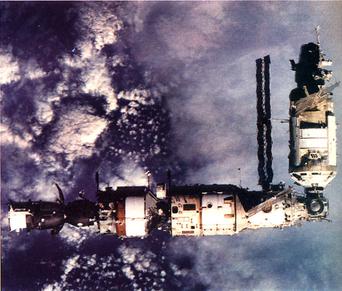
Initially, the station was operated by NPO Energia with subcontracting to KB Salyut. Following the dissolution of the Soviet Union, Mir was operated by the Russian Federal Space Agency (RKA). Most of the station's occupants were Soviet/Russian; through international collaborations such as the Interkosmos, Euromir and Shuttle–Mir programmes, the station was made accessible to space travellers from several Asian, European and North American nations. Mir was deorbited in March 2001 after funding was cut off. The cost of the Mir programme was estimated by former RKA General Director Yuri Koptev in 2001 as $4.2 billion over its lifetime (including development, assembly and orbital operation). As of 2026, five of the ten longest human spaceflights ever were aboard Mir.
Origins
Mir was authorised by a 17 February 1976 decree, to design an improved model of the Salyut space stations. Four Salyut space stations had been launched since 1971; three more were launched during Mir's development. It was planned that the station's core module (DOS-7 and the backup DOS-8) would have a total of four docking ports: one at each end of the station (as in the Salyut stations) and one on each side of a docking sphere at the front of the station to allow more modules to expand the station's capabilities. By August 1978, this had evolved to the final configuration: one aft port and five ports in a spherical compartment at the fore.
It was originally planned that the ports would connect to 7.5-tonne (8.3-short-ton) modules derived from the Soyuz spacecraft. These modules would have used a Soyuz propulsion module, as used in Soyuz and Progress; and the descent and orbital modules would have been replaced with a long laboratory module. Following a February 1979 governmental resolution, the programme was consolidated with Vladimir Chelomei's crewed Almaz military space station programme. The docking ports were reinforced to accommodate 20-tonne (22-short-ton) space-station modules based on the TKS spacecraft. NPO Energia was responsible for the overall space station, with work subcontracted to KB Salyut, due to ongoing work on the Energia rocket, Salyut 7, Soyuz-T, and Progress spacecraft. KB Salyut began work in 1979, and drawings were released in 1982 and 1983. New systems incorporated into the station included gyrodyne flywheels (taken from Almaz), Kurs automatic rendezvous system, Luch satellite communications system, Elektron oxygen generators, and Vozdukh carbon dioxide scrubbers and the Salyut 5B digital flight control computer, although the Salyut 5B computer was not installed until the delivery of the Kvant-2 module.

In early 1984, work on Mir had halted while all resources were being put into the Buran programme to prepare the Buran spacecraft for flight testing. Funding resumed in early 1984 when Valentin Glushko was ordered by the Central Committee's Secretary for Space and Defence to orbit Mir by early 1986, in time for the 27th Communist Party Congress.
It was clear that the planned processing flow could not be followed and still meet the 1986 launch date. It was decided on Cosmonaut's Day (12 April) 1985 to ship the flight model of the base block to the Baikonur Cosmodrome and conduct the systems testing and integration there. The module arrived at the launch site on 6 May, with 1100 of 2500 cables requiring rework based on the results of tests to the ground test model at Khrunichev. In October, the base block was rolled outside its cleanroom to carry out communications tests. The first launch attempt on 16 February 1986 was scrubbed when the spacecraft communications failed, but the second launch attempt, on 19 February 1986 at 21:28:23 UTC, was successful, meeting the political deadline.
Station structure
Assembly
The assembly of Mir began on 20 February 1986 with the launch of the Mir core module. Four out of the six modules which were later added (Kvant-2 in 1989, Kristall in 1990, Spektr in 1995 and Priroda in 1996) followed the same sequence to be added to the Mir station:

The module would launch independently on a Proton-K rocket, and rendezvous with the station automatically. It would then dock with the forward (-X) docking node on the core module, and then utilise its Lyappa arm to attach itself to a fixture on the core module, then lift the module away and rotate the arm to another port, before mating and docking with the new docking port. The node was equipped with only two Konus drogues, which were required for dockings. This meant that, prior to the arrival of each new module, the node would have to be depressurised to allow spacewalking cosmonauts to manually relocate the drogue to the next port to be occupied.
The other two modules, Kvant-1 and the docking module did not follow this procedure.
Kvant-1 was originally designed to be installed on the Salyut 7 station, and did not feature a propulsion system of its own. Instead, Kvant-1 would be assisted by a space tug based on the TKS spacecraft, which delivered the module to the aft docking node of the core module instead of the forward docking node. Kvant-1 successfully docked on April 11th, 1987, and the tug disposed of itself the next day.
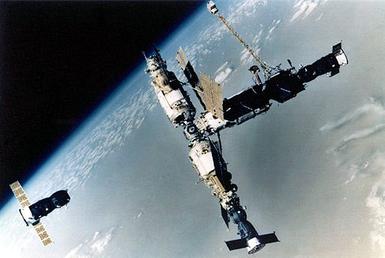
The docking module was launched on STS-74 by Space Shuttle Atlantis on November 12, 1995, and was mated to the orbiter's docking system via the Canadarm. Atlantis then docked, via the module, to Kristall, then left the module behind when it undocked later in the mission. Various other external components, including two Strela cranes, three truss structures and several experiments and other unpressurised elements were also mounted to the exterior of the station over the course of the station's history.
The station's assembly marked the beginning of the third generation of space station design, being the first to consist of more than one primary spacecraft (thus opening a new era in space architecture). First generation stations such as Salyut 1 and Skylab had monolithic designs, consisting of one module with no resupply capability; the second generation stations Salyut 6 and Salyut 7 comprised a monolithic station with two ports to allow consumables to be replenished by cargo spacecraft such as Progress. The capability of Mir to be expanded with add-on modules meant that each could be designed with a specific purpose in mind (for instance, the core module functioned largely as living quarters), thus eliminating the need to install all the station's equipment in one module.
Pressurised modules
In its completed configuration, the space station consisted of seven different modules, each launched into orbit separately over a period of ten years by either Proton-K rockets or Space Shuttle Atlantis.

Unpressurised elements
In addition to the pressurised modules, Mir featured several external components. The largest component was the Sofora girder, a large scaffolding-like structure consisting of 20 segments which, when assembled, projected 14 metres from its mount on Kvant-1. A self-contained thruster block, the VDU (Vynosnaya Dvigatyelnaya Ustanovka), was mounted on the end of Sofora and was used to augment the roll-control thrusters on the core module. The VDU's increased distance from Mir's axis allowed an 85% decrease in fuel consumption, reducing the amount of propellant required to orient the station. A second girder, Rapana, was mounted aft of Sofora on Kvant-1. This girder, a small prototype of a structure intended to be used on Mir-2 to hold large parabolic dishes away from the main station structure, was 5 metres long and used as a mounting point for externally mounted exposure experiments.
To assist in moving objects around the exterior of the station during EVAs, Mir featured two Strela cargo cranes mounted to the sides of the core module, used for moving spacewalking cosmonauts and parts. The cranes consisted of telescopic poles assembled in sections which measured around 1.8 metres (6 ft) when collapsed, but when extended using a hand crank were 14 metres (46 ft) long, meaning that all of the station's modules could be accessed during spacewalks.
Each module was fitted with external components specific to the experiments that were carried out within that module, the most obvious being the Travers antenna mounted to Priroda. This synthetic aperture radar consisted of a large dish-like framework mounted outside the module, with associated equipment within, used for Earth observations experiments, as was most of the other equipment on Priroda, including various radiometers and scan platforms. Kvant-2 also featured several scan platforms and was fitted with a mounting bracket to which the cosmonaut manoeuvring unit, or Ikar, was mated. This backpack was designed to assist cosmonauts in moving around the station and the planned Buran in a manner similar to the US Manned Maneuvering Unit, but it was only used once, during EO-5.

In addition to module-specific equipment, Kvant-2, Kristall, Spektr and Priroda were each equipped with one Lyappa arm, a robotic arm which, after the module had docked to the core module's forward port, grappled one of two fixtures positioned on the core module's docking node. The arriving module's docking probe was then retracted, and the arm raised the module so that it could be pivoted 90° for docking to one of the four radial docking ports.
Power supply
Photovoltaic arrays powered Mir. The station used a 28 volt DC supply which provided 5-, 10-, 20- and 50-amp taps. When the station was illuminated by sunlight, several solar arrays mounted on the pressurised modules provided power to Mir's systems and charged the nickel-cadmium storage batteries installed throughout the station. The arrays rotated in only one degree of freedom over a 180° arc, and tracked the Sun using Sun sensors and motors installed in the array mounts. The station itself also had to be oriented to ensure optimum illumination of the arrays. When the station's all-sky sensor detected that Mir had entered Earth's shadow, the arrays were rotated to the optimum angle predicted for reacquiring the Sun once the station passed out of the shadow. The batteries, each of 60 Ah capacity, were then used to power the station until the arrays recovered their maximum output on the day side of Earth.
The solar arrays themselves were launched and installed over a period of eleven years, more slowly than originally planned, with the station continually suffering from a shortage of power as a result. The first two arrays, each 38 m2 (410 ft2) in area, were launched on the core module, and together provided a total of 9 kW of power. A third, dorsal panel was launched on Kvant-1 and mounted on the core module in 1987, providing a further 2.5 kW from a 22 m2 (240 ft2) area. Kvant-2, launched in 1989, provided two 10 metres (33 feet) long panels which supplied 3.5 kW each, whilst Kristall was launched with two collapsible, 15 metres (49 feet) long arrays (providing 4 kW each) which were intended to be moved to Kvant-1 and installed on mounts which were attached during a spacewalk by the EO-8 crew in 1991.
This relocation was begun in 1995, when the panels were retracted and the left panel installed on Kvant-1. By this time all the arrays had degraded and were supplying much less power. To rectify this, Spektr (launched in 1995), which had initially been designed to carry two arrays, was modified to hold four, providing a total of 126 m2 (1,360 ft2) of array with a 16 kW supply. Two further arrays were flown to the station on board the Space Shuttle Atlantis during STS-74, carried on the docking module. The first of these, the Mir cooperative solar array, consisted of American photovoltaic cells mounted on a Russian frame. It was installed on the unoccupied mount on Kvant-1 in May 1996 and was connected to the socket that had previously been occupied by the core module's dorsal panel, which was by this point barely supplying 1 kW. The other panel, originally intended to be launched on Priroda, replaced the Kristall panel on Kvant-1 in November 1997, completing the station's electrical system.
Orbit control
Mir was maintained in a near circular orbit with an average perigee of 354 km (220 mi) and an average apogee of 374 km (232 mi), travelling at an average speed of 27,700 km/h (17,200 mph) and completing 15.7 orbits per day. As the station constantly lost altitude because of slight atmospheric drag, it needed to be boosted to a higher altitude several times each year. This boost was generally performed by Progress resupply vessels, although during the Shuttle-Mir programme the task was performed by US Space Shuttles, and, prior to the arrival of Kvant-1, the engines on the core module could also accomplish the task.
Attitude control was maintained by a combination of two mechanisms; to hold a set attitude, a system of twelve control moment gyroscopes (CMGs, or "gyrodynes") rotating at 10,000 rpm kept the station oriented, six CMGs being located in each of the Kvant-1 and Kvant-2 modules. When the attitude of the station needed to be changed, the gyrodynes were disengaged, thrusters (including those mounted directly to the modules, and the VDU thruster used for roll control mounted to the Sofora girder) were used to attain the new attitude and the CMGs were reengaged. This was done fairly regularly depending on experimental needs; for instance, Earth or astronomical observations required that the instrument recording images be continuously aimed at the target, and so the station was oriented to make this possible. Conversely, materials processing experiments required the minimisation of movement on board the station, and so Mir would be oriented in a gravity gradient attitude for stability. Prior to the arrival of the modules containing these gyrodynes, the station's attitude was controlled using thrusters located on the core module alone, and, in an emergency, the thrusters on docked Soyuz spacecraft could be used to maintain the station's orientation.
Communications
Radio communications provided telemetry and scientific data links between Mir and the RKA Mission Control Centre (TsUP). Radio links were also used during rendezvous and docking procedures and for audio and video communication between crew members, flight controllers and family members. As a result, Mir was equipped with several communication systems used for different purposes. The station communicated directly with the ground via the Lira antenna mounted to the core module. The Lira antenna also had the capability to use the Luch data relay satellite system (which fell into disrepair in the 1990s) and the network of Soviet tracking ships deployed in various locations around the world (which also became unavailable in the 1990s). UHF radio was used by cosmonauts conducting EVAs. UHF was also employed by other spacecraft that docked to or undocked from the station, such as Soyuz, Progress, and the Space Shuttle, to receive commands from the TsUP and Mir crew members via the TORU system.
Microgravity
At Mir's orbital altitude, the force of Earth's gravity was 88% of sea level gravity. While the constant free fall of the station offered a perceived sensation of weightlessness, the onboard environment was not one of weightlessness or zero gravity. The environment was often described as microgravity. This state of perceived weightlessness was not perfect, being disturbed by five separate effects:
The drag resulting from the residual atmosphere;
Vibratory acceleration caused by mechanical systems and the crew on the station;
Orbital corrections by the on-board gyroscopes (which spun at 10,000 rpm, producing vibrations of 166.67 Hz) or thrusters;
Tidal forces. Parts of Mir that weren't at the exact the same distance from Earth as other parts tended to follow separate orbits. As each point was physically part of the station, remedying this was impossible, and so each component was subject to small accelerations from tidal forces;
The differences in orbital plane between different locations on the station.
Life support
Mir's environmental control and life support system (ECLSS) provided or controlled atmospheric pressure, fire detection, oxygen levels, waste management and water supply. The highest priority for the ECLSS was the station's atmosphere, but the system also collected, processed, and stored waste and water produced and used by the crew—a process that recycles fluid from the sink, toilet, and condensation from the air. The Elektron system generated oxygen electrolytically, venting hydrogen to space. Bottled oxygen and solid fuel oxygen generation (SFOG) canisters, a system known as Vika, provided backup. Carbon dioxide was removed from the air by the Vozdukh system. Other byproducts of human metabolism, such as methane from the intestines and ammonia from sweat, were removed by activated charcoal filters. Similar systems are presently used on the ISS.
The atmosphere on Mir was similar to Earth's. Normal air pressure on the station was 101.3 kPa (14.7 psi); the same as at sea level on Earth. An Earth-like atmosphere offers benefits for crew comfort.
International cooperation
Interkosmos
Interkosmos (Russian: Интеркосмос) was a Soviet space exploration programme which allowed members from foreign countries allied with the Soviet Union to participate in crewed and uncrewed space exploration missions. Participation was also made available to governments of countries such as France and India.
Only the last three of the programme's 14 missions consisted of an expedition to Mir but none resulted in an extended stay in the station:
Muhammed Faris – EP-1 (1987) Syria Turkey
Aleksandr Panayatov Aleksandrov – EP-2 (1988) Bulgaria
Abdul Ahad Mohmand – EP-3 (1988) Afghanistan
European involvement
Various European astronauts visited Mir as part of several cooperative programmes, on both the Soyuz and the Space Shuttle:
Jean-Loup Chrétien – Aragatz (1988) France
Helen Sharman – Project Juno (1991) UK
Franz Viehböck – Austromir '91 (1991) Austria
Klaus-Dietrich Flade – Mir '92 (1992) Germany
Michel Tognini – Antarès (1992) France
Jean-Pierre Haigneré – Altair (1993) France
Ulf Merbold – Euromir '94 (1994) Germany
Thomas Reiter – Euromir '95 (1995) Germany