
The Minsk agreements were a series of international agreements which sought to end the Donbas War fought between armed Russian separatist groups, backed by Russian regular forces, and the Armed Forces of Ukraine. By August 2014, Ukraine had re-taken most of the territory seized by separatists. Russia then covertly invaded the Donbas to support the separatists, inflicting a heavy defeat on the Ukrainians at Ilovaisk. Peace talks were held in Minsk, Belarus. The talks involved the Trilateral Contact Group on Ukraine, consisting of representatives of Ukraine, Russia, and the Organization for Security and Co-operation in Europe (OSCE), with mediation by the leaders of France (François Hollande) and Germany (Angela Merkel) in the so-called Normandy Format. In September 2014, the first Minsk Protocol, or Minsk I, was signed by representatives of the Trilateral Contact Group and, without recognition of their status, by the then-leaders of the self-proclaimed Donetsk People's Republic (DPR) and Luhansk People's Republic (LPR).
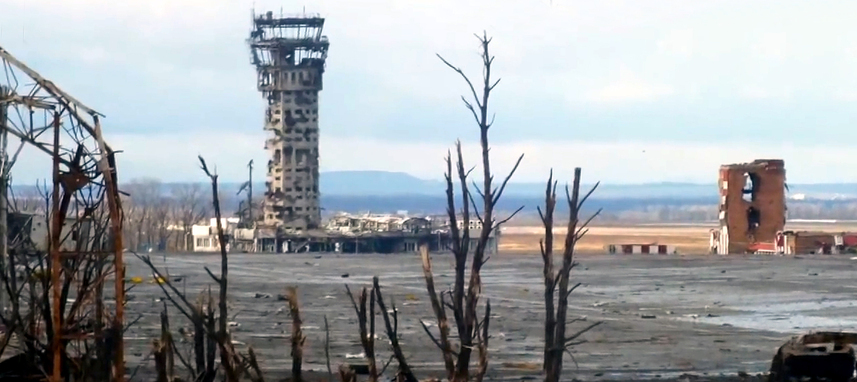
The Minsk agreement called for: an immediate ceasefire, monitored by the OSCE; immediate release of all prisoners; withdrawal of all illegal armed groups, foreign soldiers and mercenaries from Ukraine; withdrawal of heavy weaponry from the frontline; local elections in the Donbas under Ukrainian law; the granting of self-governance ("special status") to rebel-held parts of the Donbas; OSCE monitoring of the Russian-Ukrainian state border; and an amnesty for those involved in the war. On 16 September 2014, Ukraine passed a law that would grant self-rule to the rebel-held territory, amnesty for combatants, and scheduled elections there for 7 December. However, in November the separatists illegally held their own elections, which violated the Minsk agreement. The ceasefire was also repeatedly broken. On 28 September, Russian-backed forces began an offensive to capture Donetsk Airport, eventually seizing it in January 2015 with help from Russian troops.
Another agreement to end the conflict, known as Minsk II, was signed on 12 February 2015. It was a more detailed version of the first agreement, and called for another ceasefire from 15 February, withdrawal of heavy weapons further from the frontline, granting further self-governance to the Donbas, and restoring Ukrainian control of its border with Russia. It also set out timeframes. Despite this, Russian-backed forces immediately renewed an offensive on Debaltseve, saying they would not observe the ceasefire there and claiming it rightfully belonged to them. Ukraine, the EU and the US called this a breach of the ceasefire, and said the Russian military itself took part. Following the capture of Debaltseve, fighting died down, although it never ended completely, and the agreement's provisions were never fully implemented.

In 2019, all sides agreed to the Steinmeier formula; a simplified version of the Minsk agreements and means of implementing them, proposed by former German foreign minister Frank-Walter Steinmeier. Following a ceasefire and withdrawal of foreign soldiers, local elections would be held in the Donbas under Ukrainian law and observed by the OSCE. If the OSCE deemed them to be free and fair, then the separatist territories would be given "special status" (autonomy) and re-integrated into Ukraine. Ukrainians who opposed the plan argued that it would legalize the occupation of the Donbas and leave it as a Russian-controlled "Trojan horse" inside Ukraine. The Ukrainian side demanded the withdrawal of Russian forces, control of its border, and the right of internally displaced Ukrainians to return to the Donbas to vote before elections could be held. The Donbas separatists said they would not withdraw or disarm, refused to give up control of the border, and said they would seek integration with Russia. The Russian state continued to deny that its military was operating in the Donbas, insisting that elections be held there while Russian and Russian-backed forces still controlled the region and the border.
During 2021, there was a large Russian military buildup on Ukraine's borders, and increased attacks by Russian-backed forces in the Donbas, sparking an international crisis. On 21 February 2022, Russia officially recognized the DPR and LPR as independent states and sent Russian troops into the Donbas as "peacekeepers". This violated the Minsk agreements. Russian President Vladimir Putin declared that the Minsk agreements "no longer existed", and that Ukraine, not Russia, was to blame for their collapse. Russia then launched a full invasion of Ukraine on 24 February 2022.
History
In February 2014, the Russian military covertly attacked and occupied Ukrainian Crimea. Protests and unrest started in Eastern and Southern Ukraine, which researchers characterize as "unclear to what extent [they] were initiated by local dissatisfaction with the situation in Kyiv, and to what extent they were organized and supported from Russia". In spring, "DPR" and "LPR" - two unrecognized statelets - were created in Ukrainian Donbas by Russian actors. There, the Kremlin government used some of its techniques it used before during the creation of separatist enclaves in Moldova and Georgia. Russia then proceeded to establish the narrative and negotiation position in order to trap the victims of Russian aggression and involve Western states in the logic of “frozen conflict” (Umland & Essen).

In summer 2014, Ukraine launched a counter-offensive, during which it initially reclaimed large parts of lost territory. Russia had been sending special forces operatives, irregulars and small groups of regular Russian forces until late August 2014, when for the first time Russia engaged large numbers of unmarked regular military forces to help its proxies in Donbas. After losing the Battle of Ilovaisk, Ukraine was forced to sign the Minsk Protocol, or Minsk I.
Minsk Protocol
By the end of August 2014, after defeating Ukraine at Ilovaisk, Russia narrowly saved its Donbas proxies from defeat and used a show of force to cement their presence. The next step for Russia was to stabilize its control, while Ukraine wanted to prevent a military defeat. Western governments feared escalation.
The Minsk Protocol was drawn up by the Trilateral Contact Group on Ukraine, which consisted of representatives from Ukraine, Russia, and the OSCE. Meetings of the group, along with informal representatives of the breakaway Donetsk and Luhansk People's Republics, took place on 31 July, 26 August, 1 September, and 5 September 2014.

Text of the protocol
The text of the protocol consists of twelve points:
To ensure an immediate bilateral ceasefire.
To ensure the monitoring and verification of the ceasefire by the OSCE.
Decentralisation of power, including through the adoption of the Ukrainian law "On temporary Order of Local Self-Governance in Particular Districts of Donetsk and Luhansk Oblasts".
To ensure the permanent monitoring of the Ukrainian-Russian border and verification by the OSCE with the creation of security zones in the border regions of Ukraine and the Russian Federation.
Immediate release of all hostages and illegally detained persons.

A law preventing the prosecution and punishment of people in connection with the events that have taken place in some areas of Donetsk and Luhansk Oblasts.
To continue the inclusive national dialogue.
To take measures to improve the humanitarian situation in Donbas.
To ensure early local elections in accordance with the Ukrainian law "On temporary Order of Local Self-Governance in Particular Districts of Donetsk and Luhansk Oblasts".
To withdraw illegal armed groups and military equipment as well as fighters and mercenaries from the territory of Ukraine.
To adopt a programme of economic recovery and reconstruction for the Donbas region.
To provide personal security for participants in the consultations.
Signatories
The following representatives signed the document:
Swiss diplomat and OSCE representative Heidi Tagliavini
Former president of Ukraine (July 1994 to January 2005) and Ukrainian representative Leonid Kuchma
Russian Ambassador to Ukraine and Russian representative Mikhail Zurabov
Envoys of so-called DPR and LPR, Alexander Zakharchenko and Igor Plotnitsky, also signed the protocol, without "their self-declared functions" mentioned.
Follow-up memorandum
In the two weeks after the Minsk Protocol was signed, there were frequent violations of the ceasefire by both parties to the conflict. Talks continued in Minsk, and a follow-up to the Minsk Protocol was agreed to on 19 September 2014. This memorandum clarified the implementation of the Protocol. Amongst some of the peacemaking measures agreed to were:
To ban flights by combat aircraft over the security zone
To withdraw all foreign mercenaries from the conflict zone
To ban offensive operations
To pull heavy weaponry 15 kilometres (9.3 mi) back on each side of the line of contact, creating a 30-kilometre (19 mi) buffer zone
To task the OSCE Special Monitoring Mission to Ukraine with monitoring implementation of Minsk Protocol
Breaches of the first Minsk agreement
After the conclusion of Protocol and Memorandum, a fragile ceasefire was established. However, even although the agreement met Russian interests, the fighting did not stop. Both sides continued to accuse each other of ceasefire breaches. In late September 2014, the Second Battle of Donetsk Airport broke out as the separatists began an offensive to seize the airport. In late October, DPR "prime minister" and Minsk Protocol signatory Alexander Zakharchenko said that his forces would "take back" Mariupol, Kramatorsk and Sloviansk and said that DPR forces would be willing to wage "heavy battles" to do so. Soon after, Zakharchenko said that he had been misquoted, and that he had meant these cities would be taken through "peaceful means".
On 16 September 2014, Ukraine's parliament passed a law that would grant limited self-rule to the rebel-held territory, amnesty for combatants, and scheduled elections there for 7 December.
However, the separatists then announced that they would hold their own elections in November. This violated the Minsk agreement. The OSCE chairman Didier Burkhalter confirmed that the elections would go against "the letter and spirit of the Minsk Protocol", and said that they would "further complicate its implementation". This is because the elections were not agreed to by all sides, would not involve Ukrainian parties and candidates, would not be observed by the OSCE, and would be held while Russian-backed militants controlled the region. Russia said it "respected" the illegal vote, and treated the new local authorities as representing the "people of the Donbas" in future negotiations. Separatist leader Zakharchenko said "These are historical times. We are creating a new country!".
Collapse
The Protocol and Memorandum did not stop the war in the east of Ukraine. By January 2015, the Minsk Protocol ceasefire had completely collapsed. Following the Russian victory at Donetsk International Airport in defiance of the Protocol, DPR spokesman Eduard Basurin said that "the Minsk Memorandum will not be considered in the form it was adopted". Later in the day, DPR leader Alexander Zakharchenko said that the DPR "will not make any attempts at ceasefire talks any more", and that his forces were going to "attack right up to the borders of Donetsk region". The New York Times said that the ceasefire had "all but vanished". In January - February, Russia repeated its pattern of August 2014, invaded with fresh forces and attacked and defeated Ukrainian forces at Debaltseve, forcing Ukraine to sign a Package of Measures for the Implementation of the Minsk Agreements, or Minsk II.
Amidst increasing violence in the combat zone, another round of Minsk talks was scheduled for 31 January. Members of the Trilateral Contact Group travelled to Minsk to meet representatives of the DPR and LPR. The DPR and LPR signatories of the Protocol did not attend, and those representatives that did attend were not able to discuss the implementation of the Protocol or memorandum. These representatives asked for the revision of the Protocol and the memorandum. The meeting was adjourned with no result.
Minsk II, February 2015
Successive attempts to resolve the ongoing war in the Donbas region of Ukraine had seen no result by the start of February 2015. While the Minsk Protocol of 5 September 2014 did significantly reduce fighting in the conflict zone for many months, minor skirmishes continued. At the start of January 2015, Russia sent another large batch of its regular military, which together with separatist forces of the Donetsk People's Republic (DPR) and Luhansk People's Republic (LPR) began a new offensive on Ukrainian-controlled areas, resulting in the complete collapse of the Minsk Protocol ceasefire.
After heavy fighting, DPR forces captured the symbolically important Donetsk International Airport on 21 January, the last part of the city of Donetsk that had been under Ukrainian control. Following this victory, Russian military together with separatist forces pressed their offensive on the important railway and road junction of Debaltseve in late January. This renewed heavy fighting caused significant concern in the international community. Ukraine suffered another "devastating" defeat. French president François Hollande and German chancellor Angela Merkel put forth a new peace plan on 7 February.
The Franco-German plan, drawn up after talks with Ukrainian president Petro Poroshenko and Russian president Vladimir Putin, was seen as a revival of the Minsk Protocol. President Hollande said that the plan was the "last chance" for resolution of the conflict. The plan was put forth in response to American proposals to send armaments to the Ukrainian government, something that Chancellor Merkel said would only result in a worsening of the crisis.
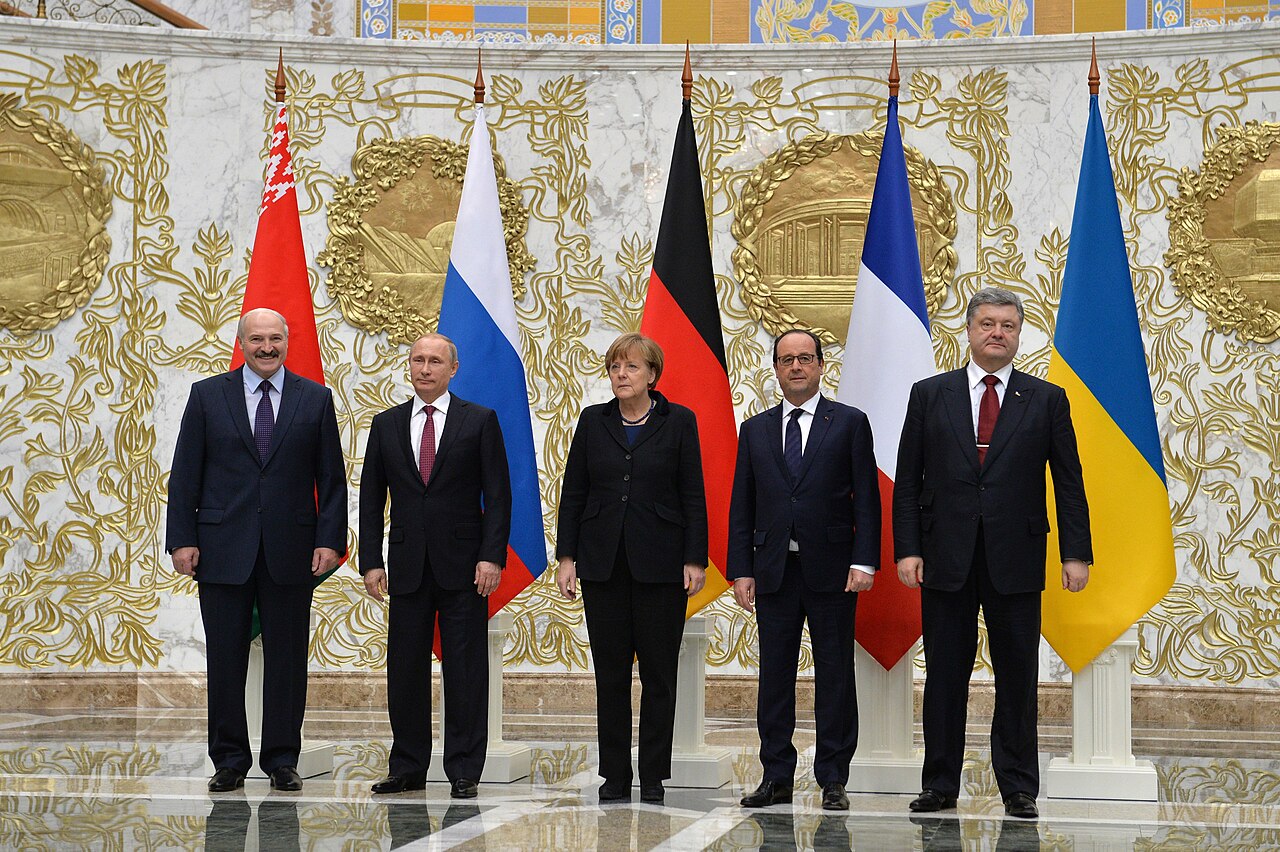
A summit to discuss the implementation of the Franco-German diplomatic plan was scheduled for 11 February at the Independence Palace in Minsk, the capital of Belarus. It was attended by Russian president Vladimir Putin, Ukrainian president Petro Poroshenko, German chancellor Angela Merkel, French president François Hollande, DPR leader Alexander Zakharchenko, and LPR leader Igor Plotnitsky. Negotiations went on overnight for sixteen hours, and were said to have been "very difficult" by the German foreign minister.
Following the talks, it was announced on 12 February 2015 that the parties to the conflict had agreed to a new package of peacemaking measures, the Package of Measures for the Implementation of the Minsk Agreements, which is commonly called Minsk II. Some of the measures agreed to were an OSCE-observed unconditional ceasefire from 15 February, withdrawal of heavy weapons from the front line, release of prisoners of war, and constitutional reform in Ukraine.
Text of the agreement
The full text of the agreement is as follows:
Immediate and full ceasefire in particular districts of Donetsk and Luhansk oblasts of Ukraine and its strict fulfilment as of 00:00 midnight EET on 15 February 2015.
Pull-out of all heavy weapons by both sides to equal distance with the aim of creation of a security zone on minimum 50 kilometres (31 mi) apart for artillery of 100mm calibre or more, and a security zone of 70 kilometres (43 mi) for multiple rocket launchers (MRLS) and 140 kilometres (87 mi) for MLRS Tornado-S, Uragan, Smerch, and Tochka U tactical missile systems:
for Ukrainian troops, from actual line of contact;
for armed formations of particular districts of Donetsk and Luhansk oblasts of Ukraine, from the contact line in accordance with the Minsk Memorandum as of 19 September 2014The pullout of the above-mentioned heavy weapons must start no later than the second day after the start of the ceasefire and finish within 14 days.This process will be assisted by OSCE with the support of the Trilateral Contact Group.
Effective monitoring and verification of ceasefire regime and pullout of heavy weapons by OSCE will be provided from the first day of pullout, using all necessary technical means such as satellites, drones, radio-location systems etc.
On the first day after the pullout a dialogue is to start on modalities of conducting local elections in accordance with the Ukrainian legislation and the Law of Ukraine "On temporary Order of Local Self-Governance in Particular Districts of Donetsk and Luhansk Oblasts," and also about the future of these districts based on the above-mentioned law.Without delays, but no later than 30 days from the date of signing of this document, a resolution has to be approved by the Verkhovna Rada of Ukraine, indicating the territory which falls under the special regime in accordance with the law "On temporary Order of Local Self-Governance in Particular Districts of Donetsk and Luhansk Oblasts," based in the line set up by the Minsk Memorandum as of 19 September 2014.
Provide pardon and amnesty by way of enacting a law that forbids persecution and punishment of persons in relation to events that took place in particular districts of Donetsk and Luhansk oblasts of Ukraine.