Windows is a proprietary graphical operating system developed and marketed by Microsoft. Windows is grouped into families that cater to particular sectors of the computing industry – Windows for personal computers, Windows Server for servers, and Windows IoT for embedded systems. Windows itself is further grouped into editions that cater to different users – Home for home users, Professional for advanced users, Education for schools, and Enterprise for corporations. Windows is sold both as a consumer retail product and to computer manufacturers, who bundle and distribute it with their systems.
The first version of Windows, Windows 1.0, was released on November 20, 1985 as a graphical operating system shell for MS-DOS in response to growing interest in graphical user interfaces (GUIs). The name Windows is a reference to the windowing system in GUIs. The 1990 release of Windows 3.0 catapulted its market success and led to the launch of various other product families, including the (now-defunct) Windows Mobile, Windows Phone, and Windows CE/Embedded Compact.
Windows is the most popular desktop operating system in the world, with a 79% market share as of April 2026, and the second-most popular operating system overall, behind Android. As of April 2026, Windows 11 is the most used desktop version of Windows, with a market share of over 70%.
All members of the Windows product family are, as of 2026, based on Windows NT. The first version of Windows in that product line, Windows NT 3.1, was intended for server computing and corporate workstations. It now consists of four sub-families that tend to be released almost simultaneously and share the same kernel.
Windows (unqualified): For a consumer or corporate workstation or tablet. The latest version is Windows 11. Its main competitors are macOS by Apple and Linux for personal computers and iPadOS and Android for tablets (cf. Usage share of operating systems § Market share by category).
Of note: "Windows" refers to both the overall product line and this sub-family of it.
Reading level
Audio Summary
Played with your browser's voice. Studio-quality audio can be added with a text-to-speech service.
Ask about this article
📝 Quick Quiz1 / 3
What is "Microsoft Windows" primarily known for?
Vocix Daily — In Your Inbox
Top stories, deep-dive articles, and "On This Day" history — one crisp digest delivered every morning.
Sources & references
Reference material for this entry is drawn from the open encyclopedic record, including Wikipedia , available under the CC BY-SA 4.0 license. Images are credited individually beside each photo.
Windows Server: For a server computer. The latest version is Windows Server 2025. Unlike its client sibling, it has adopted a strong naming scheme. The main competitor of this family is Linux. (cf. Usage share of operating systems § Market share by category)
Windows IoT (previously Windows Embedded): For IoT and embedded computers. The latest version is Windows 11 IoT Enterprise. Like Windows Server, the main competitor of this family is Linux. (cf. Usage share of operating systems § Market share by category)
Windows PE: A lightweight version of Windows designed to operate as a live operating system, used for installing Windows on bare-metal computers (especially on many computers at once), recovery, or troubleshooting purposes. The latest version is Windows PE 10.
These top-level Windows families are no longer actively developed:
MS-DOS-based versions of Windows, including Windows 1.0, Windows 2.0, Windows 3.x, and Windows 9x: The original top-level family of Windows prior to Windows NT, aimed at consumers. These versions used a monolithic kernel with MS-DOS as a foundation, with later versions in the family since Windows 95 having its own kernel. The last version was Windows Me; the family was discontinued after the release of Windows XP, with all consumer-oriented versions of Windows afterwards being based on the Windows NT kernel.
Windows Mobile: Windows Mobile was a mobile phone and PDA operating system and the predecessor to Windows Phone. The first version was Pocket PC 2000; the third version, Windows Mobile 2003, was the first version to adopt the Windows Mobile trademark. The last published version was Windows Mobile 6.5.
Windows Phone: Sold only to smartphone manufacturers. The first version was Windows Phone 7, followed by Windows Phone 8 and Windows Phone 8.1. It was succeeded by Windows 10 Mobile, which is also defunct.
Windows Embedded Compact: Most commonly known by its former name, Windows CE, it is a hybrid kernel operating system optimized for low power and memory systems, with OEMs able to modify the UI to suit their needs. The final version was Windows Embedded Compact 2013, and it is succeeded by Windows IoT.
History
The term Windows collectively describes any or all of several generations of Microsoft operating system products. These products are generally categorized as follows:
Early versions
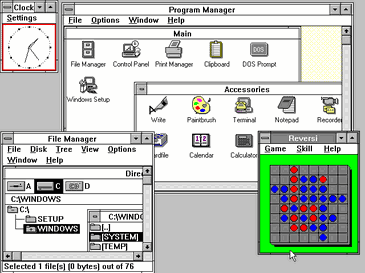
The history of Windows dates back to 1981 when Microsoft started work on a program called "Interface Manager". The name "Windows" comes from the fact that the system was one of the first to use graphical boxes to represent programs; in the industry, at the time, these were called "windows" and the underlying software was called "windowing software". It was announced in November 1983 (after the Apple Lisa, but before the Macintosh) under the name "Windows", but Windows 1.0 was not released until November 1985. Windows 1.0 was to compete with Apple's operating system, but achieved little popularity. Windows 1.0 is not a complete operating system; rather, it extends MS-DOS. The shell of Windows 1.0 is a program known as the MS-DOS Executive. Components included Calculator, Calendar, Cardfile, Clipboard Viewer, Clock, Control Panel, Notepad, Paint, Reversi, Terminal and Write. Windows 1.0 does not allow overlapping windows. Instead, all windows are tiled. Only modal dialog boxes may appear over other windows. Microsoft sold as included Windows Development libraries with the C development environment, which included numerous windows samples.
Windows 2.0 was released in December 1987, and was more popular than its predecessor. It features several improvements to the user interface and memory management. Windows 2.03 changed the OS from tiled windows to overlapping windows. The result of this change led to Apple Computer filing a suit against Microsoft alleging infringement on Apple's copyrights (eventually settled in court in Microsoft's favor in 1993). Windows 2.0 also introduced more sophisticated keyboard shortcuts and could make use of expanded memory.
Windows 2.1 was released in two different versions: Windows/286 and Windows/386. Windows/386 uses the virtual 8086 mode of the Intel 80386 to multitask several DOS programs and the paged memory model to emulate expanded memory using available extended memory. Windows/286, in spite of its name, runs on both Intel 8086 and Intel 80286 processors. It runs in real mode but can make use of the high memory area.
In addition to full Windows packages, there were runtime-only versions that shipped with early Windows software from third parties and made it possible to run their Windows software on MS-DOS and without the full Windows feature set.
The early versions of Windows are often thought of as graphical shells, mostly because they ran on top of MS-DOS and used it for file system services. However, even the earliest Windows versions already assumed many typical operating system functions; notably, having their own executable file format and providing their own device drivers (timer, graphics, printer, mouse, keyboard and sound). Unlike MS-DOS, Windows allowed users to execute multiple graphical applications at the same time, through cooperative multitasking. Windows implemented an elaborate, segment-based, software virtual memory scheme, which allowed it to run applications larger than available memory: code segments and resources were swapped in and thrown away when memory became scarce; data segments moved in memory when a given application had relinquished processor control.
Windows 3.x
Windows 3.0, released in 1990, improved the design, mostly because of virtual memory and loadable virtual device drivers (VxDs) that allow Windows to share arbitrary devices between multi-tasked DOS applications. Windows 3.0 applications can run in protected mode, which gives them access to several megabytes of memory without the obligation to participate in the software virtual memory scheme. They run inside the same address space, where the segmented memory provides a degree of protection. Windows 3.0 also featured improvements to the user interface. Microsoft rewrote critical operations from C into assembly. Windows 3.0 was the first version of Windows to achieve broad commercial success, selling 2 million copies in the first six months.
Windows 3.1, made generally available on March 1, 1992, featured a facelift. In October 1992, Windows for Workgroups, a special version with integrated peer-to-peer networking features, was released. It was sold along with Windows 3.1. Support for Windows 3.1 ended on December 31, 2001.
Windows 3.2, released in 1994, is an updated version of the Chinese version of Windows 3.1. The update was limited to this language version, as it fixed only issues related to the complex writing system of the Chinese language. Windows 3.2 was generally sold by computer manufacturers with a ten-disk version of MS-DOS that also had Simplified Chinese characters in basic output and some translated utilities.
Windows 9x
The next major consumer-oriented release of Windows, Windows 95, was released on August 24, 1995. While still remaining MS-DOS-based, Windows 95 introduced support for native 32-bit applications, plug and play hardware, preemptive multitasking, long file names of up to 255 characters, and provided increased stability over its predecessors. Windows 95 also introduced a redesigned, object oriented user interface, replacing the previous Program Manager with the Start menu, taskbar, and Windows Explorer shell. Windows 95 was a major commercial success for Microsoft; Ina Fried of CNET remarked that "by the time Windows 95 was finally ushered off the market in 2001, it had become a fixture on computer desktops around the world." Microsoft published four OEM Service Releases (OSR) of Windows 95, each of which was roughly equivalent to a service pack. The first OSR of Windows 95 was also the first version of Windows to be bundled with Microsoft's web browser, Internet Explorer. Mainstream support for Windows 95 ended on December 31, 2000, and extended support for Windows 95 ended on December 31, 2001.
Windows 95 was followed up with the release of Windows 98 on June 25, 1998, which introduced the Windows Driver Model, support for USB composite devices, support for ACPI, hibernation, and support for multi-monitor configurations. Windows 98 also included integration with Internet Explorer 4 through Active Desktop and other aspects of the Windows Desktop Update (a series of enhancements to the Explorer shell which was also made available for Windows 95). In June 1999, Microsoft released Windows 98 Second Edition, an updated version of Windows 98. Windows 98 SE added Internet Explorer 5.0 and Windows Media Player 6.2 amongst other upgrades. Mainstream support for Windows 98 ended on June 30, 2002, and extended support for Windows 98 ended on July 11, 2006.
On September 14, 2000, Microsoft released Windows Me (Millennium Edition), the last DOS-based version of Windows. Windows Me incorporated visual interface enhancements from its Windows NT-based counterpart Windows 2000, had faster boot times than previous versions (which however, required the removal of the ability to access a real mode DOS environment, removing compatibility with some older programs), expanded multimedia functionality (including Windows Media Player 7, Windows Movie Maker, and the Windows Image Acquisition framework for retrieving images from scanners and digital cameras), additional system utilities such as System File Protection and System Restore, and updated home networking tools. However, Windows Me was faced with criticism for its speed and instability, along with hardware compatibility issues and its removal of real mode DOS support. PC World considered Windows Me to be one of the worst operating systems Microsoft had ever released, and the fourth worst tech product of all time.
Windows NT
Version history
Early versions (Windows NT 3.1/3.5/3.51/4.0/2000)
In November 1988, a new development team within Microsoft (which included former Digital Equipment Corporation developers Dave Cutler and Mark Lucovsky) began work on a revamped version of IBM and Microsoft's OS/2 operating system known as "NT OS/2". NT OS/2 was intended to be a secure, multi-user operating system with POSIX compatibility and a modular, portable kernel with preemptive multitasking and support for multiple processor architectures. However, following the successful release of Windows 3.0, the NT development team decided to rework the project to use an extended 32-bit port of the Windows API known as Win32 instead of those of OS/2. Win32 maintained a similar structure to the Windows APIs (allowing existing Windows applications to easily be ported to the platform), but also supported the capabilities of the existing NT kernel. Following its approval by Microsoft's staff, development continued on what was now Windows NT, the first 32-bit version of Windows. However, IBM objected to the changes, and ultimately continued OS/2 development on its own.
Windows NT was the first Windows operating system based on a hybrid kernel. The hybrid kernel was designed as a modified microkernel, influenced by the Mach microkernel developed by Richard Rashid at Carnegie Mellon University, but without meeting all of the criteria of a pure microkernel.
The first release of the resulting operating system, Windows NT 3.1 (named to associate it with Windows 3.1) was released in July 1993, with versions for desktop workstations and servers. Windows NT 3.5 was released in September 1994, focusing on performance improvements and support for Novell's NetWare, and was followed up by Windows NT 3.51 in May 1995, which included additional improvements and support for the PowerPC architecture. Windows NT 4.0 was released in June 1996, introducing the redesigned interface of Windows 95 to the NT series. On February 17, 2000, Microsoft released Windows 2000, a successor to NT 4.0. The Windows NT name was dropped at this point in order to put a greater focus on the Windows brand.
Windows XP
The next major version of Windows NT, Windows XP, was released to manufacturing (RTM) on August 24, 2001, and to the general public on October 25, 2001. The introduction of Windows XP aimed to unify the consumer-oriented Windows 9x series with the architecture introduced by Windows NT, a change which Microsoft promised would provide better performance over its DOS-based predecessors. Windows XP would also introduce a redesigned user interface (including an updated Start menu and a "task-oriented" Windows Explorer), streamlined multimedia and networking features, Internet Explorer 6, integration with Microsoft's .NET Passport services, a "compatibility mode" to help provide backwards compatibility with software designed for previous versions of Windows, and Remote Assistance functionality.
At retail, Windows XP was marketed in two main editions: the "Home" edition was targeted towards consumers, while the "Professional" edition was targeted towards business environments and power users, and included additional security and networking features. Home and Professional were later accompanied by the "Media Center" edition (designed for home theater PCs, with an emphasis on support for DVD playback, TV tuner cards, DVR functionality, and remote controls), and the "Tablet PC" edition (designed for mobile devices meeting its specifications for a tablet computer, with support for stylus pen input and additional pen-enabled applications). Mainstream support for Windows XP ended on April 14, 2009. Extended support ended on April 8, 2014.
After Windows 2000, Microsoft also changed its release schedules for server operating systems; the server counterpart of Windows XP, Windows Server 2003, was released in April 2003. It was followed in March 2006, by Windows Server 2003 R2.
Windows Vista
After a lengthy development process, Windows Vista was released only for volume licensing on November 30, 2006, and finally, on January 30, 2007, it was officially released to everyone, including consumers. It contained a number of new features, from a redesigned shell and user interface to significant technical changes, with a particular focus on security features. It was available in a number of different editions, and has been subject to some criticism, such as drop of performance, longer boot time, criticism of new UAC, and stricter license agreement. Vista's server counterpart, Windows Server 2008 was released in early 2008.
Windows 7
On July 22, 2009, Windows 7 and Windows Server 2008 R2 were released to manufacturing (RTM) and were officially released, including for the public, months later on October 22, 2009. Unlike its predecessor, Windows Vista, which introduced a large number of new features, Windows 7 was intended to be a more focused, incremental upgrade to the Windows line, with the goal of being compatible with applications and hardware with which Windows Vista was already compatible. Windows 7 has multi-touch support, a redesigned Windows shell with an updated taskbar with revealable jump lists that contain shortcuts to files frequently used with specific applications and shortcuts to tasks within the application, a home networking system called HomeGroup, and performance improvements.
Windows 8 and 8.1
Windows 8, the successor to Windows 7, was released generally on October 26, 2012. A number of significant changes were made on Windows 8, including the introduction of a user interface based around Microsoft's Metro design language with optimizations for touch-based devices such as tablets and all-in-one PCs. These changes include the Start screen, which uses large tiles that are more convenient for touch interactions and allow for the display of continually updated information, and a new class of apps which are designed primarily for use on touch-based devices. The new Windows version required a minimum resolution of 1024×768 pixels, effectively making it unfit for netbooks with 800×600-pixel screens.
Other changes include increased integration with cloud services and other online platforms (such as social networks and Microsoft's own OneDrive (formerly SkyDrive) and Xbox Live services), the Windows Store service for software distribution, and a new variant known as Windows RT for use on devices that utilize the ARM architecture, and a new keyboard shortcut for screenshots. An update to Windows 8, called Windows 8.1, was released on October 17, 2013, and includes features such as new live tile sizes, deeper OneDrive integration, and many other revisions. Windows 8 and Windows 8.1 have been subject to some criticism, such as the removal of the Start menu.
Windows 10
On September 30, 2014, Microsoft announced Windows 10 as the successor to Windows 8.1. It was released on July 29, 2015, and addresses shortcomings in the user interface first introduced with Windows 8. Changes on PC include the return of the Start Menu, a virtual desktop system, and the ability to run Windows Store apps within windows on the desktop rather than in full-screen mode. Windows 10 is said to be available to update from qualified Windows 7 with SP1, Windows 8.1 and Windows Phone 8.1 devices from the Get Windows 10 Application (for Windows 7, Windows 8.1) or Windows Update (Windows 7).
In February 2017, Microsoft announced the migration of its Windows source code repository from Perforce to Git. This migration involved 3.5 million separate files in a 300-gigabyte repository. By May 2017, 90 percent of its engineering team was using Git, in about 8500 commits and 1760 Windows builds per day.
In June 2021, shortly before Microsoft's announcement of Windows 11, Microsoft updated their lifecycle policy pages for Windows 10, revealing that support for their last release of Windows 10 will end on October 14, 2025. On April 27, 2023, Microsoft announced that version 22H2 would be the last of Windows 10.
Windows 11
On June 24, 2021, Windows 11 was announced as the successor to Windows 10 during a livestream. The new operating system was designed to be more user-friendly and understandable. It was released on October 5, 2021. As of May 2022, Windows 11 is a free upgrade to Windows 10 users who meet the system requirements.
Windows 365
In July 2021, Microsoft announced it will start selling subscriptions to virtualized Windows desktops as part of a new Windows 365 service in the following month. The new service will allow for cross-platform usage, aiming to make the operating system available for both Apple and Android users. It is a separate service and offers several variations including Windows 365 Frontline, Windows 365 Boot, and the Windows 365 app. The subscription service will be accessible through any operating system with a web browser. The new service is an attempt at capitalizing on the growing trend, fostered during the COVID-19 pandemic, for businesses to adopt a hybrid remote work environment, in which "employees split their time between the office and home". As the service will be accessible through web browsers, Microsoft will be able to bypass the need to publish the service through Google Play or the Apple App Store.
Microsoft announced Windows 365 availability to business and enterprise customers on August 2, 2021.
Multilingual support
Multilingual support has been built into Windows since Windows 3.0. The language for both the keyboard and the interface can be changed through the Region and Language Control Panel. Components for all supported input languages, such as Input Method Editors, are automatically installed during Windows installation (in Windows XP and earlier, files for East Asian languages, such as Chinese, and files for right-to-left scripts, such as Arabic, may need to be installed separately, also from the said Control Panel). Third-party IMEs may also be installed if a user feels that the provided one is insufficient for their needs. Since Windows 2000, English editions of Windows NT have East Asian IMEs (such as Microsoft Pinyin IME and Microsoft Japanese IME) bundled, but files for East Asian languages may be manually installed on Control Panel.
Interface languages for the operating system are free for download, but some languages are limited to certain editions of Windows. Language Interface Packs (LIPs) are redistributable and may be downloaded from Microsoft's Download Center and installed for any edition of Windows (XP or later) – they translate most, but not all, of the Windows interface, and require a certain base language (the language which Windows originally shipped with). This is used for most languages in emerging markets. Full Language Packs, which translate the complete operating system, are only available for specific editions of Windows (Ultimate and Enterprise editions of Windows Vista and 7, and all editions of Windows 8, 8.1 and RT except Single Language). They do not require a specific base language and are commonly used for more popular languages such as French or Chinese. These languages cannot be downloaded through the Download Center, but are available as optional updates through the Windows Update service (except Windows 8).