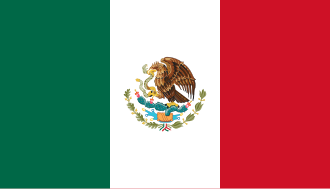
Mexico, officially the United Mexican States, is a country in North America. It is the northernmost country in Latin America, bordering the United States of America to the north and Guatemala and Belize to the southeast, while having maritime boundaries with the Pacific Ocean to the west, the Caribbean Sea to the southeast, and the Gulf of Mexico to the east. Mexico covers 1,972,550 km2 (761,610 sq mi), and is the thirteenth-largest country in the world by land area. With a population exceeding 134 million as of 2026, Mexico is the tenth-most populous country in the world and is home to the largest number of native Spanish speakers. Mexico City is the capital and largest city in Mexico, which ranks among the most populous metropolitan areas in the world.
Human presence in Mexico dates back to at least 11,500 BC, although dates as old as 28,000 BC have been proposed for less securely dated sites. Mesoamerica, considered a cradle of civilization, was home to numerous advanced societies, including the Olmecs, Maya, Zapotecs, Teotihuacan civilization, and Purépecha. Spanish colonization began in 1521 with an indigenous alliance that defeated the Aztec Empire, establishing the colony of New Spain with its capital at Tenochtitlan, now Mexico City. New Spain became a major center of the transoceanic economy during the Age of Discovery, fueled by silver mining and its position as a hub between Europe and Asia. This gave rise to one of the largest multiracial populations in the world. The Peninsular War led to the 1810–1821 Mexican War of Independence, which ended Peninsular rule and led to the creation of the First Mexican Empire, which quickly collapsed into the short-lived First Mexican Republic. In 1848, Mexico lost nearly half its territory in the Mexican-American War. Liberal reforms set in the Constitution of 1857 led to civil war and French intervention, culminating in the establishment of the Second Mexican Empire under Emperor Maximilian I of Habsburg, who was overthrown by Republican forces led by Benito Juárez. The late 19th century saw the long dictatorship of Porfirio Díaz, whose modernization policies came at the cost of severe social unrest. The 1910–1920 Mexican Revolution led to the overthrow of Díaz and the adoption of the 1917 Constitution. Mexico experienced rapid industrialization and economic growth in the 1940s–1970s, amidst electoral fraud, the Tlatelolco massacre, and economic crises. The late 20th century saw a shift towards neoliberalism, marked by the signing of the North American Free Trade Agreement (NAFTA) in 1994, amidst unrest in Chiapas.
Mexico is a federal republic with a presidential system of government, characterized by a democratic framework and the separation of powers into three branches: executive, legislative, and judicial. The federal legislature consists of the bicameral Congress of the Union, comprising the Chamber of Deputies, which represents the population, and the Senate, which provides equal representation for each state. The Constitution establishes three levels of government: the federal Union, the state governments, and the municipal governments. Mexico's federal structure grants autonomy to its 32 states, and its political system is deeply influenced by indigenous traditions and European Enlightenment ideals.

Mexico is a newly industrialized and developing country, with the world's 15th-largest economy by nominal GDP and the 13th-largest by purchasing power parity (PPP). It ranks first in the Americas and seventh in the world by the number of UNESCO World Heritage Sites. It is one of the world's 17 megadiverse countries, ranking fifth in natural biodiversity. It is a major tourist destination: as of 2022, it is the sixth most-visited country in the world, with 42.2 million international arrivals. Mexico's large economy and population, global cultural influence, and steady democratization make it a regional and middle power, increasingly identifying as an emerging power. As with much of Latin America, poverty, systemic corruption, and crime remain widespread. Since 2006, approximately 127,000 deaths have been caused by ongoing conflict between drug trafficking syndicates.
Mexico is a member of United Nations, the G20, the Organisation for Economic Co-operation and Development (OECD), the Coffee Club, the World Trade Organization (WTO), the Asia-Pacific Economic Cooperation (APEC) forum, the Organization of American States (OAS), the Community of Latin American and Caribbean States (CELAC), the Organization of Ibero-American States (OEI), and has an observer status at the Council of Europe.
Etymology
Mēxihko is the Nahuatl term for the heartland of the Aztec Empire, namely the Valley of Mexico and surrounding territories, with its people being known as the Mexica. It is generally believed that the toponym for the valley was the origin of the primary ethnonym for the Aztec Triple Alliance, but it may have been the other way around. In the colonial era (1521–1821) when Mexico was known as New Spain, this central region became the Intendency of Mexico. After New Spain achieved independence from the Spanish Empire in 1821 and became a sovereign state, the Intendency came to be known as the State of Mexico, with the new country being named after its capital, Mexico City.
The country's official name has changed as the form of government has changed. The declaration of independence signed on 6 November 1813 by the deputies of the Congress of Anáhuac called the territory América Septentrional (Northern America). The 1821 Plan of Iguala also used América Septentrional. On two occasions (1821–1823 and 1863–1867), the country was known as Imperio Mexicano (Mexican Empire). All three federal constitutions (1824, 1857, and 1917, the current constitution) used the name Estados Unidos Mexicanos—or the variant Estados-Unidos Mexicanos, all of which have been translated as "United Mexican States". The phrase República Mexicana, "Mexican Republic", was used in the 1836 Constitutional Laws. In the Nahuatl version of the current constitution, the official name is Mexika Sentik Wexteyowalko, and in its Yucatec Maya version, U Múuchꞌ Péetluꞌumiloꞌob México. In fact, by virtue of the legal equality of Spanish with the 68 indigenous languages of the country, all have their own translation of the official name.
History
Indigenous civilizations before European contact (pre-1519)
The earliest human artifacts in Mexico are chips of stone tools found in the Valley of Mexico, dated to circa 10,000 years ago. Mexico is the site of the domestication of maize, tomato, and beans, which produced an agricultural surplus. This enabled the transition from paleo-Indian hunter-gatherers to sedentary agricultural villages beginning around 5000 BC. The formative period of Mesoamerica is one of the six independent cradles of civilization, this era saw the origin of distinct cultural traits such as religious and symbolic traditions, maize cultivation, artistic and architectural complexes as well as a vigesimal (base 20) numeric system that spread from Mexican cultures to the rest of Mesoamerica. Villages became more densely populated, socially stratified with an artisan class, and developed into chiefdoms. The most powerful rulers had religious and political power, organizing the construction of ceremonial centers.
The earliest complex civilization was the Olmec culture, which flourished on the Gulf Coast from around 1500 BC. Olmec cultural traits diffused through Mexico into other formative-era cultures in Chiapas, Oaxaca, and the Valley of Mexico. In the pre-classical period, the Maya and Zapotec civilizations developed complex centers. The first true Mesoamerican writing systems were developed in the Epi-Olmec and Zapotec cultures. The Mesoamerican writing tradition reached its height in the Classic Maya Hieroglyphic script, the earliest written histories date from then. The tradition of writing was important after Spanish conquest in 1521, with indigenous scribes learning to write their languages in alphabetic letters, while continuing to create pictorial texts.

In Central Mexico, the height of the classic period saw the ascendancy of Teotihuacán, which formed a military and commercial empire. Teotihuacan, with a population of more than 150,000, had some of the largest pyramidal structures in the pre-Columbian Americas. After the collapse of Teotihuacán around 600 AD, competition ensued between political centers in such as Xochicalco and Cholula. During the Epi-Classic, Nahua peoples began moving south into Mesoamerica, and became politically and culturally dominant in central Mexico. During 1000–1519 AD, central Mexico was dominated by the Toltec culture, Oaxaca by the Mixtec, and the lowland Maya area had centers at Chichén Itzá and Mayapán. Toward the end of the post-Classic period, the Aztecs established dominance, establishing a political and economic empire based in Tenochtitlan (modern Mexico City), extending from central Mexico to Guatemala.
Spanish conquest and colonial era (1519–1821)
Although the Spanish Empire established colonies in the Caribbean in 1493, it first learned of Mexico during the Juan de Grijalva expedition of 1518. The Spanish conquest of the Aztec Empire began in 1519 when Hernán Cortés founded Veracruz. The 1521 capture of Tenochtitlan and posterior founding of Mexico City on its ruins, was the beginning of a 300-year colonial era, during which Mexico was known as Nueva España (New Spain). Two factors made Mexico a jewel in the Empire: the existence of large, hierarchically organized Mesoamerican populations that rendered tribute and performed obligatory labor, and discovery of silver deposits in north Mexico.
The Kingdom of New Spain was created from the remnants of the Aztec empire. The two pillars of Spanish rule were the State and Church, both under the authority of the Spanish crown. In 1493 the pope granted sweeping powers to the Spanish monarchy for its overseas empire, with the proviso it spread Christianity. In 1524, King Charles I created the Council of the Indies based in Spain to oversee State power in its colonies. The crown established a high court in Mexico City, the Real Audiencia ('royal audience'). In 1535, the crown appointed the first Viceroy of New Spain, the highest official of the State. The Diocese of Mexico, created in 1530, was elevated to the Archdiocese of Mexico in 1546, with an archbishop as its head. Castilian Spanish was the language of the rulers. Catholic faith was the only one permitted, with non-Catholics and Catholics, excluding Indians, holding unorthodox views subject to the Mexican Inquisition.

Spanish military forces, sometimes accompanied by native allies, led expeditions to conquer territory or quell rebellions. Notable Amerindian revolts include the Chichimeca War (1576–1606), the Tepehuán Revolt (1616–20), and Pueblo Revolt (1680). Most rebellions were small-scale, posing no major threat to the elites. To protect Mexico from the attacks of English, French, and Dutch pirates and the Crown's monopoly of revenue, only two ports were open to foreign trade—Veracruz on the Atlantic, connecting to Spain, and Acapulco on the Pacific, connecting to the Philippines. Pirate attacks included the 1663 Sack of Campeche and 1683 Attack on Veracruz.
Of greater concern to the crown was the issue of invasion, especially after Britain seized Havana and Manila in 1762, during the Seven Years' War. It created a standing military, increased coastal fortifications, and expanded the northern presidios and missions into Alta California. The volatility of the urban poor in Mexico City was evident in the 1692 riot over the price of maize. It escalated to a full-scale attack on the seats of power, with the viceregal palace and archbishop's residence attacked.
Independence era (1808–1855)
In 1810, secular priest Miguel Hidalgo y Costilla declared against "bad government" in Dolores, Guanajuato. Known as the Cry of Dolores (Spanish: Grito de Dolores) it is commemorated each year, on 16 September, as Mexico's independence day. The upheaval in the Empire, that resulted in the independence of most of its New World territories, was due to Napoleon's invasion of Spain in 1808. Hidalgo and some of his soldiers were executed by firing squad in 1811. The first 35 years after Mexico's independence were marked by instability and changing of the Mexican state from a transient monarchy to a fragile federated republic. There were military coups, foreign invasions, ideological conflict between Conservatives and Liberals, and economic stagnation.

Former Royal Army General Agustín de Iturbide became regent, as newly independent Mexico sought a constitutional monarch from Europe. When no member of a European royal house desired the position, Iturbide himself was declared Emperor Agustín I. The US was the first country to recognize Mexico's independence, sending a message to Europe via the Monroe Doctrine not to intervene in Mexico. The emperor's rule was short (1822–23), he was overthrown by army officers in the Plan of Casa Mata. Central America and Chiapas left the union to form the Federal Republic of Central America.
In 1824, the First Mexican Republic was established. Former insurgent General Guadalupe Victoria became the first president — the first of many generals to hold the presidency. In 1829, former insurgent general and fierce Liberal Vicente Guerrero, a signatory of the Plan of Iguala that achieved independence, became president in a disputed election. During his term, from April to December 1829, he abolished slavery. His Conservative vice president, former Royalist General Anastasio Bustamante, led a coup against him and Guerrero was judicially murdered.
Mexico's ability to maintain its independence and establish a viable government was in question. Spain attempted to reconquer it during the 1820s, but eventually recognized its independence. France attempted to recoup losses it claimed for its citizens during Mexico's unrest and blockaded the Gulf Coast during the Pastry War of 1838–39. General Antonio López de Santa Anna emerged as a national hero because of his role in these conflicts; Santa Anna came to dominate politics for the next 25 years, often known as the "Age of Santa Anna", until his overthrow in 1855.

Mexico contended with indigenous groups that controlled the territory that Mexico claimed in the north. For example, the Comanche controlled a huge territory in sparsely populated central and northern Texas. Wanting to stabilize and develop that area — and as few from central Mexico had chosen to resettle to this remote and hostile territory — the Mexican government encouraged Anglo-American immigration into present-day Texas, a region that bordered the US. Mexico by law was a Catholic country; the Anglo-Americans were primarily Protestant English speakers from the southern US. Some brought their black slaves, which after 1829 was contrary to Mexican law.
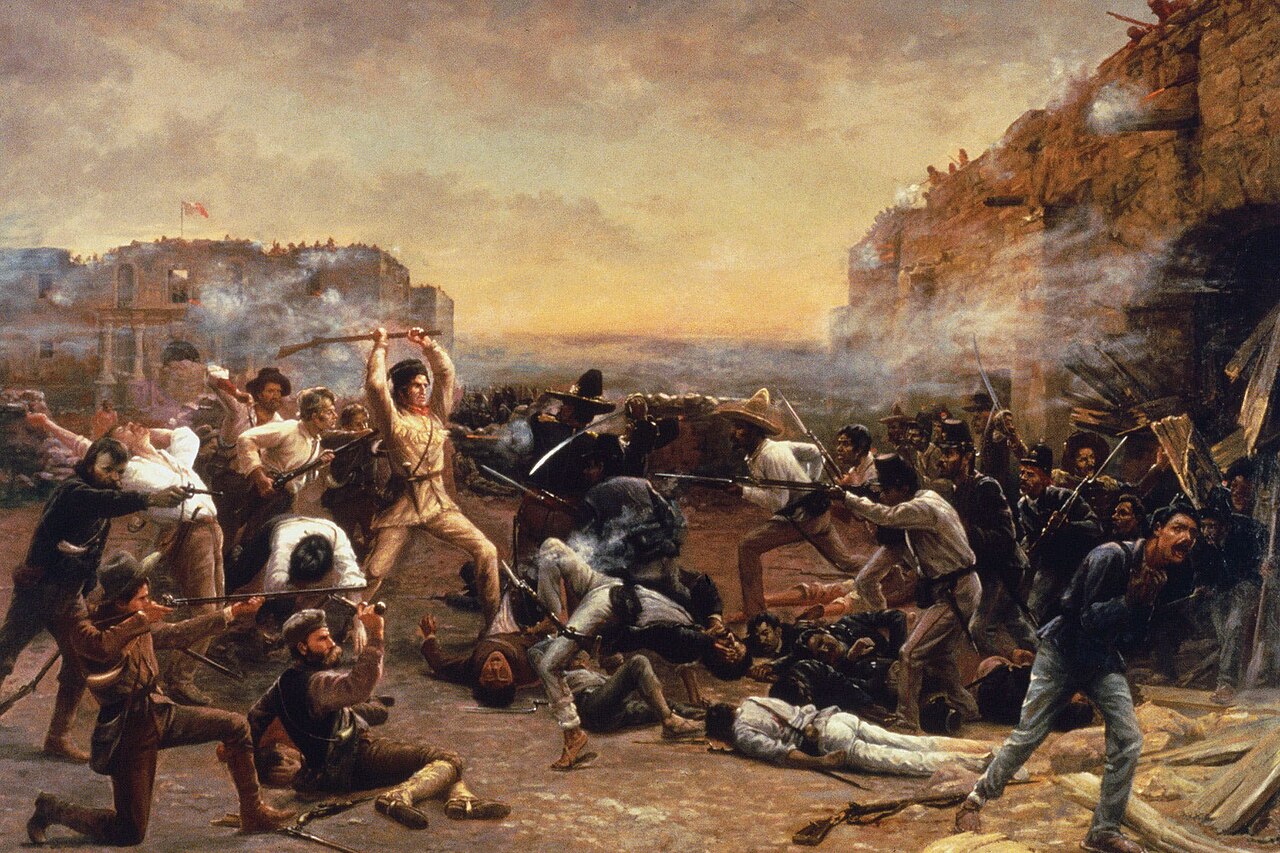
In 1835, Santa Anna sought to centralize government rule in Mexico, suspending the 1824 constitution and promulgating the Seven Laws, which placed power in his hands. As a result, civil war spread. Three new governments declared independence: the Republic of Texas, the Republic of the Rio Grande and the Republic of Yucatán. The largest blow to Mexico was the US invasion in 1846 in the Mexican–American War. Mexico lost much of its northern territory, sealed in the 1848 Treaty of Guadalupe Hidalgo. Despite this, Santa Anna returned to the presidency, but was ousted and exiled during the Liberal Revolution of Ayutla.
Liberal era (1855–1911)
The overthrow of Santa Anna, and establishment of a civilian government by liberals, allowed them to enact laws they considered vital for development. La Reforma attempted to modernize the economy and institutions along liberal principles. They promulgated a new Constitution of 1857, separating Church and State, stripping the Church and military of privileges (fueros); mandating the sale of Church-owned property and indigenous community lands, and secularizing education. Conservatives revolted, touching off the Reform War between Liberal and Conservative governments (1858–61).
The Liberals defeated the Conservative army on the battlefield, but Conservatives sought to gain power via intervention by the French, asking Emperor Napoleon III to place a European monarch as head of state in Mexico. The French Army defeated the Mexicans and placed Maximilian Habsburg on the newly established throne, supported by Mexican Conservatives. The Liberal Republic under Benito Juárez was a government in internal exile, but with the end of the American Civil War in 1865, the US government began aiding the Mexican Republic. The French Army withdrew its support, but Maximilian remained in Mexico; Republican forces executed him. The "Restored Republic" saw the return of Juárez, "the personification of the embattled republic," as president.
The Conservatives had been defeated militarily and discredited politically, for their collaboration with the French, and liberalism became synonymous with patriotism. The Mexican Army, which originated in the colonial royalist forces and transitioned into the early Republic military, was effectively destroyed following its defeat by Liberal forces in the Reform War and subsequently by the French intervention, enabling the emergence of a new generation of military leaders during the restoration of the Republic. Notable was Porfirio Díaz, a hero of the Cinco de Mayo, who sought civilian power and challenged Juárez on his re-election in 1867. Díaz then rebelled but was crushed by Juárez. Having won re-election, Juárez died in office in 1872. Liberal Sebastián Lerdo de Tejada became president, declaring a "religion of the state" for the rule of law, peace, and order. When Lerdo ran for re-election, Díaz rebelled against the civilian president, issuing the Plan of Tuxtepec. Díaz had more support and waged guerrilla war against Lerdo. On the verge of Díaz's victory on the battlefield, Lerdo fled from office into exile.
After the turmoil of 1810 to 1876, the 35-year rule of Liberal General Porfirio Díaz (1876–1911) allowed Mexico to modernize in a period described one of "order and progress". The Porfiriato was characterized by economic stability and growth, foreign investment and influence, an expansion of the rail network and telecommunications, and investments in the arts and sciences. Díaz ruled with a group of advisors that became known as the científicos ('scientists'). The regime was influenced by positivism. They rejected theology and idealism in favor of scientific methods applied towards development. An integral aspect was secular education. The Díaz government led a protracted conflict against the Yaqui that culminated with the forced relocation of Yaqui to Yucatán and Oaxaca. Díaz gave an interview where he said he was not going to run in the 1910 elections, when he would be 80. Opposition had been suppressed and there were few avenues for new leaders. His announcement set off a frenzy of activity, including the unlikely candidacy of the son of a rich landowning family, Francisco I. Madero. Madero won a surprising amount of support when Díaz changed his mind and ran in the election, jailing Madero.
Mexican Revolution (1910–20)
The Mexican Revolution was a decade-long transformational conflict, the "wind that swept Mexico." It began with uprisings against Díaz after the fraudulent 1910 election, his resignation in May 1911, demobilization of rebel forces, an interim presidency and the democratic election of Madero in fall 1911. In February 1913, a military coup overthrew Madero's government, with the support of the US, resulting in Madero's murder by agents of Federal Army General Victoriano Huerta. The US administration of Taft supported the Huerta coup, but when Democrat Woodrow Wilson was inaugurated as president in March 1913, Wilson refused to recognize Huerta's regime and allowed arms sales to the Constitutionalists. Wilson ordered troops to occupy the strategic port of Veracruz in 1914. A coalition of anti-Huerta forces in the North, the Constitutional Army led by Governor of Coahuila Venustiano Carranza, and a peasant army in the South under Emiliano Zapata defeated the Federal Army in 1914, leaving only revolutionary forces.
Following the revolutionaries' victory against Huerta, they sought to broker a political solution, but the coalition splintered, plunging Mexico again into civil war. Constitutionalist general Pancho Villa broke with Carranza and allied with Zapata. Carranza's best general Alvaro Obregón defeated Villa, his former comrade, in the Battle of Celaya in 1915, and Villa's forces melted away. Carranza became president, and the US recognized his government while Zapata's forces in the south reverted to guerrilla war. After Villa was defeated by revolutionary forces in 1915, he led an incursion raid into Columbus, New Mexico, prompting the US to send 10,000 troops in an unsuccessful attempt to capture Villa. Carranza pushed back against US troops being in northern Mexico. The expeditionary forces withdrew as the US entered World War I. Although often viewed as internal, the revolution had international elements: Germany attempted to get Mexico to side with it, sending a coded telegram in 1917 to incite war between the US and Mexico, with Mexico to regain the territory it lost in the Mexican-American War but Mexico remained neutral in the conflict.
In 1916, the winners of the Mexican revolution met at a constitutional convention to draft the Constitution of 1917, ratified in February 1917. The Constitution empowered the government to expropriate resources including land, gave rights to labor, and strengthened anticlerical provisions. It remains the governing document of Mexico. The revolutionary war killed 900,000 out of Mexico's 15 million population. Consolidating power, Carranza had Zapata assassinated in 1919. Carranza had gained the support of the peasantry, but once in power, he did little to institute land reform, which had motivated many to fight. Carranza returned some confiscated land to their original owners. Carranza's best general, Obregón, served in his administration, but returned to his home state Sonora to position himself to run in the 1920 election. Since Carranza could not run for re-election, he chose a civilian to succeed him, intending to remain in power behind the presidency. Obregón and two other Sonoran revolutionary generals drew up the Plan of Agua Prieta, overthrowing Carranza. General Adolfo de la Huerta became interim president, followed by the election of General Álvaro Obregón.
Political consolidation and one-party rule (1920–2000)
The post-revolutionary period (1920–46) was characterized by revolutionary generals serving as presidents, including Álvaro Obregón (1920–24), Plutarco Elías Calles (1924–28), Lázaro Cárdenas (1934–40), and Manuel Avila Camacho (1940–46). The government sought to bring order, end military intervention in politics, and create organizations of interest groups. Workers, peasants, office workers, and even the army for a short period, were incorporated as sectors of the single party that dominated politics from its founding in 1929. Obregón instigated land reform and strengthened organized labor. He gained recognition from the US and settled claims with companies and individuals that lost property during the Revolution. He imposed his fellow revolutionary general, Calles, as his successor. Calles provoked a major conflict with the Catholic Church and Catholic guerrilla armies when he enforced anticlerical articles of the constitution, which ended with an agreement. Although the constitution prohibited the reelection of the president, Obregón wished to run again and the constitution was amended to allow non-consecutive re-election. He won the 1928 elections but was assassinated by a Catholic activist, causing a succession crisis. Calles could not become president again, so he sought to set up a structure to manage succession, founding the Institutional Revolutionary Party, which dominated Mexico for the rest of the 20th century. Despite not holding the presidency, Calles remained the key politician during the period known as the Maximato (1929–34), that ended during the presidency of Lázaro Cárdenas, who expelled Calles and implemented economic and social reforms. This included the Mexican oil expropriation in 1938, which nationalized the U.S. and Anglo-Dutch oil company known as the Mexican Eagle Petroleum Company, which would result in the creation of the state-owned Pemex.
Cárdenas's successor, Manuel Ávila Camacho (1940–46) was moderate, and relations between the US and Mexico improved during World War II, when Mexico was a significant ally. From 1946 the election of Miguel Alemán, the first civilian president in the post-revolutionary period, Mexico embarked on a program of development, known as the Mexican miracle, characterized by industrialization, urbanization, and increased inequality between urban and rural areas. The Green Revolution, a technological movement that led to worldwide increases in crop production, began in the Yaqui Valley in the middle of the 20th century.
With robust growth, Mexico sought to showcase itself by hosting the 1968 Summer Olympics. The government poured resources into new facilities, prompting unrest among students and others. Demonstrations in Mexico City went on for weeks before the opening of the games, with the government of Gustavo Díaz Ordaz cracking down. The culmination was the Tlatelolco Massacre, which killed 300-800 protesters. Although the economy continued to flourish for some, inequality remained a factor of discontent. PRI rule became authoritarian and oppressive in the Mexican Dirty War.
In the 1980s the first cracks emerged in the PRI's political dominance. In Baja California, the PAN candidate was elected governor. When De la Madrid chose Carlos Salinas de Gortari as the candidate for the PRI, and therefore a foregone presidential victor, Cuauhtémoc Cárdenas, son of former President Lázaro Cárdenas, broke with the PRI and challenged Salinas in the 1988 elections. In 1988 there was electoral fraud, with results showing that Salinas had won the election by the narrowest percentage ever. There were protests in Mexico City over the stolen election. Salinas took the oath of office in December 1988. In 1990 the PRI was described by Mario Vargas Llosa as the "perfect dictatorship", but there had been major challenges to the PRI's hegemony.
Salinas embarked on a program of neoliberal reforms that fixed the exchange rate, controlled inflation, opened Mexico to foreign investment, and began talks with the US and Canada to join their free-trade agreement, which culminated in the North American Free Trade Agreement (NAFTA) on 1 January 1994; the same day, the Zapatista Army of National Liberation (EZLN) in Chiapas began armed rebellion against the federal government, which captured towns and brought world attention. The armed conflict was short-lived and continues as a non-violent opposition movement against neoliberalism and globalization. In 1994, following the assassination of the PRI's presidential candidate Luis Donaldo Colosio, Salinas was succeeded by victorious PRI candidate Ernesto Zedillo. Salinas left Zedillo's government to deal with the Mexican peso crisis, requiring a $50 billion IMF bailout. Macroeconomic reforms were started by Zedillo, and the economy recovered and growth peaked at 7% by 1999.
Contemporary Mexico
After 71 years of rule, the incumbent PRI lost the 2000 presidential election to Vicente Fox of the opposing conservative National Action Party (PAN). In the 2006 presidential election, Felipe Calderón from the PAN was declared the winner, with a narrow margin (0.6%) over leftist politician Andrés Manuel López Obrador of the Party of the Democratic Revolution (PRD). López Obrador, however, contested the election and pledged to create an "alternative government". In the 2012 presidential election, the PRI again won the presidency with the election of Enrique Peña Nieto. However, he won with a plurality of around 38% and did not have a legislative majority.
During the 21st century, Mexico has contended with high crime rates, bureaucratic corruption, narcotrafficking, and a stagnant economy. Many state-owned enterprises were privatized starting in the 1990s with neoliberal reforms. Pemex, the state-owned petroleum company is being privatized, with exploration licenses being issued. In a push against corruption, the ex-CEO of Pemex, Emilio Lozoya Austin, was arrested in 2020.
After founding the new political party MORENA, Andrés Manuel López Obrador (known as AMLO) won the 2018 election with over 50%. His coalition, led by his left-wing party founded after the 2012 elections, included parties from across the spectrum. The coalition won a majority in the upper and lower Congress chambers. His success is attributed to opposing political forces exhausting their chances, as well as AMLO's adoption of moderate discourse focused on reconciliation. The first confirmed case of COVID-19 in Mexico occurred in February 2020, and COVID-19 vaccination in Mexico began in December. Claudia Sheinbaum, AMLO's successor, won the 2024 presidential election in a landslide and became the first woman to lead Mexico. She was sworn in on 1 October 2024.
Geography
Mexico is located between latitudes 14° and 33°N, and longitudes 86° and 119°W in the southern portion of North America, with a total area of 1,972,550 km2 (761,606 sq mi), is the 13th largest country by total area. It has coastlines on the Pacific Ocean and Gulf of California, as well as the Gulf of Mexico and Caribbean Sea, the latter two forming part of the Atlantic Ocean. Within these seas are about 6,000 km2 (2,317 sq mi) of islands. Almost all of Mexico lies in the North American Plate, with small parts of the Baja California peninsula on the Pacific and Cocos Plates. Geophysically, some geographers include the territory east of the Isthmus of Tehuantepec (around 12% of the total) within Central America. Geopolitically, Mexico is entirely considered part of North America.
The majority of Mexican central and northern territories are located at high altitudes, and as such the highest elevations are found at the Trans-Mexican Volcanic Belt which crosses Mexico east to west: Pico de Orizaba (5,700 m or 18,701 ft), Popocatépetl (5,462 m or 17,920 ft) and Iztaccihuatl (5,286 m or 17,343 ft) and the Nevado de Toluca (4,577 m or 15,016 ft). Two mountain ranges known as Sierra Madre Oriental and Sierra Madre Occidental, which are the extension of the Rocky Mountains from northern North America crossed the country from north to south and a fourth mountain range, the Sierra Madre del Sur, runs from Michoacán to Oaxaca. The Mexican territory is prone to volcanism.
Mexico has nine distinct regions: Baja California, the Pacific Coastal Lowlands, the Mexican Plateau, the Sierra Madre Oriental, the Sierra Madre Occidental, the Cordillera Neovolcánica, the Gulf Coastal Plain, the Southern Highlands, and the Yucatán Peninsula. An important geologic feature of the Yucatán peninsula is the Chicxulub crater, the scientific consensus is that the Chicxulub impactor was responsible for the Cretaceous–Paleogene extinction event. Although Mexico is large (a little over 2,000 mi (3,219 km) in length from its farthest land points), much of its land mass is incompatible with agriculture due to aridity, soil, or terrain.
In 2018, an estimated 54.9% of land was agricultural; 11.8% was arable; 1.4% was in permanent crops; 41.7% was permanent pasture; and 33.3% was forest. Mexico is irrigated by several rivers, with the longest being the Rio Grande, which serves as a natural eastern border with the United States. The Usumacinta River serves as a natural southern border between Mexico and Guatemala.
Climate
The climate of Mexico is varied due to the country's size and topography. The Tropic of Cancer effectively divides the country into temperate and tropical zones. Land north of the Tropic of Cancer experiences cooler temperatures during the winter months. South of the Tropic of Cancer, temperatures are fairly constant year-round and vary solely as a function of elevation. This gives Mexico one of the world's most diverse weather systems.
Maritime air masses bring seasonal precipitation from May until August. Many parts of Mexico, particularly the north, have a dry climate with only sporadic rainfall, while parts of the tropical lowlands in the south average more than 2,000 mm (78.7 in) of annual precipitation. For example, many cities in the north like Monterrey, Hermosillo, and Mexicali experience temperatures of 40 °C (104 °F) or more in summer. In the Sonoran Desert temperatures reach 50 °C (122 °F) or more.
There are seven major climate types in Mexico with warm sub-humid climate being coastal up to 900 meters found mostly in the southern region of Mexico; dry and desertic climates being found in the northern half of the country; temperate humid and sub-humid being found mostly on pastures at an elevation of 1,800 meters and higher in central Mexico and cold climate usually found at an elevation of 3,500 meters and beyond. Most of the country's territory has a temperate to dry climate.
Areas south of the Tropic of Cancer with elevations up to 1,000 m (3,281 ft), the southern parts of both coastal plains as well as the Yucatán Peninsula, have a yearly median temperature between 24 and 28 °C (75.2 and 82.4 °F). Temperatures here remain high throughout the year, with only a 5 °C (9 °F) difference between winter and summer median temperatures. The Pacific coast is subject to natural hazards such as tsunamis and both Mexican coasts with the exception of the south coast of the Bay of Campeche and northern Baja California are vulnerable to serious hurricanes during the summer and fall. Although low-lying areas north of the Tropic of Cancer are hot and humid during the summer, they generally have lower yearly temperature averages (from 20 to 24 °C or 68.0 to 75.2 °F) because of more moderate conditions during the winter.
Climate change in Mexico is causing widespread impacts including rising temperatures, altered precipitation patterns, intensified hurricanes, and sea-level rise in coastal regions. These changes pose threats to water resources and agriculture (particularly for rural and smallholder farmers), and affect crops including maize and coffee, contributing to economic insecurity. Climate change is impacting Mexicans' health, exacerbating human migration, and increasing extinction risk for Mexico's biodiversity, as protected areas are expected to face warming temperatures and decreased precipitation.
Biodiversity
Mexico ranks fourth in the world in biodiversity and is one of the 17 megadiverse countries. With over 200,000 species, Mexico is home of 10–12% of the world's biodiversity. Mexico ranks first in biodiversity in reptiles with 707 known species, second in mammals with 438 species, fourth in amphibians with 290 species, and fourth in flora, with 26,000 species. Mexico is also considered the second country in the world in ecosystems and fourth in overall species. About 2,500 species are protected by Mexican legislation.
In 2002, Mexico had the second fastest rate of deforestation in the world, second only to Brazil. It had a 2019 Forest Landscape Integrity Index mean score of 6.82/10, ranking it 63rd globally out of 172 countries. According to SGI there is Deforestation and soil erosion especially in rural areas of Mexico. In the 2022 report it was noted environmental protection laws have improved in major cities but remain unenforced or unregulated in rural regions.
In Mexico, 170,000 square kilometers (65,637 sq mi) are considered "Protected Natural Areas". These include 34 biosphere reserves, 67 national parks, 4 natural monuments, 26 areas of protected flora and fauna, 4 areas for natural resource protection and 17 sanctuaries (zones rich in diverse species). Some of Mexico's native culinary ingredients include maize, tomato, beans, squash, chocolate, vanilla, avocado, guava, chayote, epazote, camote, jícama, nopal, zucchini, tejocote, huitlacoche, sapote, mamey sapote, and a great variety of chiles, such as the habanero and the jalapeño. Tequila, the distilled alcoholic drink made from cultivated agave cacti is a major industry. Because of its high biodiversity Mexico has also been a frequent site of bioprospecting by international research bodies.
Government and politics
The United Mexican States is a federation whose government is representative, democratic, and republican based on a presidential system according to the 1917 Constitution. The Constitution establishes three levels of government: the federal Union, the state governments, and the municipal governments.