
The United Nations comprise 193 sovereign states and the world's largest intergovernmental organization. All members have equal representation in the United Nations General Assembly.
The Charter of the United Nations defines the rules for admission of member states. Membership is open to all states which accept certain terms of the charter and are able to carry them out. New members must be recommended by the United Nations Security Council. In addition to the member states, the UN also invites non-member states to be observer states at the UN General Assembly. A member state that has persistently violated the principles of the United Nations Charter can be expelled from the United Nations.
Membership
The criteria for admission of new members to the UN are established in Chapter II, Article 4 of the UN Charter:
Membership in the United Nations is open to all states which accept the obligations contained in the present Charter and, in the judgement of the Organization, are able and willing to carry out these obligations.
The admission of any such state to membership in the United Nations will be effected by a decision of the General Assembly upon the recommendation of the Security Council.
A recommendation for admission from the Security Council requires affirmative votes from at least nine of the council's fifteen members, with none of the five permanent members using their veto power. The Security Council's recommendation must then be approved in the General Assembly by a two-thirds majority vote.
In principle, only sovereign states can become UN members, and currently, all UN members are sovereign states. Although five members were not sovereign when they joined the UN, they all subsequently became fully independent between 1946 and 1991. Because a state can only be admitted to membership in the UN by the approval of the Security Council and the General Assembly, a number of states that are considered sovereign according to the Montevideo Convention are not members of the UN. This is because the UN does not consider them to possess sovereignty, mainly due to the lack of international recognition or due to opposition from one of the permanent members.
In addition to the member states, the UN also invites non-member states to become observer states at the UN General Assembly, allowing them to participate and speak in General Assembly meetings, but not vote. Observers are generally intergovernmental organizations and international organizations and entities whose statehood or sovereignty is not precisely defined.
Original members
The UN officially came into existence on 24 October 1945, after ratification of the United Nations Charter by the five permanent members of the United Nations Security Council (the Republic of China, France, the Soviet Union, the United Kingdom, and the United States) and a majority of the other signatories. A total of 51 original members (or founding members) joined that year; 50 of them signed the Charter at the United Nations Conference on International Organization in San Francisco on 26 June 1945, while Poland, which was not represented at the conference, signed it on 15 October 1945.
The original members of the United Nations were: France (then the Provisional Government), Russia (then the Soviet Union), China (then Republic of China), the United Kingdom, the United States—these first five forming the Security Council—Argentina, Australia, Belarus (then the Byelorussian SSR), Belgium, Bolivia, Brazil (then the Vargas Era Brazil), Canada, Chile (then the 1925–73 Presidential Republic), Colombia, Costa Rica, Cuba (then the 1902–59 Republic), Czechoslovakia (then the Third Republic), Denmark, the Dominican Republic, Ecuador, Egypt (then the Kingdom of Egypt), El Salvador, Ethiopia (then the Ethiopian Empire), Greece (then the Kingdom of Greece), Guatemala, Haiti (then the 1859–1957 Republic), Honduras, India (then the British Raj), Iran (then the Imperial State of Iran), Iraq (then the Kingdom of Iraq), Lebanon, Liberia, Luxembourg, Mexico, the Netherlands, New Zealand (then the Dominion of New Zealand), Nicaragua, Norway, Panama, Paraguay, Peru, the Philippines (then the Commonwealth), Poland (then the Provisional Government of National Unity), Saudi Arabia, South Africa (then the Union of South Africa), Syria (then the Mandatory Republic), Turkey, Ukraine (then the Ukrainian SSR), Uruguay, Venezuela and Yugoslavia (then the Democratic Federal Yugoslavia).
Among the original members, 49 are either still UN members or had their memberships in the UN continued by a successor state (see table below); for example, the membership of the Soviet Union was continued by the Russian Federation after its dissolution (see the section Former members: Union of Soviet Socialist Republics). The other two original members, Czechoslovakia and Yugoslavia (i.e., the Socialist Federal Republic of Yugoslavia), had been dissolved and their memberships in the UN not continued from 1992 by any one successor state (see the sections Former members: Czechoslovakia and Former members: Yugoslavia).
At the time of UN's founding, the seat of China in the UN was held by the Republic of China, but as a result of United Nations General Assembly Resolution 2758 in 1971, it is now held by the People's Republic of China (see the section Former members: Republic of China (Taiwan)).
A number of the original members were not sovereign when they joined the UN, and only gained full independence later:
Belarus (then the Byelorussian Soviet Socialist Republic) and Ukraine (then the Ukrainian Soviet Socialist Republic) were both constituent republics of the Soviet Union, until gaining full independence in 1991.
India (whose territory at that time, before the Partition of India, also included the present-day territories of Bangladesh and Pakistan) was under British colonial rule, until gaining full independence in 1947.
New Zealand, while de facto sovereign at that time, "only gained full capacity to enter into relations with other states in 1947 when it passed the Statute of Westminster Adoption Act. This occurred 16 years after the British Parliament passed the Statute of Westminster Act in 1931 that recognised New Zealand's autonomy. If judged by the Montevideo Convention criteria, New Zealand did not achieve full de jure statehood until 1947." However, the UN considers New Zealand to have been independent in 1945, at the time the UN was formed.
The Philippines (then the Philippine Commonwealth) was a commonwealth with the United States, until gaining full independence in 1946.
Current members
Package deal
The start of the Cold War led to membership conflicts almost immediately, with the United States refusing to admit countries in Eastern Europe while the Soviet Union refused to admit countries in Western Europe. Starting as early as January 1946, the United States used its "automatic majority" on the Security Council to refuse the application of Albania without a veto, while the Soviet Union vetoed the applications of Ireland, Portugal and Finland. The Soviet Union also vetoed the applications of Jordan and Ceylon, stating that it did not believe they were sufficiently independent from the United Kingdom.
Starting in September 1949, the Soviet Union began to veto the applications of some neutral countries such as Nepal as well, stating that it would not admit them until its preferred applicants were also admitted. Both the United States and Soviet Union stated that they were willing to admit each other's preferred applicants, but the United States demanded that Western European applicants be voted on first while the Soviet Union demanded that Eastern European applicants be voted on first. Both superpowers refused to allow multiple applicants to be voted on simultaneously.
The impasse continued until the death of Stalin caused a brief thaw in the Cold War. By this time, 18 applications had been blocked, and the superpowers stated that they would no longer oppose a simultaneous vote. The veto of Mongolia by the Republic of China delayed the proceedings by one day, with the Soviet Union offering to exclude Mongolia from the list of 18 if Japan were also excluded. The United States abstained on the offering. In what was widely described as a "package deal", the remaining 16 countries (Albania, Jordan, Ireland, Portugal, Italy, Austria, Finland, Ceylon, Nepal, Libya, Cambodia, Laos, Hungary, Romania, Bulgaria, and Spain) were simultaneously admitted to the United Nations on 14 December 1955 (United Nations Security Council Resolution 109).
Former members
Republic of China (1945–1971)
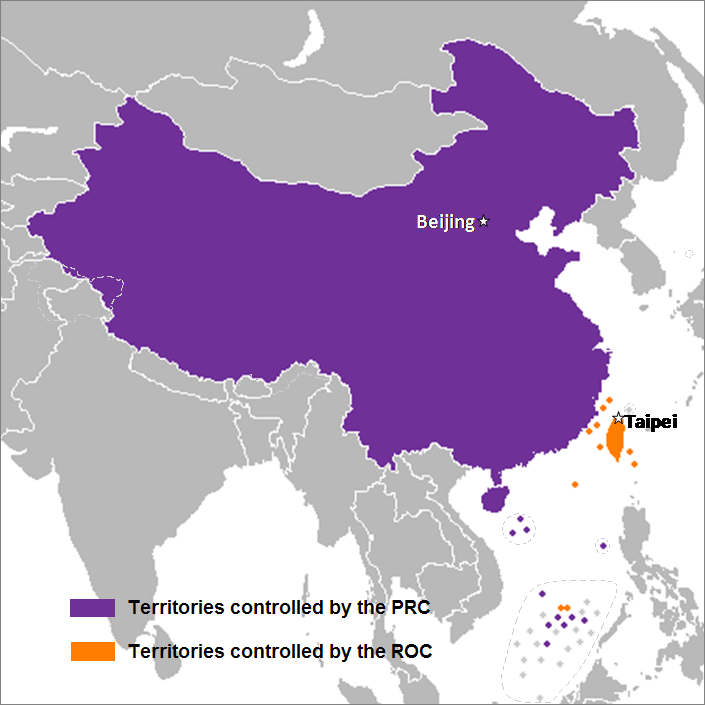
The Republic of China (ROC) joined the UN as an original member on 24 October 1945, and as set out by the United Nations Charter, Chapter V, Article 23, became one of the five permanent members of the United Nations Security Council. In 1949, as a result of the Chinese Civil War, the Kuomintang-led ROC government lost effective control of mainland China and relocated to the island of Taiwan, and the Communist Party-led government of the People's Republic of China (PRC), declared on 1 October 1949, took control of mainland China. The UN was notified on 18 November 1949 of the formation of the Central People's Government of the People's Republic of China; however, the Government of the Republic of China continued to represent China at the UN, despite the small size of the ROC's jurisdiction of Taiwan and a number of smaller islands compared to the PRC's jurisdiction of mainland China. As both governments claimed to be the sole legitimate representative of China, proposals to effect a change in the representation of China in the UN were discussed but rejected for the next two decades. Both sides rejected compromise proposals to allow both states to participate in the UN, based on the One-China policy.
By the 1970s, a shift had occurred in international diplomatic circles and the PRC had gained the upper hand in international diplomatic relations and recognition count. On 25 October 1971, the 21st time the United Nations General Assembly debated on the PRC's admission into the UN, United Nations General Assembly Resolution 2758 was adopted, by which it recognized that "the representatives of the Government of the People's Republic of China are the only lawful representatives of China to the United Nations and that the People's Republic of China is one of the five permanent members of the Security Council," and decided "to restore all its rights to the People's Republic of China and to recognize the representatives of its Government as the only legitimate representatives of China to the United Nations, and to expel forthwith the representatives of Chiang Kai-shek from the place which they unlawfully occupy at the United Nations and in all the organizations related to it." This effectively transferred the seat of China in the UN, including its permanent seat on the Security Council, from the ROC to the PRC, and expelled the ROC from the UN.
In addition to losing its seat in the UN, the UN Secretary-General concluded from the resolution that the General Assembly considered Taiwan to be a province of "China", which refers to the Greater China region. Consequently, the Secretary-General decided that it was not permitted for the ROC to become a party to treaties deposited with it.
Bids for readmission as the representative of Taiwan
In 1993, the ROC began campaigning to rejoin the UN separately from the People's Republic of China. A number of options were considered, including seeking membership in the specialized agencies, applying for observer status, applying for full membership, or having resolution 2758 revoked to reclaim the seat of China in the UN.
Every year from 1993 to 2006, UN member states submitted a memorandum to the UN Secretary-General requesting that the UN General Assembly consider allowing the ROC to resume participating in the United Nations. This approach was chosen, rather than a formal application for membership, because it could be enacted by the General Assembly, while a membership application would need Security Council approval, where the PRC held a veto. Early proposals recommended admitting the ROC with parallel representation over China, along with the People's Republic of China, pending eventual reunification, citing examples of other divided countries which had become separate UN member states, such as East and West Germany and North and South Korea. Later proposals emphasized that the ROC was a separate state, over which the PRC had no effective sovereignty. These proposed resolutions referred to the ROC under a variety of names: "Republic of China in Taiwan" (1993–1994), "Republic of China on Taiwan" (1995–1997, 1999–2002), "Republic of China" (1998), "Republic of China (Taiwan)" (2003), and "Taiwan" (2004–2006).
However, all fourteen attempts were unsuccessful as the General Assembly's General Committee declined to put the issue on the Assembly's agenda for debate, under strong opposition from the PRC.
While all these proposals were vague, requesting the ROC be allowed to participate in UN activities without specifying any legal mechanism, in 2007 the ROC submitted a formal application under the name "Taiwan" for full membership in the UN. However, the application was rejected by the United Nations Office of Legal Affairs citing General Assembly Resolution 2758, without being forwarded to the Security Council. Secretary-General of the United Nations Ban Ki-moon stated that:
The position of the United Nations is that the People's Republic of China is representing the whole of China as the sole and legitimate representative Government of China. The decision until now about the wish of the people in Taiwan to join the United Nations has been decided on that basis. The resolution (General Assembly Resolution 2758) that you just mentioned is clearly mentioning that the Government of China is the sole and legitimate Government and the position of the United Nations is that Taiwan is part of China.
Responding to the UN's rejection of its application, the ROC government has stated that Taiwan is not now nor has it ever been under the jurisdiction of the PRC, and that since General Assembly Resolution 2758 did not clarify the issue of Taiwan's representation in the UN, it does not prevent Taiwan's participation in the UN as an independent sovereign nation. The ROC government also criticized Ban for asserting that Taiwan is part of China and returning the application without passing it to the Security Council or the General Assembly, contrary to UN's standard procedure (Provisional Rules of Procedure of the Security Council, Chapter X, Rule 59). On the other hand, the PRC government, which has stated that Taiwan is part of China and firmly opposes the application of any Taiwan authorities to join the UN either as a member or an observer, praised that UN's decision "was made in accordance with the UN Charter and Resolution 2758 of the UN General Assembly, and showed the UN and its member states' universal adherence to the one-China principle". A group of UN member states put forward a draft resolution for that fall's UN General Assembly calling on the Security Council to consider the application.
The following year two referendums in Taiwan on the government's attempts to regain participation at the UN did not pass due to low turnout. That fall the ROC took a new approach, with its allies submitting a resolution requesting that the "Republic of China (Taiwan)" be allowed to have "meaningful participation" in the UN specialized agencies. Again the issue was not put on the Assembly's agenda. In 2009, the ROC chose not to bring the issue of its participation in the UN up for debate at the General Assembly for the first time since it began the campaign in 1993.
In May 2009, the Department of Health of the Republic of China was invited by the World Health Organization to attend the 62nd World Health Assembly as an observer under the name "Chinese Taipei". This was the ROC's first participation in an event organized by a UN-affiliated agency since 1971, as a result of the improved cross-strait relations since Ma Ying-jeou became the President of the Republic of China a year before.
The Republic of China is officially recognized by 11 UN member states and the Holy See. It maintains unofficial relations with around 60 nations, including the United States and Japan.
States that no longer exist
British Raj (1945–1947)
The British Raj was a founding member of the United Nations.
Czechoslovakia (1945–1992)
Czechoslovakia joined the United Nations as an original member on 24 October 1945. Upon the imminent dissolution of Czechoslovakia, in a letter dated 10 December 1992, its Permanent Representative informed the United Nations Secretary-General that the Czech and Slovak Federative Republic would cease to exist on 31 December 1992 and that the Czech Republic and Slovakia, as successor states, would apply for membership in the UN. Neither state sought sole successor state status. Both states were readmitted to the UN on 19 January 1993.
German Democratic Republic (1973–1990)
Both the Federal Republic of Germany (West Germany) and the German Democratic Republic (East Germany) were admitted to the UN on 18 September 1973. Through the accession of the East German federal states to the Federal Republic of Germany, effective from 3 October 1990, the territory of the German Democratic Republic became part of the Federal Republic of Germany. In a letter to the general secretary, the German Foreign Minister notified the UN about this unification and stated that the Federal Republic of Germany would subsequently assume its membership under the name Germany. Consequently, the Federal Republic of Germany continued being a member of the UN while the German Democratic Republic ceased to exist.
Tanganyika (1961–1964) and Zanzibar (1963–1964)
Tanganyika was admitted to the UN on 14 December 1961, and the Sultanate of Zanzibar was admitted to the UN on 16 December 1963. Following the ratification on 26 April 1964 of the Articles of Union between Tanganyika and the People's Republic of Zanzibar, the two states merged to form the single member "United Republic of Tanganyika and Zanzibar", with its name changed to the United Republic of Tanzania on 1 November 1964.
Soviet Union (1945–1991)
The Union of Soviet Socialist Republics (USSR) joined the UN as an original member on 24 October 1945, and as set out by the United Nations Charter, Chapter V, Article 23, became one of the five permanent members of the United Nations Security Council. Upon the imminent dissolution of the USSR, in a letter dated 24 December 1991, Boris Yeltsin, the President of the Russian Federation, informed the United Nations Secretary-General that the membership of the USSR in the Security Council and all other UN organs was being continued by the Russian Federation with the support of the 11 member states of the Commonwealth of Independent States.
The other fourteen independent states established from the former Soviet Republics were all admitted to the UN:
The Byelorussian Soviet Socialist Republic and the Ukrainian Soviet Socialist Republic joined the UN on 24 October 1945 together with the USSR. After declaring independence, the Ukrainian Soviet Socialist Republic changed its name to Ukraine on 24 August 1991, and on 19 September 1991, the Byelorussian Soviet Socialist Republic informed the UN that it had changed its name to Belarus.
Estonia, Latvia, and Lithuania were admitted to the UN on 17 September 1991, after regaining independence before the dissolution of the USSR. They do not consider themselves to have been legally represented by the Soviet Union during their occupation.
Russia took over the Soviet Union's seat on 24 December 1991, after a letter by president Boris Yeltsin was received by then secretary-general Javier Pérez de Cuéllar.
Armenia, Azerbaijan, Kazakhstan, Kyrgyzstan, the Republic of Moldova, Tajikistan, Turkmenistan, and Uzbekistan were admitted to the UN on 2 March 1992.
Georgia was admitted to the UN on 31 July 1992.
United Arab Republic (1958–1961)
Both Egypt and Syria joined the UN as original members on 24 October 1945. Following a plebiscite on 21 February 1958, the United Arab Republic was established by a union of Egypt and Syria and continued as a single member. On 13 October 1961, Syria, having regained its status as an independent state, resumed its separate membership in the UN. No objections were raised to Syria's return to membership in this manner. Egypt continued as a UN member under the name of the United Arab Republic, until it reverted to its original name on 2 September 1971. Syria changed its name to the Syrian Arab Republic on 14 September 1961.
Democratic Yemen (1967–1990)
Democratic Yemen (i.e., South Yemen) was admitted to the UN under the name People's Republic of South Yemen on 14 December 1967, with its name changed to the People's Democratic Republic of Yemen on 30 November 1970, and was later referred to as Democratic Yemen. On 22 May 1990, the state merged with the Yemen Arab Republic, which had been a member state since 1947, to form the Republic of Yemen, which continued as a single member under the name Yemen.