
The Meiji Restoration (明治維新, Meiji Ishin; , also translated as the Meiji Reform[ation]), referred to at the time as the Honorable Restoration (御維新/御一新, Goi(s)shin), was a political event that restored imperial rule to Japan in 1868 under Emperor Meiji and led to the westernisation of Japan. Although there were ruling emperors before the Meiji Restoration, the events restored practical power to, and consolidated the political system under, the Emperor of Japan. The Restoration led to enormous changes in Japan's political and social structure and spanned both the late Edo period (often called the Bakumatsu) and the beginning of the Meiji era, during which time Japan rapidly industrialised and adopted Western ideas, production methods and technology.
The origins of the Restoration lay in economic and political difficulties faced by the Tokugawa shogunate. These problems were compounded by the encroachment of foreign powers in the region which challenged the Tokugawa policy of sakoku, specifically the arrival of the Perry Expedition under orders from United States president Millard Fillmore. Under subsequent unequal treaties, Japan was forced to open to the West, bringing the shōgun's ability to maintain Japanese sovereignty into question. The Emperor's rebuke of shogunal actions led to the emergence of an ideological divide within the samurai class concerned with their feudal obligations to both the shōgun and the Emperor. Many lower and middle-ranking samurai became shishi ("men of spirit") who were committed to the Emperor's proclamations to expel the barbarians. Factional disputes within the domains led some domains to conflict with the Tokugawa. After some initial setbacks, the domains organised into an anti-Tokugawa alliance, and, led by Satsuma and Chōshū, they overthrew the shogunal system.
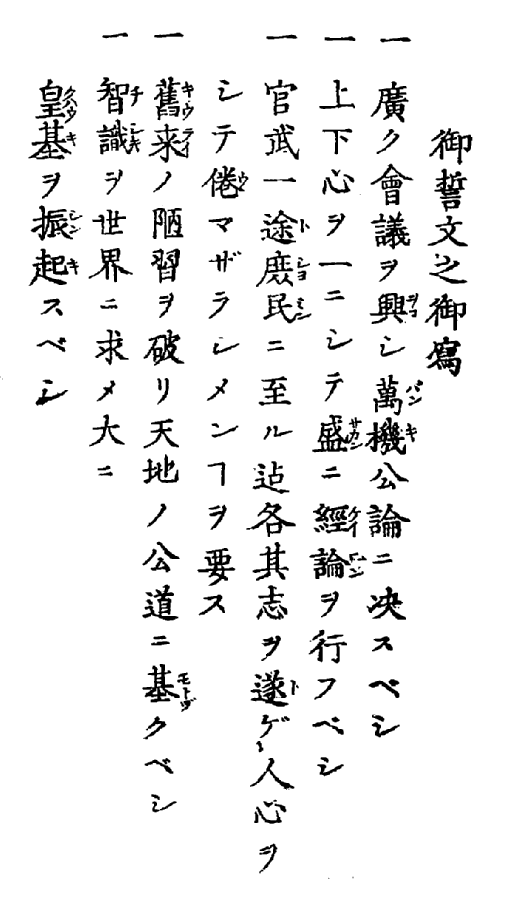
On 3 January 1868, Emperor Meiji declared political power to be restored to the Imperial House. The goals of the restored government were expressed by the new emperor in the Charter Oath. Subsequent Tokugawa resistance to the new government materialised in the Boshin War and the short-lived Republic of Ezo, but by the 1870s, the Emperor's authority was practically unquestioned. The new government reorganised whole strata of society, abolishing the old currency, the domain system, and eventually the class position of the samurai.
The abolition of the shogunate and industrialisation of society in emulation of foreign imperial powers led to backlash with the Saga Rebellion and the Satsuma Rebellion, but ultimately ended feudalism in Japanese society. The Meiji Restoration was the political process that laid the foundation for the institutions of the Empire of Japan, and would have far-reaching consequences in East Asia as Japan pursued colonial interests against its neighbours. The Meiji Constitution of 1889 would remain in place until the Allied occupation of Japan after the end of World War II.
Background
Political and social structure
In the Edo period, Japan was governed by a strict and rigid social order with inherited position. This hierarchy in descending order had the Emperor and their Court at the top. The shōgun, with the rōjū and daimyō below him inhabited the upper strata of society. Below them were various subdivisions of samurai, farmers, artisans, and merchants. Historian Marius B. Jansen refers to the political organisation of the system as being one of "feudal autonomy". This was a structure of government where the shōgun granted extensive control to the various daimyō over their own domains to control their own jurisdiction while paying homage to him through irregular taxation, the seeking of permission for marriage and movement, and systems such as that of alternate attendance. The total population of samurai families in the 19th century numbered around 5–6% of 30 million people (1,500,000–1,800,000), among these families, roughly 1 in 50 was an "upper samurai" while the rest were divided mostly evenly between "middle" and "lower" samurai, with each division containing more subdivisions.
The influence exerted by the Tokugawa shogunate (bakufu) in contemporary Japan was built on the distribution and management of land. Split into domains, each domain was measured by koku, or the amount of rice a given area of land could produce per annum. By 1650, the shōgun directly controlled land producing roughly 4.2 million koku of rice, with his direct retainers, other members of the Tokugawa family (shinpan daimyō), and his vassals (fudai daimyō) controlling a combined total of land producing 12.9 million koku out of a national 26 million koku. The remaining 9.8 million koku (just under 38%) was parceled out between about 100 rival tozama daimyō, the descendants of those who had fought against the Tokugawa at the Battle of Sekigahara. Many of the strongest tozama domains were located in western Japan away from centres of power, with the fudai often controlling government offices, but with smaller provinces to incentivize them to preserve the system.

According to the Neo-Confucian tenets of bakufu authority, the system of hierarchy developed in bushidō encouraged a series of descending subordinations, but unlike in China, its adoption by the bakufu came to inform an ethic that was distinct from the structural organisation of the Tokugawa state; this allowed it to coexist with Western scientific methods. Historian William G. Beasley argues that there was a tension between this official state ideology that encouraged enlightened meritocratic rule and the rigid class structure that prevented the lower and middle ranking samurai bureaucrats from advancing their position. When exacerbated by foreign and domestic crises, and in spite of official attempts to begin promoting samurai to offices beyond their inherited position, the social bonds between these systems weakened, leading to reformist and revolutionary attitudes among the samurai. Merchant classes, that had been flourishing economically in developing mass culture and communication, were forbidden to translate their influence into political power.
Ideological currents
Beginning especially in the last quarter of the 18th century, a kind of Shintō revival was occurring alongside a growing interest in Dutch studies. Both schools occurred as part of a turn away from China as the centre of intellectual thought. But adherents to both movements were careful not to assert that their learning was in any way meant to upset the established political order. The work of the Mito School working primarily from the Kōdōkan, was especially important in the development of nativist concepts connected to kokugaku (national learning).
There were limits. When Hirata Atsutane went too far for the bakufu in reviving the political claims the Emperor held, he was silenced. Still, the development of national learning continued in the Mito School, with the use of the term fukoku kyōhei (rich nation, strong army) to describe the solution to domestic and foreign threats applied by the scholar Fujita Yūkoku. Fujita's son, Fujita Tōko, writing in the wake of news of British victory in the First Opium War insisted that a desirable position for Japan to take would be jōi (repelling the barbarian) to be followed with kaikoku, an opening of the country on equal footing. When faced with the immediate danger the foreign threat possessed, the work of kokugaku scholars led to an evaluation of what was national, which focused attention on the Emperor and Shintō.

Sakuma Shōzan was a midranking samurai under the daimyō Sanada Yukinori of Matsushiro Domain, he held a conservative attitude to the social development of Japanese society, but was practical in his approach to the adoption of Western technology. He supplemented his view of Neo-Confucian ethics with that of the adoption of foreign scientific methods, coining the phrase "Eastern ethics, Western science". In addition to writing about the need for coastal defense, he took charge over cannon founding, built his own camera, and wrote a Japanese-English dictionary designed to contribute to the defense of Japan. He opened a school in Edo, teaching over 5,000 students from all over the country. His efforts to promote men of talent (who would be drawn exclusively from the samurai class), and reorganise the Japanese military were incredibly influential among his disciples, not least Katsu Kaishū and Yoshida Shōin. However, they would serve as the foundation for proposals that would change the social order he was attempting to preserve.
Economic development
The Tenpō Reforms (1841–1843) were a series of readjustments to government policy designed to reform issues in political and economic organisation, the result of which was to reveal a deep divide between the shogunate and the daimyō. During the 1830s and 1840s famine and popular unrest was widespread (e.g. the Osaka revolt), means to resolve these issues and their symptoms had mixed effects. Initial efforts by senior Rōjū Mizuno Tadakuni involved introducing sumptuary laws on the promotion of austerity and limiting consumption. Lowering or confiscating the stipends of samurai retainers alienated them from serving their lords, or even from the social class altogether with some choosing to pursue personal liberty and mercantile freedom not afforded to them due to their expectations as members of the samurai class. Daimyō cancelled debt owed to their own merchants and renegotiated favourable terms for debt owed to merchants under bakufu jurisdiction—due to resulting higher interest rates imposed on the daimyō to borrow more money, across Japan efforts were made to increase domain income.
Fixed rice stipends made the samurai vulnerable to fluctuations in the market, periodic coinage debasement, and the need to transfer this stipend into the new monetary system. For instance, merchants who acted as agents to sell their stipends often pocketed the profit made on these sales. Meanwhile, as part of the development of urban life, artisans and farmers diversified the production of goods and crops which, due to increasing demand, often drained the samurai's resources while other crops became more lucrative to sell than rice. Many samurai were often constantly in debt, with the daimyō living under a system of enforced expenditure by the bakufu to carry out (among other things) the alternate exchange system and public works projects.

The bakufu started to show a small annual gold deficit by 1800, which had grown to over half a million ryō by 1837. To recoup some of these losses, the bakufu initiated a system of forced loans on the daimyō and conferred special privileges to merchants. The resultant diversification of merchant and artisanal industries also brought about a high degree of commercial specialisation and profound changes to rural life. Merchants collectively set up guilds and organised monopolies over goods and services, obtaining official status as contractors and suppliers. By the time of the Tenpō Reforms some of these guilds were broken up as they were believed to be increasing prices, but much of the cause was due to production not keeping up with demand.
The changing economic history of the Edo period drastically altered the traditionally rigid social hierarchy of Tokugawa Japan, with new land becoming available for cultivation and new outlets for commercial trade and manufacturing. Beyond changing the nature of value in local economies, these changes brought with them an erosion of the official class system, with some domains offering the sale of samurai status, and many rich commoners educating their children and bribing their way into adoption by poor samurai families. While the taxation and control over monopolies partially resolved the issue of government finance, it didn't resolve the issue of samurai poverty. Among farmers, the ability to increase land cultivation and cope with price fluctuations exacerbated wealth disparities, the difference in the tax burden between different crops meant that many fell into debt and tenancy to their wealthier neighbours. Satō Nobuhiro claimed that by 1827, at least 30% of farmers had lost land this way.
Foreign influence, 1633–1854
Since 1633, a system of national isolation known as sakoku had been imposed by the Tokugawa shogunate, wherein no person was allowed to enter or leave Japan without permission from the shōgun. The resultant isolationism fuelled systemic diversification of the domestic economy to fulfil local needs. This socio-cultural development combined with strict regulation and censorship on the topic of politics created a "seldom penetrated" lack of international consciousness. Following the Shimabara Rebellion, the non-Catholic Dutch had been permitted to maintain a monopoly through their factory on Dejima, just off the coast of Nagasaki in Saga Domain. This trade, although limited in scope, had led to a growing understanding of the West by Tokugawa intellectuals. While this limited trade with the Dutch had disseminated aspects of Western culture into Japanese society, it also created an uneven understanding of the development of Western technology and military capabilities that did not seem to threaten the socio-political order.

Russian Empire
In the Edo period, a number of incidents occurred where Russians came into contact with Japanese people, due to exploration east by Russia and north by Japan. In 1804, Nikolai Rezanov entered Nagasaki bay with a letter from Tsar Alexander I requesting trade. After being refused this request, he staged a series of raids on Japanese settlements in Sakhalin and the Kuril Islands in 1806–1807. The 1811 Golovnin Incident inflamed Japanese mistrust of Russian expeditions, until Golovnin explained that the earlier raids by Rezanov had not been sanctioned by the Tsar. The growing contact with Russia caused the bakufu to attend to the defense of the northern frontier. The Napoleonic Wars drew the attention of both the Russians and the Japanese, who were concerned that the situation in Europe would impact trade with the Dutch. As a result, Russian interest in Pacific exploration declined until the 1840s.
Western Europe
During the Napoleonic Wars, the United Kingdom of Great Britain and Ireland assumed control over Dutch colonial possessions in south-east Asia, while Dejima was supplied by neutral charter ships from other countries. In 1808, a British frigate entered Nagasaki harbour demanding supplies from the Dutch. The Dutch station chief was attempting to conceal the situation in Europe, following political crisis in the Netherlands. British lieutenant-governor Stamford Raffles assumed control over Java, and made an unsuccessful attempt to bring the Nagasaki trade under British possession. This increasing contact with Europe caused the bakufu to begin hiring their own specialists to improve their understanding of western languages and cultures. However, by the time of the Morrison Incident (1837) and subsequent suppression of Western scholarship in 1839, the bakufu signalled a reverse course.
The threat of the Western powers became far more pronounced when news of Britain's success in the First Opium War against the Qing Dynasty reached Japan. The Nanking Treaty (1842) specified the transfer of Hong Kong to British control and detailed the opening of treaty ports. The ideological commitment to free trade by the British amounted to a loss of Chinese sovereignty over conducting their own foreign affairs. Information about the War was supposed to be strictly controlled, but the information spread among the daimyō. China's defeat was taken as a severe military and cultural disaster. The responses from officials within the bakufu were varied and contradictory; Dutch studies were still viewed with suspicion, but military applications were taken more seriously as interest among samurai scholars grew.

From 1843 reports started to circulate of British and French interests in the Ryukyu Islands, then in 1844 the Dutch King William II sent a letter to Japanese officials advising them to take the initiative in their interactions with foreign powers. It was around this time that the samurai intellectual Sakuma Shōzan wrote his first memoranda on the importance of coastal defence. A planned British expedition approved in 1845 failed to materialise when, conscious of the infamy incurred by forcing China to buy British opium, and in consideration of the more modest trading opportunities available in Japan, Britain decided to support and capitalise on the success of a planned American expedition to open Japan's ports.
United States
Appointed to command the American expedition in 1852, Commodore Matthew C. Perry was initially reluctant to take the command. American interests in Japan derived from ambitions to capitalise on the China trade and to ensure the protection of shipwrecked seamen, especially those of the essential and lucrative whaling industry. Their goal was to set up ports of free trade, and a place to secure provisions, including a coal pit for steam-ships. The first visit took Perry to Uraga, Kanagawa, where after entering Tokyo Bay, his consultations with the governor of Uraga led to him handing over documents requesting an end to Japanese isolation. This exchange took place in a ceremony at Kurihama on 14 July.
Beginning in August 1853, senior Rōjū Abe Masahiro took the unprecedented step of seeking a mandate from the daimyō. The results were inconclusive, with important figures urging different actions. Future rōju Hotta Masayoshi; fudai lord Ii Naosuke; and Shimazu Nariakira of Satsuma Domain agreed to some level of compromise, if only temporarily. Yamauchi Toyoshige recommended rejecting the treaty, while enlisting Dutch specialists to assist in manufacturing weapons. Tokugawa Nariaki gave the expulsionist view of the Mito School.
Less than a year later Perry returned in threatening large warships to conclude the treaty. His return in February was sooner than expected, partly because he had heard of a Russian mission in Nagasaki also seeking to negotiate a treaty. The bakufu attempted to conduct the talks at Uraga due to its further distance from Edo, but Perry insisted on Kanagawa. The talks were conducted between Perry and Hayashi Akira for 23 days. In 1854, the Convention of Kanagawa was signed. It opened up two treaty ports (Shimoda and Hakodate), ensured the safety of American seamen, and gave permission for American ships to buy their own provisions. As part of the treaty, Townsend Harris was appointed the first American consul to Japan. The treaty excluded any mention of the right to trade, which was considered a positive outcome by the bakufu's negotiators. However, Japan was now in a position where it had to sign similar treaties with Britain and Russia, effectively ending Japanese isolationism.
End of the Tokugawa shogunate
Reactions to the Unequal Treaties, 1854–1858
The anti-treaty faction was horrified at the extent of the concessions made by Abe Masahiro to Perry in the Convention of Kanagawa. Even reformers who had advocated for compromise were upset at the magnitude of concessions made. From the Mito School, Fujita Yūkoku's disciple Aizawa Seishisai extended his teacher's ideas, writing the Shinron ("New Theses") in 1825. Advocating a will to resist, Aizawa believed a policy of sonnō jōi ("revere the Emperor, expel the barbarian") would create a unity and resolution among the people. The shōgun would be responsible for subordinating the interests of the Tokugawa family to those of the Japanese people, by revering the Emperor as a symbol of the kokutai or national polity.
The positions of opening Japan and taking up arms against foreign powers were not mutually exclusive, and believers both in jōi and kaikoku realised the advantages of Western technology for the purpose of repelling the foreigners. In 1855, Abe resigned as senior rōju and was replaced by Hotta Masayoshi. An outcome of this decision was the estrangement of Tokugawa Nariaki from the senior council, as Hotta continued to drive in a reformist direction.
In 1855, the Nagasaki Naval Training Centre was founded with Katsu Kaishū serving in an important administrative function, and the individual domains were encouraged to build their own shipyards. Japan reluctantly expanded its treaties to France, Britain, the Netherlands and Russia. Negotiating treaties with Dutch Commissioner Donker Curtius in 1856 and 1857, a trade agreement was reached that opened Nagasaki and Hakodate to free trade open to all merchants; import duties of 35% were levied on private goods, but it marked a considerable change from the prior Dutch enclave on Dejima.
Harris' arrival in Japan as American consul heralded new treaty negotiations. Leveraging his position by instilling a fear of British and French imperialism (who were in the process of fighting the Second Opium War), he pursued negotiations with Hotta, and in 1857 was granted an audience with shōgun Tokugawa Iesada. In 1858, the Treaty of Amity and Commerce was confirmed, with provisions allowing for ambassadorial residence in Edo, extraterritoriality, the toleration of Christianity, and the opening of five ports for free trade between 1859 and 1863. These treaties have become known as the unequal treaties.
With the provisions of the treaties unpopular among both reformist and reactionary daimyō, Hotta sought to silence critics by seeking the approval of Emperor Kōmei, the outcome of which he considered a certainty. However, members of the Court were themselves influenced by Mito School writings and by the time Hotta reached Kyōto, they had been directly petitioned by anti-treaty daimyō, including Tokugawa Nariaki. The Emperor and his court expressed disfavour with the Harris Treaty, passing a resolution that encouraged Hotta to once more consult with the daimyō. This open rebuff caused Hotta's downfall. Although Hotta was forced from office, bakufu policy remained the same, and on 4 June 1858, Ii Naosuke was appointed tairō. Ii was conscious of going against the wishes of the Emperor and his Court, but decided to approve the treaty regardless, and it was signed on 29 July. Then, shōgun Tokugawa Iesada died on 14 August. Prior to his death it was stipulated that he would be succeeded by Tokugawa Iemochi, a child of twelve years old. It was an appointment that had been contested between factions of the daimyō, with Tokugawa Nariaki favouring his own son Tokugawa Yoshinobu as candidate for shōgun. In 1860, the Treaty of Amity and Commerce was ratified during the Japanese Embassy to the United States.
Political violence, 1858–1864
Aware of how unpopular the treaty was, Ii Naosuke took his prerogative to be the restoration of strong, centralised bakufu governance. In pursuit of this aim, he enacted the Ansei Purge wherein over one hundred political enemies were punished, with eight killed, and many more were forced into house arrest. This was a use of force by the bakufu that had not been seen in centuries. His success in recentring political authority with the bakufu culminated in Manabe Akikatsu successfully petitioning for retrospective imperial support for the treaties from Emperor Kōmei. The principle ideology of conservative reform, kōbu gattai, referenced the 'unity of Court and bakufu', and was an ideological element committed to softly renegotiating the political relationship between the Tokugawa, the Emperor, and the daimyō; as part of this relationship, Tokugawa Iemochi was arranged to marry the Emperor's sister, Kazunomiya.
As Ii continued to centralise power around the shogunate, one of the people caught in his purges was the samurai intellectual Yoshida Shōin. A pupil of Sakuma Shōzan, Yoshida was what came to be known as a shishi, a "man of spirit". The shishi were low and middle-ranking samurai who were filled with reverence for the Imperial Court at Kyōto in which lay the essential quality of national purity. This was an ideological fusion based on Mito School kokugaku studies of Neo-Confucian principles of loyalty and the Shintō revival of the early 19th century, with shishi believing loyalty to the Emperor to be of the utmost importance. They saw the bakufu as becoming increasingly self-interested, with the daimyō unwilling to intervene in mediating open disagreement between the Imperial Court and the bakufu over the issue of the foreign threat. The crisis of 1858 had changed Yoshida's perspective, where before he had been open to conciliation between the Court and bakufu, he now believed the shishi should take direct action in response to the actions of the bakufu and daimyō. Yoshida's increasingly extreme teachings lost him the support of influential samurai, as well as his own pupils (including Kido Takayoshi and Takasugi Shinsaku). He was executed in 1859 for planning the assassination of Manabe Akikatsu.
The culmination of unrest among lower-samurai in response to the heavy-handed exercise of authority by the bakufu occurred when Ii was assassinated in 1860. This action engendered a new violent consciousness centred on the principle of sonnō jōi. Later that same year, Tokugawa Nariaki died while still under confinement. Jansen writes that, in the aftermath of the killing, many lower and middle-ranking samurai began to see a means to effect "changes to their personal and collective position". In Satsuma Domain, a loyalist group under Ōkubo Toshimichi moved towards conciliation with the domain officials, concerning themselves with persuading the daimyō to break with the bakufu cause; Saigō Takamori would join this group upon return from his exile in 1862. In Tosa Domain, Takechi Hanpeita met with Kido Takayoshi and Kusaka Genzui who shared their martyred teacher's philosophy. Formalising his leadership over a group of local shishi in October 1861, the loyalist party (among whom was counted Sakamoto Ryōma, although he left in 1862) did not view their loyalty to the Emperor as contradictory to their traditional feudal loyalties.
The shishi loyalists achieved some success in national politics, successfully renegotiating the conditions of kōbu gattai to favour the Imperial Court through their co-operation with the Chōshū government. Shishi were promoted in these regions (Ōkubo in Satsuma Domain, and Kido in Chōshū—both of whom were seen to be a moderating force against extremists), but they did not represent a majority view of domain officials. Despite the politics of Chōshū Domain being decidedly more moderate than the advice of the Chōshū loyalists in Kyōto, the regent of Satsuma Domain, Shimazu Hisamitsu was angry at the amount of influence Chōshū Domain shishi were having on Court politics.
Foreign intervention
During a mission to Kyōto regarding the position of the Imperial Court in the political authority of the bakufu to order the expulsion of the foreigners, the retainers of Shimazu Hisamitsu's procession killed a British merchant who attempted to cross through the procession. Subsequent British threats for satisfaction drew Shimazu's attention away from Court politics, and thus in March 1863, the Imperial Court issued the order to expel barbarians. When the deadline for the order to expel the barbarians came, Chōshū Domain decided to open fire on the foreign powers in their waters, starting what became known as the Shimonoseki campaign. In August, British frustrations with Satsuma inaction regarding the recompense they were seeking boiled over, leading to the bombardment of Kagoshima. The expulsion order coupled with military action led not only to a deterioration of relations with the foreign powers, but also issued a challenge to bakufu authority. The resultant military failure of Satsuma and Chōshū to repel the foreign powers led the Imperial Court to backtrack, affirming the administrative role of the shōgun. However, the announcements to strengthen the authority of the bakufu did so at the expense of the interests of the daimyō who sought to reform the structure of governance.
The Shimonoseki agreement to end the foreign attacks signed by the bakufu in October 1864 signalled a shift in policy that prioritised dealing with the foreign powers in a nonantagonistic manner. The bakufu would marshal its influence against the Imperial Court whenever they agitated for a policy of jōi. Similarly, the burgeoning anti-Tokugawa movement was shifting ideological emphasis away from direct expulsion towards fukoku kyōhei (rich nation, strong army) as a way to deal with the threat posed by the foreign powers. Indicative of this is that, just prior to this time, Sakamoto Ryōma met Katsu Kaishū intending to assassinate him for his perceived pro-foreign beliefs, what occurred instead was a conversation wherein Ryōma became convinced by Kaishū's plan for rearmament, following Kaishū when he later established the Kobe Naval Training Centre in 1863. As bakufu power began to be challenged, a split emerged between the foreign powers; France, represented by Léon Roches favoured bolstering the Tokugawa to deal with internal strife, whereas Britain's minister Harry Parkes increasingly began to favour dealing with the southwest domains of Satsuma and Chōshū.
Anti-Tokugawa alliance and domain rebellion, 1864–1867
A period of conservative reaction against the shishi followed the military failures of 1863 and 1864. It was during this period of backlash against the sonnō jōi ideology of the loyalists that Takechi Hanpeita was arrested and compelled to commit seppuku by the daimyō of Tosa Domain Yamauchi Yōdō. Following the death of Tokugawa Nariaki in 1860, Mito Domain had been dominated by upper-ranking conservative samurai who favoured conciliation with the Tokugawa bakufu, but a power struggle developed from the belief that the bakufu's pro-foreign tendencies were threatening the Imperial Court's expulsion edict. With news of uprisings in Yamato and Tajima, in May 1864 pro-sonnō jōi loyalists declared the Mito Rebellion in defiance of the bakufu.
Beasley identifies two principal lessons from the military defeat of the Mito Rebellion, the requirement of one of the great domains to support the movement and the division within the social structure of Restoration politics. The shishi, being predominantly lower-ranking samurai of the rural elite, were abandoned by the local peasantry (poorer farmers either abandoned or joined the bakufu forces in attacking the loyalists). Similarly, the tepid support for (in the case of Mito) or the criticism of (in Yamato and Tajima) the revolts of the lower-ranking samurai by the more moderate middle-ranking samurai, shifted the emphasis towards "a political method more in conformity with the needs of feudal society." By the spring of 1864, Satsuma Domain policy had shifted to moderation, seeking the removal of shishi influence from the Court and its domain government, as part of this policy they worked with the bakufu to violently suppress the shishi in Kyōto. As a result, Chōshū became the last refuge for sonnō jōi loyalists. A power struggle over the domain's politics soon followed, as did a contest between bakufu and domain political power.
In Chōshū, the remnant shishi organised themselves into militias (e.g. the Kiheitai led by Takasugi Shinsaku) to assist the domain's army in the event of attack by the bakufu or foreign powers. The militias supported the moderate Sufu Masanosuke when he was forced from office by domain conservatives, and secured positions for other loyalists, including Takasugi and Kido Takayoshi, exerting their power over the government. When the Imperial Court issued edicts that reneged on the prior order to expel the barbarians, many in the militias wished to march on Kyōto to regain access to the Emperor. Despite opposition from Takasugi, the extremists won out, but the resulting Hamaguri Gate Rebellion was a political failure, leading to the death of Kusaka Genzui. The bakufu quickly moved to declare Chōshū Domain in rebellion, launching the punitive First Chōshū expedition with the co-operation of Satsuma Domain forces under Saigō Takamori in the autumn of 1864.
Despite the rōju advocating for the execution of Chōshū's daimyō Mōri Takachika, the result of the settlement was relatively generous to Chōshū, due in part to the intervention of Katsu Kaishū and Saigō. As such, when the expedition disbanded, the Chōshū militias submitted a memorandum to the domain government chastising them for acquiescing to the bakufu's demands. Then, in early 1865 Takasugi launched an attack on the domain government. The Kiheitai under Yamagata Aritomo joined the attack, and the domain government quickly ousted the conservatives who had been restored to power following the bakufu's punitive expedition. The loyalists advocated for turning from a position of foreign expulsion to fukoku kyōhei, with Itō Hirobumi, Inoue Kaoru and Ōmura Masujirō joining Takasugi and Kido in seeking to open the port of Shimonoseki for trade in order to import foreign weapons.
Satsuma-Chōshū Alliance
Beasley identifies three issues in Japanese politics until this point: that of foreign policy, that of Tokugawa authority, and that of feudal discipline. In reducing the importance of jōi sentinment in Chōshū, the first issue was no longer divisive; the incorporation or destruction of shishi loyalists by the domain governments across Japan had solved many problems related to the third issue; this left the question of bakufu power at the centre of national politics. Until this point, Satsuma Domain's cooperation with the bakufu in the Hamaguri Gate Rebellion and subsequent punitive expedition had been a point of tension and mistrust with Chōshū Domain. However, continued bakufu designs to destroy Chōshū pushed Saigō Takamori to reject the prerogatives of the Tokugawa, he appealed to the domain regent Shimazu Hisamitsu and began buying weaponry from the British. Meanwhile, Sakamoto Ryōma assisted Chōshū loyalists to bypass the bakufu's prohibition on domain weapons trade by setting up connections to British merchants via his firm in Nagasaki. From here he laid the logistical and diplomatic foundations for co-operation between the two domains. On 7 March 1866, Sakamoto successfully brought together Kido Takayoshi and Saigō Takamori to formalise an alliance between Satsuma and Chōshū.
Planning for the Second Chōshū expedition sought to end the possibility of domain resistance to Tokugawa authority. When hostilities became inevitable by the summer of 1866, Chōshū moved quickly to repulse or forestall any bakufu operations. When the bakufu sent out requests among Chōshū's neighbouring domains to assist in shogunal efforts, the domains offered noncommittal or hostile responses. Many of the daimyō were suspicious of bakufu aims and were concerned about encroaching French influence in the bakufu's capability to build a centralised state. Satsuma regent Shimazu Hisamitsu expressed a widely held belief in a memorial to the Imperial Court that accused the bakufu of seeking a draconian settlement with Chōshū that risked the safety of the country at large. The simultaneous death of shōgun Tokugawa Iemochi caused the bakufu to seek a truce.
Restoration movement
Shortly following the success of Chōshū against the bakufu, Court noble Iwakura Tomomi suggested the Emperor agitate openly for full imperial restoration, but the Court remained cautious of overplaying their hand. At the same time, the daimyō had their own designs for restructuring the system of feudal autonomy that did not fully correspond with his proposal. Emperor Kōmei died in February 1867, leaving the teenager Mutsuhito to ascend to the throne as Emperor Meiji. Offers for a mediated settlement were proposed by the new shōgun Tokugawa Yoshinobu; but when they were ignored the bakufu instituted a series of reforms to the military, administration, and finance. These serious efforts at reform sparked worries among some in the anti-Tokugawa alliance, and in 1867, Saigō and Ōkubo Toshimichi both wrote to Shimazu to indicate their support for returning the country's administration to the power of the Emperor.
At the urging of Saigō and Ōkubo, four daimyō (Date Munenari, Matsudaira Yoshinaga, Yamauchi, and the regent Shimazu) sent to negotiate with the shōgun over the opening the port at Kōbe and the policy towards Chōshū repudiated the compromise they made with Tokugawa Yoshinobu. In late June, they publicly disputed the shōgun's account in the Imperial Court when Tokugawa attempted to take advantage of a fractured opposition to assert the traditional authority of the shōgun. As plans formalised among the anti-Tokugawa alliance, Sakamoto drafted an Eight Point Plan that would serve as the foundation of restoration politics. It included provisions for expanding the military, reform of the law, establishing a bicameral legislature, and the return of political power to the Imperial Court. As a representative of Tosa Domain, Sakamoto was seeking to position himself between the Satchō alliance and the bakufu and submitted his proposals to the Tosa Domain government, which became the basis for plans submitted to the shōgun to persuade him to resign his powers.
Imperial restoration
Dissolution of the shogunate, 1867
With the domains preparing to use military force to remove the bakufu government, the Tosa Domain memorandum was submitted to Tokugawa Yoshinobu at a time when some of the shōgun's advisors were advocating for similar reforms. Seeking to maintain his title and influence, on 8 November 1867, Tokugawa Yoshinobu, the 15th Tokugawa shōgun, decided to renounce the administrative functions of his office and returned the power to the Imperial Court. The following day, the Court received the memorandum, but also sent a rescript authorising the domain governments to use military force to oust the bakufu. Ten days later on 19 November, Tokugawa also resigned the title of shōgun. As Tokugawa remained inert in temporarily exercising his authority, the Court was divided, while the daimyō continued planning for a violent confrontation. Iwakura Tomomi, Saigō Takamori, and Ōkubo Toshimichi spent the months of November and December organising a coup d'état within the divided Imperial Court, with the aim to strip the Tokugawa house of their lands held in fief. This would prevent them from dominating the future council of daimyō.
The suspicion and disorder that accompanied the shōgun's resignation led to violence in Kyōto, during which Sakamoto Ryōma was assassinated. Tosa Domain had sponsored the shōgun's abdication request, but Satsuma and Chōshū officials were intent on establishing their domains at the centre of a new system. The requirement for Satsuma and Chōshū to demonstrate they were acting in accordance with the wishes of the Emperor led them to formulate the 3 January proclamation, making the Imperial Court's anti-shogunate stance official. In analysing how the Tokugawa shogunate collapsed so suddenly, Jansen indicates that the division of the bakufu's network of feudal relations had its attention split between focus on the Imperial Court and individual preoccupation with domain affairs. The office of shōgun suffered an erosion of authority as domain bureaucrats began exercising their power over policy to promote their leadership over other domains'; this evolved into a programme realised by individual personalities and military force.