Megaupload Ltd was a Hong Kong–based online company established in 2005 that operated from 2005 to 2012 providing online services related to file storage and viewing.
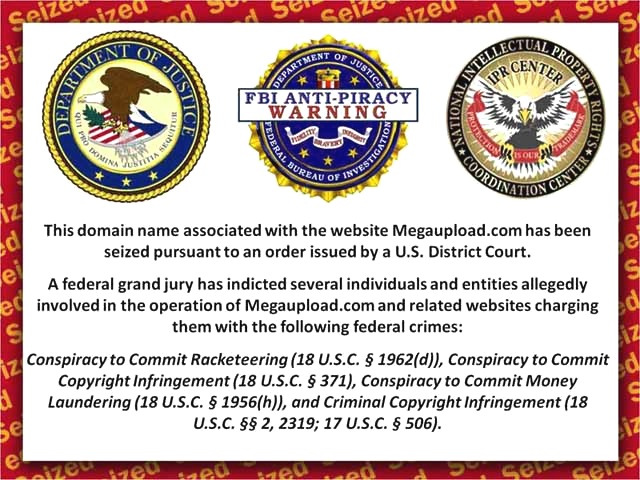
On 19 January 2012, the United States Department of Justice through the Federal Bureau of Investigation seized the domain names and closed down the sites associated with Megaupload after the owners were arrested and indicted for allegedly operating as an organisation dedicated to copyright infringement. Subsequently, HK$330 million (approximately US$42 million) worth of assets were frozen by the Customs and Excise Department of Hong Kong. The company's founder, New Zealand resident Kim Dotcom, has denied any wrongdoing, and the case against Dotcom has been the subject of controversy over its legality. In 2017, a New Zealand judge ruled that Dotcom should be extradited to the United States, but Dotcom remained at liberty in New Zealand pending the results of an appeal. On 5 July 2018, the New Zealand Court of Appeal found Dotcom and three of his former colleagues were eligible to be extradited to the U.S. authorities. His lawyer said they would appeal to the New Zealand Supreme Court. The shutdown of Megaupload led to denial-of-service (DoS) attacks on a range of websites belonging to the U.S. government and copyright organisations by the hacktivist group Anonymous.
On 19 January 2013 (2013-01-19), Megaupload was relaunched as Mega under the domain name mega.co.nz (later moved to mega.nz, and then to mega.io). The re-launch date was chosen to coincide with the first anniversary of Megaupload's takedown by the U.S. Federal Bureau of Investigation.

Company and services
The company's registered office was on the 12th floor of the Shanghai Industrial Investment Building in Room 1204 in Wan Chai, Hong Kong.
The company web services included Megaupload.com, a one-click hosting service; Megapix.com, an image hosting service; Megavideo.com and Megalive.com, video hosting services; and Megabox.com, a music hosting service. Other services included Megaclick, Megafund, Megakey and Megapay, all of which were advertisement and financial services. Along with this, four blogs were created including Megabest and Megaking. Two additional services—Megabackup and Megamovie—were in development before their closure.
Statistics
Unique visitors: 82,764,913

Page views (in history): over 1,000,000,000
Visitors per day: 50,000,000
Reach: 4%
Registered Members: 180,000,000
Storage: 25 petabytes (25,000 terabytes)
Once the 13th most visited sites on the Internet
According to Sandvine, MegaUpload accounted for 1% of total traffic on fixed access networks in North America.
In a proceeding before the High Court of New Zealand on 2 February 2012, Kim Dotcom stated that Megaupload was "hosting 12 billion unique files for over 100 million users."
Software
Mega Manager
Megaupload also released its upload/download manager, Mega Manager, a download manager that featured a link-checker for Megaupload links as well as options to manage uploaded files, and to access the online control box that was on Megaupload.
Megakey
Megakey was an adware application which removed bandwidth limitations on Mega services during "happy hour" periods. In return, the users running Megakey agreed to supply some personal identification and demographic data and to allow the substitution of ads on third party websites they visited with those of Megaupload.
Megabox
Megabox, a new form of media downloading site, was the first of its kind. Kim "Dotcom" described Megabox as "very similar to iTunes" except that it operated in a web browser using HTML5 technology and loaded "much faster than iTunes or anything else out there."
FileBox
FileBox was a Flash applet that could be embedded onto any external webpage. It allowed users to upload content to Megaupload without having to visit the website itself or download the Mega Manager.
Reception
Unavailability
Although incorporated in Hong Kong, the company did not operate there. From 2009 onward, users with Hong Kong IP addresses were banned from accessing the site. The reason for the block was never disclosed by Megaupload, but Hong Kong customs officials have suggested that the block was an attempt to hinder law enforcement investigation.
As of 23 May 2010, access to Megaupload was intermittently blocked by the Internet authorities in Saudi Arabia by their regulator Communications and Information Technology Commission. Megavideo was also intermittently blocked in the United Arab Emirates due to pornographic content being accessible through the service.
From 9 June 2011 onward, the Malaysian government through Malaysian Communications and Multimedia Commission ordered all ISPs in Malaysia to block Megaupload and Megavideo. Some ISPs reportedly blocked all the sites on the list while other ISPs throttled connection speeds.
In July 2011, access to Megaupload and Megavideo was blocked in India for Reliance Entertainment customers, after a court order was obtained, citing illegal copies of the 2011 film Singham on file hosting sites.
On 19 January 2012, U.S. federal prosecutors in the state of Virginia shut down Megaupload and laid charges against its founder Kim Dotcom and others for allegedly breaching copyright infringement laws.
For a short time after the closure of the site, users could access material via Google's web cache and the Internet Archive. One day after the indictment, Google and Archive.org voluntarily removed the site mirrors to avoid the responsibility of hosting a website taken down for copyright infringement.
Criticism
In January 2011, MarkMonitor published a report entitled "Traffic Report: Online Piracy and Counterfeiting," which said that Megaupload and Megavideo were, along with RapidShare, the top three websites classified as "digital piracy," with more than 21 billion visits per year. Megaupload responded by stating: "Activity that violates our terms of service or our acceptable use policy is not tolerated, and we go to great lengths to swiftly process legitimate DMCA takedown notices." Mark Mulligan, an analyst at Forrester Research, pointed out that the number of visits did not necessarily indicate the number of downloads of illegal material.
Megaupload Toolbar redirected users to a custom error page when a 404 error occurred in the user's browser. It was also said to contain spyware. FBM Software said that the Megaupload toolbar is free of spyware.
When a file was uploaded to Megaupload and another file with the same hash was already found to exist, the uploader would be asked if they would like to link to the already existing file. Therefore, a single file may have contained multiple links to it. This caused some controversy, since when a DMCA takedown notice was issued, only the link that was provided (but not necessarily the file itself) was removed.
Megaupload song controversy
On 9 December 2011, Megaupload published a music video entitled "The Mega Song," showing artists including Kanye West, Alicia Keys and will.i.am endorsing the company. Snoop Dogg appeared in earlier versions of the video. The music video was also uploaded to YouTube, but was removed following a takedown request by the record company Universal Music Group (UMG). Megaupload said that the video contained no infringing content, commenting: "we have signed agreements with every featured artist for this campaign." Megaupload requested an apology from UMG, and filed a lawsuit against the company in the United States District Court for the Northern District of California, on 12 December 2011. UMG denied that the takedown was ordered under the terms of the Digital Millennium Copyright Act, and said that the takedown was "pursuant to the UMG-YouTube agreement," which gives UMG "the right to block or remove user-posted videos through YouTube's CMS (Content Management System) based on a number of contractually specified criteria." The video was subsequently returned to YouTube, with the reasons for the UMG takedown remaining unclear. YouTube stated: "Our partners do not have the right to take down videos from YT unless they own the rights to them or they are live performances controlled through exclusive agreements with their artists, which is why we reinstated it." Lawyers for will.i.am initially said that he had never agreed to the project, but on 12 December, he denied any involvement in the takedown notice.
2012 indictments by the United States
On 19 January 2012, the Federal Bureau of Investigation seized and shut down Megaupload.com and commenced criminal cases against its owners and others. The lead prosecutor, Neil MacBride, had formerly served as vice president, Anti-Piracy and General Counsel, of the Business Software Alliance, where he oversaw global anti-piracy enforcement and copyright policy. On 20 January Hong Kong Customs froze more than HK$300 million (US$39 million) in assets belonging to the company.
Arrests in New Zealand
Acting upon a US Federal prosecutor's request, the New Zealand Police arrested Dotcom and three other Megaupload executives in a leased $30 million mansion at Coatesville near Auckland on Friday, 20 January 2012 (NZDT, UTC+13). This was pursuant to a request from the U.S. Federal Bureau of Investigation that the four be extradited for racketeering and money laundering. The raid was timed for the birthday celebration of Dotcom. Assets worth $17 million including art works and cars were seized. The four men arrested were Kim Dotcom (founder; 38 years old, from Germany), Finn Batato (CMO; 38, from Germany), Mathias Ortmann (CTO and co-founder; 40, from Germany) and Bram van der Kolk (29, from the Netherlands).
On 23 January, Dotcom appeared in Auckland's North Shore District Court for a bail hearing. The crown argued against bail on the basis that he was a flight risk with a helicopter on his front lawn, while defense lawyers argued that the helicopter could not fly far enough to reach another country. They also said that Dotcom denied any criminal wrongdoing. Judge David McNaughton expressed concern at the discovery of two shotguns at Dotcom's mansion during the police raid, and deferred a decision on whether to grant bail, saying that he needed more time to review the submissions. The request for bail was turned down, with Judge McNaughton saying that "he was denied due to the risk [that] Mr. Dotcom would flee jurisdiction and the possibility that if he reached Germany he wouldn't be extradited to face the charges". On 3 February 2012, an appeal to the High Court of New Zealand upheld the decision to deny bail.
On 22 February 2012, North Shore District Court Judge Nevin Dawson overturned the previous rulings and granted bail to Kim Dotcom, saying that the risk of flight had diminished after his assets had been seized.
On 5 March 2012, a formal request for the extradition to the United States of Kim Dotcom and three other senior Megaupload staff was filed in a New Zealand court.
On 30 April 2012, the New Zealand High Court ruled that around $750,000 of Kim Dotcom's assets could be returned, including a Mercedes-Benz G55 AMG and Toyota Vellfire that had been seized during the raid on his home. The assets in 63 bank accounts and around thirty other vehicles remained in custody. A paperwork error by the New Zealand authorities meant that Kim Dotcom's property had been seized in January 2012 without giving proper notice. The restraining order on his property was granted in April 2012. During April 2012, US district court judge Liam O'Grady stated "I frankly don't know that we are ever going to have a trial in this matter," as he found out that the company had never been formally served with criminal papers by the US.
On 28 June 2012, New Zealand High Court judge Justice Helen Winkelmann ruled that the search warrants used to raid the home of Kim Dotcom were invalid, saying "The warrants did not adequately describe the offences to which they related. They were general warrants, and as such, are invalid."
On 10 July 2012, a decision on whether Kim Dotcom and other Megaupload employees should be extradited to the United States was delayed until March 2013, in order to allow further time for legal arguments to be heard. New Zealand judge Justice Helen Winklemann said that U.S. authorities would need to provide evidence of "Internet piracy" before Dotcom was extradited.
On 24 September 2012, New Zealand's Prime Minister John Key ordered an inquiry into whether staff at the Government Communications Security Bureau had unlawfully spied on Kim Dotcom and the other defendants in the case. Key commented "I expect our intelligence agencies to operate always within the law. Their operations depend on public trust."
On 7 July 2014, it was reported that the proceedings to extradite Dotcom from New Zealand to the United States had been delayed until February 2015.
On 8 September 2014, the Court of Appeal ruled that the New Zealand Police were to return seized electronic devices unencrypted back to Dotcom and those involved.
On 23 December 2015, New Zealand judge Nevin Dawson ruled that Kim Dotcom, as well as three of his colleagues, can be extradited to the United States to face copyright infringement charges. Mr. Dotcom's lawyers said they would appeal the decision.
Basis of indictment
The indictment alleged that Megaupload differed from other online file storage businesses.
Media reports covering the case highlighted several points from the indictment used to support claims of illegal activity. The indictment provided instances alleged to show criminal behaviour, as well as indicating design points of Megaupload's operating model as being evidence of criminal intent:
In practice, the "vast majority" of users do not have any significant long term private storage capability. Continued storage is dependent upon regular downloads of the file occurring. Files that are infrequently accessed are rapidly removed in most cases, whereas popular downloaded files are retained. (items 7–8)
Because only a small portion of users pay for storage, the business is dependent upon advertising. Adverts are primarily viewed when files are downloaded and the business model is therefore not based upon storage but upon maximizing downloads. (items 7–8)
Persons indicted have "instructed individual users how to locate links to infringing content on the Mega Sites ... [and] ... have also shared with each other comments from Mega Site users demonstrating that they have used or are attempting to use the Mega Sites to get infringing copies of copyrighted content." (item 13)
Persons indicted, unlike the public, are not reliant upon links to stored files, but can search the internal database directly. It is said they have "searched the internal database for their associates and themselves so that they may directly access copyright-infringing content". (item 14)