
Martin Fourcade (French pronunciation: [maʁtɛ̃ fuʁkad]; born 14 September 1988) is a French retired biathlete and military officer. He is a six-time Olympic champion, a thirteen-time World Champion and a seven-time winner of the Overall World Cup. As of February 2026, he is the second most successful French Winter Olympian of all time after Quentin Fillon Maillet. Fourcade is the all-time biathlon record holder of overall World Cup titles with seven big crystal globes and he's also the all-time record holder of the most consecutive Major Championships titles with at least one non-team gold medal in every major championship from 2011 to 2018.
On 13 March 2020, he announced his retirement following the 2019–2020 season. Since April 2018, he serves as president of the Athletes' Commission of the organising committee for the 2024 Olympic and Paralympic Games in Paris, France. In February 2022 Fourcade was elected to serve eight-year terms as a member of both the International Olympic Committee and the IOC Athletes' Commission.
Fourcade is an officer of the French Army. He graduated from the High Mountain Military School in Chamonix in 2014. In 2017 he was made a sous-lieutenant.

Career
This article uses the phrase "non-team" when referring to individual competitions to avoid mixing up one of the biathlon disciplines, the individual discipline and individual competitions in general.
Early career
Fourcade took up biathlon in 2002 and started competing internationally in 2006, following in the footsteps of his older brother Simon Fourcade. The younger Fourcade competed for France in the 2007 and 2008 Junior World Championships, winning a bronze medal in the relay in 2007.
Fourcade first competed in the Biathlon World Cup at Oslo in March 2008, finishing 61st in what would be his only World Cup appearance that season. The next season was already much more successful for him, as he grabbed his first World Cup points at Hochfilzen, placing 36th in the individual race and 10th in the sprint. His best results that year came at the 2009 World Championships, where he finished in the top 20 in every competition, including an 8th place in the pursuit and a 4th place in the relay. Fourcade finished 24th in the overall World Cup that year.

2009–10 season: First wins and first discipline World Cup title, First Olympic gold
Fourcade again improved in the 2009–10 season, consistently finishing in the top 10 and making the French team for the 2010 Winter Olympics, together with his brother. Fourcade grabbed a gold medal in the mass start, marking his first Olympic medal and the first time he made the podium in a World Cup event. Fourcade then claimed his first victory in a pursuit at Kontiolahti, and followed up with two more first places at Oslo, in a sprint and another pursuit. The two pursuit victories meant Fourcade won the 2009–10 Pursuit World Cup, edging out Austria's Simon Eder by just one point. In the overall World Cup he finished 5th, 64 points ahead of his brother Simon, who finished a career-best 7th.
2010–11 season: First World Championship title, first overall World Cup podium
The 2010–11 season was also highly successful for Fourcade. He opened the season at Östersund with three top 5 finishes, including two 3rd places. After somewhat weaker showings at Pokljuka and Oberhof, Fourcade placed runner-up in all three races at Ruhpolding. Fourcade won mass starts at both Antholz and Fort Kent, and entered the 2011 World Championships in Khanty-Mansiysk, Russia as one of the favourites.
The first event at the World Championships was the mixed relay, where the French placed 3rd after Fourcade as anchor showed the best male performance in the race to lift his team up from 5th. Fourcade then claimed the silver medal behind Arnd Peiffer in the sprint, despite missing two shots at the prone stage; Fourcade was the fastest skier in the competition. The next day in the pursuit Fourcade won the gold despite three penalties, thanks to turning in another fastest skiing performance.

Fourcade finished 3rd in the Overall World Cup, 4th in the Sprint, 2nd in the Pursuit, 3rd in the Individual and 2nd in the Mass Start.
2011–12 season: First overall World Cup title, three World Championships golds
Fourcade had the best possible start in 2011–12 season with 2 wins in the individual and the pursuit in Östersund, Sweden, leading the Overall ranking for the first time.
In Nové Město, Czech Republic, he finished 3rd in the sprint, alongside his older brother Simon who took the 2nd place, behind Norway's Emil Hegle Svendsen. It was the first time in biathlon's history that 2 brothers stood on a podium together. In the following pursuit (although finishing respectively 2nd and 3rd) Simon was downgraded to 4th place after IBU decided to upgrade Germany's Arnd Peiffer following a target's malfunction (Peiffer did an extra lap). But the French team claimed Martin had purposely slowed down before crossing the line, seeing that Simon was far behind. IBU finally decided to tie Peiffer and Martin.
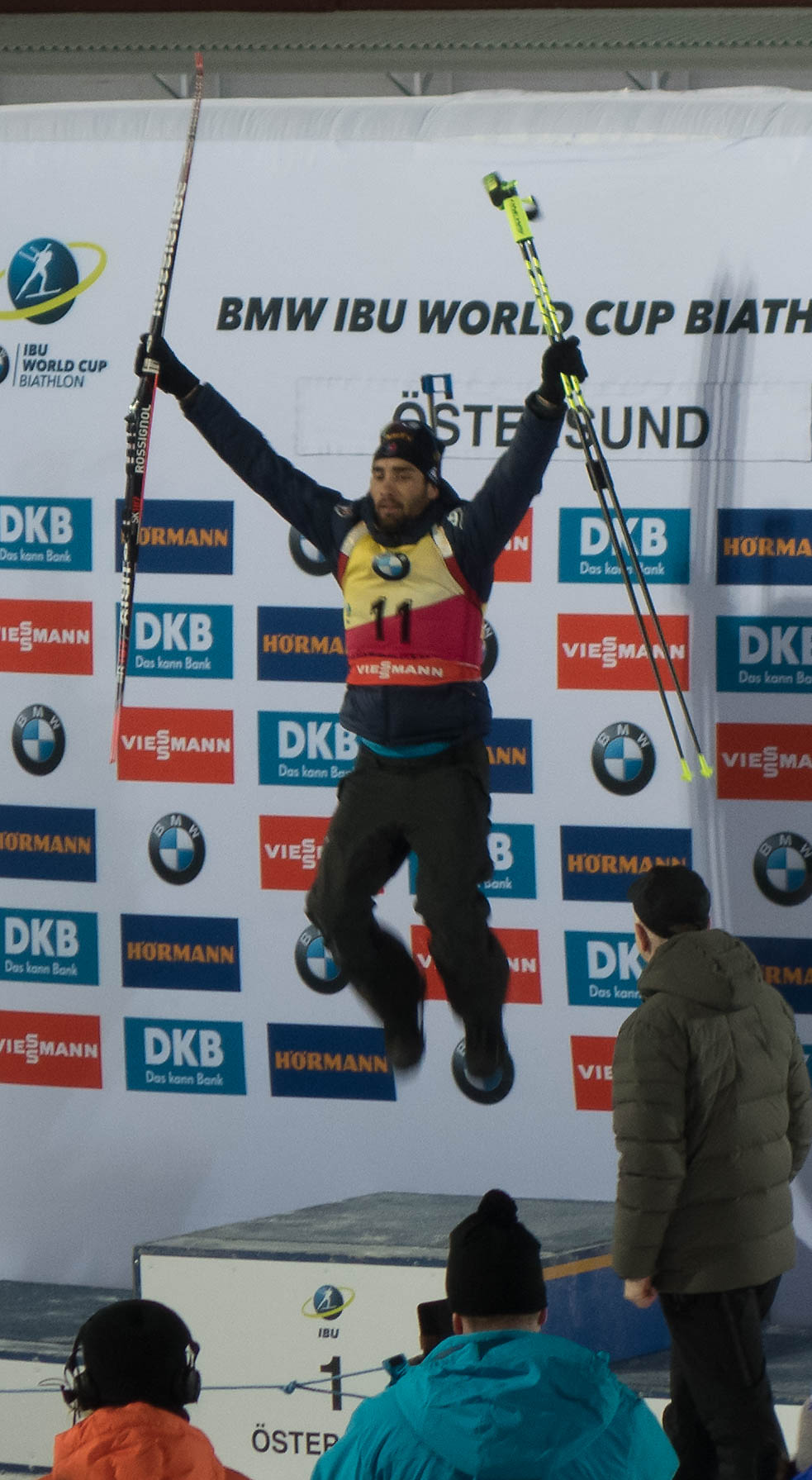
Antholz was a fantastic weekend for the French team, both men and women relays taking 1st place and Fourcade finishing 3rd of the sprint and the mass Start.
On home soil in Oslo, Emil Hegle Svendsen grabbed the yellow bib from Fourcade.
The first to start, Fourcade managed to win the sprint despite extreme temperatures in Kontiolahti, Finland (−18 °C).

At the World Championships in Ruhpolding, Fourcade won three gold medals in sprint, pursuit and mass start. He became only the third male biathlete to win three non-team gold medals at a single World Championships after Raphaël Poirée (Oberhof 2004) and Ole Einar Bjørndalen (Hochfilzen 2005 and Pyeongchang 2009).
Fourcade won the overall World Cup for the first time, as well as the discipline titles in the sprint and the pursuit.
2012–13 season: Overwhelming overall World Cup title, a World Championship gold and five medals
Fourcade started the 2012–13 season with a win in the individual in Östersund. At the time he had improved his shooting to 89%.
In Hochfilzen, Fourcade finished 2nd and 3rd in the sprint and in the pursuit, respectively.
Having had mediocre weekends in Pokljuka and Oberhof, Fourcade went on to win both the sprint and the mass start in Ruhpolding.
At the World Championships in Nové Město, Fourcade had to settle for silver both in sprint and in pursuit as Emil Hegle Svendsen won both events. In the latter, Fourcade lost the gold by one tenth of a second to Svendsen, leaving the Frenchman disappointed, citing that he would "think of that 2,4 cm everyday when training next summer". Fourcade was, however, able to take a gold in the individual, his fifth World Championships gold medal.
The end of the season was a successful one for Fourcade, as he picked up wins in the pursuit in Oslo, in the individual and in the sprint in Sochi and in the sprint and in the mass start in Khanty-Mansiysk.
Fourcade finished the season with over 400 overall world cup points more than Svendsen who finished second, thus winning his second overall World Cup title. In addition, he won all of discipline titles, becoming only the second male biathlete after Raphaël Poirée to win all of the crystal globes in one season.
2013–14 season: Olympic golds and a silver, third overall World Cup title in a row
Just like in the previous season, Fourcade started the 2013–14 season by winning the Östersund individual. In addition, he won the sprint two days later. He then went on to take a third win of the season in Hochfilzen pursuit. Fourcade couldn't, however, add to his win count in Annecy, France, his best result being third in the sprint.
At the start of the year 2014 Fourcade won the mass start in Oberhof, his first World Cup victory there. He then decided to skip the Ruhpolding weekend to train for the olympics. His final tune-up for the olympics, the Antholz World Cup weekend wasn't all that successful, although the French team, anchored by Martin Fourcade, did win the men's relay.
Ahead of the 2014 Winter Olympics in Sochi Fourcade admitted that he will be under pressure, but that he will be able to handle it. He also said that he is capable of winning every race he enters but that there will be others, mainly Emil Hegle Svendsen, with a great level of self-confidence. The first non-team race, the sprint, ended in disappointing sixth place for Fourcade. However, he was able to turn the tables in the following pursuit, climbing from sixth to first, winning his first olympic gold medal. After the last shot at the last standing shooting Fourcade famously stretched his arm in the air and pumped his fist, explaining that it was all happiness, knowing the weight of that shooting. In the individual, Fourcade carried on his good form, hitting 19 out of 20 targets in winning his second olympic gold medal. The mass-start ended in a slight disappointment for Fourcade, for even though claiming his third medal of the games, a silver, he lost the gold by some centimeters, Svendsen claiming the victory in photo-finish. Regardless of that, Fourcade was by far the most successful male biathlete of the 2014 Winter Olympics. In addition, he became only the second male biathlete after Ole Einar Bjørndalen to have won a non-team Olympic gold medal, a non-team World Championships gold medal, the Overall World Cup title and all of the discipline World Cup titles in his career.
After the olympics there were three weekends left in the world cup, with Fourcade claiming the second place in the Pokljuka mass start, and second places in the Kontiolahti sprint and pursuit (Johannes Thingnes Bø winning both of the Kontiolahti races). With the pursuit second place, Fourcade secured his third overall World Cup title.
Fourcade won the final event of the season, the Oslo mass start, which ensured that he won the mass start crystal globe. He finished the season with the Overall crystal globe as well as sprint, pursuit and mass start crystal globes.
2014–15 season: Historic fourth overall World Cup title in a row, a World Championship gold and medals
Before the 2014–15 season Fourcade suffered from mononucleosis and was forced to heavily cut back his training hours in the summer.
Unlike the two previous years, Fourcade couldn't win the Östersund individual, in fact with six shooting errors he slumped to 81st place, his second worst World Cup result ever. This appeared to be only temporary, however, as he won both of the following races, the sprint and the pursuit.
His next victory came in the Hochfilzen pursuit where he climbed from seventh place to first, thanks to a clean shooting. Pokljuka was not as successful, as Fourcade didn't add to his win tally. Even so, he collected second most points of the weekend behind Anton Shipulin of Russia.
The Oberhof weekend at the start of the year 2015 was a very successful one for the French star as he won both the sprint and the mass start. The final shooting of the mass start was one of the most memorable moments of the season as a strong wind forced the leading Fourcade to wait patiently for it to calm down while many athletes, including eventual runner-up Anton Shipulin, left the shooting range. None of them shot clean, however, and it was the clean shooting Fourcade who again took the lead and the victory.
After two below par -weekends, when Shipulin and most notably Simon Schempp of Germany were able to reduce the gap to Fourcade in the Overall World Cup, the Frenchman was able to regroup to score fourth and third places in Nové Město sprint and pursuit, respectively.
The last weekend before the world championships, the Oslo weekend, saw Fourcade complete the return to form, as the Frenchman won the individual race. He started first, shot 20 out of 20 and stayed on top until the end. Fourcade then went on to take the second place behind Arnd Peiffer in the sprint.
At the World Championships in Kontiolahti, Fourcade didn't medal in the three other non-team events, but won his sixth world championships gold medal in the individual. Having made one shooting error on the second prone stage he had to play catch up, as his rival Emil Hegle Svendsen had cleared all the targets earlier. Fourcade didn't make any more shooting mistakes and overtook Svendsen at the finish to take the gold. If it hadn't been for the late success of eventual bronze medalist Ondrej Moravec, the elder of the Fourcade brothers, Simon, would have been on the podium as well. By claiming his sixth non-team gold, Martin Fourcade became the third most successful non-team gold medal winning male biathlete at the World Championships after Ole Einar Bjørndalen and Raphaël Poirée, and moved ahead of his rival Svendsen, Alexander Tikhonov and Frank Ullrich who all stand at five non-team gold medals.
At the season finale in Khanty-Mansiysk, Fourcade claimed a victory in the sprint, his 8th win of the season. He then finished 4th in the pursuit, which was enough to secure the big crystal globe, as well as the pursuit discipline title.
Despite the off season mononucleosis, Fourcade finished the season winning the Overall World Cup title and the sprint and pursuit discipline titles. He became the first male biathlete to win the Overall title four times in succession.
2015–16 season: Overall World Cup title and all of the discipline titles, World Championship success
Before starting his biathlon campaign for 2015–16, Fourcade had a brief foray into cross-country skiing, finishing 12th in a 15 km freestyle FIS race at Beitostølen before competing in the opening meeting of the 2015–16 FIS Cross-Country World Cup at Ruka, where he finished 22nd in the 10 km freestyle, posting the third best French performance of the day, and beating his previous personal best result on the Cross-Country World Cup of a 47th place in 2012.
Like the year before, Fourcade started the biathlon season with an indifferent showing in the Östersund individual. And like the previous year, he was able to regroup to win both of the two other solo Östersund races, the sprint and the pursuit. He missed five times in the two competitions altogether, but was still able to win both races quite comfortably with his outstanding ski speed.
In Hochfilzen, Fourcade and Simon Schempp dominated the field, with Schempp winning the sprint and Fourcade finishing second and the two swapping places in the following pursuit. The Pokljuka weekend was a good but not a great one for Fourcade, as he collected third most world cup points there. Schempp was, however, able to gain on the lead of Fourcade quite considerably.
With world number two Bjørndalen and world number three Schempp absent from the first two and all three Oberhof-replacing Ruhpolding races, respectively, Fourcade was able to take a sizeable lead in the overall rankings. After the first of the two Ruhpolding weekends, a familiar threat in Emil Hegle Svendsen took over as the nearest challenger to Fourcade in the overall rankings. However, Fourcade was able to take a big lead in the final race of the weekend, the mass start. The two great rivals arrived toe to toe at the final standing shoot, only for Fourcade to hit all five targets and win the race and Svendsen to miss three times and fall to the 13th place.
Fourcade then carried on the good form by winning the Ruhpolding individual race and placing second in the mass start. The next weekend, the Antholz weekend was a poor one for Fourcade, although he did rise from 28th place to fourth in the pursuit.
The trip to North America started very well for Fourcade, as he won the Canmore sprint. He also took the Canmore single mixed relay with Marie Dorin Habert. In the Presque Isle sprint, Fourcade finished third behind Johannes Thingnes Bø and Anton Shipulin. In the following pursuit, Bø seemed to be on his way to winning a double before missing twice on the last shooting. Fourcade, some 40 seconds back, cleared all five targets and left the range before his Norwegian rival. By claiming the pursuit, Fourcade equalled the number of world cup race wins of Raphaël Poirée, with 44 victories. The race also marked the 100th time Fourcade wore the prestigious yellow bib.
To prepare for the 2016 World Championships in Oslo, Fourcade bought an apartment in Oslo with the help of his friend Tarjei Bø in June 2015. Judging by his success in the championships, this seemed to be a good move. Fourcade started by anchoring the French mixed relay team to a gold medal before winning both the sprint and the pursuit in convincing fashion. With these gold medals, Fourcade secured his fifth straight Overall World Cup title and brought his number of World Championship gold medals to nine. He then went on to keep the golden streak going by winning the individual race. Fourcade had a one-minute penalty at the first standing stage but, as in the three previous major individual races, this proved to be his only mistake of the race. That turned out to be just enough to beat clean-shooting Dominik Landertinger of Austria. By claiming his tenth World Championship gold medal and ninth non-team gold medal, Fourcade became the first biathlete ever to win the longest event in biathlon three times in succession at the World Championships. In addition, Fourcade claimed the individual discipline crystal globe with a margin of two points over bronze medallist Simon Eder of Austria, leaving the great Frenchman all but certain to win all of the crystal globes that season. The final race of the championships, the mass start, saw Fourcade narrowly miss the chance to win all four non-team gold medals as Johannes Thingnes Bø edged the Frenchman on the last loop. With his non-team medals, Fourcade became only the second male biathlete to win three golds and one silver in non-team competitions in a single World Championships, after Raphaël Poirée (Oberhof 2004). And by claiming three non-team gold medals to take his career tally to 9, Fourcade became the second most successful non-team gold medal winning male biathlete at the World Championships after Ole Einar Bjørndalen.
Fourcade finished the season winning the overall World Cup title as well as all of the discipline titles, becoming the first male biathlete to win all five crystal globes of a season multiple times. The overall title was his fifth in succession.
2016–17 season: Sixth overall World Cup title in a row, a World Championship gold and medals
Yet again the first competition weekend of the season in Östersund proved to be a successful one for Fourcade. He started the campaign with a convincing victory in the mixed relay with Marie Dorin Habert. Fourcade then won the individual race, the first non-team race of the season, despite two missed shots at the first standing stage. He hit all the remaining targets while Johannes Thingnes Bø, who had a comfortable lead coming to the last shooting, fell victim to nerves and a strong wind and missed two targets. This allowed fast-skiing Fourcade to take the victory. The sprint was a dominant race for Fourcade, who missed no targets and outskied everyone else. Fourcade couldn't, however, complete the Östersund clean sweep, as he surprisingly let go a 42-second lead in the pursuit. He suffered from a combination of nerves and wind to miss four targets altogether as he was beaten by the surprise pair of the season, Anton Babikov and Maxim Tsvetkov of Russia. The third place ensured, however, that Fourcade would take a sizeable lead in the world cup total points from the first weekend.
Fourcade continued his domination in Pokljuka, winning all three competitions of the weekend. He overtook a fellow clean-shooter Johannes Thingnes Bø in the sprint with a strong last loop. This ensured that Fourcade now had at least one victory at every World Cup venue in the current calendar. In the pursuit, Fourcade shot clean all stages and left Anton Shipulin, who had arrived at the last standing just after Fourcade, third behind Emil Hegle Svendsen. Fourcade then anchored the French team to victory in the relay, having had a 20-second head start thanks to three good legs from Jean Guillaume Beatrix, Quentin Fillon Maillet and Simon Desthieux.
For the second weekend in a row, Fourcade won all three competitions of the weekend, this time in Nové Město. He won the sprint with a margin of 1,6 seconds with one penalty, outskiing the clean-shooting Anton Shipulin. Fourcade then shot a single penalty in a convincing pursuit victory and wrapped up the weekend with another 19 out of 20 targets -mass start competition, claiming his 7th non-team victory of the season. By winning 7 of the 8 non-team competitions, placing third in the remaining one and winning both relay competitions, Fourcade had the most successful December in biathlon history.
The first race after the Christmas break was the Oberhof sprint, where Fourcade had the lead coming to the second shooting, but couldn't manage the tough winds and missed three targets. He finished eighth, his worst result of the season, thus ending the streak of 10 podium finishes and 8 non-team podium finishes. However, Fourcade was able to turn the tables in the following pursuit. He hit 19 out of 20 targets in difficult conditions and climbed from 51 seconds back of Julian Eberhard to win with a margin of over a minute to Arnd Peiffer. With this win, Fourcade secured having at least one victory from every competition weekend of the season. In the mass start, Fourcade missed twice and finished third behind Germans Simon Schempp and Erik Lesser, despite leading after the last shooting. This was the 10th podium out of 11 races of the season for Fourcade.
Fourcade continued to amass victories and World Cup lead in Ruhpolding. He outskied Julian Eberhard and Emil Hegle Svendsen in the sprint, all three of them shooting clean. In the following pursuit, Eberhard dropped out of the fight for victory earlier on, but Svendsen got close to Fourcade. This was because the Frenchman missed three times in the second and third shooting combined. Before the last shooting, Svendsen had the lead for a moment and a number of other athletes caught them as well. But from there on, Fourcade opened up a lead, held his nerve and technique to shoot clean, and easily held his lead in the final lap.