
The Mapuche ( mə-POO-chee, Mapuche and Spanish: [maˈputʃe]), also known as Araucanians, are a group of Indigenous inhabitants of south-central Chile and southwestern Argentina, including parts of Patagonia. The collective term refers to a wide-ranging ethnicity composed of various groups who share a common social, religious, and economic structure, as well as a common linguistic heritage as Mapudungun speakers. Their homelands once extended from Choapa Valley to the Chiloé Archipelago and later spread eastward to Puelmapu, a land comprising part of the Argentine pampa and Patagonia. Today, the Mapuche represent 77.16% of Chile’s indigenous peoples and about 8.8% of the total national population. The Mapuche are concentrated in the Araucanía region. Many have migrated from rural areas to the cities of Santiago and Buenos Aires to pursue economic opportunities. Around 92% of the Mapuches are from Chile.
The Mapuche traditional economy is based on agriculture; their traditional social organization consists of extended families, under the direction of a lonko or chief. In times of war, the Mapuche would unite in larger groupings and elect a toki (meaning "axe" or "axe-bearer") to lead them. Mapuche material culture is known for its textiles and silverwork.
At the time of Spanish arrival, the Picunche inhabited the valleys between the Choapa and Itata, Araucanian Mapuche inhabited the valleys between the Itata and Toltén rivers, south of there, and the Huilliche and the Cunco lived as far south as the Chiloé Archipelago. In the seventeenth, eighteenth, and nineteenth centuries, Mapuche groups migrated eastward into the Andes and Pampas, conquering, fusing with and establishing relationships with the Poya and Pehuenche. At about the same time, ethnic groups of the Pampa regions, the Puelche, Ranquel, and northern Aonikenk, made contact with Mapuche groups. The Tehuelche adopted the Mapuche language and some of their culture, in what came to be called Araucanization, during which Patagonia came under effective Mapuche suzerainty.

Mapuche in the Spanish-ruled areas, especially the Picunche, mingled with the Spanish during the colonial period, forming a mestizo population that lost its Indigenous identity. But Mapuche society in Araucanía and Patagonia remained independent until the late nineteenth century, when Chile occupied Araucanía and Argentina conquered Puelmapu. Since then the Mapuche have become subjects, and later nationals and citizens, of those states. Today, many Mapuche and Chilean communities are engaged in the so-called Mapuche conflict over land and Indigenous rights in both Argentina and Chile.
Etymology
Historically, the Spanish colonizers of South America referred to the Mapuche people as Araucanians ( ARR-aw-KAY-nee-ənz; Spanish: araucanos). This term is now considered pejorative by some people. For others, the importance of the term Araucanian lies in the universality of the epic work La Araucana, written by Alonso de Ercilla, and the feats of that people in their long and interminable war against the Spanish Empire. The name is probably derived from the placename rag ko (Spanish Arauco), meaning "chalky/clayish water". Although some have speculated a link with the Quechua word awqa, meaning "rebel" or "enemy", this is probably not the case.
Scholars believe that the various Mapuche groups (Moluche, Williche, Pikunche, etc.) called themselves Reche during the early Spanish colonial period, due to what they referred to as their pure native blood, derived from re meaning "pure" and che meaning "people".

The name Mapuche is used both to refer collectively to the Pikunche, Williche, and Moluche or Nguluche from Araucanía, at other times, exclusively to the Moluche or Nguluche from Araucanía. However, Mapuche is a relatively recent endonym meaning "People of the Earth" or "Children of the Land", with mapu meaning "earth" or "land", and che meaning "person". It is preferred as a term when referring to the people after the Arauco War.
The Mapuche identify by the geography of their territories, such as:
Pwelche (also Hispanicized as Puelche): "people of the east" occupied Pwel mapu or Puel mapu, the eastern lands (Pampa and Patagonia of Argentina).
Pikunche (also Hispanicized as Picunche): "people of the north" occupied Pikun-mapu, the "northern lands".
Williche (also Hispanicized as Huilliche): "people of the south" occupied Willi mapu, the "southern lands".
Pewenche (also Hispanicized as Pehuenche): "people of the pewen (Araucaria araucana)" occupied Pewen mapu, "the land of the pewen".

Lafkenche: "people of the sea" occupied Lafken mapu, "the land of the sea"; also known as Coastal Mapuche.
Nagche: "people of the plains" occupied Nag mapu, "the land of the plains" (located in sectors of the Cordillera de Nahuelbuta and the low zones bordering it). Its epic and literary name is Araucanians and its old autochthonous name is Reche. The ancient Mapuche Toqui ("axe-bearer") like Lef-Traru ("swift hawk", better known as Lautaro), Kallfülikan ("blue quartz stone", better known as Caupolicán – "polished flint") or Pelontraru ("Shining Caracara", better known as Pelantaro) were Nagche.
Wenteche: "people of the valleys" occupied Wente mapu, "the land of the valleys".

History
Pre-Columbian period
Archaeological finds have shown that Mapuche culture existed in Chile and Argentina as early as 600 to 500 BC. Genetically the Mapuche differ from the adjacent Indigenous peoples of Patagonia. This suggests a "different origin or long-lasting separation of Mapuche and Patagonian populations".
Troops of the Inca Empire are reported to have reached the Maule River and had a battle with the Mapuche between the Maule and the Itata Rivers there. The southern border of the Inca Empire is believed by most modern scholars to have been situated between Santiago and the Maipo River, or somewhere between Santiago and the Maule River. Thus, the bulk of the Mapuche escaped Inca rule. Through their contact with Incan invaders Mapuches would have for the first time met people with state organizations. Their contact with the Incas gave them a collective awareness distinguishing between them and the invaders and uniting them into loose geo-political units despite their lack of state organization.
At the time of the arrival of the first Spaniards to Chile, the largest Indigenous population concentration was in the area spanning from the Itata River to Chiloé Island – that is the Mapuche heartland. The Mapuche population between Itata River and Reloncaví Sound has been estimated at 705,000–900,000 in the mid-sixteenth century by historian José Bengoa.

Arauco War
The Spanish expansion into Mapuche territory was an offshoot of the conquest of Peru. In 1536, Diego de Almagro set out to conquer Chile, after crossing the Itata River they were intercepted by a numerous contingent of Araucanian Mapuche armed with many bows and pikes in the Battle of Reynogüelén. Discouraged by the ferocity of the Mapuches, and the apparent lack of gold and silver in these lands, Almagro decided upon a full retreat the following year to Peru. In 1541, Pedro de Valdivia reached Chile from Cuzco and founded Santiago. The northern Mapuche tribes, known as Picunches had recently gained independence from Inca rule, being commanded by Michimalonco, who had defeated the Inca governor Quilicanta. It would be the same Michimalonco who would lead the Picunche resistance against the Spanish between 1541 and 1545. His most famous achievement is the Destruction of Santiago.
In 1550, Pedro de Valdivia, who aimed to control all of Chile to the Straits of Magellan, campaigned in south-central Chile to conquer more Mapuche controlled territory. Between 1550 and 1553, the Spanish founded several cities in Mapuche lands including Concepción, Valdivia, Imperial, Villarrica, and Angol. The Spanish also established the forts of Arauco, Purén, and Tucapel. Further efforts by the Spanish to gain more territory engaged them in the Arauco War against the Mapuche, a sporadic conflict that lasted nearly 350 years. Hostility towards the conquerors was compounded by the lack of a tradition of forced labor akin to the Inca mit'a among the Mapuche, who largely refused to serve the Spanish.
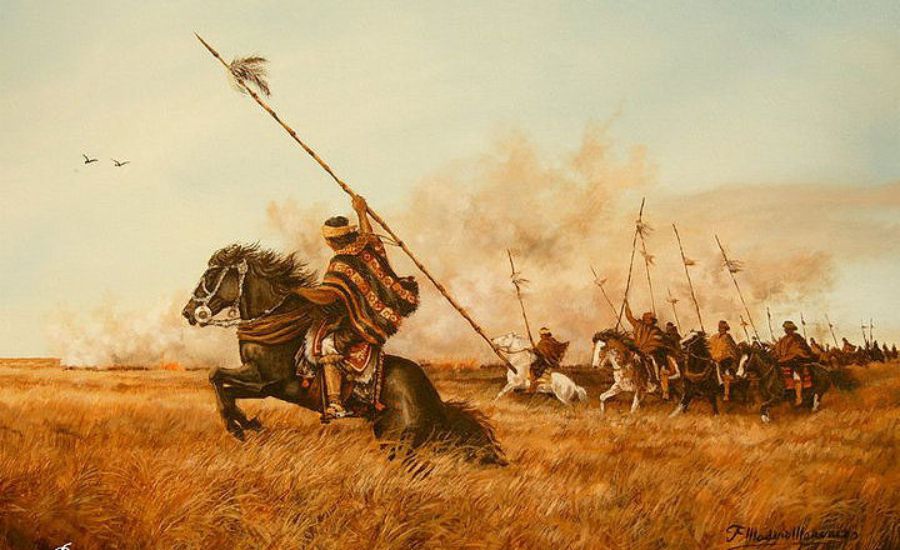
From their establishment in 1550 to 1598, the Mapuche frequently laid siege to Spanish settlements in Araucanía. In 1553, the Mapuches held a council at which they resolved to make war. They chose as their "toqui" (wartime chief) a strong man called Caupolicán and as his vice toqui Lautaro, because he had served as an auxiliary to the Spanish cavalry; he created the first Mapuche cavalry corps. With six thousand warriors under his command, Lautaro attacked the fort at Tucapel. The Spanish garrison was unable to withstand the assault and retreated to Purén. Lautaro seized and burned the fort and prepared his army certain that the Spaniards would attempt to retake Tucapel. Valdivia mounted a counter-attack, but he was quickly surrounded. He and his army was massacred by the Mapuches in the Battle of Tucapel. In 1554 Lautaro went to destroy Concepción where in the Battle of Marihueñu he defeated Governor Villagra and devastated the city. In 1555 Lautaro went to the city of Angol and destroyed it, he also returned to Concepción, rebuilt by the Spanish and destroyed it again. In 1557 Lautaro headed with his army to destroy Santiago, fighting numerous battles with the Spanish along the way, but he and his army were devastated in the Battle of Mataquito.
From 1558 to 1598, war was mostly a low-intensity conflict. Mapuche numbers decreased significantly following contact with the Spanish conquerors and settlers; wars and epidemics decimated the population. Others died in Spanish-owned gold mines.
In 1598 a party of warriors from Purén led by Pelantaro, who were returning south from a raid in the Chillán area, ambushed Governor Martín García Óñez de Loyola and his troops in the Battle of Curalaba while they rested without taking any precautions against attack. Almost all the Spaniards died, save a cleric named Bartolomé Pérez, who was taken prisoner, and a soldier named Bernardo de Pereda. Led by Pelantaro the Mapuche then initiated a general uprising that destroyed all the cities in their homeland south of the Biobío River.
In the years following the Battle of Curalaba, a general uprising developed among the Mapuches and Huilliches led to the Destruction of the Seven Cities. The Spanish cities of Angol, Imperial, Osorno, Santa Cruz de Oñez, Valdivia, and Villarrica were either destroyed or abandoned. The city of Castro was taken by a Dutch-Mapuche alliance in 1599, but reconquered by the Spanish in 1600. Only Chillán and Concepción resisted Mapuche sieges and raids. Except for the Chiloé Archipelago, all Chilean territory south of the Bíobío River was freed from Spanish rule. Despite continued Spanish attempts to reconquer the territories south of the Biobio River, the border remained stable during the centuries in which the Spanish reigned in South America. In this period the Mapuche Nation crossed the Andes to conquer the present Argentine provinces of Chubut, Neuquen, La Pampa, Buenos Aires and Río Negro. Historians disagree over the time period during which the expansion took place, but estimate it occurred roughly between 1550 and 1850.
Boroano people
The Boroano, Boroga, or Borogano (also spelled with v) were a group of mapuche native to the aillarehue of Boroa in Araucanía. They were involved in several conflicts in the northern Patagonian pampas, and supported figures such as José Miguel Carrera, the Pincheira brothers, and Juan Manuel Rosas. The military power and influence of the Boroano ended with the massacre carried out by the lonco Calfucurá in 1834 during a trade meeting.
Incorporation into Chile and Argentina
In the nineteenth century, Argentina and Chile experienced a fast territorial expansion. Argentina established a colony at the Falkland Islands in 1820, settled Chubut with Welsh immigrants in 1865 and conquered Formosa, Misiones and Chaco from Paraguay in 1870. Later Argentina would also annex the Puna de Atacama in 1898. Chile on the other hand, established a colony at the Strait of Magellan in 1843, settled Valdivia, Osorno, and Llanquihue with German immigrants, and conquered land from Peru and Bolivia. Later Chile would also annex Easter Island. In this context, Mapuche controlled territory began to be conquered by Argentina and Chile due to two reasons. First, the Argentinean and Chilean states aimed for territorial continuity, and second it remained the sole place for Argentinean livestock to expand and Chilean agriculture to expand.
Between 1861 and 1879 Argentina and Chile incorporated several Mapuche territories to their controlled territory. In January 1881, with Chile having decisively defeated Peru in the battles of Chorrillos and Miraflores, Chile and Argentina resumed the conquest of Mapuche controlled lands.
The conquest of Araucanía caused numerous Mapuches to be displaced and forced to roam in search of shelter and food. Scholar Pablo Miramán claims the introduction of state education during the Occupation of Araucanía had detrimental effects on traditional Mapuche education. Chile finally achieved the occupation and integration of the territories south of the Biobío River in 1884 when the last communities surrendered, and the cities of Villarrica and previously Angol were reestablished. Schools, cities, and legal systems were established, incorporating inhabitants into the national framework.
The rural-to-urban migration of the Mapuche people in the 20th century can be divided into two main stages: economic migration, which intensified from the 1920s and peaked in the 1950s and 1960s, and political migration following the 1973 coup. Economic migration initially responded to the need for jobs in cities, such as Santiago, where Mapuche arrived in the 1920s to work in bakeries and formed organizations like the "Sociedad Galvarino." This migration flow was accentuated by industrial growth and the lack of rural opportunities. By 1961, it was estimated that up to 25% of the Mapuche population lived outside traditional communities, though data was incomplete, and censuses did not differentiate between Mapuche and non-Mapuche citizens.
Despite its impact, statistics on Mapuche rural-to-urban migration have historically been insufficient, marked by integrationist policies that did not account for their Indigenous identity but treated them as citizens. Forced community divisions under laws such as the 1931 Decree with Force of Law No. 266 and the record-breaking divisions under Decree-Law No. 2568 of 1979 contributed to land fragmentation and forced migration to cities. In the 1952 census, only 875 Mapuche were recorded in Santiago, a figure significantly lower than independent estimates, such as Domingo Curaqueo's, which identified 10 000 Mapuche over the age of 21 in the same province.
In the years following the occupation the economy of Araucanía changed from being based on sheep and cattle herding to one based on agriculture and wood extraction. About 70% of the Mapuche Territory left in the hands of Argentina, the loss of land by Mapuches following the occupation caused severe erosion since Mapuches continued to practice a massive livestock herding in limited areas.
Modern political conflict (1990–present)
The term "Wallmapu" began to gain widespread use outside Mapudungun-speaking communities after the Council of All Lands adopted its Mapudungun name, Aukiñ Wallmapu Ngulam, upon the organization's founding in 1990. It arose in response to what Indigenous movements describe as "repression" and the perceived disregard of land deeds (Títulos de Merced). This was accompanied by a wave of Mapuche migration from the south-central region to major Chilean cities during the Chilean military dictatorship and before. The council was notable for engaging in historical revisionism and adopting political stances opposing the Chilean state's interests in the region, particularly regarding demands for "ancestral land recovery" and "political territorial autonomy for the Mapuche people." This movement also included the creation of the Wenufoye national Mapuche flag in 1992, along with five additional flags representing key Mapuche territories in southern Chile. Since 2005, the term has also been promoted by the Mapuche nationalist party Wallmapuwen.
The Chilean historian Cristóbal García Huidobro states that: "the terminology ‘Wallmapu’ is not a relatively old one, but rather a newer one. It arises, as far as it has been understood, from a revisionist movement, at the beginning of the 1990s (...) they make a re-study and a revisionism of the identity, of the language, as well as of the symbols that would represent the Mapuche people (...) it is not a historical question as such, it does not come from the ancestral culture of the Mapuche people who never perceived their territory as a particularly defined place". The term means "Universe" ancestraly in the Mapuche language.
The construction of the Ralco Hydroelectric Plant, which displaced Indigenous burial sites, was a breaking point in state-Mapuche relations, contributing to the formation of the Coordinadora Arauco-Malleco (CAM) in December 1997 following the burning of three trucks belonging to Forestal Arauco. This first attack marks the beginning of the period of violence in the Southern Macrozone of Chile and a turning point in the development of the Mapuche autonomist political movement. Since then, violence has progressively increased and expanded to the neighboring regions of Biobío and Los Lagos.
Land disputes and violent confrontations continue in some Mapuche areas, particularly in the northern sections of the Araucanía region between and around Traiguén and Lumaco. In 2003, the Commission for Historical Truth and New Treatments issued a report to defuse tensions calling for drastic changes in Chile's treatment of its Indigenous people, more than 80% of whom are Mapuche. The recommendations included the formal recognition of political and "territorial" rights for Indigenous peoples, as well as efforts to promote their cultural identities.
Though Japanese and Swiss interests are active in the economy of Araucanía (Ngulu Mapu), the two chief forestry companies are Chilean-owned. In the past, the firms have planted hundreds of thousands of hectares with non-native species such as Monterey pine, Douglas firs, and eucalyptus trees, sometimes replacing native Valdivian forests, although such substitution and replacement is now forgotten.
Chile exports wood to the United States, almost all of which comes from this southern region, with an annual value of around $600 million. Stand.earth, a conservation group, has led an international campaign for preservation, resulting in the Home Depot chain and other leading wood importers agreeing to revise their purchasing policies to "provide for the protection of native forests in Chile". Some Mapuche leaders want stronger protections for the forests.
In recent years, the crimes committed by Mapuche armed insurgents have been prosecuted under counter-terrorism legislation, originally introduced by the military dictatorship of Augusto Pinochet to control political dissidents. The law allows prosecutors to withhold evidence from the defense for up to six months and to conceal the identity of witnesses, who may give evidence in court behind screens. Insurgent groups, such as the Coordinadora Arauco Malleco, use multiple tactics with the more extreme occurrences such as the burning of homes, churches, vehicles, structures, and pastures, which at times included causing deaths and threats to specific targets. As of 2005, protesters from Mapuche communities have used these tactics against properties of both multinational forestry corporations and private individuals. In 2010 the Mapuche launched many hunger strikes in attempts to effect change in the anti-terrorism legislation.
As of 2019, the Chilean government committed human rights abuses against the Mapuche based on Israeli military techniques and surveillance according to the French website Orin21.
In May 2022, the Chamber of Deputies of Chile declared the Coordinadora Arauco-Malleco, Resistencia Mapuche Malleco, Resistencia Mapuche Lafkenche, and Weichán Auka Mapu as "illegal terrorist organizations".
Oil exploitation and fracking in the Vaca Muerta site in Neuquen, one of the biggest shale-oil and shale-gas deposits in the world, has produced waste dumps of sludge waste, polluting the environment close to the town of Añelo, which is about 1,200 km south of Buenos Aires. In 2018, the Mapuche were suing Exxon, French company TotalEnergies and Pan American Energy.
Culture
At the time of the arrival of Europeans, the Mapuche organized and constructed a network of forts and defensive buildings. Ancient Mapuche also built ceremonial constructions such as some earthwork mounds discovered near Purén. Mapuche quickly adopted iron metal-working (Picunches already worked copper) Mapuche learned horse riding and the use of cavalry in war from the Spaniards, along with the cultivation of wheat and sheep.
In the 300-year co-existence between the Spanish colonies and the relatively well-delineated autonomous Mapuche regions, the Mapuche also developed a strong tradition of trading with Spaniards, Argentines, and Chileans. Such trade lies at the heart of the Mapuche silver-working tradition, for Mapuche wrought their jewelry from the large and widely dispersed quantity of Spanish, Argentine, and Chilean silver coins. Mapuche also made headdresses with coins, which were called trarilonko, etc.
Mapuche languages
Mapuche languages are spoken in Chile and Argentina. The two living branches are Huilliche and Mapudungun. Although not genetically related, lexical influence has been discerned from Quechua. Linguists estimate that only about 200,000 full-fluency speakers remain in Chile. The language receives only token support in the educational system. In recent years, it has started to be taught in rural schools of Bío-Bío, Araucanía, and Los Lagos Regions.
Mapuche speakers of Chilean Spanish who also speak Mapudungun tend to use more impersonal pronouns when speaking Spanish.
Cosmology and beliefs
Central to Mapuche cosmology is the idea of a creator called ngenechen, who is embodied in four components: an older man (fucha/futra/cha chau), an older woman (kude/kuse), a young man, and a young woman. They believe in worlds known as the Wenu Mapu and Minche Mapu. Also, Mapuche cosmology is informed by complex notions of spirits that coexist with humans and animals in the natural world, and daily circumstances can dictate spiritual practices.
The most well-known Mapuche ritual ceremony is the Ngillatun, which loosely translates as "to pray" or "general prayer". These ceremonies are often major communal events that are of extreme spiritual and social importance. Many other ceremonies are practiced, and not all are for public or communal participation but are sometimes limited to family.
The main groups of deities and/or spirits in Mapuche mythology are the Pillan and Wangulen (ancestral spirits), the Ngen (spirits in nature), and the wekufe (evil spirits).
Central to Mapuche belief is the role of the machi (shaman). It is usually filled by a woman, following an apprenticeship with an older machi, and has many of the characteristics typical of shamans. The machi performs ceremonies for curing diseases, warding off evil, influencing weather, harvests, social interactions, and dreamwork. Machis often have extensive knowledge of regional medicinal herbs. As biodiversity in the Chilean countryside has declined due to commercial agriculture and forestry, the dissemination of such knowledge has also declined, but the Mapuche people are reviving it in their communities. Machis have an extensive knowledge of sacred stones and sacred animals.
Like many cultures, the Mapuche have a deluge myth (epeu) of a major flood in which the world is destroyed and recreated. The myth involves two opposing forces: Kai Kai (water, which brings death through floods) and Tren Tren (dry earth, which brings sunshine). In the deluge almost all humanity is drowned; the few not drowned survive through cannibalism. At last, only one couple is left. A machi tells them that they must give their only child to the waters, which they do, and this restores order to the world.