
Magna Graecia was the historical Greek-speaking area of southern Italy. It encompassed the modern Italian regions of Calabria, Apulia, Basilicata, Campania, and Sicily. These regions were extensively settled by Greeks beginning in the 8th century BC.
Initially founded by their metropoleis (mother cities), the settlements evolved into independent and powerful Greek city-states (poleis). The settlers brought with them Hellenic civilization, which over time developed distinct local forms due to both their distance from Greece and the influence of the indigenous peoples of southern Italy. This interaction left a lasting imprint on Italy, including on Roman culture. The Greek settlers also influenced native groups such as the Sicels and the Oenotrians, many of whom adopted Greek culture and became Hellenized. In areas like architecture and urban planning, the colonies sometimes surpassed the achievements of the motherland. The ancient inhabitants of Magna Graecia are referred to as Italiotes and Siceliotes.
Ruins of several cities from Magna Graecia remain visible today, including Neàpolis ("New City", now Naples), Syrakousai (Syracuse), Akragas (Agrigento), Taras (Taranto), Rhegion (Reggio Calabria), and Kroton (Crotone). The most populous city was Sybaris (now Sibari), with an estimated population of between 300,000 and 500,000, from 600 to 510 BC.

Governments in these city-states were typically aristocratic, and the cities often engaged in warfare with one another. Their independence came to an end during the Second Punic War, when they were annexed by the Roman Republic in 205 BC.
Despite the political changes, cultural life in Magna Graecia flourished. Greek art, literature, and philosophy had a decisive influence on the region, especially in cities like Taras. South Italian Greek pottery, particularly from the 4th century BC, is a notable cultural contribution. Settlers from Magna Graecia also achieved great success in the Ancient Olympic Games—athletes from Crotone alone won 18 titles over 25 Olympiads.
Although most Greek inhabitants of Magna Graecia were fully Latinized during the Middle Ages, traces of Greek language and culture persisted. The Griko people of Calabria (Bovesia) and Salento (Grecìa Salentina) still maintain aspects of their Greek heritage, including the Griko language. This language is the last living trace of the once-vibrant Greek presence in Magna Graecia.
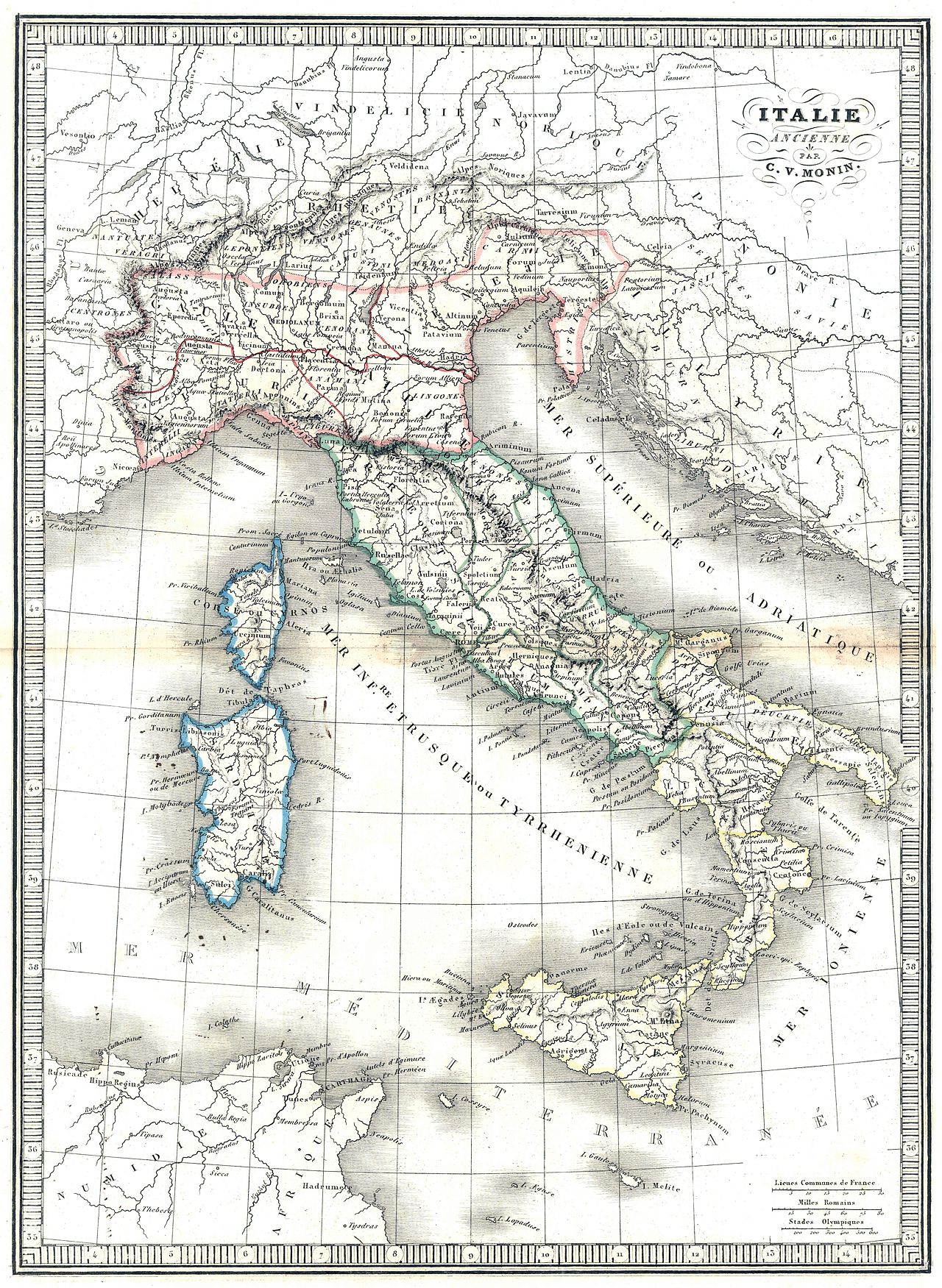
Terminology
The original Greek expression Megálē Hellás (lit. 'Great[er] Greece'), later translated into Latin as Magna Graecia, is attested for the first time in a passage from the 2nd century BC by the Greek historian Polybius (written around 150 BC), where he ascribed the term to Pythagoras and his philosophical school.
Ancient authors use "Magna Graecia" to mean different parts of southern Italy, including or excluding Sicily, Strabo and Livy being the most prominent advocates of the wider definitions. Strabo used the term to refer to the territory that had been conquered by the Greeks.
There are various hypotheses on the origin of the name Megálē Hellás. The term could be explained by the prosperity and cultural and economic splendour of the region (6th–5th century BC); notably by the Achaeans of the city of Kroton, to refer to the network of colonies they founded or controlled between the end of the 6th and mid-5th centuries at the time of the Pythagoreans.

Context
There were several reasons for the Greeks to establish overseas colonies; demographic crises (famine, overcrowding, etc.), stasis, a developing need for new commercial outlets and ports, and expulsion from their homeland after wars.
During the Archaic period, the Greek population grew beyond the capacity of the limited arable land of Greece proper, resulting in the large-scale establishment of colonies elsewhere: according to one estimate, the population of the widening area of Greek settlement increased roughly tenfold from 800 BC to 400 BC, from 800,000 to as many as 7+1⁄2-10 million. This was not simply for trade, but also to found settlements. These Greek colonies were not, as Roman colonies were, dependent on their mother-city, but were independent city-states in their own right.
Another reason was the strong economic growth with the consequent overpopulation of the motherland. The terrain that some of these Greek city-states were in could not support a large city. Politics was also the reason as refugees from Greek city-states tended to settle away from these cities in the colonies.

Greeks settled outside of Greece in two distinct ways. The first was in permanent settlements founded by the Greeks, which formed as independent poleis. The second form was in what historians refer to as emporia; trading posts which were occupied by both Greeks and non-Greeks and which were primarily concerned with the manufacture and sale of goods. Examples of this latter type of settlement are found at Al Mina in the east and Pithekoussai in the west.
From about 750 BC the Greeks began 250 years of expansion, settling colonies in all directions.
History
Greek colonisation
According to Strabo's Geographica, the colonisation of Magna Graecia had already begun by the time of the Trojan War and lasted for several centuries.

Greeks began to settle in southern Italy in the 8th century BC. Their first great migratory wave was by the Euboeans aimed at the Gulf of Naples (Pithecusae, Cumae) and the Strait of Messina (Zancle, Rhegium). Pithecusae on the island of Ischia is considered the oldest Greek settlement in Italy, and Cumae their first colony on the mainland of Italy.
The second wave was of the Achaeans who concentrated initially on the Ionian coast (Metapontion, Poseidonia, Sybaris, Kroton), shortly before 720 BC. At an unknown date between the 8th and 6th centuries BC the Athenians, of Ionian lineage, founded Scylletium (near today's Catanzaro).
With colonisation, Greek culture was exported to Italy with its dialects of the Ancient Greek language, its religious rites, and its traditions of the independent polis. An original Hellenic civilization soon developed, and later interacted with the native Italic civilisations. The most important cultural transplant was the Chalcidean/Cumaean variety of the Greek alphabet, which was adopted by the Etruscans; the Old Italic alphabet subsequently evolved into the Latin alphabet, which became the most widely used alphabet in the world.

Remains of some of these Greek colonies can be seen today, such as those of Neapolis ('new city', now Naples), Syracusae (Syracuse), Akragas (Agrigento), Taras (Taranto), and Rhegion (Reggio Calabria).
Secondary colonisation
Over time, due to overpopulation and other political and commercial reasons, the new cities expanded their presence in Italy by founding other Greek cities; effectively expanding the Greek civilisation to the whole territory known today as Magna Graecia.
An intense colonisation program was undertaken by Syracuse, at the time of the tyranny of Dionysius I of Syracuse, around 387–385 BC. This phenomenon affected the entire Adriatic coast, and in particular led to the foundation in Italy of Ancón (now Ancona) and Adria; in the Dalmatian coast he saw the foundation of Issa (current Vis), Pharos (Stari Grad), Dimos (Hvar); Lissos (now Lezhë) was founded on the Albanian coast. Issa in turn then founded Tragurium (now Trogir), Melaina Corcyra (now Korčula) and Epetium (now Stobreč, a suburb of Split).
Rhegium (now Reggio Calabria) founded Pyxus (Policastro Bussentino) in Lucania; Locri founded Medma (Rosarno), Polyxena and Hipponium (Vibo Valentia) in present-day Calabria; Sybaris (now Sibari) revitalised the indigenous centres of Laüs and Scydrus in Calabria and founded Poseidonia (Paestum), in Campania; Kroton (now Crotone) founded Terina and participated in the foundation of Caulonia (near Monasterace marina) in Calabria; Messana (now Messina), in collaboration with Rhegium, founded Metaurus (Gioia Tauro); Taras together with Thurii founded Heracleia (Policoro) in Lucania in 434 BC, and also Callipolis ('beautiful city').
Expansion and conflict
At the beginning of the 6th century BC, all the main cities of Magna Graecia on the Ionian Sea had achieved a high economic and cultural development, which shifted their interests towards expansion of their territory by waging war on neighbouring cities. The 6th century was therefore characterised by great clashes between the colonies. Some of the clashes that established the new balance and the new relationships of force were the Battle of the Sagra river (the clash between Locri Epizefiri and Kroton), the destruction of Siris (by Sybaris and Metapontum), and the clash between Kroton and Sybaris (which ended with the destruction of the latter).
As with all the events of this period precise dates are unknown, but the destruction of Sybaris may have occurred around 510 BC, while the two other clashes are placed around 580–560 BC, with the destruction of Siris before the Battle of the Sagra.
Roman Era
The first Greek city to be absorbed into the Roman Republic was Neàpolis in 327 BC.
At the beginning of the 3rd century, Rome was a great power but had not yet entered into conflict with most of Magna Graecia, which had been allies of the Samnites. However, the needs of the Roman populace determined their need for territorial expansion towards the south. As the Greek cities of southern Italy came under threat from the Bruttii and Lucanians from the end of the 4th century BC, they asked for help from Rome, which exploited this opportunity by sending military garrisons in the 280s BC.
Following Rome's victory over Taras after the Pyrrhic War in 272 BC, most of the cities of southern Italy were linked to Rome with pacts and treaties (foedera) which sanctioned a sort of indirect control.
Sicily was conquered by Rome during the First Punic War. Only Syracuse remained independent until 212 because its king Hiero II was a devoted ally of the Romans. His grandson Hieronymus however allied with Hannibal, which prompted the Romans to besiege the city, which fell in 212 BC.
After the second Punic War, Rome pursued an unprecedented program of reorganisation in the rest of Magna Graecia, where many of the cities were annexed to the Roman Republic in 205 BC, as a consequence of their defection to Hannibal. Roman colonies (civium romanorum) were the main element of the new territorial control plan starting from the lex Atinia of 197 BC. In 194 BC, garrisons of 300 Roman veterans were implanted in Volturnum, Liternum, Puteoli, Salernum and Buxentum, and to Sipontum on the Adriatic. This model was replicated in the territory of the Brettii; 194 BC saw the foundation of the Roman colonies of Kroton and Tempsa, followed by the Latin colonies of Copia (193 BC) and Valentia (192 BC).
The social, linguistic and administrative changes arising from the Roman conquest only took root in this region by the 1st century AD, while Greek culture remained strong and was actively cultivated as shown by epigraphic evidence.
Middle Ages
During the Early Middle Ages, following the disastrous Gothic War, new waves of Byzantine Christian Greeks fleeing the Slavic invasion of the Peloponnese settled in Calabria, further strengthened the Hellenic element in the region. The iconoclast emperor Leo III appropriated lands that had been granted to the Papacy in southern Italy and the Eastern Roman (Byzantine) Empire continued to govern the area in the form of the Catapanate of Italy (965–1071) through the Middle Ages, well after northern Italy fell to the Lombards.
At the time of the Normans' late medieval conquest of southern Italy and Sicily (in the late 12th century), the Salento peninsula (the "heel" of Italy), up to one-third of Sicily (concentrated in the Val Demone), and much of Calabria and Lucania were still largely Greek-speaking. Some regions of southern Italy experienced demographic shifts as Greeks began to migrate northwards in significant numbers from regions further south; one such region was Cilento, which came to have a Greek-speaking majority. At this time the language had evolved into medieval Greek, also known as Byzantine Greek, and its speakers were known as Byzantine Greeks. The resultant fusion of local Byzantine Greek culture with Norman and Arab culture (from the Arab occupation of Sicily) gave rise to Norman-Arab-Byzantine culture in Sicily.
List of Greek poleis
Southern mainland Italy
This is a list of the 22 poleis ("city-states") in Italy, according to Mogens Herman Hansen. It does not list all the Hellenic settlements, only those organised around a polis structure.
Sicily
This is a list of the 46 poleis ("city-states") in Sicily, according to Mogens Herman Hansen. It does not list all the Hellenic settlements, only those organised around a polis structure.
Italian Greek colonies outside Magna Graecia
Administration
The administrative organisation of Magna Graecia was inherited from the Hellenic poleis, taking up the concept of "city-states" administered by the aristocracy. The cities of Magna Graecia were independent like the Greek poleis of the motherland, and had an army and a military fleet. There were also cases of tyranny as in Syracuse, governed by the tyrant Dionysius, who fought the Carthaginians until his death.
Economy
In the cities of Magna Graecia, trade, agriculture and crafts developed. Initially oriented to the indigenous Italic populations, the trade was immediately an excellent channel of exchange with the Greeks of the motherland, even if today it is difficult to establish precisely the type of goods traded and the volume of these exchanges.
Coinage
Greek coinage of Italy and Sicily originated from local Italiotes and Siceliotes who formed numerous city-states. These Hellenistic communities descended from Greek migrants. Southern Italy was so thoroughly Hellenized that it was known as the Magna Graecia. Each of the polities struck their own coinage.
Taras (or Tarentum) was among the most prominent city-states.
By the second century BC, some of these Greek coinages evolved under Roman rule, and can be classified as the first Roman provincial currencies.
Culture
The Greek colonists of Magna Graecia elaborated a civilization, which had peculiar characteristics, due to the distance from the motherland and the influence of the indigenous peoples of southern Italy. From the motherland Greece, art, literature and philosophy decisively influenced the life of the colonies. In Magna Graecia much impetus was given to culture, especially in some cities, such as Taras (now Taranto). Pythagoras moved to Crotone where he founded his school in 530 BC. Among others, Aeschylus, Herodotus, Xenophanes and Plato visited Magna Graecia.
Among the illustrious characters born in Magna Graecia are the philosophers Parmenides of Elea, Zeno of Elea, Gorgias of Lentini and Empedocles of Agrigento; the Pythagoreans Philolaus of Crotone, Archytas of Taranto, Lysis of Taranto, Echecrates and Timaeus of Locri; the mathematician Archimedes of Syracuse; the poets Theocritus of Syracuse, Stesichorus, Ibycus of Reggio Calabria, Nossis of Locri, Alexis of Thuri and Leonidas of Taranto; the doctors Alcmeon of Crotone and Democedes of Crotone; the sculptor from Reggio Clearchus; the painter Zeuxis, the musicologist Aristoxenus of Taranto and the legislator Zaleucus of Locri.
Language
A remnant of Greek influence can be found in the survival of the Greek language in some villages of the above-mentioned Salento peninsula (the "heel" of Italy). This living dialect of Greek, known locally as Griko, is found in the Italian regions of Calabria and Apulia. Griko is considered by linguists to be a descendant of Byzantine Greek, which had been the majority language of Salento through the Middle Ages, combining also some ancient Doric and local romance elements. There is a rich oral tradition and Griko folklore, limited now but once numerous, to around 30,000 people, most of them having abandoned their language in favour of Italian. Some scholars, such as Gerhard Rohlfs, argue that the origins of Griko may ultimately be traced to the colonies of Magna Graecia.
Art and architecture
Magna Graecia, in some fields such as architecture and urban planning, sometimes surpassed the mother country and the other Greek colonies. In Magna Graecia, as well as in the other Greek colonies, the Doric style enriched with showy decorations was adopted as the dominant architectural style. In Magna Graecia, in particular, a Doric style influenced by the Ionic one was also used, especially in Sicily in the Achaean colonies. In Magna Graecia, limestone was used as a building material due to the difficulty in finding other materials. The Doric style in Magna Graecia reached its apogee, surpassing that of the motherland and the other Greek colonies.