The modern region of Macedonia, as defined in the middle of the 19th century, spans several countries in southeastern Europe. It is known to have been inhabited since Paleolithic times.
Ancient period
Еarliest historical inhabitants of the region of Macedonia
The earliest historical inhabitants of the region were the Pelasgians, the Bryges, the Paeonians and the Thracians. The Pelasgians occupied Emathia and the Bryges occupied northern Epirus, as well as Macedonia, mainly west of the Axios River and parts of Mygdonia. Thracians, in early times occupied mainly the eastern parts of Macedonia, (Mygdonia, Crestonia, Bisaltia).
The Ancient Macedonians are missing from early historical accounts because they had been living in the southern extremities of the region – the Orestian highlands – since before the Dark Ages. The Macedonian tribes subsequently moved down from Orestis in the upper Haliacmon due to pressure from the Orestae.

The name of the region of Macedonia (Greek: Μακεδονία, Makedonia) derives from the tribal name of the ancient Macedonians (Greek: Μακεδόνες, Makedónes, Makedones). According to the Greek historian Herodotus, Makednon (Greek: Mακεδνόν) was an alternative name for the Doric ethnos and specifically for the Dorian tribe that stayed behind during the great southward migration of the Dorian Greeks. The word "Makednos" is cognate with the Doric Greek word "Μάκος" Μakos (Attic form Μήκος – "mékos"), which is Greek for "length". The ancient Macedonians took this name either because they were physically tall, or because they settled in the mountains. The latter definition would translate "Macedonian" as "Highlander".
Expansion of the kingdom of Macedon
The Macedonians (Greek: Μακεδόνες, Makedónes) were an ancient tribe that lived on the alluvial plain around the rivers Haliacmon and lower Axios in the northeastern part of mainland Greece. Essentially an ancient Greek people, they gradually expanded from their homeland along the Haliacmon valley on the northern edge of the Greek world, absorbing or driving out neighbouring non-Greek tribes, primarily Thracian and Illyrian. They spoke Ancient Macedonian, which is usually classified as a Northwest Doric Greek dialect or occasionally as a Hellenic language. However, the prestige language of the region was at first Attic and then Koine Greek. Their religious beliefs mirrored those of other Greeks, following the main deities of the Greek pantheon, although the Macedonians continued Archaic burial practices that had ceased in other parts of Greece after the 6th century BC. Aside from the monarchy, the core of Macedonian society was its nobility. Similar to the aristocracy of neighboring Thessaly, their wealth was largely built on herding horses and cattle.
Roman province
After the defeat of Andriscus in 148 BC, Macedonia officially became a province of the Roman Republic in 146 BC. Hellenization of the non-Greek population was not yet complete in 146 BC, and many of the Thracian and Illyrian tribes had preserved their languages. It is also possible that the ancient Macedonian tongue was still spoken, alongside Koine, the common Greek language of the Hellenistic era. From an early period, the Roman province of Macedonia included Epirus, Thessaly, parts of Thrace and Illyria, thus making the region of Macedonia permanently lose any connection with its ancient borders, and now be the home of a greater variety of inhabitants.

Middle Ages
Taking advantage of the desolation left by the nomadic tribes, Slavs settled in the Balkan Peninsula from the 6th century AD.
(see also: South Slavs). Aided by the Avars and by Turkic Bulgars, Slavic tribes in the 6th century started a gradual invasion into the lands of Byzantium. They infiltrated into Macedonia and reached as far south as Thessaly and the Peloponnese, settling in isolated regions that the Byzantines called Sclavinias, until they were gradually pacified. Many Slavs came to serve as soldiers in Byzantine armies and settled in other parts of the Byzantine Empire. Slavic settlers assimilated many among the Romanised and Hellenised Paeonian, Illyrian and Thracian population of Macedonia, but pockets of tribes that fled to the mountains remained independent. Greek historiography considers that present-day Aromanians (Vlachs), Sarakatsani and Albanians originate from these mountainous populations, a fact disputed by other national historiographies. The interaction between Romanised and non-Romanised indigenous peoples and the Slavs resulted in linguistic similarities which are reflected in modern Bulgarian, Albanian, Romanian and Macedonian, all of them members of the Balkan language area. The Slavs also occupied the hinterland of Thessaloniki, launching consecutive attacks on the city in 584, 586, 609, 620, and 622 AD, but never taking it. Detachments of Avars often joined the Slavs in their onslaughts, but the Avars did not form any lasting settlements in the region. A branch of the Bulgars led by khan Kuber, however, settled in western Macedonia and eastern Albania around 680 AD and also engaged in attacks on Byzantium together with the Slavs. By this time, several different ethnicities inhabited the whole Macedonia region, with South Slavs forming the overall majority in the northern fringes of Macedonia while Greeks dominated the highlands of western Macedonia, the central plains, and the coastline.
Ottoman rule
Muslims and Christians
The initial period of Ottoman rule led a depopulation of the plains and river valleys of Macedonia. The Christian population there fled to the mountains. Ottomans were largely brought from Asia Minor and settled parts of the region. Towns destroyed in Vardar Macedonia during the conquest were renewed, this time populated exclusively by Muslims. The Ottoman element in Macedonia was especially strong in the 17th and the 18th century with travellers defining the majority of the population, especially the urban one, as Muslim. The Ottoman population, however, sharply declined at the end of the 18th and the beginning of the 19th century on account of the incessant wars led by the Ottoman Empire, the low birth rate and the higher death toll of the frequent plague epidemics among Muslims than among Christians.

The Ottoman–Habsburg War (1683–1699), the subsequent flight of a substantial part of the Serbian population in Kosovo to Austria and the reprisals and looting during the Ottoman counteroffensive led to an influx of Albanian Muslims into Kosovo, northern and northwestern Macedonia. Being in the position of power, the Albanian Muslims managed to push out their Christian neighbours and conquered additional territories in the 18th and the 19th centuries. Pressures from central government following the first Russo-Turkish war that ended in 1774 and in which Ottoman Greeks were implicated as a "fifth column" led to the superficial Islamization of several thousand Greek-speakers in western Macedonia. These Greek Muslims retained their Greek language and identity, remained Crypto-Christians, and were subsequently called Vallahades by local Greek Orthodox Christians because apparently the only Turkish-Arabic they ever bothered to learn was how to say "wa-llahi" or "by Allah". The destruction and abandoning of the Christian Aromanian city of Moscopole and other important Aromanian settlements in the southern Albania (Epirus-Macedonia) region in the second half of the 18th century caused a large-scale migration of thousands of Aromanians to the cities and villages of Western Macedonia, most notably to Bitola, Krushevo and surrounding regions. Thessaloniki also became the home of a large Jewish population following Spain's expulsions of Jews after 1492. The Jews later formed small colonies in other Macedonian cities, most notably Bitola and Serres.
Hellenic idea
The rise of European nationalism in the 18th century led to the expansion of the Hellenic idea in Macedonia. Its main pillar throughout the centuries of Ottoman rule had been the indigenous Greek population of historical Macedonia. Under the influence of the Greek schools and the Patriarchate of Constantinople, however, it started to spread among the other orthodox subjects of the Empire as the urban Christian population of Slavic and Albanian origin started to view itself increasingly as Greek. The Greek language became a symbol of civilization and a basic means of communication between non-Muslims. The process of Hellenization was additionally reinforced after the abolition of the Bulgarian Archbishopric of Ohrid in 1767. Though with a predominantly Greek clergy, the Archbishopric did not yield to the direct order of Constantinople and had autonomy in many vital domains. However, the poverty of the Christian peasantry and the lack of proper schooling in villages preserved the linguistic diversity of the Macedonian countryside. The Hellenic idea reached its peak during the Greek War of Independence (1821–1829) which received the active support of the Greek Macedonian population as part of their struggle for the resurrection of Greek statehood. According to the Istituto Geografiko de Agostini of Rome, in 1903 in the vilayets of Selanik and Monastir Greek was the dominant language of instruction in the region:
Macedonian question
In Europe, the classic non-national states were the multi-ethnic empires such as the Ottoman Empire, ruled by a Sultan and the population belonged to many ethnic groups, which spoke many languages. The idea of nation state was an increasing emphasis during the 19th century, on the ethnic and racial origins of the nations. The most noticeable characteristic was the degree to which nation-states use the state as an instrument of national unity, in economic, social and cultural life. By the 19th century, the Ottomans had fallen well behind the rest of Europe in science, technology, and industry.
Bulgarian propaganda
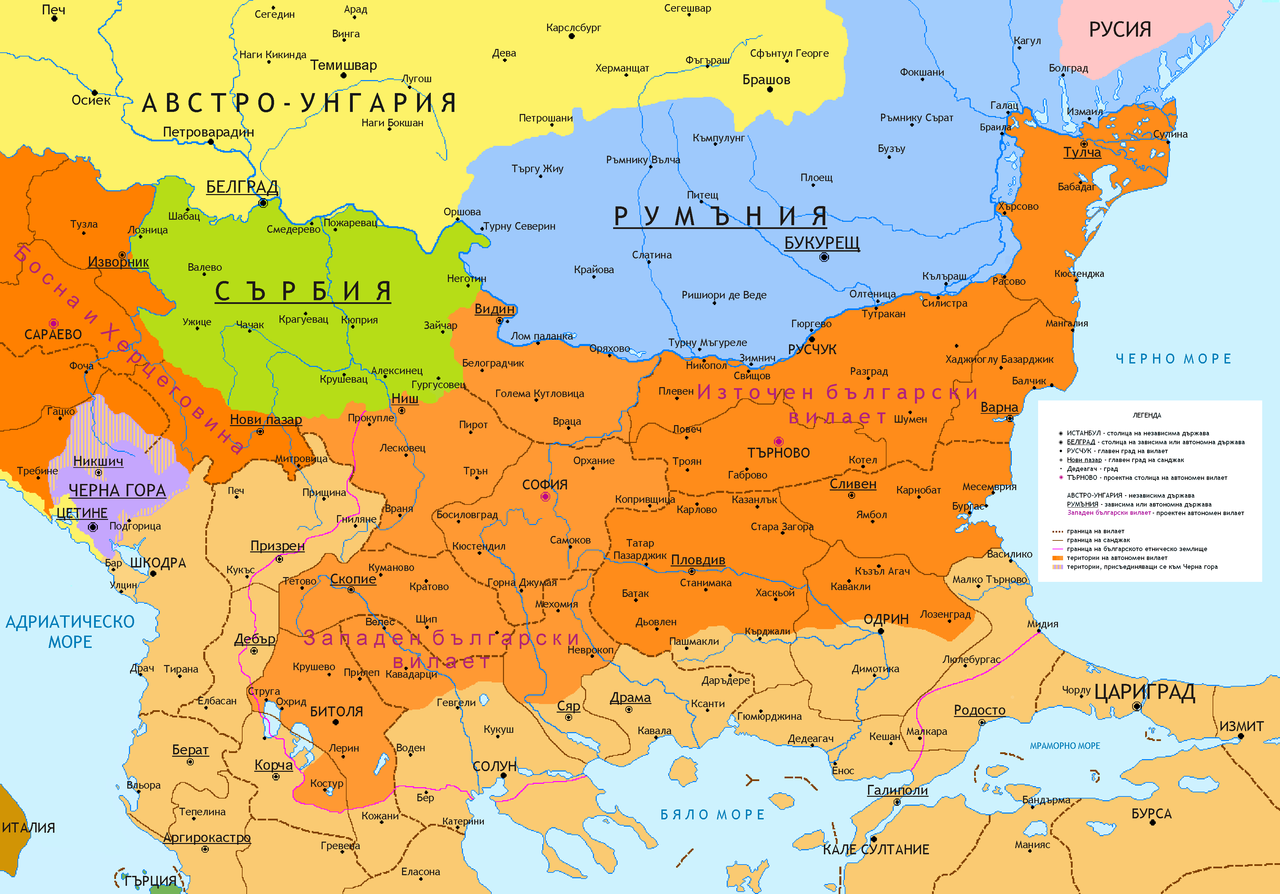
By that time Bulgarians had initiated a purposeful struggle against the Greek clerics. Bulgarian religious leaders had realised that any further struggle for the rights of the Bulgarians in the Ottoman Empire could not succeed unless they managed to obtain at least some degree of autonomy from the Patriarchate of Constantinople. The foundation of the Bulgarian Exarchate in 1870, which included most of Macedonia by a firman of Sultan Abdülaziz was the direct result of the struggle of the Bulgarian Orthodox against the domination of the Greek Patriarchate of Constantinople in the 1850s and 1860s.
Afterward, in 1876 the Bulgarians revolted in the April Uprising. The emergence of Bulgarian national sentiments was closely related to the re-establishment of the independent Bulgarian church. This rise of national awareness became known as the Bulgarian National Revival. However, the uprising was crushed by the Ottomans. As a result, on the Constantinople Conference in 1876 the predominant Bulgarian character of the Slavs in Macedonia reflected in the borders of future autonomous Bulgaria as it was drawn there. The Great Powers eventually gave their consent to variant, which excluded historical Macedonia and Thrace, and denied Bulgaria access to the Aegean Sea, but otherwise incorporated all other regions in the Ottoman Empire inhabited by Bulgarians. At the last minute, however, the Ottomans rejected the plan with the secret support of Britain. Having its reputation at stake, Russia had no other choice but to declare war on the Ottomans in April 1877. The Treaty of San Stefano from 1878, which reflected the maximum desired by Russian expansionist policy, gave Bulgaria the whole of Macedonia except Thessaloniki, the Chalcidice peninsula and the valley of the Aliakmon.
The Congress of Berlin in the same year redistributed most Bulgarian territories that the previous treaty had given to the Principality of Bulgaria back to the Ottoman Empire. This included the whole of Macedonia. As a result, in late 1878, the Kresna–Razlog uprising – an unsuccessful Bulgarian revolt against the Ottoman rule in the region of Macedonia – broke out. However the decision taken at the Congress of Berlin soon turned the Macedonian question into "the apple of constant discord" between Serbia, Greece and Bulgaria. The Bulgarian national revival in Macedonia was not unopposed. The Greeks and Serbs, too, had national ambitions in the region, and believed that these could be furthered by a policy of cultural and linguistic dissimilation of the Macedonian Slavs, to be achieved through educational and church propaganda. Nonetheless, by the 1870s the Bulgarians were clearly the dominant national party in Macedonia. It was widely anticipated that the Macedonian Slavs would continue to evolve as an integral part of the Bulgarian nation, and that, in the event of the Ottoman Empire's demise, Macedonia would be included in a Bulgarian successor-state. That these anticipations proved false was due not to any intrinsic peculiarities of the Macedonian Slavs, setting them apart from the Bulgarians, but to a series of catastrophic events, which, over a period of seventy years, diverted the course of Macedonian history away from its presumed trend.

Serbian propaganda
A great contribution to the Serbian cause was made by an astronomer and historian from Trieste, Spiridon Gopčević (also known as Leo Brenner). Gopčević published in 1889 the ethnographic research Macedonia and Old Serbia, which defined more than three-quarters of the Macedonian population as Serbian.
The work of Gopčević was further developed by two Serbian scholars, geographer Jovan Cvijić and linguist Aleksandar Belić. Less extreme than Gopčević, Cvijić and Belić claimed only the Slavs of northern Macedonia were Serbian whereas those of southern Macedonia were identified as "Macedonian Slavs", an amorphous Slavic mass that was neither Bulgarian, nor Serbian but could turn out either Bulgarian or Serbian if the respective people were to rule the region.
Greek propaganda
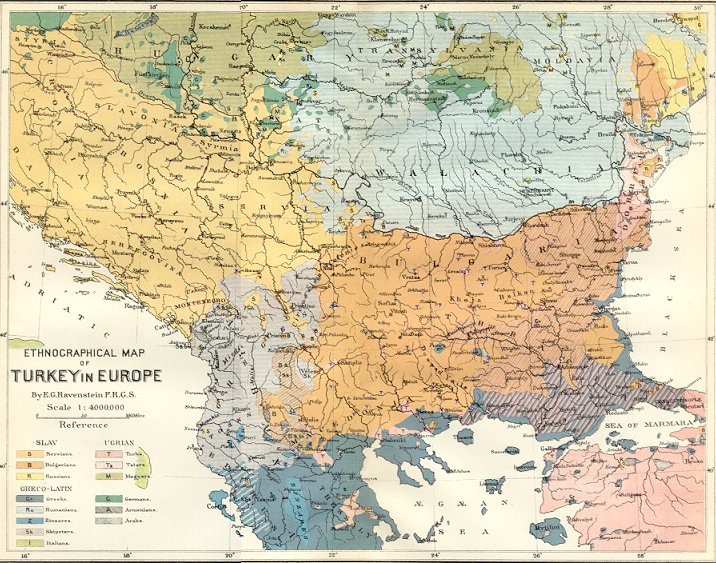
It was established by the end of the 19th century that the majority of the population of central and Southern Macedonia (vilaets of Monastiri and Thessaloniki) were predominantly an ethnic Greek population, while the Northern parts of the region (vilaet of Skopje) were predominantly Slavic. Jews and Ottoman communities were scattered all over. Because of Macedonia's such polyethnic nature, the arguments which Greece used to promote its claim to the whole region were usually of historical and religious character. The Greeks consistently linked nationality to the allegiance to the Patriarchate of Constantinople. "Bulgarophone", "Albanophone" and "Vlachophone" Greeks were coined to describe the population who were Slavic, Albanian or Vlach (Aromanian)-speaking. There was also pressure on Aromanians to become linguistically dissimilated from the 18th century, when dissimilation efforts were encouraged by the Greek missionary Cosmas of Aetolia (1714–1779) who taught that Aromanians should speak Greek because as he said "it's the language of our Church" and established over 100 Greek schools in northern and western Greece. The offensive of the clergy against the use of Aromanian was by no means limited to religious issues but was a tool devised in order to convince the non-Greek speakers to abandon what they regarded as a "worthless" idiom and adopt the superior Greek speech: "There we are Metsovian brothers, together with those who are fooling themselves with this sordid and vile Aromanian language... forgive me for calling it a language", "repulsive speech with a disgusting diction".
Ethnic Macedonian propaganda
The ethnic Macedonian ideology during the second half of the 19th century was at its inception. One of the first preserved accounts is an article The Macedonian question by Petko Slaveykov, published on 18 January 1871 in the "Macedonia" newspaper in Constantinople. In this article Petko Slaveykov writes: "We have many times heard from the Macedonists that they are not Bulgarians, but they are rather Macedonians, descendants of the Ancient Macedonians". In a letter written to the Bulgarian Exarch in February 1874 Petko Slaveykov reports that discontentment with the current situation "has given birth among local patriots to the disastrous idea of working independently on the advancement of their own local dialect and what’s more, of their own, separate Macedonian church leadership."
In 1875 Gjorgjija Pulevski published in Belgrade a book called Dictionary of Three Languages (Rečnik od tri jezika). The text of the Rečnik contains programmatic statements where Pulevski argues for an independent Slavic Macedonian nation and language. It was the first work that publicly claimed Macedonian to be a separate language. In 1880 he published Slognica Rechovska in Sofia as an attempt at a grammar of the language of the Slavs who lived in Macedonia. Although he had no formal education, Pulevski published several other books, including three dictionaries and a collection of songs from Macedonia, customs, and holidays.
The first significant manifestation of ethnic Macedonian nationalism was the book On Macedonian Matters (Za Makedonskite Raboti) published in Sofia in 1903 by Krste Misirkov. In the book Misirkov advocated that the Slavs of Macedonia should take a separate way from the Bulgarians and the Bulgarian language. Misirkov considered that the term "Macedonian" should be used to define the whole Slavic population of Macedonia, obliterating the existing division between Greeks, Bulgarians and Serbians. The adoption of a separate "Macedonian language" was also advocated as a means of unification of the Ethnic Macedonians with Serbian, Bulgarian and Greek consciousness. On Macedonian Matters was written in the South Slavic dialect spoken in central Macedonia (Veles-Prilep-Bitola-Ohrid). This dialect was proposed by Misirkov as the basis for the future language, and, as Misirkov says, a dialect which is most different from all other neighboring languages (as the eastern dialect was too close to Bulgarian and the northern one too close to Serbian). Misirkov calls this language Macedonian.
While Misirkov talked about the Macedonian consciousness and the Macedonian language as a future goal, he described the wider region of Macedonia in the early 20th century as inhabited by Bulgarians, Greeks, Serbs, Turks, Albanians, Aromanians, and Jews. As regards the ethnic Macedonians themselves, Misirkov maintained that they had called themselves Bulgarians until the publication of the book and were always called Bulgarians by independent observers until 1878 when the Serbian views also started to get recognition. He also explained that the reason for that was because local Slavs were allies with the Bulgars in the wars against Byzantine Empire and because of that Byzantine Greeks renamed them into "Bulgarians", in that way the term became an identification for Macedonian Slavs in the future. Misirkov rejected the ideas in On Macedonian Matters later and turned into a staunch advocate of the Bulgarian cause. He returned to the ethnic Macedonian idea again in the 1920s.
Another prominent activist for the ethnic Macedonian national revival was Dimitrija Čupovski, who was one of the founders and the president of the Macedonian Literary Society established in Saint Petersburg in 1902. During the 1913–14 period, Čupovski published the newspaper Makedonski Golos' (Македонскi Голосъ) (meaning Macedonian voice) in which he and fellow members of the Petersburg Macedonian Colony propagandized the existence of a separate Macedonian people different from Greeks, Bulgarians and Serbs, and were struggling for popularizing the idea for an independent Macedonian state.
During the 1920s and 30s the idea was promoted by some of the leftist members of the Macedonian Federative Organization and later IMRO (United) and also by some members of the Communist Party of Yugoslavia. In 1934 the Comintern in coordination with IMRO (United) published a resolution on the Macedonian question in which for the first time, an authoritative international organization has recognized the existence of a separate Macedonian nation and Macedonian language.
The ideas of Misirkov, Pulevski and other Macedonians would remain largely unnoticed until World War II when they were adopted by the Macedonian Partisans movement which in 1944 set up the Anti-fascist Assembly for the National Liberation of Macedonia and proclaimed a Macedonian nation-state of ethnic Macedonians. They made Macedonian the official language of the Macedonian state further influencing its codification in 1945. The state was later incorporated in the Socialist Federal Republic of Yugoslavia.
The present-day historians from North Macedonia claim that IMRO was split into two factions: the first aimed an ethnic Macedonian state, and the second believed in a Macedonia as a part of wider Bulgarian entity.
These claims of present-day historians from North Macedonia that the "Autonomists" in IMRO who defended a Macedonian position are largely ungrounded. IMRO regarded itself – and was regarded by the Ottoman authorities, the Greek guerilla groups, the contemporary press in Europe and even by Misirkov -as an exclusively Bulgarian organization.
Romanian propaganda
Romanian influence in the area made some success in Bitola, Kruševo, and in the Aromanian villages in the districts of Bitola and Ohrid. Most Aromanians regard and regarded themselves as a separate ethnic group, and Romanians view such nations as subgroups of a wider Romanian ethnicity. Some Aromanians do identify as part of the Romanian nation however. Currently, among anti-Romanian groups of Aromanians, particularly in Greece, these acts are referred to as "the Romanian propaganda".
Development of the name "Macedonian Slavs"
The name "Macedonian Slavs" started to appear in publications at the end of the 1880s and the beginning of the 1890s. Though the successes of the Serbian propaganda effort had proved that the Slavic population of Macedonia was not only Bulgarian, they still failed to convince that this population was, in fact, Serbian. Rarely used until the end of the 19th century compared to 'Bulgarians', the term 'Macedonian Slavs' served more to conceal rather than define the national character of the population of Macedonia. Scholars resorted to it usually as a result of Serbian pressure or used it as a general term for the Slavs inhabiting Macedonia regardless of their ethnic affinities. The Serbian politician Stojan Novaković proposed in 1887 employing the Macedonistic ideas as they means to counteract the Bulgarian influence in Macedonia, thereby promoting Serbian interests in the region.
Absent national consciousness
What stood behind the difficulties to properly define the nationality of the Slavic population of Macedonia was the apparent levity with which this population regarded it. The existence of a separate Macedonian national consciousness prior to the 1940s is disputed. This confusion is illustrated by Robert Newman in 1935, who recounts discovering in a village in Vardar Macedonia two brothers, one who considered himself a Serb, and the other considered himself a Bulgarian. In another village he met a man who had been, "a Macedonian peasant all his life", but who had varyingly been called a Turk, a Serb and a Bulgarian. However anti-Serb and pro-Bulgarian feelings among the local population at this period prevailed.
Statistical data
Ottoman statistics
The basis of the Ottoman censuses was the millet system. People were assigned to ethnic categories according to religious affiliation. So all Sunni Muslims were categorised as Turks, all members of Greek Orthodox church as Greeks, while rest being divided between Bulgarian and Serb Orthodox churches. All censuses concluded that the province is of Christian majority, among whom the Bulgarians prevail.
1882 Ottoman census in Macedonia:
1895 census:
Special survey in 1904 of Hilmi Pasha of the three Macedonian vilayets of Selanik, Manastir and Kosovo (648 thousand followes of the Ecumenical Patriarchate and 557 thousand faithful of the Bulgarian Exarchate, but an additional 250 thousand of the former) had identified as Bulgarian speakers. The survey also extends to parts of the three vilayets which are not part of the region of Macedonia, i.e., Sandžak, Kosovo, parts of eastern Albania and Epirus.
Census 1906:
Rival statistical data
Encyclopædia Britannica
The 1911 edition of the Encyclopædia Britannica gave the following statistical estimates about the population of Macedonia:
Slavs (described in the encyclopaedia as a "Slavonic population, the bulk of which is regarded by almost all independent sources as Bulgarians"): approximately 1,150,000, whereof, 1,000,000 Orthodox and 150,000 Muslims (called Pomaks)
Turks: ca. 500,000 (Muslims)
Greeks: ca. 250,000, whereof ca. 240,000 Orthodox and 14,000 Muslims
Albanians: ca. 120,000, whereof 10,000 Orthodox and 110,000 Muslims