
The MV George Prince ferry disaster was a nautical disaster that occurred in the Mississippi River in St. Charles Parish, Louisiana, United States, on the morning of October 20, 1976 (1976-10-20). The Luling–Destrehan Ferry George Prince was struck by the Norwegian tanker SS Frosta, which was traveling upriver. The collision occurred at mile post 120.8 above Head of Passes, less than three-quarters of a mile from the construction site of the Luling Bridge which would replace the ferry seven years later. The ferry was crossing from Destrehan, Louisiana on the East Bank to Luling, Louisiana on the West Bank. Ninety-six passengers and crew were aboard the ferry when it was struck, and seventy-eight perished. This accident is the deadliest ferry disaster in United States history. It is also the deadliest peacetime nautical disaster involving a non-submersible vessel in U.S. waters since the explosion of the SS Grandcamp in 1947, which killed 581 people.
Background
Luling–Destrehan Ferry operations
The Luling–Destrehan Ferry was one of three routes then operated by the Louisiana Department of Highways, District 2. The others were the pedestrian Taft–Norco Ferry and the vehicle Edgard–Reserve Ferry.
The ferry operated with two boats, the Ollie K. Wilds and the George Prince. The George Prince was the larger of the two, and operated around the clock, while the smaller boat only worked at peak hours. During peak hours, the ferries did not operate on a fixed schedule.

The ferry landings are pontoons connected to a shell road by a small ramp, and are held in place by pilings in the river bottom. The ferries made a "figure-8" transit, always running upriver when departing, letting the current carry the boat downriver, then turning upriver to land on the opposite bank.
The East Bank ferry landing was situated upriver of two busy grain elevators, limiting the boats' ability to maneuver and, when ships were present, obscuring the boats' radar. Visibility was often limited by clouds of grain dust from transfer operations, although no transfer was taking place the morning of the accident.
Motor vessel George Prince
The George Prince was a ferry owned and operated by the Louisiana Department of Highways, originally built in 1937 at Slidell, LA, and converted for its final use at Avondale, LA. In 1969, the U.S. Coast Guard ceased inspection and certification of the vessel at the request of the state of Louisiana. It was a free ferry and was not carrying passengers "for hire", so the Coast Guard complied with the request.
The George Prince was 120 feet (37 m) in length and 34 feet (10 m) in breadth, with a gross weight of 259 tons, and powered by a 670-horsepower (500 kW) diesel engine. She was equipped with two radar units (although only one was turned on at the time of the accident). Her crew of five consisted of a pilot, an engineer, and three deckhands.
The entire crew of the George Prince had duties while afloat; none of these duties were to serve as lookout. Had there been a designated lookout, there was no way for the lookout to communicate with the pilot except by hand signals.
SS Frosta
The SS Frosta was a tanker ship, built in 1961 in Germany and owned by A/S Ludwig, of Bergen, Norway. The Frosta was 664 feet (202 m) in length, 90 feet (27 m) in breadth, with a gross weight of 22,850 tons, and powered by a steam turbine engine, rated at 16,800 hp (12.5 MW).

The Frosta departed empty from Rotterdam, the Netherlands on October 4, bound for Baton Rouge, Louisiana. The voyage was uneventful. At the Southwest Pass of the Mississippi River, on the night of October 19, the Frosta took aboard the first of three pilots to guide her up the river. The pilot at the time of the collision was Nicholas Colombo, a member of the New Orleans-Baton Rouge Steamship Pilots Association, and the third pilot aboard the ship for the journey upstream. Colombo directed the ship take a speed equivalent to 12 miles per hour (19 km/h) upstream, his preferred speed. The crew ordered a speed of "half ahead", which gave them a forward momentum of 11.4 mph (18.3 km/h), stemming a current of 1.1 mph (1.8 km/h).
When the ship was about a mile below the Luling–Destrehan ferry crossing, the pilot saw a ferry cross from the West Bank to the East Bank of the river. This was the MV Ollie K. Wilds, which worked the route along with the George Prince. At this time, the ship was on the west side of the channel, and was passing two ships moored to grain elevators on the East Bank of the river.
Collision
George Prince
At about 6:00am on October 20, 1976, the George Prince was berthed at the East Bank landing, taking on vehicles. Her crew had been on duty all night and was due to get off duty at 7:00. She was facing upriver and took on a full load of vehicles, consisting of 20 cars, eight trucks, six motorcycles, and an unknown number of pedestrians. Of the passengers aboard, there is no accounting of people in vehicles versus pedestrians. About 20 people were crowded in a waiting room to avoid the pre-dawn chill.

Once loaded, the George Prince departed and made a short run upriver before turning to cross the river. She did not give any indication of her departure by radio or horn. When operating in tandem, the ferries operated by sight with each other. The George Prince proceeded across the river, never changing course nor acknowledging radio traffic.
According to the survivors, some of the passengers were aware of the Frosta as it traveled upriver, and there was a growing anxiety over what appeared to be a collision course, although this anxiety was somewhat tempered by their belief that the ferry would maneuver to avoid the ship, especially since there was no indication of danger from the George Prince. When the Frosta sounded the danger signal, there was an immediate panic from those who could see the ship, and their flight from danger alerted others. It can never be known whether the passengers on the side opposite the oncoming ship were aware of the danger, as all the survivors were on the side of the impact. When the ferry had nearly finished its voyage across the river, she was struck near the middle of the port side by the bow of the Frosta. The force of the collision drove the stem of the Frosta 8 feet (2.4 m) into the side, impaling the George Prince on the port side and pushing her sideways up the river. The starboard side of the George Prince was quickly submerged, and the vessel capsized almost immediately. After capsizing, the ferry was driven under the ship, where the bottoms of the vessels collided.
All the vehicles were thrown off of the deck except for a motorcycle, which was entangled in the railing. One vehicle floated briefly before filling with water and sinking; the rest sank immediately.
Less than two minutes had elapsed since departing the dock.
The circumstances of a collision in 1974 resembled those of the 1976 tragedy except that, in the earlier accident, there were no fatalities. The accident occurred just before dawn in good visibility; the ferry operator failed to see the upbound vessels, though they were seen by the passengers on the deck; and the ferry operator failed to make good use of his radios to check for river traffic. Following the investigation by the Coast Guard, an administrative law judge suspended the ferry operator's license for three months. That decision was affirmed by the Coast Guard Commandant and by the National Transportation Safety Board in a decision adopted six days after the 1976 tragedy.
SS Frosta
With the East Bank ferry landing obstructed by ships, the Frosta could not see any activity at the landing until a quarter-mile away. At the point of collision, though, the river is more than half-a-mile wide. Having spotted the Ollie K. Wilds crossing, the pilot was aware of the ferry operation.
The pilot observed a ferry depart the East Bank landing, heading upriver. He called twice on his hand-held transceiver, waiting ample time between transmissions for a reply, but receiving none. He blew the ship's horn twice, indicating his desire to pass in front of the ferry. While the two-blast signal had no standing or meaning according to the "Western River Rules of the Road", it was commonly understood at the time for the ferry to give way and allow the ship to pass. At the time of the horn signal, the ferry had already turned to port, beginning to cross the river, and was less than a quarter-mile away.
The ferry did not respond, and the pilot again called on the radio, and repeated the two-blast signal on the ship's horn. The ferry still did not respond, and proceeded directly into the path of the Frosta.
At this point, the pilot began continuous radio calls and horn blasts. He also ordered the Frosta full astern. The pilot made no attempt to turn the ship, though. He was traveling on the west side of the channel; this gave him no choice but to turn the ship to the starboard, which, had the ferry turned, would have meant that the ship turned toward the ferry. The pilot also feared striking a bridge pier construction site just upriver, or running aground or into one of the ships docked at the grain elevator.
The ferry was on a constant bearing, less than 500 feet (150 m) away, when it passed out of sight of the Frosta's bridge crew. The crew felt a slight bump as the ship collided with the ferry. The ferry rolled off the bow of the ship to the starboard side, then rolled under, emerging on the ship's port side, 275 yards (251 m) from the bank. As the ferry came into view, it was nearly totally capsized. A vehicle was seen floating down the river, with its headlights still on, before filling with water and sinking.
The pilot ordered "all stop" on the engines to avoid hazarding any survivors with a churning propeller. The captain of the ship and the pilot both called for assistance from any vessel in the area, and notified the Coast Guard. The ship maneuvered through the construction area and anchored midstream over a mile upriver, carried most of this way by forward momentum. Once anchored, Frosta launched two of her life boats in a futile attempt to rescue survivors. None of the crew of the ship ever saw any survivors in the water.
Rescue and recovery
Rescue
A total of 18 passengers survived the collision. Passengers who were able to see downstream became aware of the rapidly closing motions of the vessels, and rightly concluded that the collision was imminent. Fourteen of the survivors were thrown clear and surfaced without difficulty. Three others were briefly trapped under the George Prince. The last survivor had run back to his vehicle, thinking he would be safer in his truck. After the collision, he managed to escape his sinking vehicle through a window. Only one survivor had a life jacket before going into the water, but had not had time to put it on. Two others found life jackets floating in the river, which they used for a short time, but neither man had time to properly don the life jackets.
Aboard the Ollie K. Wilds, the crew in the pilot house did not see the collision. As they were preparing to offload vehicles, an engineer burst through the door, saying a passenger saw a ship run over the ferry. The captain of the ferry immediately ordered his vessel to cast off, having offloaded just one of his 15 vehicle load. He contacted the pilot of the Frosta, and asked him if the ferry had sunk. "He went in front of me, and I ran him over," was the pilot's reply.
A St. Charles Parish sheriff's deputy, who had been riding aboard the Ollie K. Wilds, used a radio aboard to report the collision to his dispatcher in Hahnville, and requested assistance.
The Ollie K. Wilds proceeded across the river cautiously, so as to not run over any survivors. As the ferries touched, passengers bridged the gap with benches from the waiting room, and sixteen survivors, perched on the overturned hull, came across to safety.
As the Ollie K. Wilds was crossing the river, a deck hand and the deputy had launched the small rescue boat. They pulled one survivor from the water.
The tugboat MV Alma S. was preparing to help turn one of the ships at the grain elevator. He heard the Frosta's pilot making the emergency calls, and heard the horn sounding. The crew cast off from the ship and proceeded slowly across the river toward the overturned ferry, with the survivors standing on the hull. Fifteen yards (14 m) from the George Prince, the crew heard a man call for help. The crew threw a life ring to him, and pulled him aboard.
All the survivors were taken to the West Bank ferry landing for the expected arrival of aid. All the passengers were taken to hospitals, and stayed there for at least 72 hours.
Recovery
The Coast Guard, immediately notified of the collision from the frantic radio calls, dispatched helicopters to the scene. One helicopter stopped at Lakefront Airport to pick up a diving team. The divers were airborne at 7:14, and arrived at 7:25. They were on the vessel at 7:34. They checked for survivors by tapping on the hull, with no response. At 8:33, they reported that there were no signs of life, and that other divers were needed to search inside the hull for bodies.
Having heard news media reports of the tragedy, a professional dive team drove themselves to the site and offered assistance. Being commercial divers, they were equipped with air line masks instead of tanks, and were much less restricted in their movements. They were also accustomed to working in the "blackout" conditions of the river. Large amounts of sediment obscure any vision in the river.
The dive team recovered nine bodies from the passenger compartment of the George Prince. Two more were recovered from the pilot house. The engine room held five bodies. One was found in a bathroom doorway, and another was found in a storeroom.
Fifty-seven bodies, and a portion of another, were found in submerged vehicles, as they were recovered from the river bottom between October 23 and October 27, 1976. One body was found in the river on May 22, 1977.
Salvage and investigation
Salvage
Coordination and responsibility for salvage of the George Prince and her vehicles was assumed by the state's Director of Administration, Charles Roemer II, father of future governor Buddy Roemer.
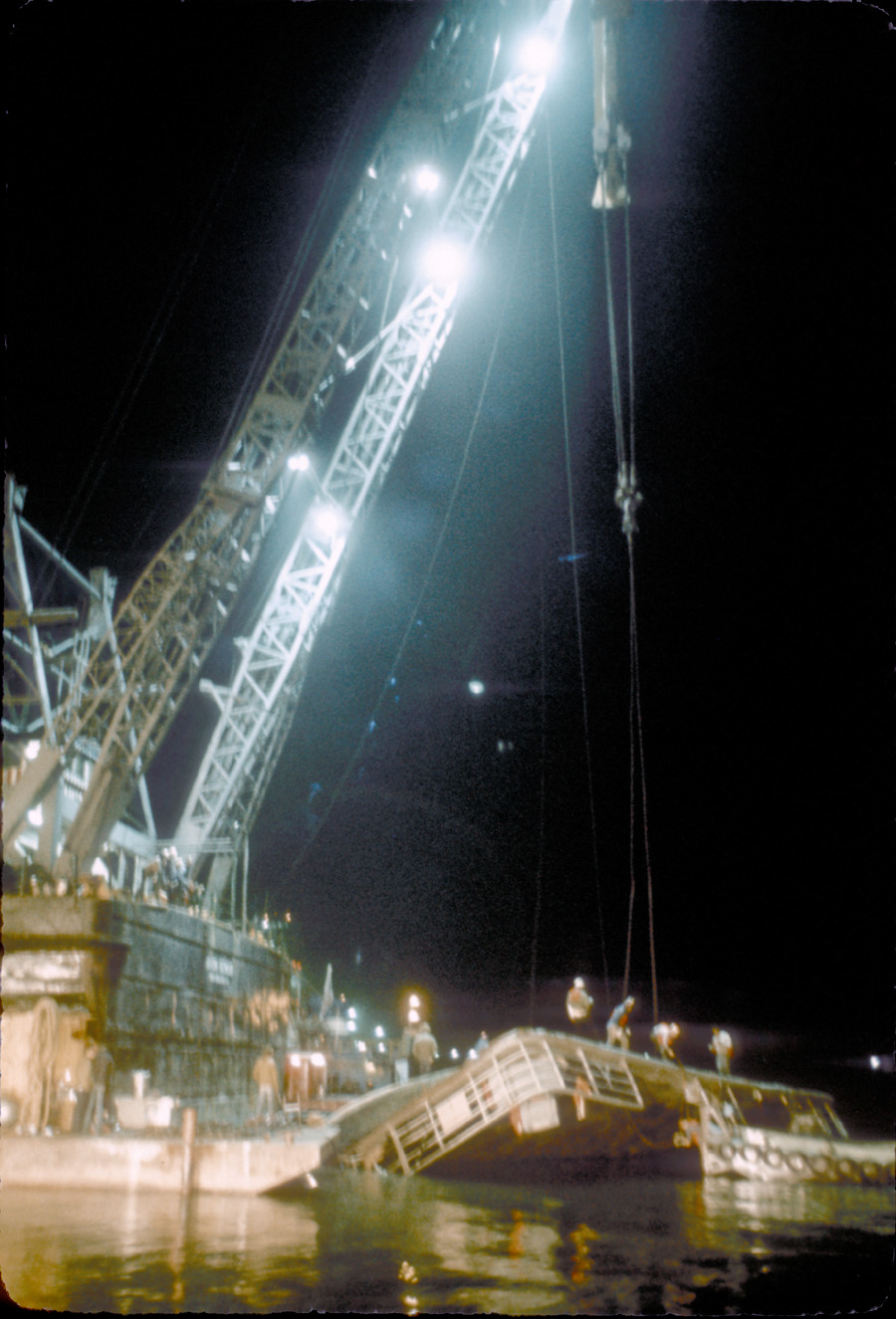
That afternoon, a crane barge arrived on scene, and prepared to right and raise the ferry, which by now rested on the river bottom near the West Bank, with the hull barely protruding from the water. Overnight, the ferry was turned over by the salvage crew. The next morning, lifting operations began, and continued late into the night. At 10:00 p.m., the ferry was raised enough to permit dewatering operations, and the river reopened to limited marine traffic. The ferry was towed to the Louisiana Department of Highways yard in Plaquemine, LA, for further investigation. The damage was deemed irreparable, and the George Prince never sailed again.
Investigation
Investigators used the weather conditions from Moisant International Airport (now Louis Armstrong New Orleans International Airport), less than seven miles (11 km) away. Conditions there were recorded as a "clear, crisp, pre-dawn darkness, without fog, haze, or other local environmental impairment to visibility." Winds were from the north-northeast at 13 knots (24 km/h), with gusts to 20 knots (37 km/h).
The river conditions were measured at the Carrollton Gauge, 29 kilometres (18 mi) downriver. Maximum velocity was 1.5 mph (2.4 km/h), with average velocity of 1.16 mph (1.87 km/h), and the river was 2 feet (61 cm) above sea level.
Once it was raised, Coast Guard officials from the Marine Investigation Office boarded the ferry and examined the pilot house. One of the radar sets was off, another was on. The radio was turned on, and tuned to channel 13, the same channel used by the river pilot.
A plywood box was found in the pilot house, containing various logbooks and other documents, along with a half-pint bottle of Seagrams V. O. whiskey, with about an inch of whiskey remaining. No fingerprints could be recovered from the bottle, despite the efforts of the FBI laboratory in Washington, DC.
The body of the ferry pilot was autopsied by Orleans Parish coroner Dr. Frank Minyard. The blood alcohol level was determined to be 0.09%, just shy of the legal definition of alcohol intoxication (in 1976) of 0.10%. (The laws in Louisiana and every other state have changed since 1976; Auletta would have been defined as legally intoxicated under today's law in all 50 states.) No other drugs were present. Minyard's report stated that the pilot, Egidio Auletta, had been drinking and was experiencing a large degree of impairment at the time of his death at the helm.
Conclusions of the investigation
Findings regarding the ferry
From the Coast Guard investigation report:
The George Prince, under the control of Egidio Auletta, departed and turned almost immediately to cross the river, because the current was slow and the volume of automobile traffic made it attractive to cross as quickly as possible.
The departure into stream traffic created a situation where risk of collision could exist, but Auletta did not signal his intent to cross the river by radio or horn. Had he announced his departure with the proper signal, and signaled his intent to cross in front of the Frosta, he would have made a rude but acceptable crossing of the river.
Due to complacency, fatigue, and/or the effects of alcohol, Auletta failed to detect the approaching ship until the final seconds before collision, when she disappeared from the view of the Frosta's pilot, by which time the collision was inevitable. The investigators concluded that he had time to maneuver to lessen the collision by making it a glancing blow, but the forward momentum and downstream current made the collision "beyond human remedy".