
The Métis are a mixed-ancestry Indigenous people whose historical homelands include Canada's three Prairie Provinces extending into parts of Ontario, British Columbia, the Northwest Territories and the northwest United States. They have a shared history and culture, deriving from specific mixed European (primarily French, Scottish, and English) and Indigenous ancestry (primarily Cree with strong kinship to Cree people and communities), which became distinct through ethnogenesis by the mid-18th century, during the early years of the North American fur trade.
In Canada, the Métis, with a population of 624,220 as of 2021, are one of three legally recognized Indigenous peoples in the Constitution Act, 1982, along with the First Nations and Inuit.
The term Métis (uppercase 'M') typically refers to the specific community of people defined as the Métis Nation, which originated largely in the Red River Valley and organized politically in the 19th century, radiating outwards from the Red River Settlement (now Winnipeg). Descendants of this community are known as the Red River Métis. In 1870, the Métis Provisional Government of Louis Riel negotiated the entry of the Red River Settlement into Confederation as the Province of Manitoba, making Manitoba the only province to be founded by an Indigenous person.

Alberta is the only Canadian province with a recognized Métis land base: the eight Métis settlements, with a population of approximately 5,000 people on 1.25 million acres (5,100 km2) and the newer Metis lands near Fort McKay, purchased from the Government of Alberta in 2017.
Background
Etymology
The word métis itself is originally French for 'person of mixed parentage' and derives from the Latin word mixticius, from mixtus, 'mixed'. It is a cognate of the Spanish term mestizo.
Semantic definitions
The definitions and usage of the terms "Métis", "Metis", and "métis" (lowercase) have at times been controversial and contentious; however, there are also legal definitions.
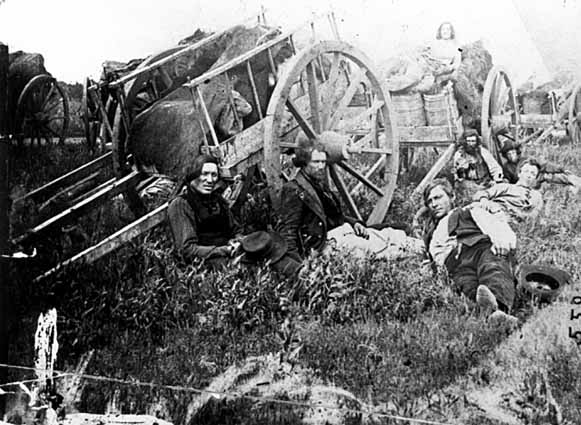
Descendants of English or Scottish and Indigenous were in some cases also historically called "half-breeds" or "Anglo-Métis" or "countryborn". They sometimes adopted a more agrarian culture of subsistence farming and tended to be reared in Protestant denominations.
Lowercase 'm'
Starting in the 17th century, the French word métis was initially used as a noun by those in the North American fur trade, and by settlers in general, to refer to people of mixed European and North-American Indigenous parentage in New France (which at that time extended from the Maritime provinces through southern Quebec and the Great Lakes to the Mississippi River, thence southward to Mississippi and Alabama). At the time, it applied generally to French-speaking people who were of partial Indigenous and partial ethnic French descent. It also came to be used for people of mixed European and Indigenous backgrounds in other French colonies, generally the children of unions between French men and non-French women from the colonized areas, including Guadeloupe in the Caribbean; Senegal in West Africa; Algeria in North Africa; and the former French Indochina in Southeast Asia.
The first documented "métis" child was a girl born about 1628 near Lake Nipissing, given the first name Marguerite, who was the daughter of a Nipissing woman and Jean Nicollet de Belleborne (born about 1598, likely in Cherbourg, France).

Today, the spelling métis with a lowercase 'm' typically functions as an adjective. The definition of the word has at times been disputed, as some people have attempted to use lower-case métis in the archaic sense of having a single, distant Indigenous ancestor or being in some other way "mixed".
Uppercase 'M'
As French Canadians followed the North American fur trade to the west, some of the settlers made unions with different Indigenous women, including the Cree. Over time, the Métis (uppercase 'M') emerged as a distinct Indigenous people during the late 18th century, with the term referring to a particular sociocultural heritage and an ethnic identification.
In this regard, the term Métis is more than a racial classification and refers to the Métis Nation, an Indigenous peoples in Canada and the United States who originated largely in the Red River Valley and organized politically in the 19th century, developing and dispersing outwards from the Red River Settlement (now Winnipeg). Descendants of this community are therefore also often known as the Red River Métis.

Numerous spellings of Métis have been used interchangeably, including métif, michif; currently the most agreed-upon spelling is Métis; however, some prefer to use Metis as inclusive of persons of both English and French descent.
The majority of Indigenous groups and legal scholars define Métis as the people who originate from the historic homeland of the Métis Nation, which encompasses the Prairie Provinces of Manitoba, Saskatchewan, and Alberta and extends into contiguous parts of Ontario, British Columbia, the Northwest Territories, and the northern United States.
The Métis National Council, in 2002, defined Métis as: "a person who self-identifies as Métis, is distinct from other Aboriginal Peoples, is of historic Métis Nation ancestry and who is accepted by the Métis Nation."

Canadian Geographic's Indigenous Peoples Atlas of Canada identifies Métis people as one of three Canadian Indigenous peoples in the following terms:Within non-Indigenous society, there are two competing ideas of what being Métis means. The first, when spelled with a lowercase "m" (métis), means individuals or people having mixed-Ancestry parents and ancestries, e.g., North American Indigenous and European/Euro-Canadian/Euro-American. It is a racial categorization. This is the oldest meaning of métis and is based on the French verb métisser [sic], to mix Ancestry or ethnicities. The related noun for the act of Ancestry-mixing is métissage. The second meaning of being Métis, and the one that is embraced by the Métis Nation, relates to a self-defining people with a distinct history in a specific region (Western Canada's prairies) with some spillover into British Columbia, Ontario, North Dakota, Montana and Northwest Territories. In this case, the term Métis is spelled with an uppercase "M" and often, but does not always, contain an accent aigu (é).
The Métis of Canada and the Métis of the United States adopted parts of their Indigenous and European cultures while forming customs and traditions of their own, as well as developing a common language. Some argue that the ethnogenesis of the Métis began when the Métis organized politically at the Battle of Seven Oaks in 1816.
Other groups and individuals
Scholars, Métis people, and First Nations elders and community leaders state that only the descendants of the Red River Métis should be constitutionally recognized as Métis people, as they developed a distinct culture as a people historically, and have continued to exist as a distinct culture and community over many generations.
Objections to this stance have been made to the Métis National Council by both individuals and newly formed groups who do not meet the established citizenship criteria. These individuals and unrecognized groups have recently emerged largely in the Maritime, Quebec, and Ontario regions, and are generally referred to as "Eastern Metis". Those objecting usually state that having a single, distant, Indigenous or possibly Indigenous ancestor should be enough to be considered Métis. They also disagree that they should have to meet the resident requirement as defined by the federally recognized Métis organizations. Darryl R. Leroux and Adam Gaudry write:
Since the early 2000s, there has been a meteoric rise in the number of people self-identifying as Métis in Eastern Canada. New census data shows the highest increases in self-reported "Métis" people between 2006 and 2016 were in Québec (149.2 per cent) and in Nova Scotia (124.3 per cent). In Canada during the same period, the increase was less than 60 per cent. Rather than a spike in birth rates, almost all of the increase is due to white Franco-Québécois and Acadian settlers "becoming" Indigenous.
David Chartrand, president of the Manitoba Métis Federation, responding in 2020, said he does not believe these new, self-identified individuals and communities are Métis:
They are not part of us, never were. There is no connection historically in any way or fashion that they can use as even an argument to say that they are part of our nation.
In a 2016 decision, Daniels v Canada (Indian Affairs and Northern Development), the Supreme Court of Canada stated in par. 17:
There is no consensus on who is considered Métis or a non-status Indian, nor need there be. Cultural and ethnic labels do not lend themselves to neat boundaries. 'Métis' can refer to the historic Métis community in Manitoba's Red River Settlement or it can be used as a general term for anyone with mixed European and Aboriginal heritage. Some mixed-ancestry communities identify as Métis, others as Indian.
Indigenous elders from the Miꞌkmaq and other First Nations communities in the Eastern part of Canada, along with recognized Métis leaders, do not agree with this perspective. They say that there is no distinct Metis community or culture in the Maritimes or Quebec, as individuals with mixed ancestry integrated into either Indigenous communities or European settlements instead. They suggest that these newly formed Eastern groups are not legitimate:
"When you're looking at the Maritimes and Quebec, the children of intermarriage were accepted by either party, in our case the Mi'kmaq or the Acadian," Mi'kmaw elder and historian Daniel Paul says. "There was no such thing as a Metis community here in this region."
Riel's Métis
Quoting Louis Riel from Tremaudan's Histoire de la nation métisse dans l'ouest canadien:
The Métis have as paternal ancestors the former employees of the Hudson's Bay and North-West Companies, and as maternal ancestors Indian women belonging to various tribes.
The French word Métis is derived from the Latin participle mixtus, which means "mixed"; it expresses well the idea it represents.
Quite appropriate also, was the corresponding English term "Half-Breed" in the first generation of blood mixing, but now that European blood and Indian blood are mingled to varying degrees, it is no longer generally applicable.
The French word Métis expresses the idea of this mixture in as satisfactory a way as possible, and becomes by that fact, a proper race name suitable for our race.
A little observation in passing without offending anyone.
Very polite and amiable people, may sometimes say to a Métis, "You don't look at all like a Métis. You surely can't have much Indian blood. Why, you could pass anywhere for pure White."
The Métis, a trifle disconcerted by the tone of these remarks, would like to lay claim to both sides of his origin. But fear of upsetting or totally dispelling these kind assumptions holds him back. While he is hesitating to choose among the different replies that come to mind, words like these succeed in silencing him completely. "Ah! bah! You have scarcely any Indian blood. You haven't enough worth mentioning." Here is how the Métis think privately.
"It is true that our Indian origin is humble, but it is indeed just that we honour our mothers as well as our fathers. Why should we be so preoccupied with what degree of mingling we have of European and Indian blood? No matter how little we have of one or the other, do not both gratitude and filial love require us to make a point of saying, 'We are Métis."
Métis people in Canada
Métis people in Canada are specific cultural communities who trace their descent to First Nations and European settlers, primarily the French, in the early decades of the colonization of Canada. Métis peoples are recognized as one of Canada's Indigenous peoples under the Constitution Act of 1982, along with First Nations and Inuit. On April 8, 2014, the Supreme Court of Canada Daniels v Canada appeal held that "Métis and non status Indians are 'Indians' under s. 91(24)," but excluded the Powley test as the only criterion to determine Metis identity.
Canadian Métis represent the majority of people who identify as Métis, although there are a number of Métis in the United States. In Canada, the population is 587,545 with 20.5 percent living in Ontario and 19.5 percent in Alberta. The Acadians of eastern Canada, some of whom have mixed French and Indigenous origins, are not Métis according to Crown–Indigenous Relations and Northern Affairs Canada and other historic Indigenous communities. This viewpoint sees Métis as historically the children of French fur traders and Nehiyaw women of western and west central Canada.
While the Métis initially developed as the mixed-ancestry descendants of early unions between First Nations and colonial-era European settlers (usually Indigenous women and male French settlers), within generations (particularly in central and western Canada), a distinct Métis culture developed. The women in the unions in eastern Canada were usually Algonquin and Ojibwe, and in western Canada they were Saulteaux, Cree, Ojibwe, Nakoda, and Dakota/Lakota or of mixed descent from these peoples. Their unions with European men engaged in the fur trade in the Old Northwest were often of the type known as marriage à la façon du pays ("according to the custom of the country").
After New France was ceded to Great Britain's control in 1763, there was an important distinction between French Métis born of francophone voyageur fathers and the Anglo-Métis (known as "country born" or Mixed Bloods, for instance in the 1870 census of Manitoba) descended from English or Scottish fathers. Today these two cultures have essentially coalesced into location-specific Métis traditions. This does not preclude a range of other Métis cultural expressions across North America. Such polyethnic people were historically referred to by other terms, many of which are now considered to be offensive, such as Mixed-bloods, Half-breeds, Bois-Brûlés, Bungi, Black Scots and Jackatars, the last term from Newfoundland.
While people of Métis culture or heritage are found across Canada, the traditional Métis "homeland" (areas where Métis populations and culture developed as a distinct ethnicity historically) includes much of the present-day Canadian Prairies along with parts of Northwestern Ontario, British Columbia, and the Northwest-Nunavut Territory. The most well-known group are the "Red River Métis", centering on southern and central parts of Manitoba along the Red River of the North.
Closely related are the Métis in the United States, primarily those in border areas such as Northern Michigan, the Red River Valley and Eastern Montana. These were areas in which there was considerable Aboriginal and European mixing due to the 19th-century fur trade. However, they do not have a federally recognized status in the United States, except as enrolled members of federally recognized tribes. Although Métis existed farther west than today's Manitoba, much less is known about the Métis of Northern Canada.
Identity
Self-identity and legal status
In 2016, 587,545 people in Canada self-identified as Métis. They represented 35.1% of the total Aboriginal population and 1.5% of the total Canadian population. Most Métis people today are descendants of unions between generations of Métis individuals and live in urban areas. The exception are the Métis in rural and northern parts that exist in close proximity to First Nations communities.
Over the past century, countless Métis have assimilated into the general European Canadian populations. Métis heritage (and thereby Aboriginal ancestry) is more common than is generally realized. People with more distant ancestry, who assimilated into non-Métis society, are not part of the Métis ethnicity or culture.
"What we're seeing is the phenomenon of non-Indigenous people, or those with a very distant ancestry – from the 1600 and 1700s – now claiming that they now have political rights which prevail over those Indigenous nations," said Veldon Coburn, a professor in Indigenous studies at the University of Ottawa and member of the Algonquins of Pikwàkanagàn.
Unlike among First Nations peoples, laws concerning the Métis make no distinction between Treaty status and non-Treaty status. The Métis did not sign treaties with Canada, with the exception of an adhesion to Treaty 3 in Northwest Ontario. This adherence was never implemented by the federal government. The legal definition is not yet fully developed. Section Thirty-five of the Constitution Act, 1982 recognizes the rights of Indian, Métis and Inuit; however, that text does not define these groups. In 2003, the Supreme Court of Canada defined a Métis person as someone who self-identifies as Métis, has an ancestral connection to the historic Métis community, and is accepted by the modern community with continuity to the historic Métis community.
View of identity
The most well-known and historically documented mixed-ancestry population in Canadian history are the groups who developed during the fur trade in south-eastern Rupert's Land, primarily in the Red River Settlement (now Manitoba) and the Southbranch Settlements (Saskatchewan). In the late 19th century, they organized politically (led by men who had European educations) and had confrontations with the Canadian government in an effort to assert their independence.
This was not the only place where some degree of intermixing (métisser) between European and Indigenous people occurred. It was part of the history of colonization from the earliest days of settlements on the Atlantic Coast throughout the Americas. But the strong sense of ethnic national identity among the mostly French- and Michif-speaking Métis along the Red River, demonstrated during armed resistance movements led by Louis Riel, resulted in a specific use of the term "Métis" throughout Canada.
Continued organizing and political activity resulted in "the Métis" gaining official recognition from the national government as one of the recognized Aboriginal groups in S.35 of the Constitution Act, 1982, which states:
35. (1) The existing aboriginal and treaty rights of the Aboriginal People of Canada are hereby recognized and affirmed.