
Love Canal was a neighborhood in Niagara Falls, New York, United States, infamous as the location of a 0.28 km2 (0.11 sq mi) landfill that became the site of an environmental disaster discovered in 1977. Decades of exposure to dumped toxic chemicals harmed the health of hundreds, often profoundly. The area was cleaned up over a period of twenty-one years in a Superfund operation.
Love Canal's history began in the 1880's. William Love, a local real estate entrepreneur, conducted a large-scale dig project to obtain hydroelectricity to power a city he planned to build along the canal. Work halted in 1883, when alternating current (AC) electricity supply systems were invented. The abandoned dig project left a one mile (1.6km) long, about 40 meter deep trench. In the 1920s, the canal became a dump site for municipal refuse for the city of Niagara Falls. During the 1940s, the canal was purchased by Hooker Chemical Company, which used the site to dump 19,800 metric tonnes of chemical byproducts from the manufacturing of dyes, perfumes, and solvents for rubber and synthetic resins. Hooker Chemical later sold the land to the local school district in 1953 for $1.
Over the next three decades, Love Canal attracted national attention for the public health problems originating from the former dumping of toxic waste on the grounds. This event displaced numerous families, leaving them with longstanding health issues and symptoms of high white blood cell counts and leukemia. Subsequently, the federal government passed the Superfund law in 1980. The resulting Superfund cleanup operation demolished the neighborhood, ending in 2004.

In 1988, New York State Department of Health Commissioner David Axelrod called the Love Canal incident a "national symbol of a failure to exercise a sense of concern for future generations". The Love Canal incident was especially significant as a situation where the inhabitants "overflowed into the wastes instead of the other way around".
Geography
Love Canal was a neighborhood located in the city of Niagara Falls in the western region of New York state. The neighborhood covers 36 blocks in the far southeastern corner of the city, stretching from 93rd Street comprising the western border to 100th Street in the east border and 103rd Street in the northeast. Bergholtz Creek defines the northern border with the Niagara River marking the southern border one-quarter mile (400 m) away. The LaSalle Expressway splits an uninhabited portion of the south from the north. The canal covers 16 acres (6.5 ha) of land in the central eastern portion.
Early history, canal dig, 1894–1940
In 1890, William T. Love, a former railroad lawyer, prepared plans to construct a preplanned urban community of parks and residences on the shore of Lake Ontario. Love, who would become notorious for similar real-estate schemes later in life, claimed it would serve the area's burgeoning industries with much-needed hydroelectricity. He named the project Model City, New York.

After 1892, Love's plan incorporated a shipping lane that would bypass the Niagara River and its Niagara Falls, in direct competition with the existing Welland Canal to the west of the Niagara River; the canal would add a new water transportation route between Lake Erie and Lake Ontario. He arranged backing from banks in New York City, Chicago, and England. During October 1893, the first factory opened for business. In May 1894, work on the canal began. Steel companies and other manufacturers expressed interest in opening plants along Love Canal. Love began having a canal dug and built a few streets and houses.
The Panic of 1893 caused investors to end sponsorship of the project. Then in 1906, environmental groups successfully lobbied Congress to pass a law, designed to preserve Niagara Falls, prohibiting the removal of water from the Niagara River. Only one mile (1.6 km) of the canal was dug, about 50 feet (15 m) wide and 10–40 feet (3–12 m) deep, stretching northward from the Niagara River.
The Panic of 1907 combined with the development of the transmission of electrical power over great distances, creating access to hydroelectric power far from water sources, proved disastrous for what remained of the Model City plan. The last piece of property owned by Love's corporation was lost to foreclosure and sold at public auction in 1910. By that point, Love himself was long gone; in 1897 he left the United States for England, before returning to attempt similar schemes in Washington, Illinois, and Delaware.
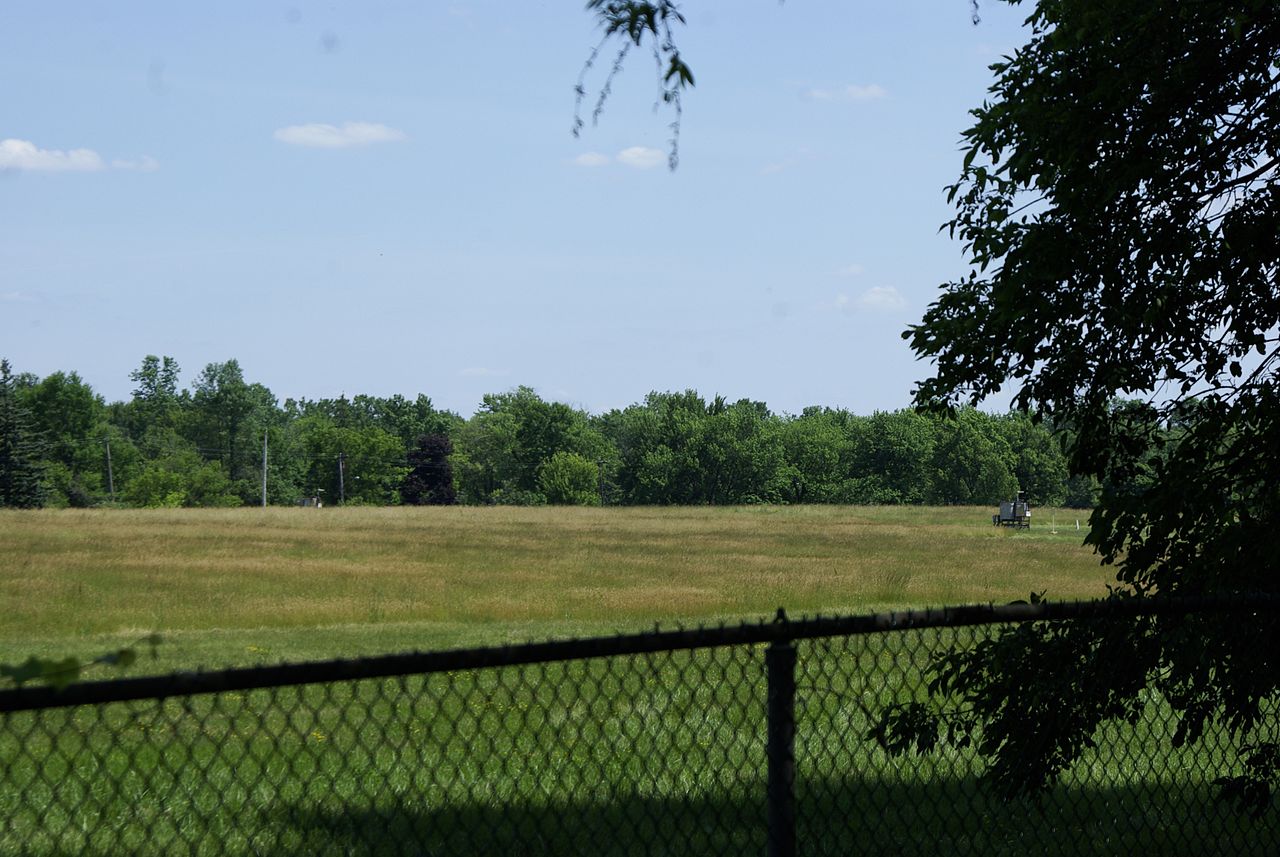
With the project abandoned, the canal gradually filled with water. Local children swam there during summers and skated during the winters. In the 1920s, the city of Niagara Falls used the canal as a municipal landfill.
Industry and tourism increased steadily throughout the first half of the 20th century due to a great demand for industrial products and the increased mobility of people to travel. Paper, rubber, plastics, petrochemicals, carbon insulators, and abrasives comprised the city's major industries.
At the time of the dump's closure in 1952, Niagara Falls was experiencing prosperity, and the population had been expanding dramatically, growing by 31% in twenty years (1940–1960) from 78,020 to 102,394.

Hooker Chemical Company, 1940s–1952
By the end of the 1940s, Hooker Chemical Company was searching for a place to dispose its large quantity of chemical waste. The Niagara Power and Development Company granted Hooker permission during 1942 to dump wastes into the canal. The canal was drained and lined with thick clay. Into this site, Hooker began placing 55-US-gallon (210 L) drums. In 1947, Hooker bought the canal and the 70-foot-wide (21 m) banks on either side of the canal. It subsequently converted it into a 16-acre (6.5 ha) landfill.
In 1948, the City of Niagara Falls ended self-sufficient disposal of refuse and Hooker Chemical became the sole user and owner of the site.
In early 1952, when it became apparent that the site would likely be developed for construction, Hooker ceased use of Love Canal as a dumpsite. During its 10-year lifespan, the landfill served as the dumping site of 21,800 short tons (19,800 t) of chemicals, mostly composed of products such as "caustics, alkalines, fatty acid and chlorinated hydrocarbons resulting from the manufacturing of dyes, perfumes, and solvents for rubber and synthetic resins". These chemicals were buried at a depth of twenty to twenty-five feet (6 to 7.5 m). Upon its closure, the canal was covered with a clay seal to prevent leakage. Over time, vegetation settled and began to grow atop the dump site.

By the 1950s, the city of Niagara Falls was experiencing a population increase. With a growing population, the Niagara Falls City School District needed land to build new schools and attempted to purchase the property from Hooker Chemical. The population reached more than 98,000 by the 1950 census.
Sale of the site, 1952
During March 1951, the school board prepared a plan showing a school being built over the canal and listing condemnation values for each property that would need to be acquired. During March 1952, the superintendent of Niagara Falls School Board inquired of Hooker with regard to purchasing the Love Canal property for the purpose of constructing a new school. After this, in an internal company memorandum dated March 27, 1952, Bjarne Klaussen, Hooker's vice president, wrote to the works manager that "it may be advisable to discontinue using the Love Canal property for a dumping ground." During April 1952, after discussing the sale of the land with Ansley Wilcox II, Hooker's in-house legal counsel, Klaussen then wrote to the company president, R.L. Murray, suggesting that the sale could alleviate them from future liabilities for the buried chemicals:
The more we thought about it, the more interested Wilcox and I became in the proposition, and finally came to the conclusion that the Love Canal property is rapidly becoming a liability because of housing projects in the near vicinity of our property. A school, however, could be built in the center unfilled section (with chemicals underground). We became convinced that it would be a wise move to turn this property over to the schools provided we could not be held responsible for future claims or damages resulting from underground storage of chemicals.
While the school board condemned some nearby properties, Hooker agreed to sell its property to the school board for $1. Hooker's letter to the board agreeing to enter into negotiations noted that "in view of the nature of the property and the purposes for which it has been used, it will be necessary for us to have special provisions incorporated into the deed with respect to the use of the property and other pertinent matters." The board rejected the company's proposal that the deed require the land to be used for park purposes only, with the school itself to be built nearby.
As "a means of avoiding liability by relinquishing control of the site", Hooker deeded the site to the school board in 1953 for $1 with a liability limitation clause. The sale document signed on April 28, 1953, included a seventeen-line caveat purporting to release the company from all legal obligations should lawsuits occur in the future.
Prior to the delivery of this instrument of conveyance, the grantee herein has been advised by the grantor that the premises above described have been filled, in whole or in part, to the present grade level thereof with waste products resulting from the manufacturing of chemicals by the grantor at its plant in the City of Niagara Falls, New York, and the grantee assumes all risk and liability incident to the use thereof. It is therefore understood and agreed that, as a part of the consideration for this conveyance and as a condition thereof, no claim, suit, action or demand of any nature whatsoever shall ever be made by the grantee, its successors or assigns, against the grantor, its successors or assigns, for injury to a person or persons, including death resulting therefrom, or loss of or damage to property caused by, in connection with or by reason of the presence of said industrial wastes. It is further agreed as a condition hereof that each subsequent conveyance of the aforesaid lands shall be made subject to the foregoing provisions and conditions.
Critics of Hooker's actions believe that, in the words of Craig E. Colton and Peter N. Skinner, "Hooker assigned the board with a continuing duty to protect property buyers from chemicals when the company itself accepted no such 'moral obligation'." The transfer effectively ended what provision of security and maintenance for the hazardous waste had existed before and placed all responsibility in clearly unqualified hands. It was this attempt to evade their responsibility, Colten and Skinner contend, that would "ultimately come back to haunt not only Hooker but all other chemical producers in the United States through the strict liability provisions of Superfund legislation." However, Eric Zuesse writes that Hooker's decision to sell the property rather than allowing the school board to condemn it stemmed from a desire to document its warnings. "Had the land been condemned and seized," says Hooker, "the company would have been unable to air its concerns to all future owners of the property. It is difficult to see any other reason for what it did."
Not long after having taken control of the land, the Niagara Falls School Board proceeded to develop the land, including construction activity that substantially breached containment structures in a number of ways, allowing previously trapped chemicals to seep out.
The resulting breaches combined with particularly heavy rainstorms released and spread the chemical waste, resulting in a public health emergency and an urban planning scandal. In what became a test case for liability clauses, Hooker Chemical was found to be "negligent" in their disposal of waste, though not reckless in the sale of the land. The dumpsite was discovered and investigated by the local newspaper, the Niagara Falls Gazette, from 1976 through the evacuation in 1978.
Construction of the 93rd Street School and the 99th Street School, 1952–1955
Despite the disclaimer, the School Board began construction of the 99th Street School in its originally intended location. In January 1954, the school's architect wrote to the education committee informing them that during excavation, workers discovered two dump sites filled with 55-US-gallon (210 L; 46 imp gal) drums containing chemical wastes. The architect also noted it would be "poor policy" to build in that area since it was not known what wastes were present in the ground, and the concrete foundation might be damaged. The school board then relocated the school site eighty to eighty-five feet (24 to 26 m) further north. The kindergarten playground also had to be relocated because it was directly on top of a chemical dump.
Upon completion in 1955, 400 children attended the school, and it opened along with several other schools that had been built to accommodate students. That same year, a twenty-five-foot (7.6 m) area crumbled exposing toxic chemical drums, which then filled with water during rainstorms. This created large puddles that children enjoyed playing in. In 1955, a second school, the 93rd Street School, was opened six blocks away.
Home construction, 1950s
The school district sold the remaining land sometime in late 1957 or early 1958, resulting in homes being constructed by private developers, as well as the Niagara Falls Housing Authority. The sale came despite the warning of a Hooker attorney, Arthur Chambers, that, as paraphrased in the minutes of a board meeting, due to chemical waste having been dumped in that area, the land was not suitable for construction where underground facilities would be necessary. He stated that his company could not prevent the Board from selling the land or from doing anything they wanted to with it, but it was their intent that this property be used for a school and for parking. He further stated that Hooker felt the property should not be divided for the purpose of building homes and hoped that no one will be injured.
During 1957, the City of Niagara Falls constructed sewers for a mixture of low-income and single family residences to be built on lands adjacent to the landfill site. While building the gravel sewer beds, construction crews broke through the clay seal, breaching the canal walls. Specifically, the local government removed part of the protective clay cap to use as fill dirt for the nearby 93rd Street School, and punched holes in the solid clay walls to build water lines and the LaSalle Expressway. This allowed the toxic wastes to escape when rainwater, no longer kept out by the partially removed clay cap, washed them through the gaps in the walls. Hence, the buried chemicals could migrate and seep from the canal.
The land where the homes were being built was not part of the agreement between the school board and Hooker; thus, none of these residents knew the canal's history. When constructing the houses, builders tore through barrels of waste to put foundations, waterlines and basements. There was no monitoring or evaluating of the chemical wastes stored under the ground. Additionally, the clay cover of the canal, which was supposed to be impermeable, began to crack. The subsequent construction of the LaSalle Expressway restricted groundwater from flowing to the Niagara River. After the exceptionally wet winter and spring of 1962, the elevated expressway turned the breached canal into an overflowing pool. People reported having puddles of oil or colored liquid in yards or basements.
By the 1970s, the Love Canal area was an established suburb that appealed to commuters and families. It was proximate to the school and newly constructed churches, it was conveniently located just a few miles from the city center, and the expressway provided access to shopping and leisure opportunities. Census data revealed the area had a higher than median income, and the majority of its households included young children. Due to the great percentage of new construction in the area, less than 3% of housing units were unoccupied. In 1976, a report evaluating Niagara Falls ranked Love Canal the fourth-best area in "social well-being." In total, 800 private houses and 240 low-income apartments were constructed, including public housing project Griffon Manor, where residents were 60% African American and mainly renters. Before the public revelation of the environmental crisis, developers were planning to continue to expand the area with additional homes. There were 410 children in the school during 1978.
Lead-up and discovery, 1970s
Leading up to the mid 1970s, complaints by residents of chemical odors had been made intermittently. Old waste drums could be seen bursting out of backyards and trees were turning black. Children would come back from schoolyards with burns on their hands. During the spring of 1977, the State Departments of Health and Environmental Conservation began an intensive air, soil, and groundwater sampling and analysis program after qualitative identification of a number of organic compounds in the basements of 11 homes adjacent to the Love Canal. Cinder blocks in home foundations showed evidence of chemical exposure, though at the time, this fact did not require the installation of a liner to prevent leaching. It is reported that children still played on playgrounds affected by the landfill surface until spring of 1978, when New York State Health Department finally classified the area as a threat to human health and ordered access restriction to the landfill. When the state of New York stepped in to Love Canal in April 1978, 230 adults and 134 children lived in the homes with backyards directly on the canal, 410 students went to the elementary school, and 2,618 people lived in homes spread not more than four blocks from the landfill.
Contaminants
Numerous contaminants dumped in the landfill included chlorinated hydrocarbon residues, processed sludge, fly ash, and other materials, including residential municipal garbage.
Data showed unacceptable levels of toxic vapors associated with more than 80 compounds were emanating from the basements of numerous homes in the first ring directly adjacent to the Love Canal. Ten of the most prevalent and most toxic compounds – including benzene, a known human carcinogen – were selected for evaluation purposes and as indicators of the presence of other chemical constituents.
Laboratory analyses of soil and sediment samples from the Love Canal indicate the presence of more than 200 distinct organic chemical compounds; approximately 100 of these have been identified to date.
Numerous other chemicals seeped through the ground. Some of the chemicals and toxic materials found included benzene, chloroform, toluene, dioxin, and various kinds of PCB.
Health effects
At first, scientific studies did not conclusively prove the chemicals were responsible for the residents' illnesses, and scientists were divided on the issue, even though eleven known or suspected carcinogens had been identified, one of the most prevalent being benzene. Also present was dioxin (polychlorinated dibenzodioxins) in the water, a very hazardous substance. Dioxin pollution is usually measured in parts per trillion; at Love Canal, water samples showed dioxin levels of 53 parts per billion (53,000 parts per trillion). Geologists were recruited to determine whether underground swales were responsible for carrying the chemicals to the surrounding residential areas. Once there, chemicals could leach into basements and evaporate into household air.
In 1979, the EPA announced the result of blood tests that showed high white blood cell counts, a precursor to leukemia, and chromosome damage in Love Canal residents. 33% of the residents had undergone chromosomal damage. In a typical population, chromosomal damage affects 1% of people. Other studies were unable to find harm. In 1991 United States National Research Council (NRC) surveyed Love Canal health studies. The NRC noted the major exposure of concern was the groundwater rather than drinking water; the groundwater "seeped into basements" and then resulted in exposure through air and soil. Several studies reported higher levels of low-birth weight babies and birth defects among the exposed residents with some evidence the effect subsided after the exposure was eliminated. The National Research Council also noted a study that found exposed children were found to have an "excess of seizures, learning problems, hyperactivity, eye irritation, skin rashes, abdominal pain, and incontinence" and stunted growth. Voles in the area were found to have significantly increased mortality compared to controls (mean life expectancy in exposed animals "23.6 and 29.2 days, respectively, compared to 48.8 days" for control animals). New York State also has an ongoing health study of Love Canal residents. In that year, the Albert Elia Building Co., Inc., now Sevenson Environmental Services, Inc., was selected as the principal contractor to safely re-bury the toxic waste at the Love Canal Site.
According to the United States Environmental Protection Agency (EPA), in 1979 residents exhibited a "disturbingly high rate of miscarriages ... Love Canal can now be added to a growing list of environmental disasters involving toxics, ranging from industrial workers stricken by nervous disorders and cancers to the discovery of toxic materials in the milk of nursing mothers." In one case, two out of four children in a single Love Canal family had birth defects; one girl was born deaf with a cleft palate, an extra row of teeth, and slight intellectual disability, and a boy was born with an eye defect.
Activism tactics
Activism at Love Canal was organized by community residents, homeowners and renters alike, though not conjoined. Tom Heiser and Lois Gibbs were names known in media for standing up to Hooker Chemical. White women took the most prominent public and active roles. Residents of Griffon Manor received less media coverage and less governmental and community assistance due to racism and classism, yet organized with their own demands all the same.
In addition to community organizing and pressuring authorities for appropriate responses, direct-action forms of activism were employed. Some residents even took matters into their own hands and orchestrated community testing. Tactics included protests and rallies, which were intentionally timed and planned in an effort to maximize media attention. Such events included "controversial" methods such as mothers protesting while pushing strollers, marching by pregnant women, and children holding protest signs. Notably, two EPA employees were also held hostage by activists for approximately five hours at the office of the Love Canal Homeowners Association (LCHA) , to bring their demands to the attention of the federal government.
Role of community organizations
Numerous organizations were formed in response to the crisis at Love Canal, with members' activism emphasizing different concerns. In addition to the Love Canal Homeowners Association (LCHA) which organized mainly white mothers and homeowners, other major organizations included the Ecumenical Taskforce (ETF), composed of local religious denominations and institutions, National Association for the Advancement of Colored People (NAACP), and the Concerned Love Canal Renters Association (CLCRA).
Women of the Love Canal Homeowners' Association
Members of the Love Canal Homeowners' Association were predominately women, who banded together, protesting against the department of health to get answers about unexplained health effects.
On August 2, 1978, Lois Gibbs, a local mother who called an election to head the Love Canal Homeowners' Association, began to rally homeowners. Her son, Michael Gibbs, began attending school in September 1977. He developed epilepsy in December, suffered from asthma and a urinary tract infection, and had a low white blood cell count, all associated with his exposure to the leaking chemical waste. Gibbs had learned from Brown that her neighborhood sat atop the buried chemical waste.
During the following years, Gibbs organized an effort to investigate community concerns about the health of its residents. She and other residents made repeated complaints of strange odors and "substances" that surfaced in their yards. In Gibbs' neighborhood, there was a high rate of unexplained illnesses, miscarriages, and intellectual disability. Basements were often covered with a thick, black substance, and vegetation was dying. In many yards, the only vegetation that grew were shrubby grasses. Although city officials were asked to investigate the area, they did not act to solve the problem. Niagara Falls mayor Michael O'Laughlin infamously stated that there was "nothing wrong" in Love Canal.
With further investigation, Gibbs discovered the chemical danger of the adjacent canal. This began her organization's two-year effort to demonstrate that the waste buried by Hooker Chemical was responsible for the health problems of local residents. Throughout the ordeal, homeowners' concerns were ignored not only by Hooker Chemical (now a subsidiary of Occidental Petroleum), but also by members of government. These parties argued that the area's endemic health problems were unrelated to the toxic chemicals buried in the Canal. Since the residents could not prove the chemicals on their property had come from Hooker's disposal site, they could not prove liability. Throughout the legal battle, residents were unable to sell their properties and relocate.
Concerned Love Canal Renter's Association
The Concerned Love Canal Renter's Association (CLCRA), formed September 1978, was an activist group that organized shortly after the NAACP's involvement to give a voice to the residents of Love Canal that were renters. Many of the renters of Griffon Manor, a public housing project, were Black. William Abrams Sr., former resident of Griffon Manor and 1978 President of the Niagara Falls NAACP chapter, demanded equal treatment of renters during investigation of Love Canal. Although publicly supported by leadership of the LCHA, high racial tension ran between rank and file members of the LCHA and Griffon Manor residents. Many property owners considered including renters in relocation negotiations to be too expensive and risky to ask for. There were misconceptions about the effect the contamination had on Griffon Manor residents', some alleging the contamination was absent from the housing project entirely. All Love Canal residents, renter or homeowner, navigated a public health department that wasn't working urgently enough to address the environmental disaster.
The CLCRA's main concerns surrounded adequate testing and relocation allocation for renters as well as home owners. Elene Thornton was a leader of the CLCRA and conducted her own testing events for her community and advocated for the proper financial assistance to support anyone who chose to leave. In 1980, a group named LCARA (Love Canal Area Revitalization Agency), distributed $500,000 to renters and $17.5 billion to homeowners before any decisions or settlements had been decided on to aid the renter population. Ultimately, the New York government agreed to buyout residents homes from the affected area. Most property owners as well as renters were relocated to communities and other public housing projects just a few miles away from Love Canal.