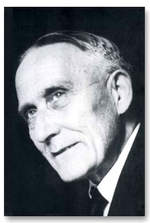
Louis Massignon (25 July 1883 – 31 October 1962) was a French Catholic scholar of Islam and a pioneer of Catholic-Muslim mutual understanding. He was an influential figure in the twentieth century with regard to the Catholic Church's relationship with Islam and played a role in Islam being accepted as an Abrahamic faith among Catholics.
Although a Catholic himself, he tried to understand Islam from within and thus had a great influence on the way Islam was seen in the West; among other things, he paved the way for a greater openness to dialogue inside the Catholic Church towards Islam. Some scholars maintain that his research, esteem for Islam and Muslims, and cultivation of key students in Islamic studies largely prepared the way for the positive vision of Islam articulated in the Lumen gentium and the Nostra aetate at the Second Vatican Council.
Life
Louis Massignon was born in Nogent-sur-Marne near Paris, France. His father, Fernand Massignon (1855–1922), a painter and a sculptor under the pseudonym Pierre Roche, was an intimate friend of novelist Joris-Karl Huysmans. Whereas his father was a sceptic, his mother, Marie Hovyn Massignon, had a deep prayer life and was his earliest and foremost religious influence. Huysmans' own conversion to Roman Catholicism was one of the first major inspirations of the young Louis in a friendly tutorial relationship that lasted from 1901 till Huysmans' death in 1907.
Studies
Louis Massignon started his studies at the Lycée Louis-le-Grand in Paris (1896) where he befriended his classmate Henri Maspero, later a renowned sinologist.
Following his baccalauréat (1901) he went on a first trip to Algeria where his family had relations, and ties with high colonial officers: Henry de Vialar, Henry de Castries, and Alfred Le Chatelier, the founder of the Chair of Muslim Sociology at the Collège de France in Paris.
In 1902, he continued his studies, graduating licencié ès-lettres on an essay on Honoré d'Urfé and embarking on the first of his many Arab subjects: the corporations of Fez in the 15th century.
Exploring the sources of his study in Morocco in 1904, he vowed to dedicate himself to the study of Arabic after a dangerous confrontation in the desert.
In 1906, he received his diplome d'études supèrieures on the strength of his study.
Conversion to Christianity
In 1907, he was sent on an archeological mission to Mesopotamia. In Baghdad he was the guest of the great Muslim family of the Alusi, who introduced him to the brand of Arab hospitality he was to honour throughout his life. It was the Alusi who saved him from a very dangerous situation in the desert when in 1908—during the ferment of the Young Turk Revolution—he was captured as a "spy" and almost killed. (The Alusi also helped him gather the sources for his magnum opus on the 10th-century mystic al-Hallaj.)
This situation of captivity, and the experience of Muslim spirituality, also brought about his conversion to Christianity: In mortal danger, which filled him with extreme, physical anguish, he first felt remorse for his past life, made an abortive and tentative suicide attempt, fell into a delirium and a state of great agitation (later diagnosed as either malaria, or a stroke caused by sun and fatigue), and finally experienced the presence of God as a "visitation of a Stranger", who overwhelmed him, leaving him passive and helpless, feeling judged for having judged others harshly, and almost making him lose his very sense of identity. Yet he also experienced this visitation as a liberation from his (outer) captivity, and a promise that he was going to return to Paris. He himself interpreted the state of delirium as a "reaction of [his] brain to the forced conversion of [his] soul".
He recovered rapidly from his illness, had a second spiritual experience and travelled to Beirut accompanied by the Iraqi priest Anastase-Marie al-Karmali (Anastasius-Maria the Carmelite), with whom Massignon became friends. In Beirut, Massignon made a confession to Father Anastase-Marie, thus confirming his conversion to Catholicism. The priest eventually escorted Massignon all the way to Brittany and met his parents before returning to Baghdad. Louis and Father Anastase-Marie would maintain a correspondence until 1936.
Massignon strongly felt that he was assisted in his encounter with God and in his conversion by the intercession of living and deceased friends, among them Joris-Karl Huysmans and Charles de Foucauld (1858–1916), who had also experienced God in a Muslim context.
Thus, his conversion provided a firm basis for his lifelong association with the latter. He made Massignon the executor of his spiritual legacy: the Directoire—the Rule for the foundation of the Little Brothers of Jesus, which Louis Massignon duly saw to publication in 1928 after a long hesitation by the Church authorities over the imprimatur.
However, Massignon did not follow Foucauld's invitation to join him in his life as a hermit among the Tuareg in Tamanrasset. Instead, in 27 January 1914, he married a cousin, Marcelle Dansaert-Testelin. His daughter was the linguist and ethnographer, Geneviève Massignon.
Activities in World War I
During World War I he was a translating officer for the 2ème Bureau (the French Intelligence) at the headquarters of the 17th French Colonial Division, in which capacity he was affected to the Sykes-Picot mission (1917) as a temporary captain acting on his experience as an Arabist and an Islamist, after a spell of his own volition as an infantry second lieutenant at the Macedonian front (1916), where he was twice mentioned in dispatches and awarded a medal for bravery.
Within this mission, he became acquainted with T. E. Lawrence in August 1917 in Cairo and apparently there had been plans to attach Massignon to the Arab Legion, an Arab force who had rallied to Sharif Husain's revolt and were trained by the British and French. He had several friendly interviews with Lawrence, among others on the Handbook for Arabia, which served as an example for his own Annuaire du Monde Musulman. They both shared the same sense of honour and betrayal after the collapse of the Arab-Anglo-French relationship on the disclosure of the 1917 Balfour Declaration. Massignon does not figure among the friends in Lawrence's published letters, which does not mean that Lawrence did not take an intellectual interest in the subsequent contributions to Arabism by Massignon since, it will be remembered he had started his own career as a keen Francophile.
Scholarly work after World War I
On June 15, 1919, Massignon was provisionally appointed to the Chair of Muslim Sociology and Sociography at the Collège de France in Paris. In January 1926, Massignon was finally given the chair in January 1926, when the creator of the chair and incumbent, Alfred le Chatelier retired. He conducted research on various subjects related to Islam, such as the lives of al-Hallaj, Muhammad's companion Salman Pak and the significance of Abraham for the three Abrahamic religions. Since 1911, he had edited a journal on Islamic world, Revue du monde musulman.
His four-volume doctoral thesis on al-Hallaj, finished in 1914, was published in 1922. He continued to work on the life of the mystic for the rest of his life and showed the importance of al-Hallaj as figure in Muslim spirituality as reflected also in intellectual discussions, art, poetry and legends. It was criticized by many as giving prominence to a relatively marginal figure in Islam: especially sharp criticism appears in Edward Said's Orientalism. Likewise, his great openness for Islam was seen with skeptical eyes by many Catholics.
Religious commitments
In the 1930s, Francis of Assisi played a great role in his life: In 1931, Massignon became a Franciscan tertiary and took the name of "Ibrahim" (due to the hospitality of Abraham to the angels). On February 9, 1934, he and Mary Kahil, a friend from his youth, prayed at the abandoned Franciscan church of Damietta, Egypt, where Francis of Assisi had met Sultan al-Malik al-Kamil in 1219. They took a vow of Badaliya ('substitution'), offering their lives for the Muslims, "not so they would be converted, but so that the will of God might be accomplished in them and through them". This vow led to the formal foundation of the Badaliya prayer association in 1947, first in Cairo and then in Paris. Especially after the 9/11 attacks, Badaliya prayer groups were also established in Boston and Washington DC.
Encouraged by Mary Kahil and with the permission of Pope Pius XII, he became a Melkite Greek Catholic on February 5, 1949, which meant he still remained in the Catholic Church, but was no longer affiliated with the Roman Rite.
Instead the Melkite Church consists of Arab Catholics and its Byzantine Rite liturgy is celebrated in Arabic. This indirectly allowed Massignon to be closer to Arab Christians and Muslims alike.
As a Greek Catholic, he could be ordained as a priest although he was married (yet it was not for this reason that he had had himself transferred to Greek Catholicism). He was ordained by Bishop Kamel Medawar on January 28, 1950, with the permission of Patriarch Maximos IV, despite some opposition from the Holy See, which, however, finally accepted his priestly ordination. Being a priest meant for Massignon offering his life in substitution for others, especially for the Muslims.
Political commitment after World War II
After World War II, while still remaining active as a scholar, his focus of attention shifted to political action to help Muslims and Arab Christians. In this he followed the model of Mahatma Gandhi, whose work he studied later in his life and considered a saint, and his principles of non-violent action (ahimsa and satyagraha). (He was also president of the Amis de Gandhi association.) He made it clear that he did not hope for success in all his areas of action, but that, first and foremost, he wanted to bear witness to Truth and Justice, just as Jesus Christ had done.
He committed himself to the following (in chronological order):
for the Arabs living in Palestine who were displaced by the foundation of the state of Israel in 1948; he believed in peaceful coexistence of Jews, Muslims, and Christians in Palestine
Against the French government's removal of the Sultan Sidi Muhammad of Morocco in 1953, promoted by two self-styled Muslim religious leaders, El Glaoui and El Kittani; he was supported in this by two committees, France-Islam and the newly founded France-Maghreb, the latter having among its members François Mitterrand, François Mauriac, André Julien
For the amnesty of political prisoners in Madagascar, as president of the Comité pour l'amnistie aux condamnés politiques d'outre-mer. The committee finally reached this amnesty
For a peaceful solution of the colonial tensions in Algeria which culminated in the Algerian War of Independence. As such, he set up during the war a Christian-Muslim pilgrimage to the chapel of the Seven Sleepers in Vieux-Marché due to the shared veneration of the saints by both religions.
Dialogue was very important for him; he also talked to the Iranian religious sociologist Ali Shariati who would later become extremely influential as a modernist Muslim thinker in Iran. Shariati had immense respect for Massignon and adored him as a teacher and a master in his book Kavir (book). In August 1957, Massignon participated in the International Meeting of the monastery of Toumliline, an inter-faith conference that focused that year on Education. At the end of the conference king Mohammed V invited the participants to his palace and awarded Massignon the Grand Cordon du Ouissam Alaoui, the equivalent of the French Legion of Honour for Morocco).
Massignon died on October 31, 1962, and was buried on November 6 in Pordic, Brittany. Louis Gardet, his friend and colleague, assisted in the posthumous edition of Louis Massignon's work La passion de Hussayn Ibn Mansûr an-Hallâj, published in 1975.
Teaching
Among his students were many scholarly luminaries:
Henry Corbin, whom he directed towards his major study of Suhrawardi (Shaykh Al-Ishraq)
Eva de Vitray-Meyerovitch, convert to Islam and scholar of Jalâl ud Dîn Rûmî
Abdel Rahman Badawi, the Egyptian scholar of Islamic philosophy
Abd al-Halim Mahmud, Grand Shaykh of Al-Azhar University
Vincent-Mansour Monteil
George Makdisi
Eliezer Paul Kraus, discovered Al-Farabi's commentaries The Philosophy of Plato and Aristotle, and the Commentary on Laws
Ali Shariati, sociologist, philosopher and Iranian political activist
Jean Mohamed Ben Abdejlil, convert from Islam and Franciscan friar, also a godson of Massignon
Religious views
While firmly rooted in Catholic faith, Massignon was also inspired by Islamic theology, which made him a very independent thinker in religious matters, while he avoided any kind of heresy.
Religious beliefs
Massignon's faith can be characterized by the basic concepts of sacred hospitality (Arabic: diyafa), generosity (Arabic: karam, and mystical substitution (Arabic: badaliya).
Sacred hospitality
Sacred hospitality, a concept that was inspired by the Islamic commandment of hospitality, demands, in Massignon's eyes to accept anyone and even serve him without wanting to change him or wishing him to be different. It is also rooted in the life of Jesus Christ, "who asked for hospitality and died on a cross", thereby accepting even the violence of his executioners.
This concept also forms the basis for his strong belief in peaceful coexistence among different ethnicities, which made him speak out against the displacement of the Arabs from Palestine, as well as (at least initially) the decolonization of Algeria that implied the emigration of the French Algerians and Algerian Jews, the Pieds noirs, and the end of a multi-religious Algeria.
Substitution and intercession
The concept of mystical substitution was first suggested to Massignon by Huysmans' biography of Saint Lydwine of Schiedam, "whose life exemplified the writer's belief that one could atone for the sins of others by offering up one's suffering on their behalf." This is also, ultimately, a concept inspired by Jesus Christ, whose suffering on the Cross, according to Saint Paul, redeemed mankind from sin.
He also believed in the power of intercession—i.e., of praying for others—and had felt this power himself, especially during his conversion to Christianity.
Following this idea, Massignon wanted to dedicate his whole life as a substitute for the Muslims, not necessarily so that they would be converted (not putting up with their difference for religion would have been against his idea of sacred hospitality) but that God's will would be fulfilled through them. He also saw his becoming a priest later in life as a way of offering up his life for others.
View of Islam
In Massignon's view, Islam is a religion based on Muhammad's genuine inspiration, which made him see the oneness (tawhid) of God. This inspiration was completed by research in which Muhammad found the origins of the Arab people in the Biblical person of Ismael. He thus sees the revelation in Islam as a "mysterious answer of (divine) grace to Abraham's prayer for Ismael and the Arab race".