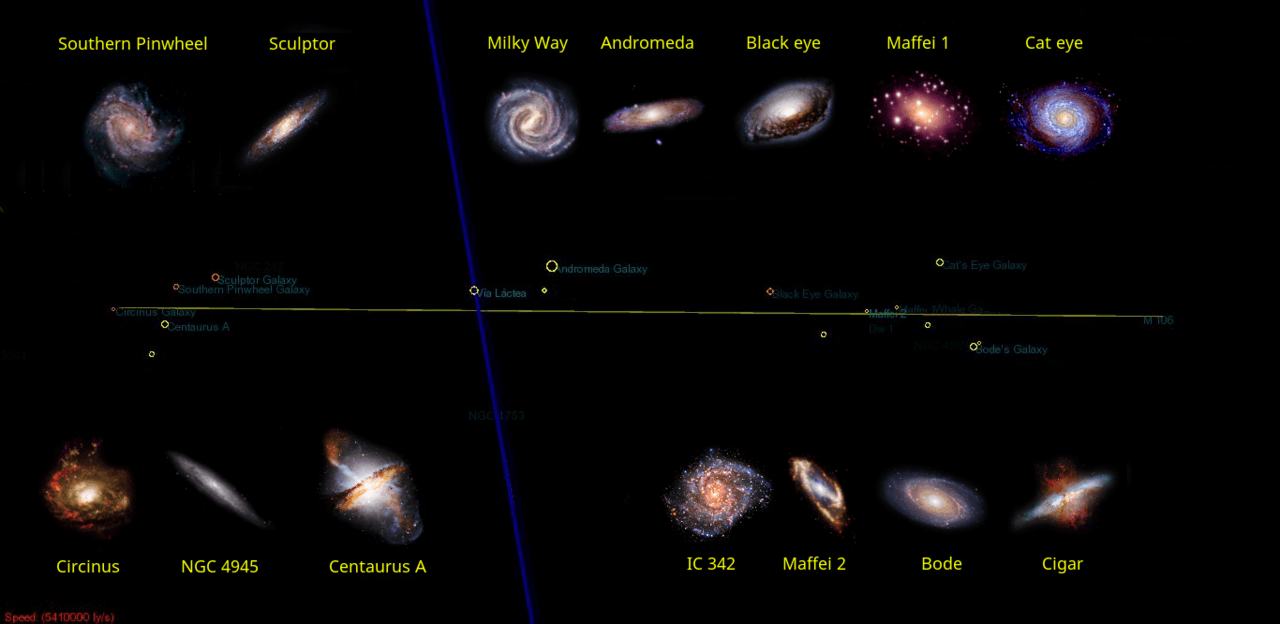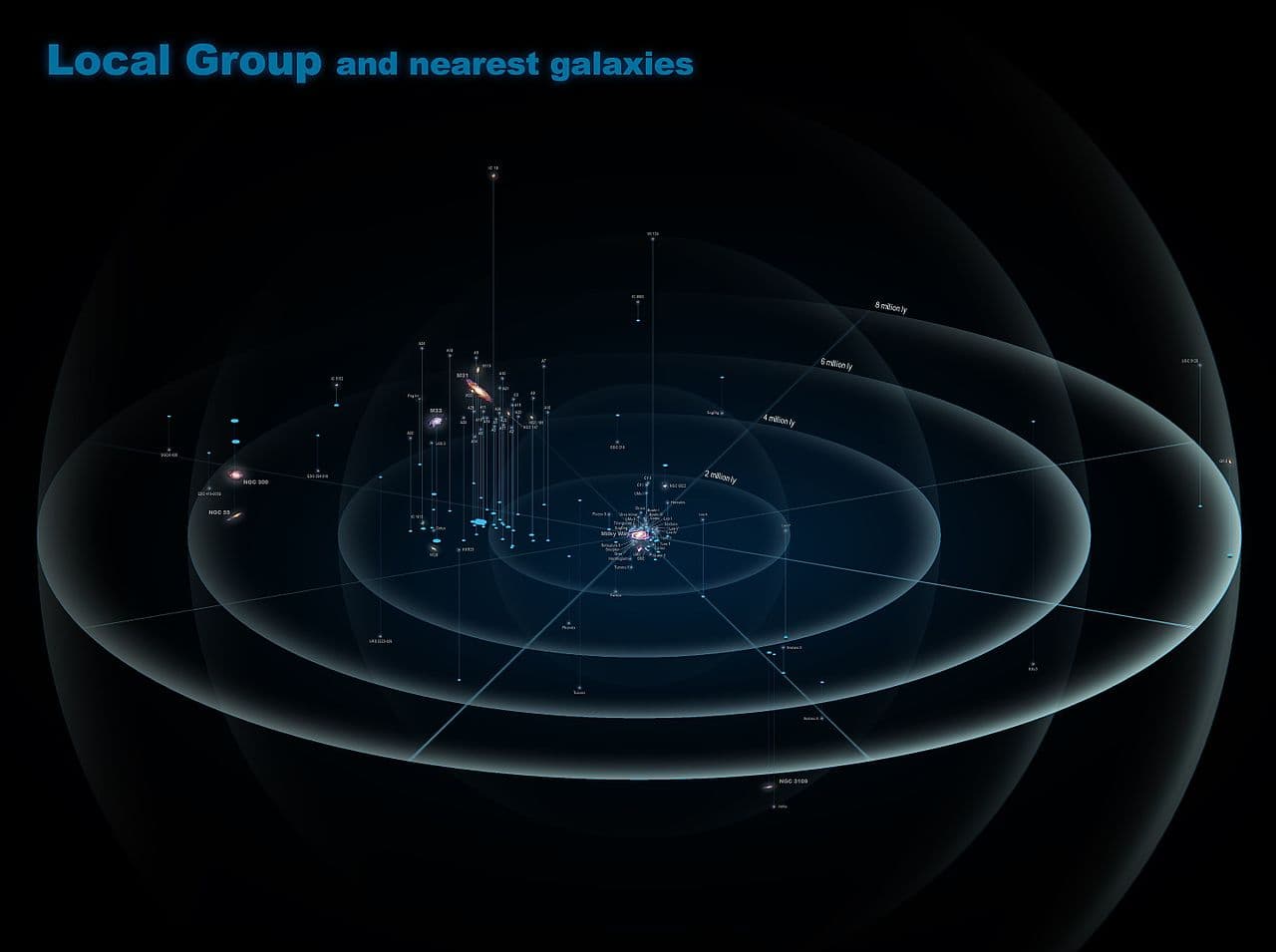
The Local Sheet or the Coma–Sculptor Cloud is a nearby galaxy filament and an extragalactic region of space where the Milky Way, the members of the Local Group, and other galaxies share a similar peculiar velocity. This region lies within a diameter of about 10.4 megaparsecs (34 million light-years; 3.2×10²⁰ kilometres), 465 kiloparsecs (1.52 million light-years; 1.43×10¹⁹ kilometres) thick, and galaxies beyond that distance show markedly different velocities. The Local Group has only a relatively small peculiar velocity of 66 km⋅s−1 with respect to the Local Sheet. Typical velocity dispersion of galaxies is only 40 km⋅s−1 in the radial direction. Nearly all nearby bright galaxies belong to the Local Sheet. The Local Sheet is part of the Local Volume and is in the Virgo Supercluster (Local Supercluster). The Local Sheet forms a wall of galaxies delineating one boundary of the Local Void.
A significant component of the mean velocity of the galaxies in the Local Sheet appears as the result of the gravitational attraction of the Virgo Cluster of galaxies, resulting in a peculiar motion ~185 km⋅s−1 toward the cluster. A second component is directed away from the center of the Local Void; an expanding region of space spanning an estimated 45 Mpc (150 Mly) that is only sparsely populated with galaxies. This component has a velocity of 259 km⋅s−1. The Local Sheet is inclined 8° from the Local Supercluster (Virgo Supercluster).
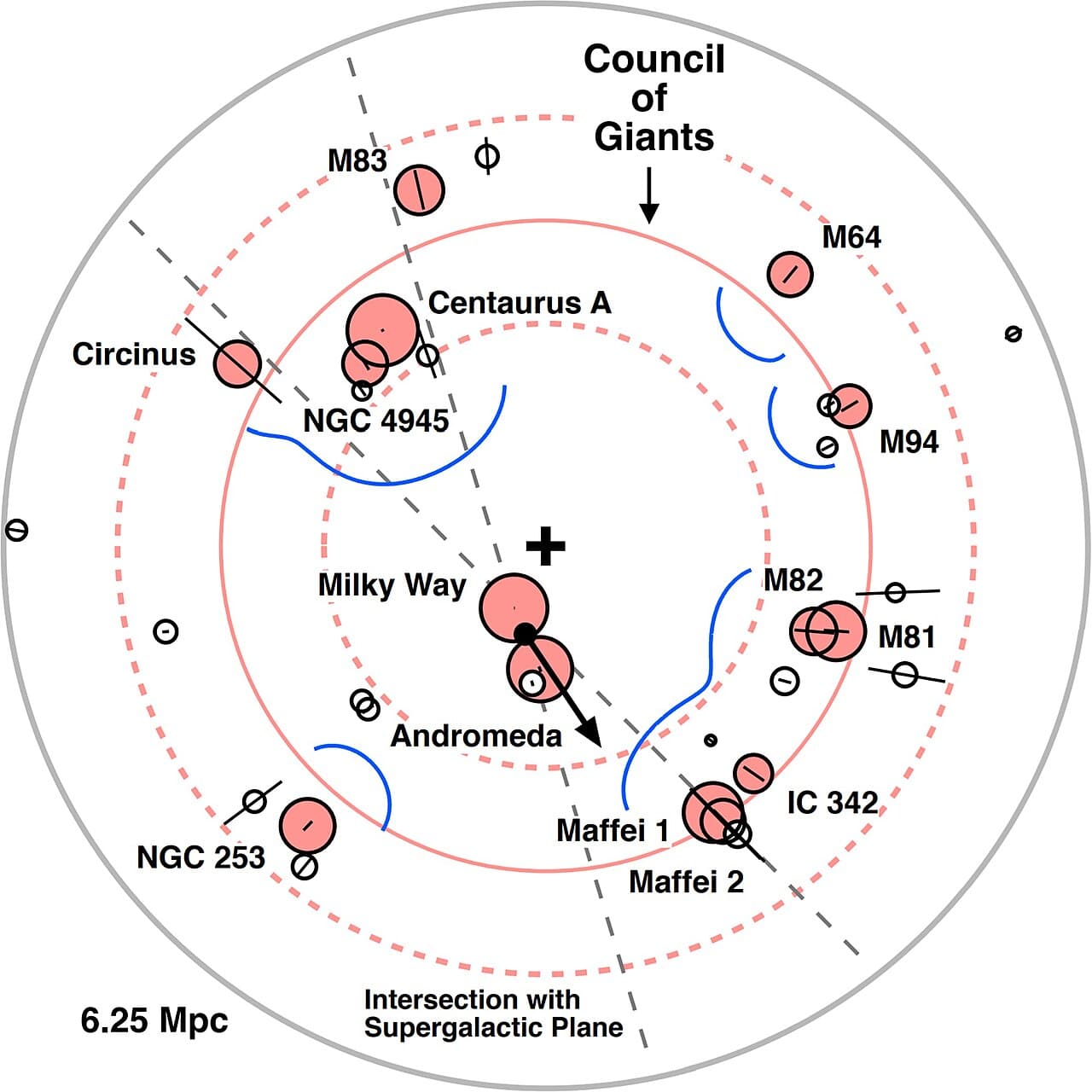
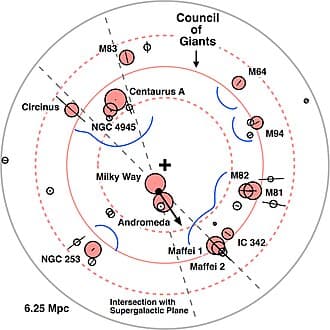
The so-called Council of Giants is a ring of twelve large galaxies surrounding the Local Group in the Local Sheet, with a radius of 3.746 Mpc (12.22 Mly) and its center located at 810 kpc (2.6 Mly) away from the Sun. Ten of these are spirals, while the remaining two are ellipticals. The two ellipticals (Maffei 1 and Centaurus A) lie on opposite sides of the Local Group.
* The mass is given as the logarithm (base unspecified) of the mass in solar masses.
Location
The Local Sheet is the co-moving part of the Coma-Sculptor Cloud, which was identified and described in 1987 by astronomer Brent Tully with colleague Richard Fisher in his book The Nearby Galaxies Atlas as Cloud 14. It is a huge 10 Mpc (33 Mly) prolate, filament and is mostly host to late-type galaxies, in contrast to the Virgo Cluster, in which more than half of the giant galaxies are early-type galaxies.