
Nathan Freudenthal Leopold Jr. (November 19, 1904 – August 29, 1971) and Richard Albert Loeb ( ; June 11, 1905 – January 28, 1936), together known as Leopold and Loeb, were two American murderers who kidnapped and killed 14-year-old Bobby Franks in Chicago, Illinois, United States, on May 21, 1924.
Leopold and Loeb, both students at the University of Chicago, were respectively aged 19 and 18 and were engaged in a relationship at the time of their crime. They committed the murder – characterized at the time as "the crime of the century" – hoping to demonstrate superior intellect, which they believed enabled and entitled them to carry out a "perfect crime" without consequences.
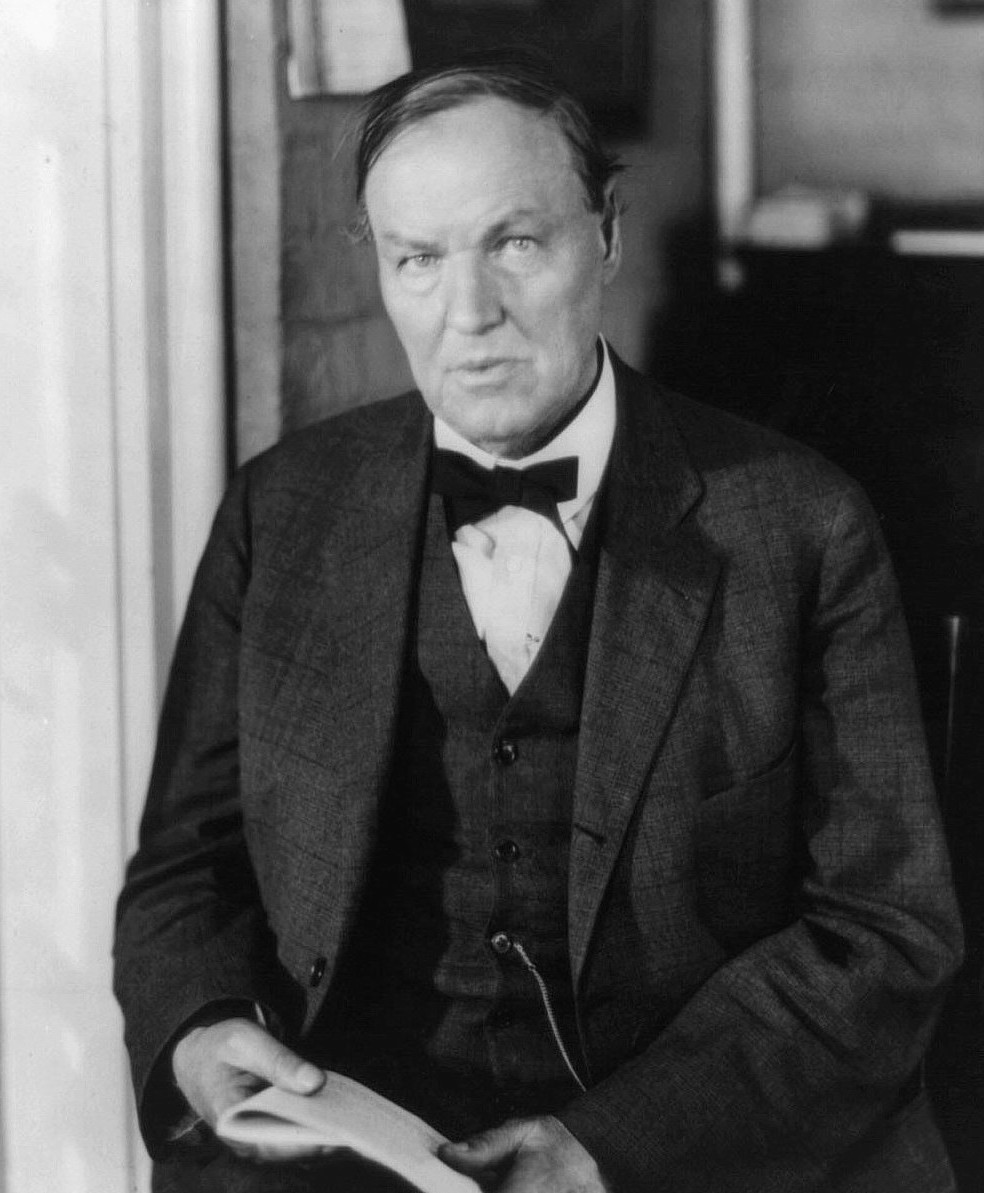
Leopold's and Loeb's families retained Clarence Darrow as lead counsel for their defense. Darrow's eight-hour summation at their sentencing hearing is noted for its influential criticism of capital punishment as retributive rather than transformative justice. Both men were sentenced to life imprisonment plus 99 years. Loeb was murdered by a fellow prisoner in 1936. Leopold was released on parole in 1958. The case has since served as the inspiration for several dramatic works.
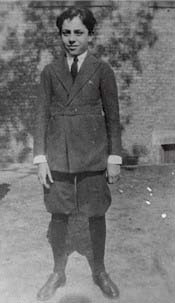
Early lives
Nathan Leopold
Nathan Freudenthal Leopold Jr. was born on November 19, 1904, in Chicago, Illinois, the third son of Florence (née Foreman) and Nathan Leopold Sr., a wealthy German-Jewish immigrant family. A child prodigy, Leopold was recorded in his baby book as having spoken his first words at the age of four months and three weeks old. Leopold began his college studies at the University of Chicago, transferred to the University of Michigan, but returned after a year to study at the University of Chicago. At the time of the murder, he had completed an undergraduate degree at the University of Chicago with Phi Beta Kappa honors. He planned to begin studies at Harvard Law School after a trip to Europe.
By many accounts, Leopold, who had bulging eyes and a small stature, was sensitive about his appearance. He threw himself into intellectual pursuits where he met with remarkable success. Leopold had studied 15 languages and claimed to speak five fluently. He had achieved a measure of national recognition as an ornithologist. Leopold and several other ornithologists identified nesting sites of Kirtland's warblers and made astute observations about the parasitic nesting behavior of brown-headed cowbirds, which threatened the warblers. He maintained his interest in birds after his crime, raising birds in prison and working to help with the struggling Puerto Rican Parrot population after his release on parole.
Richard Loeb
Richard Albert Loeb was born on June 11, 1905, in Chicago, the third of four sons of Anna Henrietta (née Bohnen) and Albert Henry Loeb, a wealthy lawyer and retired vice president of Sears, Roebuck & Company. His father was Jewish and his mother was Catholic. Like Leopold, Loeb was exceptionally intelligent. He was an avid reader, with a passion for history and crime stories. At age 12, he entered the innovative University of Chicago High School. With the encouragement of his governess, he completed his high school education in two years. In 1923, at the age of 17, he would reportedly become the University of Michigan's youngest graduate. Following graduation from Michigan, Loeb enrolled in a few history classes at the University of Chicago. Unlike Leopold, Loeb was athletic and considered handsome.
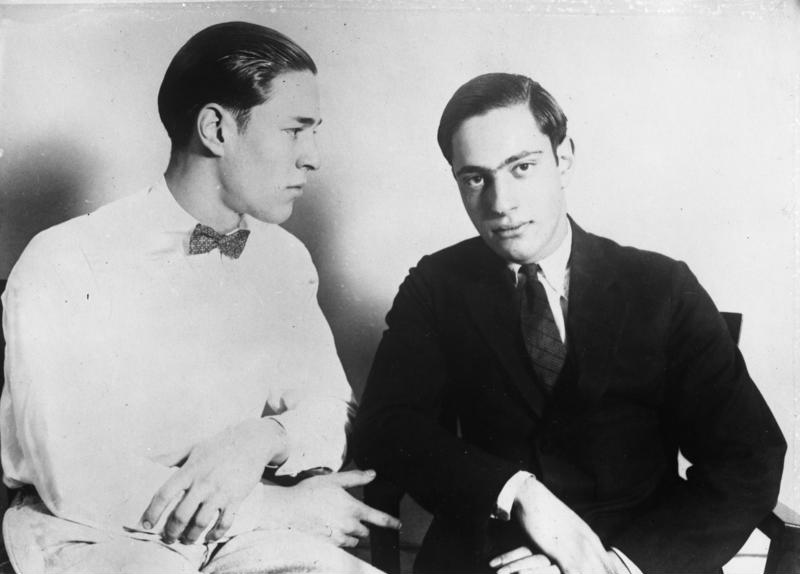
Adolescence and early crimes
The two young men grew up with their families in the affluent Kenwood neighborhood on Chicago's South Side. The Loebs owned a summer estate (the farm part of which is now called Castle Farms and is a popular wedding venue) in Charlevoix, Michigan, as well as a mansion in Kenwood, two blocks from the Leopold home.
Though Leopold and Loeb knew each other casually while growing up, they began to see more of each other in the spring of 1920; their relationship flourished at the University of Chicago, as part of a mutual friend group. Their sexual relationship began in February 1921 and continued until their arrest.
Since childhood Loeb had been stealing small things from friends, family and stores. He would sometimes show off his pick-pocketing skills to friends in high school in an attempt to impress them. When Loeb met Leopold, they began to steal things together, and worked out a system to cheat their friends and family during games of bridge, though it was largely unsuccessful.
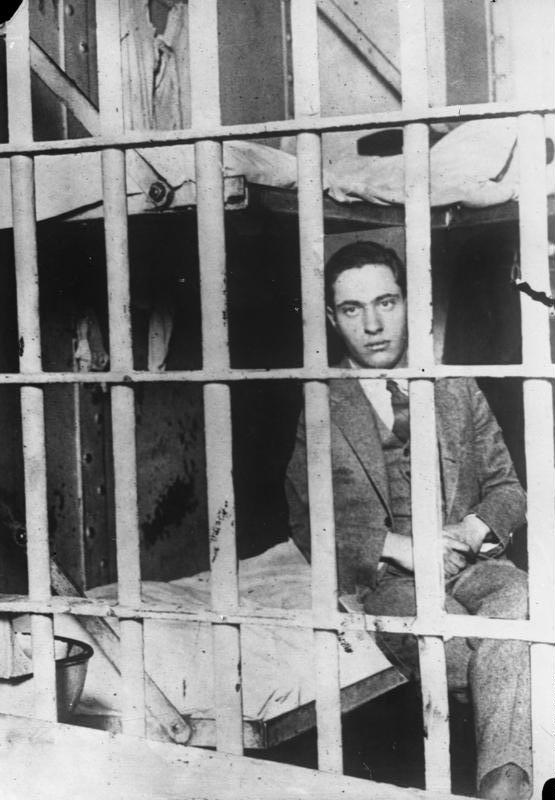
They also began to commit more serious crimes such as burglary, though they often took only relatively minor things such as wine, piano benches and vacuum cleaners. They would also drive around throwing bricks through windows and committed several arsons, often mingling with the crowd watching firefighters work.
While Loeb seems to have been content to do these things for fun, Leopold felt the need to justify them philosophically. He was an individual hedonist: as he explained it, he would weigh all of the pleasure or pain he would receive from an action, and do what would give him the most pleasure. This extended to every aspect of his life, including his eventual decision to commit murder. As he explained to a psychiatrist: "Making up my mind to commit murder was practically the same as making up my mind whether or not I should eat pie for supper, whether it would give me pleasure or not."
Leopold was also interested in Friedrich Nietzsche's concept of "supermen" (Übermenschen), interpreting them as transcendent individuals possessing extraordinary and unusual capabilities, whose superior intellects allowed them to rise above the laws and rules that bound the unimportant, average populace. Leopold believed it was possible that he and Loeb could become such individuals, and as such, by his interpretation of Nietzsche's doctrines, they were not bound by any of society's normal ethics or rules. In a letter to Loeb, he wrote, "A superman ... is, on account of certain superior qualities inherent in him, exempted from the ordinary laws which govern men. He is not liable for anything he may do."
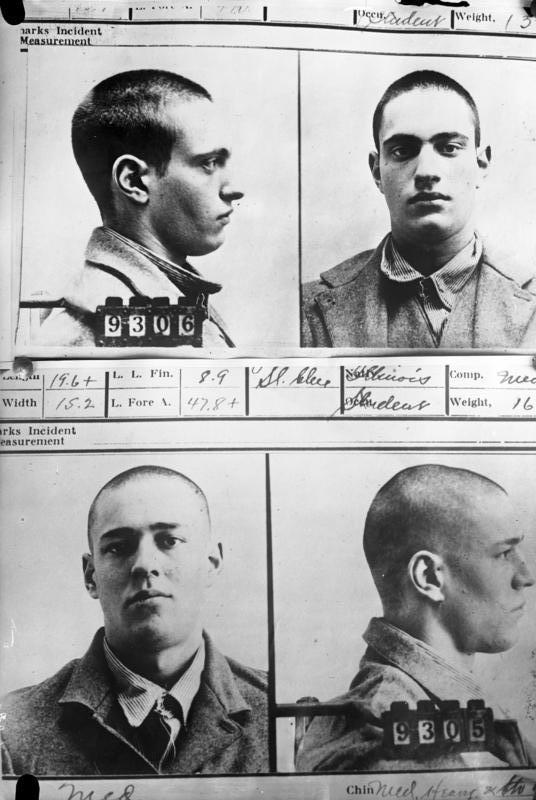
After robbing Loeb's old fraternity house at the University of Michigan, where they stole penknives, a camera, and a typewriter that they later used to type the ransom note for their murder victim, Bobby Franks, Loeb proposed they should commit a "perfect crime" that would attract public attention and confirm their superiority to others.
Murder of Bobby Franks
Murder
Leopold and Loeb, who were 19 and 18, respectively, at the time, settled on kidnapping and murdering a younger adolescent as their perfect crime. They spent seven months planning everything, from the method of abduction to the disposal of the body. To obfuscate the actual nature of their crime and their motive for it, they decided to make a ransom demand, and they also devised an intricate plan for collecting the ransom, which involved a long series of complex instructions that would be communicated one instruction at a time.
After a lengthy search for a suitable victim, mostly on the grounds of the Harvard School for Boys in the Kenwood area, the pair decided upon Robert "Bobby" Franks (born September 19, 1909), 14-year-old son of wealthy Chicago watch manufacturer Jacob Franks. Bobby was an across-the-street neighbor of Loeb's who had played tennis at the Loeb residence several times.
On the afternoon of May 21, 1924, using an automobile that Leopold rented under the name Morton D. Ballard, they offered Franks a ride as he walked home from school. The boy initially refused, because his destination was less than two blocks away, but Loeb persuaded him to enter the car to discuss a tennis racket that he had been using. The precise sequence of the events that followed remains in dispute, but the prevailing view placed Leopold behind the wheel of the car while Loeb sat in the back seat. Loeb struck Franks, who was sitting in front of him in the passenger seat, several times in the head with the handle-end of a chisel. Contemporary press reports noted that the blow was struck with a cold chisel wrapped in tape, and that Leopold made an additional confession after learning the penalty would be the same for both regardless of which had actually struck the fatal blow. He then dragged Franks into the back seat, gagged him, and waited until the boy eventually died. With the body on the floor of the back seat, out of view, the men drove to their predetermined dumping spot near Wolf Lake, in the extreme south side of Chicago. After nightfall, they removed Franks' clothes, then concealed the body in a culvert along the Pennsylvania Railroad tracks north of the lake. To obscure the body's identity, they poured hydrochloric acid on the face and genitals to disguise the fact that he had been circumcised, as circumcision was unusual among non-Jews in the United States at the time.
Investigation
By the time the two men returned to Chicago, word had already spread that Franks was missing. Leopold called Franks' mother, identifying himself as "George Johnson", and told her that Franks had been kidnapped; instructions for delivering the ransom would follow. After mailing the typed ransom note and burning Franks' clothes, then cleaning the blood stains from the rented vehicle's upholstery, they spent the remainder of the evening playing cards.
Once the Franks family received the ransom note on the following morning, Leopold called a second time and dictated the first set of instructions for the delivery of the ransom payment. The intricate plan was stalled almost immediately when Franks' father forgot the address of the store where he was supposed to receive the next set of directions, and it was abandoned entirely when word came the same day that Franks' body had been found. Leopold and Loeb disposed of the typewriter and burned a blanket which they had used to move Franks' body. They then went about their lives as usual.

Leopold and Loeb both enjoyed chatting about the murder with their friends and relatives. Leopold discussed the case with his professor and a female friend, joking that he would confess and give her the reward money. Loeb helped a couple of reporter friends of his find the drugstore to which he and Leopold had tried to send Mr. Franks, and when asked to describe Bobby he replied: "If I were to murder anybody, it would be just such a cocky little son of a bitch as Bobby Franks."
Police found a pair of eyeglasses near Franks' body. Although the prescription and the frame were common, they were fitted with an unusual hinge which had been purchased by only three customers in Chicago, one of whom was Leopold. When questioned, Leopold offered the possibility that his glasses might have dropped out of his pocket during a bird-watching trip the previous weekend.
During formal questioning on May 29, Leopold and Loeb asserted that on the night of the murder they had picked up two women in Chicago using Leopold's car, then dropped them off some time later near without learning their last names; however, Leopold's chauffeur told police that he had been repairing the car that afternoon, and his wife confirmed that claim. The typewriter was recovered from the Jackson Park Lagoon on June 7.
Confession
Loeb soon confessed, saying that Leopold had planned the crime and had killed Franks in the back seat of the car while he (Loeb) drove. Soon after, Leopold told police that he was the driver and Loeb the killer. Their confessions otherwise corroborated most of the evidence in the case. Both confessions were announced by the state's attorney on May 31.
Leopold later claimed, long after Loeb was dead, that he pleaded in vain with Loeb to admit to killing Franks. "Mompsie feels less terrible than she might, thinking you did it," he quotes Loeb as saying, "and I'm not going to take that shred of comfort away from her." Most observers believed that Loeb did strike the fatal blows. During the sentencing hearing, the defense revealed through psychiatrist Dr. Bernard A. Glueck, described by one reporter as the most credible of the three defense alienists, that Loeb had washed blood from his hands at the culvert where Franks' body was found, establishing him as the actual killer; the revelation was strategically timed to undermine State's Attorney Crowe, who had long assumed Leopold to be the murderer. (A witness claimed to have seen Loeb driving the car, and Leopold in the back seat, minutes before the kidnapping.)
Both Leopold and Loeb admitted that they were driven by their thrill-seeking, Übermenschen (supermen) delusions, and their aspiration to commit a "perfect crime". Neither claimed to have looked forward to the killing, but Leopold admitted interest in learning what it would feel like to be a murderer. He was disappointed to note that he felt the same as ever.
Trial
The trial of Leopold and Loeb at Chicago's Cook County Criminal Court became a media spectacle and the third to be labeled "the trial of the century," after those of Harry Thaw and Sacco and Vanzetti. The Leopold and Loeb families hired the renowned criminal defense attorney Clarence Darrow to lead the defense team. It was rumored that Darrow was paid $1 million for his services, but he was actually paid $65,000 (equivalent to $1.19 million in 2025). Darrow took the case because he was a staunch opponent of capital punishment.
While it was generally assumed that the men's defense would be based on a plea of not guilty by reason of insanity, Darrow concluded that a jury trial would almost certainly end in conviction and the death penalty. Thus, he elected to enter a plea of guilty, hoping to persuade Cook County Circuit Court Judge John R. Caverly to impose sentences of life imprisonment.
The trial (technically an extended sentencing hearing, as their guilty pleas had already been accepted) ran for 32 days. The state's attorney, Robert E. Crowe, presented 88 witnesses, documenting details of the crime. The defense presented extensive psychiatric testimony in an effort to establish mitigating circumstances, including physical abnormalities, an over-abundance of money and, in Leopold's case, sexual abuse by a governess.
One piece of evidence was a letter written by Leopold mentioning his homosexual affair with Loeb. Both the prosecution and the defense interpreted this information as supportive of their own position. The prosecution presented Leopold and Loeb as "perverts" and their homosexuality as a motive for their crime, whereas Darrow presented their relationship as evidence that they suffered from insanity and were therefore not responsible for their actions. Darrow called a series of expert witnesses, who offered a catalog of Leopold's and Loeb's abnormalities. One witness testified to their dysfunctional endocrine glands, another to the delusions that had led to their crime.
Darrow's speech
Darrow's impassioned, eight-hour-long "masterful plea" at the conclusion of the hearing has been called the finest speech of his career. Contemporary press reported that in his final plea on August 25, Darrow declared the crime was "inherent in the boys' organisms," arguing it came from ancestors or from training and environment while their minds were forming, and that "to believe any boy responsible for himself or early training is to be absurd." Its principal arguments were that the methods and punishments of the American justice system were inhumane, and the youth and immaturity of the accused:
We read of killing one hundred thousand men in a day [during World War I]; probably exaggerated, but what of it?
We read about it and we rejoiced in it; if it was the other fellows who were killed. We were fed on flesh and drank blood.
Even down to the prattling babe, and I need not tell your honor this, because you know, I need not tell you how many upright, honorable young boys have come into this court charged with murder, some saved and some gone to their death, boys who fought in this war and learned how cheap human life was. You know it and I know it.
These boys were brought up in it.
...
It will take fifty years to wipe it out of the human heart, at least, if ever. I know this, for I have studied these things, that after the Civil War in 1865, crimes of this sort increased, marvelously increased. No one needs to tell me that crime has no cause. It has as definite a cause as any other disease, and I know that out of the hatred and bitterness of the Civil War crime increased as America had never seen before.
...
I know that Europe is going through it today; I know it has followed every war; and I know it has influenced these boys so that blood was not the same blood to them that it would have been if the world had not been bathed in blood.
...
Your Honor knows that in this very court crimes of violence have increased growing out of the war.
Not necessarily by those who fought but by those that learned that blood was cheap and human life was cheap and if the State could take it lightly why not the individual?
...
Has the court any right to consider anything but these two boys?
Yes.
The State says that your Honor has a right to consider the welfare of the community, as you have. If the welfare of the community would be benefited by taking these lives, well and good.
I think it would work evil that no one could measure.
Has your Honor a right to consider the families of these defendants?
I have been sorry, and I am sorry for the bereavement of Mr. and Mrs. Franks and the little sister; for those broken ties that cannot be mended.
All I can hope and wish is that some good may come from it.
But as compared with the families of Leopold and Loeb, they are to be envied. They are to be envied, and everyone knows it.
...