
Leonid Ilyich Brezhnev (19 December 1906 – 10 November 1982) was a Soviet politician who served as General Secretary of the Communist Party of the Soviet Union from 1964 until his death in 1982. He also held office as Chairman of the Presidium of the Supreme Soviet (head of state) from 1960 to 1964 and later from 1977 to 1982. His tenure as General Secretary and leader of the Soviet Union was second only to Joseph Stalin's in duration.
Brezhnev was born to a working-class family in Kamenskoye within the Yekaterinoslav Governorate of the Russian Empire. After the October Revolution created the Soviet Union, he joined the ruling Communist party's youth league in 1923 before becoming an official party member in 1929. When Nazi Germany invaded the Soviet Union in June 1941, he joined the Red Army as a commissar and rose rapidly through the ranks to become a major general during World War II. After the war ended, Brezhnev was promoted to the party's Central Committee in 1952 and became a full member of the Politburo by 1957. In 1964, he took part in the removal of Nikita Khrushchev as leader of the Soviet Union and replaced him as First Secretary of the CPSU. When Khrushchev was ousted, Brezhnev formed a triumvirate alongside Premier Alexei Kosygin and CC Secretary Nikolai Podgorny that initially led the country in Khrushchev's place. By the end of the 1960s, he had successfully consolidated power to become the dominant figure within the Soviet leadership.
In the short term, Brezhnev's governance improved the Soviet Union's international standing while stabilizing the position of its ruling party at home. Whereas Khrushchev regularly enacted policies without consulting the Politburo, Brezhnev was careful to minimize dissent among the party elite by reaching decisions through consensus, thereby restoring the semblance of collective leadership. Additionally, while pushing for détente between the two Cold War superpowers, he achieved nuclear parity with the United States and strengthened Moscow's dominion over Central and Eastern Europe. Furthermore, the country's massive arms buildup and widespread military interventionism under Brezhnev's leadership served to substantially expand Soviet influence abroad, particularly in the Middle East and Africa. By the mid-1970s, numerous observers argued that the Soviet Union had surpassed the United States to become the world's strongest military power.

Conversely, Brezhnev's leadership also witnessed a significant increase in repression and censorship throughout the Soviet Union compared with the relatively liberal years of the Khrushchev Thaw. Ultimately, Brezhnev's hostility towards political and economic reform ushered in an era of socioeconomic decline referred to as the Era of Stagnation. In addition to pervasive corruption within the country, this period was characterized by the shrinking availability of consumer goods and declining economic growth.
After 1975, Brezhnev's health rapidly deteriorated and he increasingly withdrew himself from governing the country despite remaining its highest authority. He eventually died on 10 November 1982 and was succeeded as General Secretary by Yuri Andropov. Upon coming to power in 1985, Mikhail Gorbachev denounced Brezhnev's government for its inefficiency and inflexibility before launching a campaign to liberalize the Soviet Union. Notwithstanding the backlash to his regime's policies in the mid-1980s, Brezhnev's rule has received consistently high approval ratings in public polls conducted in post-Soviet Russia.
Early life and early career
1906–1939: Origins
Leonid Ilyich Brezhnev was born on 19 December 1906 in Kamenskoye (now Kamianske, Ukraine) within the Yekaterinoslav Governorate of the Russian Empire to metalworker Ilya Yakovlevich Brezhnev (1874–1934) and his wife, Natalia Denisovna Mazalova (1886–1975). His father lived in Brezhnevo, Kursk Governorate, before moving to Kamenskoye. The parents of Brezhnev's mother came from Yenakiieve. Brezhnev's ethnicity was given as Ukrainian in some documents, including his passport, and Russian in others.
Brezhnev's niece wrote that in 1913, Brezhnev enrolled in a parish school. Two years later, he was admitted to a grammar school. Brezhnev left Kamenskoe for Kursk due to the famine of 1921–1923 and got employment as a porter at a cooking fat factory.
In 1923, Brezhnev joined the Komsomol, the Bolshevik youth organization. His biographer Paul J. Murphy believed he did it for careerist reasons. In the same year, Brezhnev enrolled at a college and four years later got a degree in land management. He started to work a year before graduation, first as a trainee in the Byelorussian SSR and, after receiving the diploma, in the Kursk Governorate and later in the Ural Oblast. During his work there, Brezhnev applied for Communist Party membership in 1929, spending two years as a candidate before becoming a full Party member two years later. Brezhnev reached the position of head of the land registry of Sverdlovsk in 1930, but relinquished it just half a year later to move to Moscow to enroll at the Institute of Agricultural Machinery. Historian Susanne Schattenberg speculates that he did so to avoid the excesses of collectivization that the Soviet Union was undergoing at that time.
Brezhnev did not stay in Moscow for long and left only two months later due to a housing shortage. Initially, he worked as a fitter at a plant in Zaporozhye. A year later, he enrolled in an evening program to study thermal engineering, while simultaneously working at the Dnieper Metallurgical Combine. While still a student, Brezhnev was appointed as the director of the Workers’ Faculty in 1933. He graduated from the institute in 1935, but worked as an engineer for less than half a year before being drafted into the Red Army. During his one-year service, Brezhnev received military training in Chita and became a political commissar of a tank division.

During Stalin's Great Purge, Brezhnev was one of many apparatchiks who exploited the resulting openings in the government and the party to advance rapidly in the regime's ranks. In 1936, he was appointed director of the Dniprodzerzhynsk Technical College and a year later he became Deputy Chairman of the Kamenskoye City Soviet. In May 1938, he obtained a position in Dnepropetrovsk and met Nikita Khrushchev, who had just taken control of the Ukrainian Communist Party. This relationship would be decisive for Brezhnev's future career. In 1939, he was appointed propaganda secretary of the Dnipropetrovsk party committee. During this time, Brezhnev took the first steps toward building a network of supporters which came to be known as the "Dnipropetrovsk Mafia" that would greatly aid his rise to power.
1941–1945: World War II
When Nazi Germany invaded the Soviet Union, Brezhnev was tasked with overseeing mobilization plans and the evacuation of Soviet factories. In July, he requested to be drafted into the military and was assigned to the Southern Front. During the retreat of Soviet forces, he returned to Dnepropetrovsk and remained in the city up to 25 August, the day it fell. In Autumn, Brezhnev was made deputy of political administration for the Southern Front, with the rank of Brigade-Commissar (equivalent to Colonel). During this period, Brezhnev developed his contacts with Khrushchev further, directly serving under his leadership from July to October 1941.
When the Germans occupied Ukraine in 1942, Brezhnev was sent to the Caucasus as deputy head of political administration of the North Caucasus Front. In April 1943, he became head of the Political Department of the 18th Army. Later that year, the 18th Army became part of the 1st Ukrainian Front, as the Red Army regained the initiative and advanced westward through Ukraine. In 1944, Brezhnev was promoted to the rank of major general as the Soviets successfully pushed German forces out of Transcarpathia. At the end of the war in Europe, Brezhnev was chief political commissar of the 4th Ukrainian Front, which entered Prague in May 1945, after the German surrender.

Rise to power
Promotion to the Central Committee
At the end of the war, Brezhnev was the head of the political administration of the Carpathian Military District and oversaw the Sovietization of newly incorporated territories. He left the position in June 1946, and a few months later was appointed the first secretary of the Zaporizhzhia regional party committee, where his deputy was Andrei Kirilenko, one of the most important members of the Dnipropetrovsk Mafia. After working on reconstruction projects in Ukraine, he returned to Dnipropetrovsk in November 1947 as regional first party secretary. In 1950 Brezhnev became a deputy of the Supreme Soviet of the Soviet Union, the Soviet Union's supreme state organ of power. In July that year, he was sent to the Moldavian SSR and appointed Party First Secretary of the Communist Party of Moldova, where he was responsible for completing the introduction of collective agriculture. Konstantin Chernenko, a loyal addition to the "mafia", was working in Moldova as head of the agitprop department, and one of the officials Brezhnev brought with him from Dnipropetrovsk was the future USSR Minister of the Interior, Nikolai Shchelokov.
In 1952, Brezhnev met with Stalin who subsequently promoted him to the Communist Party's Central Committee as a candidate member of the Presidium (formerly the Politburo) and made him a member of the Secretariat. Following Stalin's death in March 1953, Brezhnev was demoted to first deputy head of the political directorate of the Army and Navy. He remained close to the main events, as he participated in the arrest of Lavrentiy Beria in June. In August, he was promoted to lieutenant general.
Advancement under Khrushchev
Brezhnev's patron Khrushchev succeeded Stalin as General Secretary, while Khrushchev's rival Georgy Malenkov succeeded Stalin as Chairman of the Council of Ministers. In February 1954, Brezhnev was appointed second secretary of the Communist Party of the Kazakh SSR, where he worked under Panteleimon Ponomarenko who was Malenkov's protege. Following Khrushchev's victory over Malenkov, Ponomarenko was removed in May 1955 and Brezhnev was promoted to First Secretary in August. In Kazakhstan, Brezhnev oversaw the construction of the Baikonur Cosmodrome and conducted the Virgin Lands campaign. He was recalled to Moscow in 1956, before it became clear that the campaign would turn out to be disappointing.

In Moscow, Brezhnev became a candidate member of the Politburo and was appointed secretary of Defense Industry. In this position, he oversaw the development of the Soviet missile and nuclear arms programs. In June 1957, he backed Khrushchev in his struggle with Malenkov's Stalinist old guard in the Party leadership, the so-called "Anti-Party Group". Following the Stalinists' defeat, Brezhnev became a full member of the Politburo. In May 1960, he was promoted to the post of Chairman of the Presidium of the Supreme Soviet, making him the nominal head of state, although the real power resided with Khrushchev as First Secretary of the Soviet Communist Party and Premier.
Replacement of Khrushchev as First Secretary
Khrushchev's position as Party leader was secure until about 1962, but as he aged, he grew more erratic, and his performance undermined the confidence of his fellow leaders. The Soviet Union's mounting economic problems also increased the pressure on Khrushchev's leadership. Brezhnev remained outwardly loyal to Khrushchev, but became involved in a 1963 plot to remove him from power, possibly playing a leading role. Also in 1963, Brezhnev succeeded Frol Kozlov, another Khrushchev protégé, as Secretary of the Central Committee, thereby positioning himself as Khrushchev's likely successor. Khrushchev made him Second Secretary, or deputy party leader, in 1964.
After returning from Scandinavia and Czechoslovakia in October 1964, Khrushchev, unaware of the plot, went on holiday to the Pitsunda resort on the Black Sea. Anastas Mikoyan visited Khrushchev, hinting that he should not be too complacent about his present situation. Vladimir Semichastny, head of the KGB, was a crucial part of the conspiracy, as it was his duty to inform Khrushchev if anyone was plotting against his leadership. Nikolai Ignatov, whom Khrushchev had sacked, discreetly requested the opinion of several Central Committee members. After some false starts, fellow conspirator Mikhail Suslov phoned Khrushchev on 12 October and requested that he return to Moscow to discuss the state of Soviet agriculture. Finally, Khrushchev understood what was happening, and said to Mikoyan, "If it's me who is the question, I will not make a fight of it." Mikoyan wanted to remove Khrushchev from the office of First Secretary but retain him as the Chairman of the Council of Ministers, but the rest of the Presidium, headed by Brezhnev, wanted to remove him from active politics altogether.

Brezhnev and Suslov appealed to the Central Committee, blaming Khrushchev for economic failures, and accusing him of voluntarism and immodest behavior. Influenced by Brezhnev's allies, Politburo members voted on 14 October to remove Khrushchev from office. Some members of the Central Committee wanted him to undergo punishment of some kind, but Brezhnev, who had already been assured the office of the General Secretary, saw little reason to punish Khrushchev further. Brezhnev was appointed First Secretary on the same day, but at the time was believed to be a transitional leader, who would only "keep the shop" until another leader was appointed. Alexei Kosygin was appointed head of government, and Mikoyan was retained as head of state. Brezhnev and his companions supported the general party line taken after Stalin's death but felt that Khrushchev's reforms had removed much of the Soviet Union's stability. When Khrushchev left the public spotlight, there was no popular commotion, as most Soviet citizens, including the intelligentsia, anticipated a period of stabilization, steady development of Soviet society and continuing economic growth in the years ahead.
Political scientist George W. Breslauer has compared Khrushchev and Brezhnev as leaders. He argues they took different routes to build legitimate authority, depending on their personalities and the state of public opinion. Khrushchev worked to decentralize the government system and empower local leadership, which had been wholly subservient; Brezhnev sought to centralize authority, going so far as to weaken the roles of the other members of the Central Committee and the Politburo.
Leader of the Soviet Union (1964–1982)
Consolidation of power
Upon replacing Khrushchev as the party's First Secretary, Brezhnev became the de jure supreme authority of the Soviet Union. However, he was initially forced to govern as part of an unofficial Triumvirate (also known by its Russian name Troika) alongside the country's Premier, Alexei Kosygin, and Nikolai Podgorny, a Secretary of the CPSU Central Committee and later Chairman of the Presidium. Due to Khrushchev's disregard for the rest of the Politburo upon combining his leadership of the party with that of the Soviet government, a plenum of the Central Committee in October 1964 forbade any single individual from holding both the offices of General Secretary and Premier.
According to Tomas Sniegon and Nikita Pivovarov, Brezhnev ousted or demoted potential rivals, thus enabling him to consolidate power when Khrushchev was removed from power.
During his consolidation of power, Brezhnev first had to contend with the ambitions of Alexander Shelepin, the former chairman of the KGB and current head of the Party-State Control Committee. In early 1965, Shelepin began calling for the restoration of "obedience and order" within the Soviet Union as part of his own bid to seize power. Towards this end, he exploited his control over both state and party organs to leverage support within the regime. Recognizing Shelepin as an imminent threat to his position, Brezhnev mobilized the Soviet collective leadership to remove him from the Party-State Control Committee before having the body dissolved altogether on 6 December 1965.
Additionally, by the end of 1965, Brezhnev had Podgorny removed from the Secretariat, thereby significantly curtailing the latter's ability to build support within the party apparatus. In the ensuing years, Podgorny's network of supporters was steadily eroded as the protégés he cultivated in his rise to power were removed from the Central Committee. By 1977, Brezhnev was secure enough in his position to replace Podgorny as head of state and remove him from the Politburo altogether.
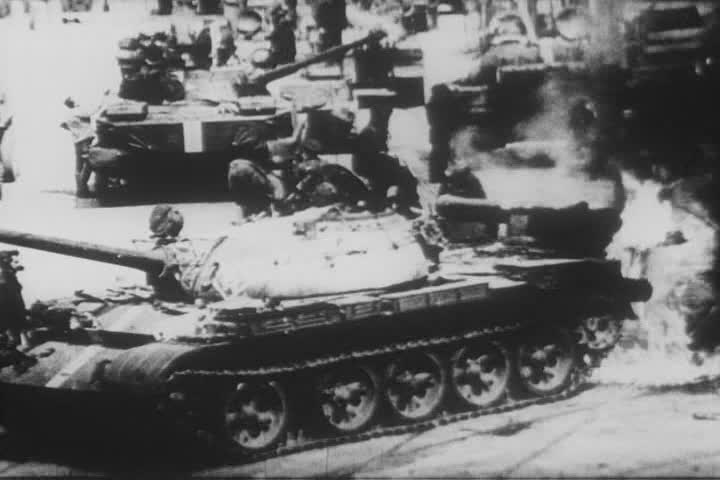
After sidelining Shelepin and Podgorny as threats to his leadership in 1965, Brezhnev directed his attentions to his remaining political rival, Alexei Kosygin. In the 1960s, U.S. National Security Advisor Henry Kissinger initially perceived Kosygin to be the dominant leader of Soviet foreign policy in the Politburo. Within the same timeframe, Kosygin was also in charge of economic administration in his role as Chairman of the Council of Ministers. However, his position was weakened following his enactment of several economic reforms in 1965 that collectively came to be known within the Party as the "Kosygin reforms". Due largely to coinciding with the Prague Spring (whose sharp departure from the Soviet model led to its armed suppression in 1968), the reforms provoked a backlash among the party's old guard who proceeded to flock to Brezhnev and strengthened his position within the Soviet leadership. In 1969, Brezhnev further expanded his authority following a clash with Second Secretary Mikhail Suslov and other party officials who thereafter became firm supporters of his leadership over the Party.
Brezhnev was adept at politics within the Soviet Union. Unlike Khrushchev, he did not make decisions without consulting with his colleagues and hearing their opinions. By the early 1970s, Brezhnev had successfully consolidated his position as first among equals within the Politburo. While Kosygin continued to hold office as Premier until shortly before his death in 1980, Brezhnev's dominance over the Soviet leadership remained secure from the mid-1970s up until his eventual death in 1982.
Domestic policies
Ideological development
Ideologically, Brezhnev's rule was associated with the doctrine of Developed Socialism. This concept initially appeared in the Eastern Bloc countries during the 1960s, was rhetorically adopted by Brezhnev in 1971, took the central position at the Party Congress in 1976, and was inscribed in the Constitution the following year.
Brezhnev has defined it as the Soviet-style socialism, which he believed had been successfully constructed in the Soviet Union. It emphasized the advanced technological developments with the use of nuclear power in production, computer planning, as well as a highly mechanized agriculture. Under developed socialism all social strata within the Soviet Union were closer to each other than ever before due to the highly developed productive force in the country.
One of the main reasons behind the doctrine was an attempt to secure Soviet leadership among the Socialist bloc by presenting the USSR as a country that had reached a more advanced level of socialist development which other countries were yet to achieve. Domestically, Developed Socialism was a response to the inability to reach communism by 1980, as had been promised by Khrushchev. It entrenched Party rule and promoted conservativism and caution by focusing on gradual change.
Repression
Brezhnev's stabilization policy included ending the liberalizing reforms of Khrushchev, and clamping down on cultural freedom. This policy gradually led to an increasingly authoritarian and conservative attitude.
By the mid-1970s, there were an estimated 10,000 political and religious prisoners across the Soviet Union, living in grievous conditions and suffering from malnutrition. Many of these prisoners were considered by the Soviet state to be mentally unfit and were hospitalized in mental asylums across the Soviet Union. Under Brezhnev's rule, the KGB infiltrated most, if not all, anti-government organisations, which ensured that there was little to no opposition against him or his power base.
The trial of the writers Yuli Daniel and Andrei Sinyavsky in 1966, the first such public trials since Stalin's reign, marked the reversion to a repressive cultural policy. Under Yuri Andropov the state security service (in the form of the KGB) regained some of the powers it had enjoyed under Stalin. However, there was no return to the purges of the 1930s and 1940s, and Stalin's legacy remained largely discredited among the Soviet intelligentsia.
Economics
Economic growth until 1973
Between 1960 and 1970, Soviet agriculture output increased by 3% annually. Industry also improved: during the Eighth Five-Year Plan (1966–1970), the output of factories and mines increased by 138% compared to 1960. The economic reform of 1965 was initiated by Kosygin, though its origins are often traced back to the Khrushchev Era. The reform introduced market principles to Soviet enterprises to reduce their dependence on plan indicators. It was ultimately cancelled by the Central Committee, though the Committee admitted that economic problems did exist
Under Brezhnev, the Politburo abandoned Khrushchev's decentralization experiments. By 1966, two years after taking power, Brezhnev abolished the Regional Economic Councils, which were organized to manage the regional economies of the Soviet Union. The Politburo became aggressively anti-reformist and the Soviet Union could not afford to maintain its massive subsidy for the Eastern Bloc in the form of cheap oil and gas exports. Brezhnev attempted to raise the standard of living by increasing the production of consumer goods during the Ninth Five-Year Plan, but it was ultimately unsuccessful, and the bulk of the state investment remained in industrial capital-goods production.
By the early 1970s, the Soviet Union had the world's second largest industrial capacity, and produced more steel, oil, pig-iron, cement and tractors than any other country. Before 1973, the Soviet economy was expanding at a faster rate than that of the American economy (albeit by a very small margin). The USSR also kept a steady pace with the economies of Western Europe. Between 1964 and 1973, the Soviet economy stood at roughly half the output per head of Western Europe and a little more than one third that of the U.S. In 1973, the process of catching up with the rest of the West came to an end and the Era of Stagnation was apparent.
Economic stagnation until 1982
The Era of Stagnation is a term coined by Mikhail Gorbachev to describe the time when Brezhnev was in power and his inability to deal with changing times. The CIA estimated that the Soviet economy peaked in the early 1970s. After that, economic growth began to slow down due to the prioritization of heavy industry and military spending over consumer goods. The social stagnation was stimulated by the growing demands of unskilled workers, labor shortages and a decline in productivity and labor discipline.
The GNP growth rate fell to 1% to 2% per year, falling behind the rate for the United States. The Soviet Union outproduced the U.S. in heavy industry, but due to the cumbersome procedures of the centralized planning system, Soviet industries were incapable of the innovation needed to meet public demand. The Soviets had almost no access to microcomputers, and the availability of cars and phones per capita was lower than in its Eastern satellites. This gap was also seen in agriculture, where the Soviet Union was import-dependent. In 1978, all satellites surpassed the Soviet Union in meat and egg production per capita, and Hungary produced more wheat.
In 1971, Brezhnev acknowledged that vast military expenditure slowed the growth of the Soviet economy. However, he was able to defer economic collapse by selling oil to Western Europe and arms to the Arab World.
Agricultural policy
Brezhnev's agricultural policy reinforced conventional methods for organizing the collective farms. Output quotas continued to be imposed centrally. Brezhnev also continued Khrushchev's policy of amalgamating farms. In order to address problems such as insufficient production of fodder crops and a declining sugar beet harvest, he allowed the enlargement of privately owned plots and pushed for an increase in state investments in farming, which amounted to an all-time high in the 1970s of 27% of all state investment.
Robert Service characterized the Soviet government's involvement in agriculture under Brezhnev as generally "unimaginative" and "incompetent". Since Khrushchev's rule, the import of cereal had become a staple of Soviet policy. When Brezhnev had difficulty sealing commercial trade agreements with the United States, he turned to other countries such as Argentina. In 1976, the Politburo issued a resolution that ordered kolkhozes close to each other to collaborate in their efforts to increase production. In the meantime, the state's subsidies to the food-and-agriculture sector did not prevent bankrupt farms from operating at a loss as rises in the price of produce were offset by the increased cost of fuel and other resources.
Brezhnev's call for an increase in the maximum size of privately owned plots within the Soviet Union removed important obstacles for the expansion of agricultural output but did not solve underlying problems. These included the growing shortage of skilled workers, the payment of workers in proportion to the quantity rather than quality of their work, and farm machinery that was too large for small collective farms and the roadless countryside. Under Brezhnev, private plots yielded 30% of the national agricultural production when they cultivated only 4% of the land. This was seen by some as proof that de-collectivization was necessary to prevent Soviet agriculture from collapsing, but leading Soviet politicians shrank from supporting such drastic measures due to ideological and political interests.
Social policy
Society
Over the eighteen years that Brezhnev ruled the Soviet Union, average income per head increased by half, slightly less growth than what it had been the previous years; three-quarters of this growth came in the 1960s and early 1970s. This can be explained by the end of the post-war recovery. Consumption per head rose by an estimated 70% under Brezhnev. Most of the increase in consumer production in the early Brezhnev era can be attributed to the Kosygin reform.