
Lagos State (Yoruba: Ìpínlẹ̀ Èkó, Gun: Ayìmátẹ̀n Awọnlìn tọ̀n) is a state in southwestern Nigeria. Of the 36 states, Lagos is the 1st or 2nd most populous state (depending on the source) but is the smallest by area. Bounded to the south by the Bight of Benin and to the west by the international border with the Republic of Benin, Lagos State borders Ogun State to the north and east, making it the only Nigerian state to border only one other state. Named for the city of Lagos — the most populous city in Africa — the state was formed from the Western Region and the former Federal Capital Territory on 27 May 1967.
Geographically, Lagos State is dominated by bodies of water with nearly a quarter of the state's area being lagoons, creeks, and rivers. The largest of these bodies are the Lagos and Lekki lagoons in the state's interior with the Ogun and Osun rivers flowing into them. Many other rivers and creeks flow throughout the state and serve as vital means of transportation for people and goods. On land, non-urbanized areas are within the tropical Nigerian lowland forests ecoregion with natural areas containing threatened populations of mona monkey, tree pangolin, and hooded vulture along with a transitory population of African forest elephants. Offshore, the state is also biodiverse as there are large fish populations along with African manatees and crocodiles.
Lagos State has been inhabited for years by various indigenous ethnic groups, primarily the majority Yoruba people who live throughout the state but also the Ewe and Ogu peoples in the far west. As a result of migration since the nineteenth century, Lagos State also has large populations of non-native Nigerian ethnic groups with Edo, Efik, Fulani, Hausa, Igbo, Ijaw, Ibibio, and Nupe peoples among other Nigerian groups. There are also groups from outside of Nigeria's modern borders with the Saro (Sierra Leonean) and Amaro (Brazilian) groups being descendants of formerly enslaved people who returned to Africa in the 1800s with a longstanding Middle Eastern Nigerian community (mainly Syrian and Lebanese Nigerians) also forming a significant part of Lagos' population along with recent immigrants from Benin, China, Ghana, India, Togo, and the United Kingdom. Religiously, the state is also diverse, as there is a sizable number of Christian, Muslim and traditional ethnic religions.
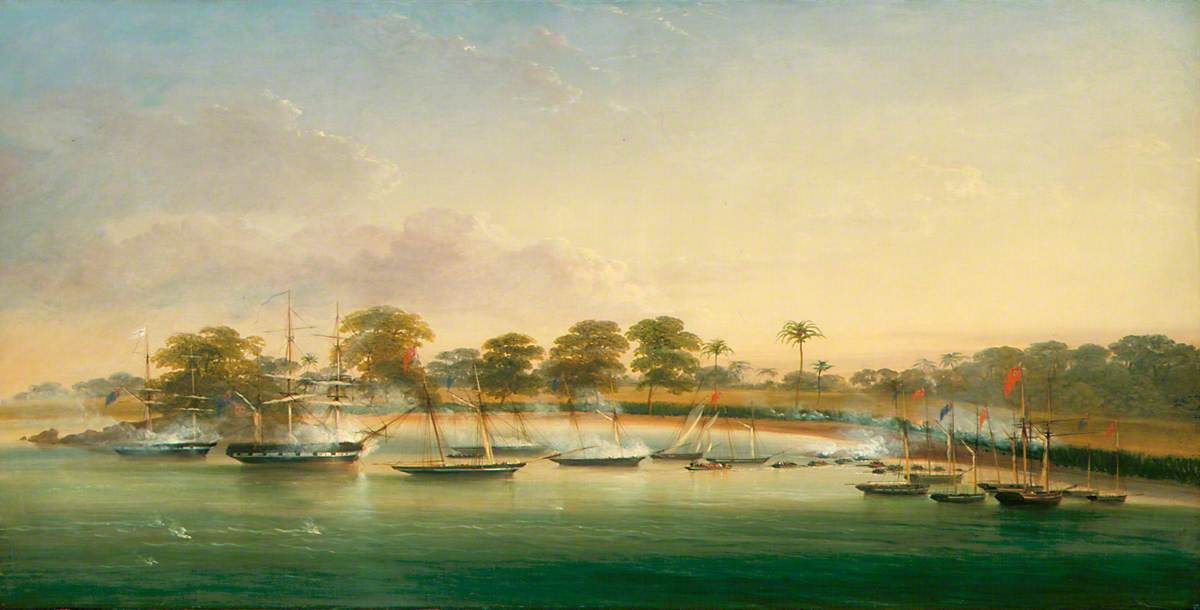
In the pre-colonial period, the area that is now Lagos State was mainly fishing villages and ports that at various points were controlled by states including the Benin Empire and Oyo Empire until the early 1800s when the city of Lagos had developed into a major kingdom of its own right. In 1850, the British successfully attacked the kingdom in the Bombardment of Lagos before installing an ally as Oba and signing a treaty that established Lagos as being under British protection. Ten years later, the forced Lagos Treaty of Cession led to the formal establishment of the Lagos Colony. In 1906, the colony was incorporated into the new Southern Nigeria Protectorate which merged into British Nigeria in 1914 with the city of Lagos as its capital. Upon independence in 1960, Lagos remained as the capital with much of the city forming the Federal Capital Territory while the rest of modern-day Lagos State was a part of the Western Region until 1967 when the region was split and the area became Lagos State.
Economically, Lagos State is one of the fastest-growing urban areas in the world. It contains the most populous city in Nigeria and one of the most important states in the country, a major financial centre and has one of the largest economies in Africa with a gross domestic product of $84 billion comparable with Ghana's $75 billion, Angola's $70 billion, and Ethiopia's $93 billion. Lagos State is also a key culture, education, and transportation hub for Nigeria and Sub-Saharan Africa. Additionally, the state also has the highest literacy rate in Nigeria. It is known for its vibrant culture, bustling markets, and significant economic activities. Despite overcrowding and chronic debilitating traffic, Lagos State has the highest Human Development Index in Nigeria and numerous development projects.
History
Early history
Before the Portuguese name of Lagos had been adopted, Lagos' initial name was Eko which referred mainly to the Island. The first to settle in Eko were the Aworis. Trade later drew various groups to the island, including the Portuguese in the 16th century. The Awori hunters and fishermen had originally come from Ile-Ife to the coast.

It was in 1760 that the name Lagos was adopted by the Portuguese. Naming it after a city in Southern Portugal which was used as port for slave trade.
British Involvement
In late 1851, the British Royal Navy bombarded Lagos (in present-day Nigeria) in the "Reduction of Lagos." The attack aimed to suppress the Atlantic slave trade, which had thrived in Lagos since the arrival of the Portuguese. The British sought to depose Oba Kosoko, who resisted efforts to end the trade. After Kosoko fled, the British installed Oba Akitoye, a more cooperative ruler aligned with their anti-slavery efforts. In 1861, Oba Docemo was the one who signed the treaty making Lagos a British colony.
Post-colonial era
Lagos State was created on 27 May 1967 according to the State Creation and Transitional Provisions Decree No. 14 of 1967, which restructured Nigeria into a federation of 12 states. Before the issuance of this Decree, Lagos city, which was the country's capital had been administered directly by the Federal Government through the Federal Ministry of Lagos Affairs. However, Ikeja, Agege, Mushin, Ikorodu, Epe, Surulere, and Badagry were administered by the then Western Region Government. Lagos, the city, along with these other towns were captured to create the state of Lagos, with the state becoming fully recognized as a semi-autonomous administrative division on 11 April 1968. Lagos served the dual role of being the State and Federal Capital until 1976 when the capital of the state was moved to Ikeja. After the full establishment of the Federal Capital Territory, based on the recommendation of the Akinola Àgùdà–led committee set up by General Murtala Muhammed to review the need for a new capital for Nigeria in 1975. The seat of the Federal Government was formally relocated to Abuja on 12 December 1991. Nevertheless, Lagos remains the financial centre of the country, and even grew to become the most populous city in the state and the country.

Cities and towns
Lagos
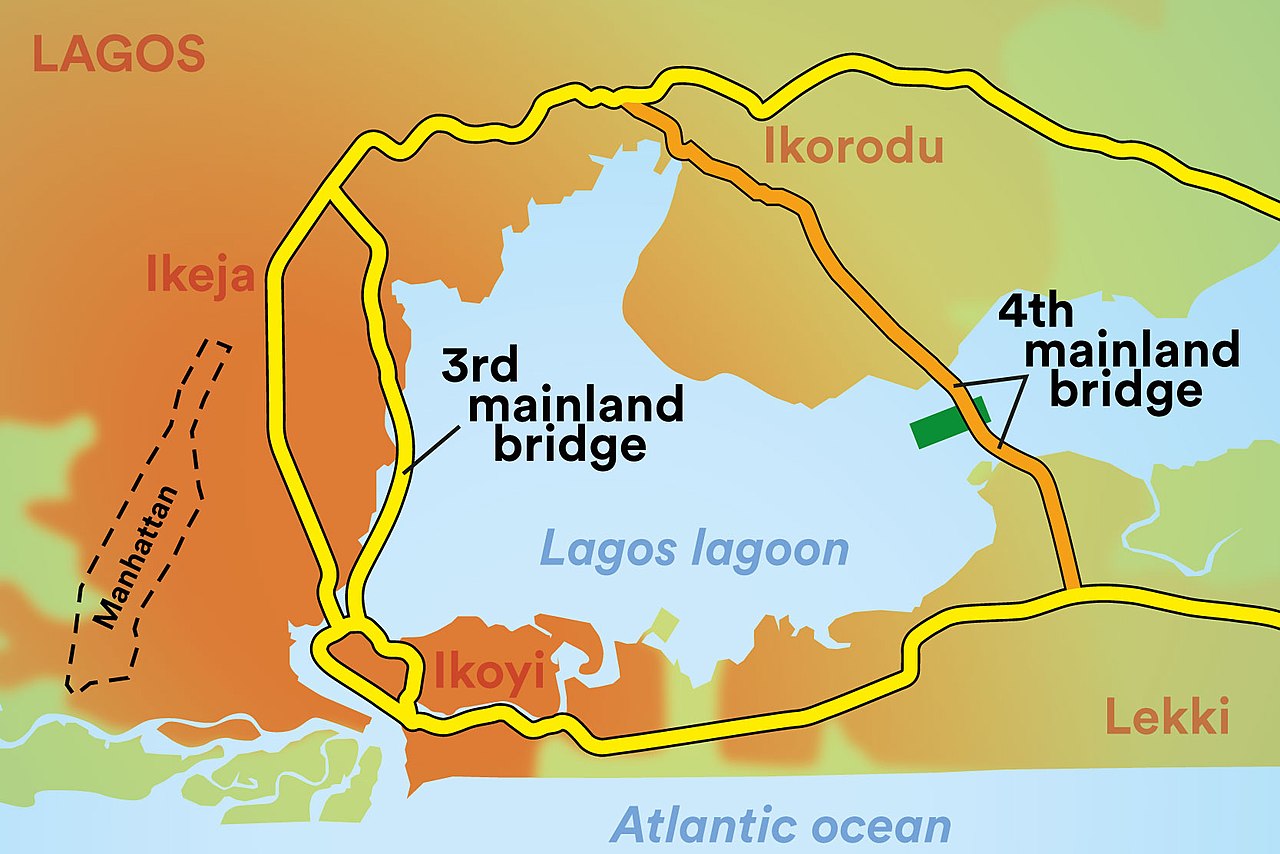
Lagos is the most populous city in Lagos State, Nigeria as a whole, and the continent of Africa. The conurbation is one of the most populous in the world. Lagos is a port which originated on islands separated by creeks, such as Lagos Island, fringing the southwest mouth of Lagos Lagoon while protected from the Atlantic Ocean by barrier islands and long sand spits such as Bar Beach, which stretch up to 100 kilometres (62 miles) east and west of the mouth. The metropolitan area of Lagos includes Ikeja (which is the capital of Lagos State) and Agege and Mushin.
Ikeja
Ikeja is the state capital of Lagos State. Ikeja is a planned residential and commercial town with shopping malls, pharmacies and government reserved areas. The Murtala Mohammed International Airport is in Ikeja. Ikeja is also home to Fela Kuti's African Shrine, Late Chief Gani Fawehinmi house and Lagbaja's Motherland. It also has the largest shopping center on the mainland.
Lekki
Lekki is a city in the south eastern part of the state. It is a naturally formed peninsula, it is still largely under construction. As of 2015, only phase 1 of the project had been completed, with phase 2 nearing completion. The peninsula is approximately 70 to 80 km long, with an average width of 10 km. Lekki currently houses several estates, gated residential developments, agricultural farmlands, areas allocated for a Free Trade Zone, an airport, and a sea port under construction. The proposed land use master plan for the Lekki envisages the Peninsula as a "Blue-Green Environment City", expected to accommodate over 3.4 million residential population and an additional non-residential population of at least 1.9 million.

Ikorodu
Ikorodu is a city located north-east of the state along the Lagos Lagoon. It shares a boundary with Ogun State. As of the 2006 Census, Ikorodu boosted population of about 535,619. It is the third largest city in the south-west after Ibadan and Lagos while it is the 12th largest city in Nigeria. In 2022, it had an estimated population of 1,041,066. The population of the city currently grows at 5.26% annually, and it is projected to reach 1.7 million by 2035.
Eko Atlantic
Eko Atlantic is a planned city being constructed on land reclaimed from the Atlantic Ocean. It is located on the former Lagos' Bar Beach. Upon completion, the new island which is still under development is anticipating at least 250,000 residents and a daily flow of at least 150,000 commuters. The development will also have a positive environmental impact; its purpose is to stop the erosion of the Lagos coastline. The Eko Atlantic City project received global recognition in 2009, as the Lagos State government and its private sector partners on the Project, South Energyx, received the Clinton Global Initiative Commitment Certificate.
Badagry
Badagry is a coastal town in the state. It is situated between Metropolitan Lagos, and the border of the Republic of Benin at Seme. As of the preliminary 2006 census results, the municipality had a population of 241,093.

The area is led by a traditional king, Akran De Wheno Aholu Menu – Toyi 1, who is also the permanent vice-chairman of obas and chiefs in Lagos State. It is known to hold the country's oldest storey building.
Badagry is home to the Ewe and Egun people who are predominantly fishermen.
Epe
Epe is a town located on the north side of the Lekki Lagoon. It is popular for the fishing activities attributed to the city. Per the 2006 Census the population of Epe was 181,409.
Epe is widely regarded as Lagos's fishing capital. Fishing is the main occupation of the people here, so it is no surprise that a sculpture of two giant fishes, erected at the Lekki-Epe T-Junction, welcomes you to Epe. The Epe Fish Market is regarded as Lagos's largest seafood market.
Epe town is well-known for its tranquilly. Aside from the adventure, sightseeing, and serenity, you also have access to low-cost animal protein.
Epe, like any other society, has special occasions and festivals where people come together to celebrate. Epe residents celebrate various festivals such as the Kayo-kayo festival, the Ebi bi festival, Ojude-Oba, and the Epe day.
Some campuses of popular higher education institutions in Lagos can be found within Epe. Lagos State University (LASU), Pan-Atlantic University (PAU), Yaba College of Technology, and Michael Otedola College of Primary Education are among them (MOCOPED).
Epe is also the birthplace of notable individuals such as former Lagos State Governor Akinwunmi Ambode and Nigerian businessman Femi Otedola.
Ojo
Ojo is a town predominantly inhabited by the Awori people, with a population of 507,693. It is home to several notable institutions, including Lagos State University and the Lagos State University of Education, formerly known as Adeniran Ogunsanya College of Education (AOCOED). The town also hosts the Federal Government College, Ijanikin, and the renowned Alaba International Market.
Lagos State, with a Gross domestic product (GDP) based on PPP in 2025 estimated to be over US$250 billion, is the major economic centre of Nigeria. The state's dynamic economy, driven by its bustling port, thriving tech scene, and a robust manufacturing sector, is continuously expanding, positioning Lagos as a significant global economic hub. If Lagos were an independent nation, it would rank among the top 30 economies globally and it would be the fifth largest economy in Africa.
Lagos State houses headquarters of most conglomerates and commercial banks in Nigeria. The state has the lowest incidence of extreme poverty (around 1.3% of the population against a national average of 31%) of all states in Nigeria, according to World Bank data from 2018. Despite that, slums and poverty are a major issue in the Lagos area.
Its total generated revenue in 2017 was around ₦334 billion (equivalent to US$920 million), growing by 10.43% compared to 2016. By the first half of 2021, the State's internally generated revenue (IGR) alone stood at over ₦267 billion.
Lekki Free Trade Zone
Lekki Free Trade Zone (Lekki FTZ) is a free zone situated at the eastern part of Lekki, which covers a total area of about 155 square kilometres. The first phase of the zone has an area of 30 square kilometres, with about 27 square kilometres for urban construction purposes, which would accommodate a total resident population of 120,000. According to the Master Plan, the free zone will be developed into a new modern city within a city with integration of industries, commerce and business, real estate development, warehousing and logistics, tourism, and entertainment.
Mineral resources
The following mineral resources are found in Lagos State:
Clay
Bitumen
Glass Sand
Crude Oil
Geography
Water Borders
Lagos State's water boundaries are defined by the Atlantic Ocean to the south and the Lagos Lagoon to the east. The state is also intersected by several rivers and creeks, including the Ogun River, which drains into the Lagoon. Major coastal areas include Victoria Island, Lekki, and Epe. Lagos’ strategic location along the Atlantic Ocean has made it a critical point for trade and commerce, with the Lagos Port Complex and Tin Can Island Port serving as Nigeria's busiest shipping hubs.
Climate
Under the Köppen climate classification, Lagos State has a tropical monsoon climate (Am), characterized by distinct wet and dry seasons. The rainy season lasts from April to October, with an annual average rainfall of 1,800 to 2,000 mm. Humidity levels remain high throughout the year.
Dry Season: November to March, characterized by harmattan winds, which bring dry and dusty air from the Sahara Desert.
Rainy Season: Heavy rainfall and occasional thunderstorms from April to October.
Average daytime temperatures range between 28 °C to 34 °C (82 °F to 93 °F). The highest recorded temperature in Lagos was 38 °C (100 °F), while the lowest was 21 °C (70 °F).
Lagos has a Tropical wet and dry or savanna climate. The city's yearly temperature is 28.67 °C (83.61 °F) and it is -0.79% lower than Nigeria's averages. Lagos typically receives about 132.01 millimeters (5.2 inches) of precipitation and has 193.63 rainy days (53.05% of the time) annually.
Drainage
Lagos State is characterized by a complex network of lagoons, creeks, and rivers. The Lagos Lagoon serves as the main drainage basin for the state, connected to the Atlantic Ocean through the Commodore Channel. The Ogun River, which originates in Ogun State, flows southward into Lagos Lagoon. The Badagry Creek and the Five Cowrie Creek also contribute to the state's drainage system.
Flooding is a recurring challenge, particularly during the rainy season from April to October, as the low-lying topography and coastal location make Lagos vulnerable to waterlogging and storm surges.