
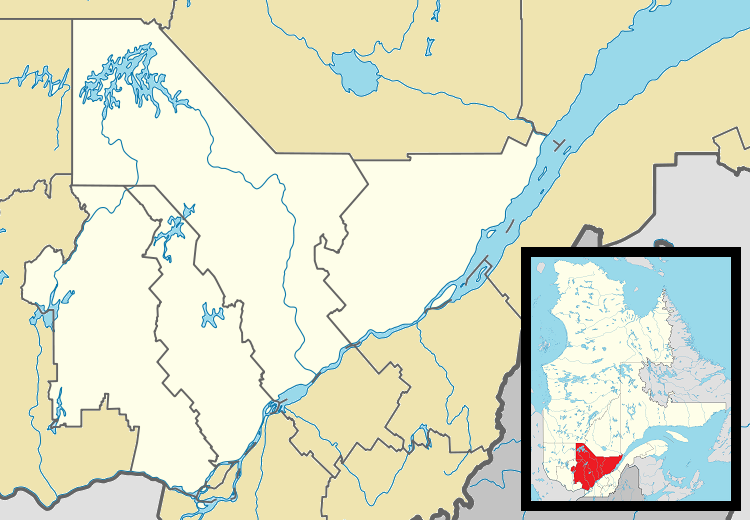
La Tuque ( lah TEWK, French: [la tyk], Canadian French: [la t͡sʏk]) is a city located in north-central Quebec, Canada, on the Saint-Maurice River, between Trois-Rivières and Chambord. The population was 11,129 at the 2021 Canadian census, most of which live within the urban area. At over 28,000 square kilometres (11,000 square miles), it is the largest city in Canada by area.
The Classique internationale de canots de la Mauricie canoeing race begins at La Tuque.
The name, which dates to the eighteenth century, originates from a nearby rock formation which resembles a French-Canadian knitted cap known as the tuque.
In 1823–24, the explorer François Verreault described the location as:
« un Portage nommé Ushabatshuan (le courant trop fort pour le sauter). Les Voyageurs le nomment la Tuque, à cause d'une Montagne haute, dont le pic ressemble à une Tuque. Ce portage est d'une lieue, avec des fortes côtes à monter ».
("a portage named Ushabatshuan ('the rapids too strong to jump'). The voyageurs call it La Tuque, due to a tall mountain whose peak resembles a "tuque." The portage is a league long, and climbs steep slopes.")

The hat-shaped mountain which gave its name to the town of La Tuque is located between the Saint-Maurice River (left bank) and the WestRock paper mill. The summit of this mountain is about 245 metres (804 feet). It is located 200 m (660 ft) from the river and about 400 m (1,300 ft) upstream (northeast side) of the La Tuque hydroelectric power plant.
History
The territory of La Tuque was first inhabited by Atikamekw Indigenous people. In the early 1850s, settlers were drawn to the area to exploit the forest resources. The La Tuque Post Office opened in 1887, but the area remained isolated from the rest of the Mauricie until the early 1900s when the National Transcontinental Railway was built, prompting industrial development and the growth of a community on the east bank of the Saint-Maurice River where there was a large set of falls.
On November 15, 1909, the Village Municipality of La Tuque was incorporated, with Achille Comeau as first mayor. A few months later on April 4, 1910, the Village Municipality of La Tuque Falls was formed, with Wenceslas Plante as first mayor. Less than one year later in March 1911, both villages merged to form the Town of La Tuque, with Wenceslas Plante as first mayor.

In the 1940s, the hydro-electric generating station on the Saint-Maurice River was built, resulting in the partial destruction of the rock formation that gave the town its name.
In 1972, the Municipality of Haute-Mauricie was formed out of portions from the unincorporated Carignan and Malhiot Townships, in the proximity of the Saint-Maurice Wildlife Reserve. However, its low population and constantly rising administrative costs led to the merger of Haute-Mauricie with La Tuque in August 1993.
On March 26, 2003, Le Haut-Saint-Maurice Regional County Municipality was dissolved and all its municipalities and unorganized territories were amalgamated into the new City of La Tuque, thereby becoming the largest municipality with city status in land area in Quebec, and largest in Canada (38,000 km2). On January 1, 2006, the municipalities of La Bostonnais and Lac-Édouard separated and were reestablished.

In May 2010, some 120 forest fires broke out around La Tuque, burning until June. Smoke from these fires reached portions of Eastern Ontario and southern Quebec, including the cities of Ottawa and Montreal, as well as the northern US states.
In 2011, the 100th anniversary of La Tuque was celebrated with various cultural activities, including a large parade held on June 25 as well as the creation of a recipe book made by local residents.
Geography
While the urban area of La Tuque is relatively small, its entire territory is the largest city in Canada. It consists of almost all the entire former regional county municipality of Le Haut-Saint-Maurice, and includes the settlements of Carignan, Clova, La Croche, Fitzpatrick, Kiskissink, Oskélanéo, Parent, Rapide-Blanc, Rivière-aux-Rats, and Sanmaur.

Enclosed by but not administratively part of the city are the three First Nations reserves of Coucoucache, Obedjiwan, and Wemotaci.
Notable bodies of water in La Tuque are:
Gouin Reservoir

Lake Edouard
Lake Kiskissink
Lake Wayagamac
Grand Lake Bostonnais
Ventadour Lake
Notable rivers in La Tuque are:
Saint-Maurice
Vermillon
Manouane
Croche
Bostonnais
Little Bostonnais
Trenche
Climate
La Tuque has a humid continental climate (Köppen Dfb) with warm summers and cold, snowy winters.
Demographics
In the 2021 Census of Population conducted by Statistics Canada, La Tuque had a population of 11,129 living in 5,543 of its 6,930 total private dwellings, a change of 1.2% from its 2016 population of 11,001. With a land area of 24,809.4 km2 (9,579.0 sq mi), it had a population density of 0.4/km2 (1.2/sq mi) in 2021.
Territorial equivalent
The population of the La Tuque territorial equivalent according to the Canada 2021 Census is 15,038.
Economy
The local economy centres on pulp and paper; the city has a pulp-milling centre as well as a major hydroelectric station.
As the gateway to the upper Mauricie, La Tuque's economy also offers outdoor tourism opportunities and caters to hunting and fishing trips in its large hinterland, which is partially regulated by the following zone d'exploitation contrôlées:
Zec de la Croche
Zec de la Bessonne
Zec Borgia
Zec Frémont
Zec du Gros-Brochet
Zec Jeannotte, Québec
Zec Kiskissink
Zec Menokeosawin
Zec Tawachiche
Zec Wessonneau
Government
Urban agglomeration
The Urban agglomeration of La Tuque is an urban agglomeration that consists of:
the city of La Tuque,
the municipality of La Bostonnais,
the municipality of Lac-Édouard.
The agglomeration comprises the elements of the redefined city of La Tuque as it existed after amalgamation on March 26, 2003, including the two municipalities that chose to de-merge on January 1, 2006.
The agglomeration of La Tuque succeeded to the regional county municipality of Haut-Saint-Maurice, which was created in 1982 from part of the Quebec ridings's (county's) of Champlain electoral district, of Quebec electoral district of Saint-Maurice and of Abitibi. Le Haut-Saint-Maurice was dissolved during the merger of all municipalities in 2003 to create the city of La Tuque. Following the referendum on recreating La Bostonnais and Lac-Édouard, the agglomeration of La Tuque was created to allow municipalities to manage in common some competencies.