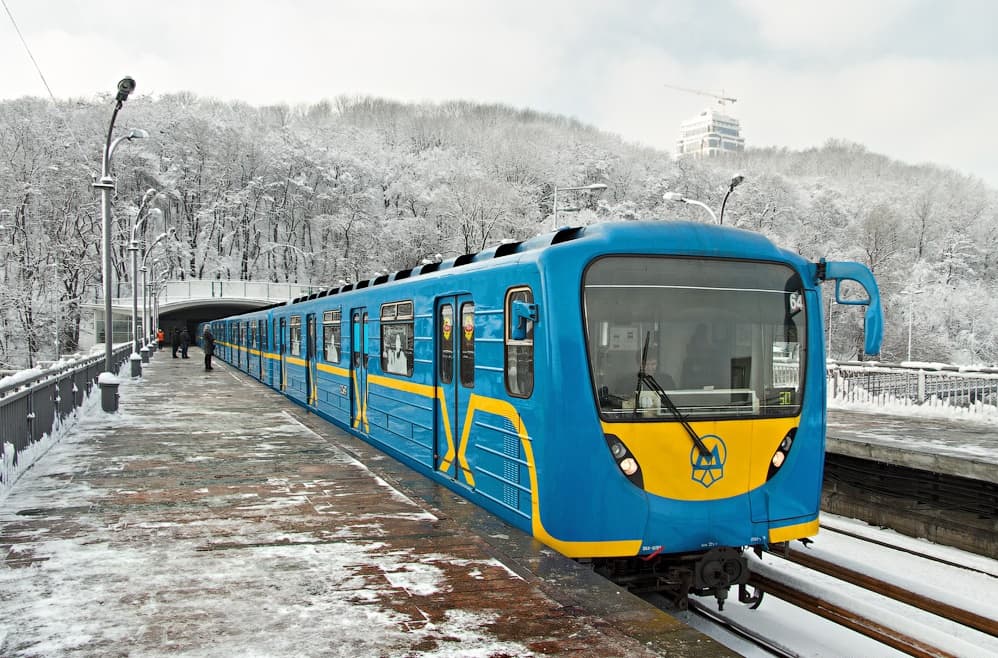
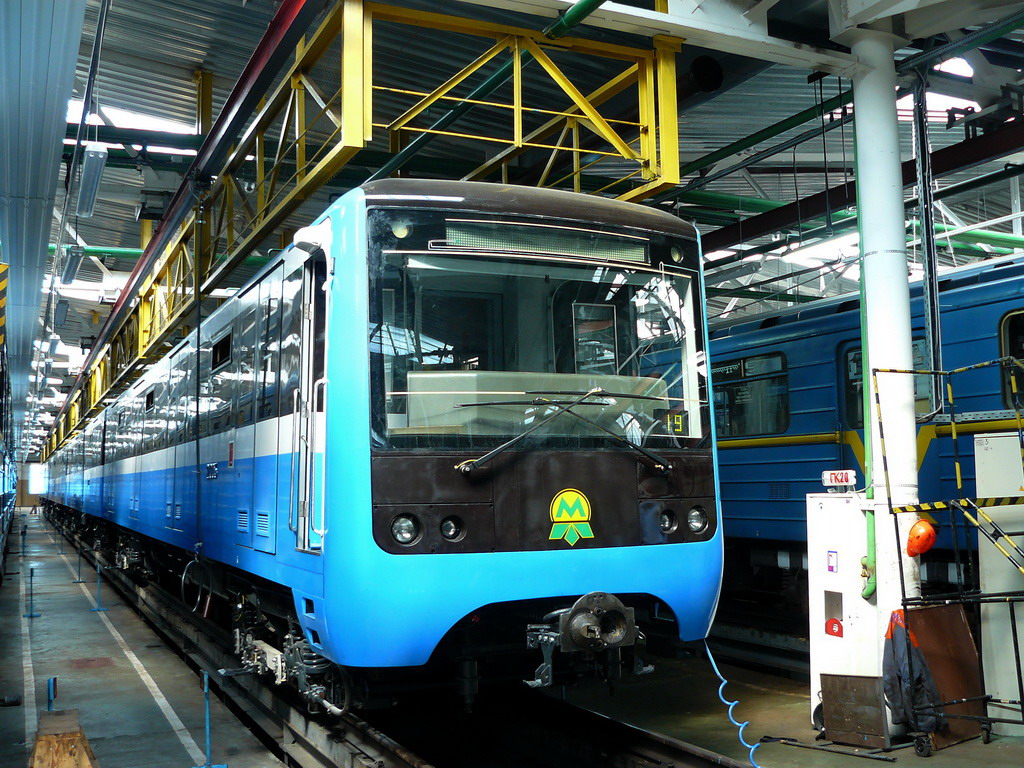
The Kyiv Metro is a rapid transit system in Kyiv, Ukraine, owned by the Kyiv City Council and operated by the city-owned company Kyivskyi Metropoliten. It was initially opened on 6 November 1960, as a single 5.24 km (3.26 mi) line with five stations. It was the first rapid transit system in Ukraine, and the third in the former Soviet Union, after the Moscow Metro and Leningrad Metro. It is one of the three metro systems in Ukraine, together with Kharkiv Metro and Dnipro Metro.
Today, the system consists of three lines and 52 stations, located throughout Kyiv's ten raion (districts), and operates 69.6 kilometers (43.2 mi) of routes, with 67.6 km (42.00 mi) used for revenue service and 2.048 km (1.27 mi) for non-revenue service. At 105.5 m (346 ft 1.5 in) below ground level, Arsenalna station on the Sviatoshynsko-Brovarska Line is the second deepest metro station in the world after Hongyancun station in Chongqing, China.
In 2016, annual ridership for the metro was 484.56 million passengers, or about 1.32 million passengers daily. The metro accounted for 46.7% of Kyiv's public transport load in 2014.
There are also Kyiv Light Rail (rapid tram) and Kyiv Urban Electric Train (commuter rail), which are not parts of Kyiv Metro and are run by different companies (Kyivpastrans and Ukrainian Railways respectively).
History
Beginnings (1884-1920)
The first idea for an underground railway appeared in 1884. The project, which was given for analysis to the city council by the director of the Southwestern railways, Dmytro Andrievskiy, planned to create tunnels from Kyiv-Pasazhyrskyi railway station. The tunnel was expected to start near Poshtova square and finish near Bessarabka. A new railway station was to be built there, while the old railway station was to be converted into a freight railway station. The project was long discussed but eventually turned down by the city council.
Kyiv was a pioneering city for Imperial Russian rapid transit, opening the first Russian tram system. In September 1916, businessmen of the Russo-American trading corporation attempted to collect funds to sponsor the construction of a metro in Kyiv. As a reason to construct it, the trading corporation wrote:
Reading level
Audio Summary
Played with your browser's voice. Studio-quality audio can be added with a text-to-speech service.
Ask about this article
📝 Quick Quiz1 / 3
What is "Kyiv Metro" primarily known for?
Vocix Daily — In Your Inbox
Top stories, deep-dive articles, and "On This Day" history — one crisp digest delivered every morning.
Sources & references
Reference material for this entry is drawn from the open encyclopedic record, including Wikipedia , available under the CC BY-SA 4.0 license. Images are credited individually beside each photo.
The development has been lately going at a fast pace, not only when talking about population growth, but as well while talking about the development of trade and industry businesses. The specifics of Kyiv, namely: the distance between the residential districts from the central business district, the insane price of the apartments in the centre and its neighbourhoods, the elongation and hilly position of the city, a predominantly commercial habit of its inhabitants - all those factors make the question of cheap, fast and safe transportation arise. The Kyiv city tram can't answer any of the issues. The tram's drawbacks are widely known, and the reason they appear is that, in the given conditions, the tram network development is not able to keep pace with the fast-growing city. An increase in rolling stock on the main lines may cause a slowdown in street movement, while an increase in speed threatens the safety of people. The only way out of the situation is the transfer from on-ground trams to underground trams, starting from the main streets.
Despite the arguments, the project was not accepted by the city council, again.
After the downfall of the Tsarist government, Hetman Skoropadsky was also interested in the building of a metro system, somewhere near the district of Zvirynets, where the government center was planned to be built. As one of the members of his cabinet argued:
[...] [The engineers] have an idea to construct trams, but not the ones [that ride] now, - those overground, and [those] in tunnels that are called "metropoliten" [underground]. The soil of Zvirynets and Kyiv as a whole, where the underground is to be built, is the best for this kind of construction. Under these circumstances, the underground may be even better placed than [the one] in Paris...
Kyiv is situated on the hills and ravines created by the nature itself, [so] the underground, appearing from the hill into the ravine, then again passing through the mountain, will transfer everyone and everything from Bessarabka to Demiivka, from Zvirynets to Lukianivka, from Naberezhna [ave.] or Prorizna [str.] to Zadniprovski Slobidky.
However, the project lost its support after the downfall of the Hetmanate in the autumn of 1918 and the change of the Ukrainian government towards the Directorate. Then, in 1919–1920, during the Russian Civil War (in which Ukraine was involved), the project was shelved for good.
Following the Bolsheviks' victory in the Russian Civil War, Kyiv became only a provincial city, and no large-scale proposals to improve the city were made.
Initial promotion (1936-1949)
In 1934, the capital of the Ukrainian SSR was moved from Kharkiv to Kyiv. On 9 July 1936, the Presidium of the Kyiv City Council assessed the diploma project by Papazov (Papazian), an Armenian graduate of the Moscow University of Transport Engineering, called, "The Project of the Kyiv Metro." The meeting minutes stated that "the author successfully resolved one of the problems of reconstruction of the city of Kyiv and establishment of intra-city transportation and also answered various practical questions about the Metro plan (the routes of the underground, the position of stations)." The engineer Papazov (Papazian) received a bonus of 1,000 Soviet rubles for this project from the City of Kyiv. However, it is unknown if his proposals were taken into account in the plan. A few days before, on 5 July, the Kyiv newspaper Bil'shovyk (Ukrainian) published an article that featured a project of underground, prepared by engineers from the Transport Devices Institute in Ukraine's Soviet Socialist Republic's Academy of Sciences. The project promised to consruct three lines of a Metro, approximately 50 km (31 mi) long.
Rumors started spreading that the construction of the Metro would begin soon. At first, the city council denied these rumors, amid letters from the specialists in the drilling and mining sectors offering their services. But in 1938, officials started preparatory work. However, this stopped abruptly in 1941 with the start of the Great Patriotic War (World War II). By the end of the war, Kyiv was destroyed. Being the third largest city in the USSR, a massive reconstruction process was ordered. This time, the Metro was taken into account.
Work continued in 1944, after Kyiv's liberation. On 5 August 1944, a resolution from the Soviet Union's Government was proclaimed. The resolution planned for underground construction, thus the government ordered the appropriate organizations to continue preparatory works, create a technical project, and estimate total costs. To finance this initial work, the USSR's National Commissariat of Finances allocated 1 million Soviet rubles from the Reserve Fund of the USSR's government. On 22 February 1945, another resolution was proclaimed, which definitively ordered the underground to be constructed.
To determine where the underground construction was most suitable, experts from the Kyiv Office of Metrogiprotrans analyzed the flow of passengers in the streets of Kyiv, both in the city center and in the outskirts. The analysis revealed three suitable directions to construct the underground: Sviatoshyn–Brovary, Kurenivka–Demiivka, and Syrets–Pechersk. The former two were chosen to be built. It was decided that the first section of underground openings along these two directions—30.4 km (18.9 mi) in length—would be constructed by 1950.
This plan, however, did not come to life. The final preparations were not conducted until 1949. By the decision of the Ministry of Communication, the Kyivmetrobud enterprise was established on 14 April. Only then did the underground construction finally begin.
First phase
Construction planning of the first line (M1) of the Kyiv Metro began in August 1949. The initial plan had seven stations, and a project design competition for the stations was announced in 1952. The competition commission wanted all seven stations to have a Stalinist style: richly decorated and adorned with Communist symbols and national (Ukrainian) motifs. However, the competition was cancelled, partly due to the cancellation of the two westernmost stations and partly due to Khrushchev Thaw, which made the Stalinist style inappropriate.
Tunnel drilling was frequently met with unanticipated difficulties—such as unexpected drilling terrain and underground water sources—causing the construction to fall severely behind schedule. In December 1951, the first connection between separate tunnels was made between Dnipro and Arsenalna stations, while the last was created between the Vokzalna and Universytet stations, in May 1959.
Various difficulties arose during the construction of the underground. For example, Arsenalna station was constantly flooded by underground waters despite its exceptional depth, which was originally intended to prevent flooding. Moreover, the project came to a standstill in 1954 when funding was instead allocated to the development of unused land fit for agriculture. Nevertheless, work progressed.At the beginning of 1958, a competition for the best design of stations was announced. A commission analyzing the works was created, consisting of activists, engineering and architecture experts from both the Ukrainian SSR and the USSR, sculptors, artists, writers, and the heads of the organizations Glavtunelstroy, Metrogiprotrans, and Kyivmetrobud. In July, an exhibition of 80 works was organized. The best five designs were used for the first five stations of the Kyiv Metro: Vokzalna, Universytet, Khreshchatyk, Arsenalna, and Dnipro.
During this construction, 660,400 m3 (23,321,805.9 cu ft) of concrete was poured, and 7,300 m2 (78,576.5 sq ft) of granite and marble were used to decorate the stations.
On 22 October 1960, a test run was made by Alexey Semagin, a motorman of the Moscow Metro, and Ivan Vynogradov, the former train operator from the central railway station of Kyiv-Pasazhyrskyi. Semagin drove, with Vynogradov acting as an assistant.
On 6 November 1960, the anniversary of the October Revolution, the five-station, 5.24 km (3.26 mi) Vokzalna–Dnipro portion of the east–west line (today known as the Sviatoshynsko-Brovarska Line) was opened. That day, the motormen changed their places, and thus Ivan Vynogragov has now been deemed the first motorman of the Kyiv Metro.
Opening and aftermath
The underground was not available to the public the same day the line was declared open. During the first week, special passes had to be shown to ride the newly opened section. True public service only started on 13 November. At the time, the stations had no turnstiles; the tickets were shown to the inspector.
Immediately after the Kyiv Metro's opening, the need for a train depot became a problem. It was not feasible to construct a permanent on-ground depot as the stations were deep underground. Yet the creation of an underground depot was costly. At first, it was solved by creating a temporary depot next to Dnipro station, where Kyivmetrobud had its headquarters at the time. There were some warehouses constructed as well so that necessary items could be substituted if needed. Unfortunately, this temporary depot was not connected to the main underground line. To move trains to the depot, an overhead crane was used.
Simultaneously, another logistics problem appeared: there was no connection between the underground and the railway. At the time, the metro line was served by type Д underground trains (produced by Metrowagonmash). To deliver them to the underground, the trains had to be placed on a special carriage at Darnytsia railway station. The carriage was then transported by trams (via the now non-existing tram line along the Dnipro river) to the temporary depot, where the trains were then lifted onto the railway turntable. Since the procedure was uncomfortable and tedious, most trains were stabled overnight in the tunnels and visited the depot only for maintenance.
At the time, the Kyiv Metro was under the jurisdiction of the USSR's Ministry of Communication, and not of Kyiv's city council. Until 1962, the motormen were mostly from Moscow, as no institution provided appropriate training in Ukraine. Some Kyiv railway engineers were employed (such as Vynogragov), but they had to qualify as motormen in Moscow.
Extension of the first line
The second stage of construction of the first line started in 1960, and finished on 5 November 1963, with the opening of a 3.4 km (2.1 mi) section with two stations: Politekhnichnyi Instytut and Zavod Bilshovyk (now Shuliavska station). A year later, new type E underground trains were introduced.
In 1965, the line crossed the Dnieper river on the newly constructed Kyiv Metro Bridge and Rusanivskyi Metropolitan Bridge and was extended to the large residential areas being built along the east bank of the river. Like the Dnipro station, Hidropark, Livoberezhna, and Darnytsia stations all were built on-ground. Additionally, to resolve the question of a temporary depot, a permanent depot (Darnytsia Metro Depot) was built between Livoberezhna and Darnytsia stations; importantly, it had access to Kyiv-Dniprovskyi railway station. New trains could now be easily transported immediately into the depot, which, having a connection with the metro line, could also easily host trains.
A few developments were made to the old stations. Since Khreshchatyk station was opened with only one exit, a second one was built and opened on 4 September 1965. A third exit was finished in May 1970. While being modernized, the station was lengthened by 40 meters.
Further extension of the first line to the east was made in 1968, when Komsomolska station (now Chernihivska station) was opened, along with another facility where the trains could be repaired.
When it was discovered that Leningrad's Metro E-type underground trains were not suitable for the platform screen doors of new stations under construction, they were delivered to Kyiv in 1969; meanwhile, Kyiv's older D-type trains, which did not have any problems with these new stations, were transported to Leningrad.
In 1970, an additional carriage was added to every train, for a total of four. A fifth was added two years later. Since 1972, the number of carriages has remained constant (as of 4 July 2017).
On 5 November 1971, Kyiv's then-westernmost neighborhoods were connected to the metro. Three new stations were opened: Zhovtneva (now Beresteiska), Nyvky, and Sviatoshyno (now with the "o" removed). Thus, the metro was extended to 14 stations and a length of 18.2 km (11.3 mi).
On 23 August 1972, the billionth passenger of the Kyiv Metro entered Arsenalna station. The worker of the "Arsenal" factory was given a yearly ticket for the Metro as commemoration of the event.
Finally, in 1973–1974, another modernization of the Metro was made, the third to the rolling stock. New type Eм underground trains from Leningrad's train building facility were delivered to Kyiv.
Further extensions on this line occurred in 1978 (with Pionerska station, now Lisova) and 2003 (with Zhytomyrska and Akademmistechko stations).
Second line
Construction of the second line (M2) began in 1971. The line became known as "Kurenivsko-Chervonoarmiyska"; however, the name did not completely correspond to the actual route, as it does not pass via Kurenivka. In mid-1960, when plans for the line were made, the construction was expected to go towards Kurenivka and Priorka, connecting Zavodska station (instead of today's Tarasa Shevchenka), Petropavlivska station near Kurenivskyi park, and Shevhenka Square station under the square. However, as the decision to create the Obolon residential district was made, these plans changed.
The new line was constructed in the open and its stations were not constructed deep underground. Because of this, historical buildings were demolished in the Podil neighborhood. During construction, archaeologists discovered a 600–700 m2 (6,500–7,500 sq ft) house dated from Kyivs'ka Rus' (879–1240) under the Red Square (now Kontraktova Square). The discovery helped historians understand the life of Podil inhabitants in the Middle Ages at a much more profound scale. This archaeological research was one of the reasons the underground construction was suspended, which is why the small 2.32 km (1.44 mi) stretch was opened only on 17 December 1976. It contained three stations: Kalinina Square (later renamed to Ploshcha Zhovtnevoi Revolutsii (lit. 'October Revolution Square') on 17 October 1977 for the upcoming 60th anniversary of the October Revolution; now Maidan Nezalezhnosti), Poshtova Ploshcha, and Chervona Ploshcha. Additionally, there was a repair facility near Chervona Ploshcha and a transfer corridor to the older (M1) line, separate for trains and passengers. This corridor allowed the exchange of rolling stock, and more importantly, allowed trains on the new line to access the Darnytsia depot until a new one appeared in 1988.
Simultaneously, an extension on the first line was made eastward. In 1978, Pionerska station was opened, which might have been the next step towards the realization of Stalin times projects (the line was planned to be extended to Brovary, the satellite town of Kyiv). Nevertheless, construction on the first line came to a halt, and, as of 4 July 2017, there were no plans yet to extend the line eastwards beyond Lisova station, so construction efforts were shifted to the second line.
The second line—which became known as the Kurenivsko-Chervonoarmiyska line (today the Obolonsko–Teremkivska line)—continued expanding. On 19 December 1980, three new stations—Tarasa Shevchenka, Petrivka (now Pochaina station), and Prospekt Korniychuka (now Obolon station)—were opened on the northern part of the line. After another two years, the Minska and Heroiv Dnipra stations were added to the second line, on the 55th anniversary of the October Revolution. This connected the then-largest residential district of Kyiv to the rapid transit network.
Construction did not stop at the southern end of the line. Ploshcha Lva Tolstoho and Respublikanskyi Stadion (now Olimpiiska station) were opened on 19 December 1981, followed by Chervonoarmiiska (now Palats "Ukrayina" station) and Dzerzhynska (now Lybidska station) on 30 December 1984. Construction then started to the southwest of the newly opened terminus but was soon interrupted by an accident while workers were drilling through the difficult terrain under the Lybid river. Further work only continued 21 years later, in the summer of 2005.
Infrastructure development
In 1980, while the construction of the M2 line was at its height, the new rolling stock from Metrowagonmash (81-717/714) started to be used.
In 1985, a new train repair plant was built, first called ОМ-2. Additionally, once it appeared that the corridor between October Revolution Square and Khreshchatyk was not able to cope with the stream of passengers, a second corridor was built (informally called the "long" corridor), opening on 3 December 1986. The same year, disambiguation to the Darnytsia depot was made (three tracks were made, of which two are for passenger traffic, while the third was supposed to let the trains exit the depot).
On 30 December 1987, the second (eastern) exit from the Hydropark station was built and opened only in summer.
Lastly, on 19 March 1988, a new depot (called the Obolon Depot) was created to serve the M2 line.
Third line
Soviet period
The first event connected with the construction of the third line (M3) was the creation of a new tunnel on the M1 line between the Vokzalna and Khreshchatyk stations. In the middle of it, a new station, Leninska, was to arise, specially designed as a transfer hub to the future M3 line. When the new tunnel was ready to be connected to the rest of the line, service in the old M1 tunnel between Vokzalna and Khreshchatyk was interrupted from 31 March to 1 October 1987. During this time, two shuttle trains carried passengers from Vokzalna to Universytet stations, and the tunnel between Universytet and Khreshchatyk was closed. To manage passengers, additional temporary lines of buses and trolleybuses were created. The Leninska station itself was inaugurated on the 70th anniversary of the October Revolution, on 6 November 1987, and is now known as Teatralna station.
The older tunnels, over 300 m (980 ft) each, partially cut by the ceiling of the Zoloti Vorota station, still exist and are now accessible only for maintenance by staff.
Construction of the third line (called the Syretsko-Pecherska Line, the northwest–southeast axis) started in 1981. The initial 2.1 km (1.3 mi) segment was finished on 31 December 1989 and featured three stations: Zoloti Vorota, Palats Sportu, and Mechnikova (now Klovska). The first two were transfer hubs to other lines; the third was the start of a technical tunnel between lines M2 and M3, which allowed trains from the M3 line to use the Obolon depot on the M2 line. Until 30 April 1990, the exit from Zoloti Vorota station (the then-northern terminus of M3) was only possible via Leninska station. An exit from Zoloti Vorota onto Volodymyrska Street was only opened on 1 May 1990.