
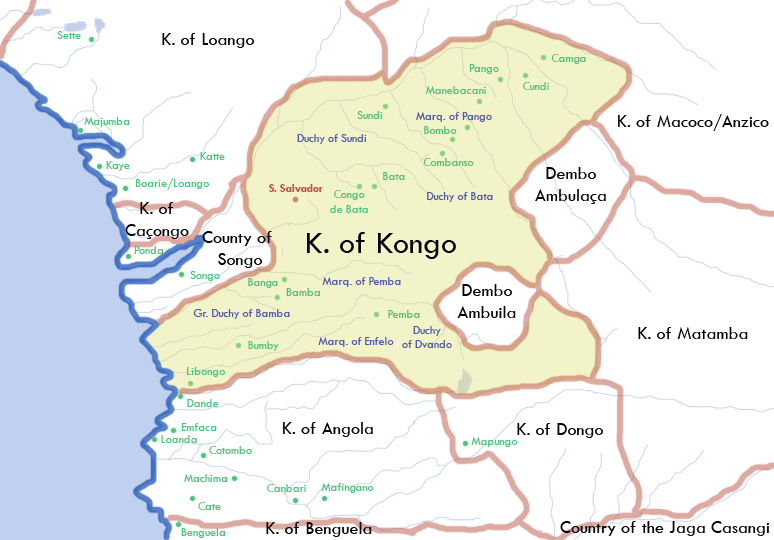
The Kingdom of Kongo (Kongo: Kongo Dya Ntotila or Wene wa Kongo; Portuguese: Reino do Congo; Latin: Regnum Congo) was a kingdom in Central Africa. It was located in present-day northern Angola, the western portion of the Democratic Republic of the Congo, southern Gabon and the Republic of the Congo. At its greatest extent it reached from the Atlantic Ocean in the west to the Kwango River in the east, and from the Congo River in the north to the Kwanza River in the south. The kingdom consisted of several core provinces ruled by the Manikongo, the Portuguese version of the Kongo title Mwene Kongo, meaning "lord or ruler of the Kongo kingdom", and its sphere of influence extended to neighbouring kingdoms, such as Ngoyo, Kakongo, Loango, Ndongo, and Matamba, the latter two located in what became Angola.
From c. 1390 to 1862, it was an independent state. From 1862 to 1914, it functioned intermittently as a vassal state of the Kingdom of Portugal. In 1914, following the Portuguese suppression of a Kongo revolt, Portugal abolished the titular monarchy. The title of King of Kongo was restored from 1915 until 1975, as an honorific without real power. The remaining territories of the kingdom were assimilated into the colony of Portuguese Angola and the Independent State of the Congo respectively. The modern-day Bundu dia Kongo sect favours reviving the kingdom through secession from Angola, the Republic of the Congo, and the Democratic Republic of the Congo.
History
Oral traditions about the early history of the country were set in writing for the first time in the late 16th century. Especially detailed versions were recorded in the mid-17th century, which include those written by the Italian Capuchin missionary Giovanni Cavazzi da Montecuccolo. Traditions about the foundation changed over time, depending on historical circumstances.

Modern research into oral tradition, including recording them in writing began in the 1910s with Mpetelo Boka and Lievan Sakala Boku writing in KiKongo, and extended by Redemptorist missionaries like Jean Cuvelier and Joséph de Munck. In 1934, Cuvelier published a KiKongo language summary of these traditions in Nkutama a mvila za makanda. Although Cuvelier and other scholars contended that these traditions applied to the earliest period of Kongo's history, it is more likely that they relate primarily to local traditions of clans (makanda) and especially to the period following 1750.
Foundation
By the 13th century there were three main federations of states in the western Congo Basin. In the east were the Seven Kingdoms of Kongo dia Nlaza, considered to be the oldest and most powerful, which likely included Nsundi, Mbata, Mpangu, and possibly Kundi and Okanga. South of these was Mpemba. It included various kingdoms such as Mpemba Kasi and Vunda. To its west across the Congo River was a confederation of three small states; Vungu (its leader), Kakongo, and Ngoyo.
According to Kongo tradition in the seventeenth century, the kingdom's origin was in Vungu, which had extended its authority across the Congo to Mpemba Kasi, which was itself the northernmost territory of Mpemba, whose capital was located about 150 miles south. A dynasty of rulers from this small polity built up its rule along the Kwilu Valley, or what was called Nsi a Kwilu, and its elite are buried near its centre. Traditions from the 17th century allude to this sacred burial ground. According to the missionary Girolamo da Montesarchio, an Italian Capuchin who visited the area from 1650 to 1652, the site was so holy that looking upon it was deadly. These rocks may be the rugged uplands of Lovo where there is extensive cave and rock art that dates from at least the fifteenth century.

The Kingdom of Kongo was founded around 1390 through the political marriage between the two KiKongo speaking peoples; Nima a Nzima, ruler of the Mpemba Kasi and Vungu, and Lukeni lua Nsanze ("Luqueni Luansanze"), daughter of Nsaku lau, the ruler of the neighbouring Mbata Kingdom. At some point around 1375, Nimi a Nzima started this alliance with Nsaku lau. This marital alliance guaranteed that each of the two allies would help ensure the succession of its ally's lineage in the other's territory. Mbata in turn was a former province of the Seven Kingdoms of Kongo dia Nlaza, whose capital lay farther east along the current border of Angola and Democratic Republic of Congo. Mbata may have been the senior partner in the original alliance, as he had the title of "Nkaka andi a Mwene Kongo," or grandfather of the king of Kongo.
Nimi a Nzima and Lukeni lua Nsanze's son, Lukeni lua Nimi (circa 1380–1420), began the expansion that would found the Kingdom of Kongo. Lukeni lua Nimi led expansion southward into lands ruled by Mpemba. He established a new base on the mountain Mongo dia Kongo and made alliances with the Mwene Mpangala, ruler of a market town then loyal to Mpemba and also with the Mwene Kabunga whose lands lay west of there of uncertain loyalty and the site of a shrine. Two centuries later the Mwene Kabunga's descendants still symbolically challenged the conquest in an annual celebration. He furthered this with a second more important alliance with Vunda, another of Mpemba's subordinate rulers. To cement this alliance, as with the one with Mbata, Lukeni lua Nimi allowed him to be an elector to the kingdom.
After the death of Lukeni lua Nimi, the rulers that followed Lukeni claimed relation to his kanda (lineage), and were known as the Kilukeni. The Kilukeni kanda — or "house", as it was recorded in Portuguese language documents written in Kongo — ruled Kongo unopposed until 1567.

Expansion and early development
The 16th-century tradition said that the former kingdoms "in ancient times had separate kings, but now all are subjects and tributaries of the king of Congo." Tradition noted that in each case the governorship was given to members of the royal family or other noble families. Governors who served terms determined by the king had the right to appoint their own clients to lower positions, down to villages who had their own locally chosen leadership. As this centralisation increased, the allied provinces gradually lost influence until their powers were only symbolic, manifested in Mbata, once a co-kingdom, and by 1620 simply known by the title "Grandfather of the King of Kongo" (Nkaka'ndi a Mwene Kongo).
The kingdom of the Kongo's early campaigns of expansion brought new populations under the kingdom's control and produced many war captives. Starting in the 14th century (and reaching its height in the 17th century), the kings of the Kongo forcibly relocated captured peoples to the royal capital at M'banza-Kongo. The resulting high concentration of population around M'banza-Kongo and its outskirts played a critical role in the centralisation of Kongo. The capital was a densely settled area in an otherwise sparsely populated region where rural population densities probably did not exceed 5 persons per km2. Early Portuguese travellers described M'banza-Kongo as a large city, the size of the Portuguese town of Évora as it was in 1491. By the end of the sixteenth century, Kongo's population was probably over half a million people in a core region of some 130,000 square kilometres. By the early seventeenth century the city and its hinterland had a population of around 100,000, or nearly one out of every six inhabitants in the Kingdom (according to baptismal statistics compiled by a Jesuit priest in 1623), while the kingdom as a whole numbered some 780,000.
The concentration of population, economic activity, and political power in M'banza-Kongo strengthened the Kongolese monarchy and allowed for a centralised government. Captives taken in war were enslaved and integrated into the local population, producing a food and labour surplus, while rural regions of the kingdom paid taxes in the form of goods the capital could not produce itself. A class of urban nobility developed in the capital, and their demand for positions at court and consumer goods fuelled the kingdom's economy. Rural development was intentionally discouraged by the Kongolese king, ensuring the capital remained the economic and political centre of the kingdom. This concentration allowed resources, soldiers and surplus foodstuffs to be readily available at the request of the king and made the king overwhelmingly powerful when compared to any potential rival.

Contact with Portugal and Christianisation
In 1483, the Portuguese explorer Diogo Cão reached the coast of the Kongo Kingdom. Cão left some of his men in Kongo and took Kongo nobles to Portugal. He returned to Kongo with the Kongo nobles in 1485; such commissioning, hiring, or even kidnapping of local Africans to use as local ambassadors, especially for newly contacted areas, was by then an already established practice. At that point the ruling king, Nzinga a Nkuwu, decided he would become Christian and sent another, large mission headed by Kala ka Mfusu, the noble who had earlier gone to Portugal as a hostage. They remained in Europe for nearly four years, studying Christianity and learning reading and writing. The mission returned with Cão, who was accompanied with Catholic priests and soldiers in 1491, baptising Nzinga a Nkuwu, who took the Christian name of João I in honour of Portugal's king at the time, João II. Moreover, the king's principal nobles. starting with the ruler of Soyo, the coastal province, were baptised as well.
However, one of the key obstacles in this conversion was the issue of monogamy. While Catholic writers saw Kongolese resistance to this as grounded in lust and sin, the reasons for resistance were in fact, fundamental to Kongolese social structure. Ann Hilton notes that polygamy was deeply embedded in the system of state formation through marriage and household alliances of the kanda. Thus, tampering with polygamy threatened to de-stabilise the social and political world of Kongo. Therefore, upon the death of João I in 1506, a conflict arose between conservatives who preferred the Kongolese faith and the Catholic bloc led by Afonso I. After Afonso's triumph against his half brother, Mpanzu a Kitima, in 1509, Catholicism became the state cult for the ruling Mwissikongo.
According to Afonso's own account, he was able to win the battle thanks to the intervention of a heavenly vision of the cross of Saint James and the Virgin Mary. Inspired by these events, he subsequently designed a coat of arms for Kongo that was used by all following kings on official documents, royal paraphernalia and the like until 1860.
Reign of Afonso I
Upon his ascension as king in 1509, Afonso I worked to create a viable version of the Catholic Church in Kongo, providing for its income from royal assets and taxation that provided salaries for its workers. With advisers from Portugal such as Rui d'Aguiar, the Portuguese royal chaplain sent to assist Kongo's religious development, Afonso created a syncretic version of Christianity that would remain a part of its culture for the rest of the kingdom's independent existence. King Afonso himself studied hard at this task. Rui d'Aguiar once said Afonso I knew more of the church's tenets than he did.
The Kongo church was always short of ordained clergy and made up for it by the employment of a strong laity. Kongolese school teachers or mestres (KiKongo alongi a aleke) were the anchor of this system. Recruited from the nobility and trained in the kingdom's schools, they provided religious instruction and services to others building upon Kongo's growing Christian population. At the same time, they permitted the growth of syncretic forms of Christianity which incorporated older religious ideas with Christian ones. Examples of this are the introduction of KiKongo words to translate Christian concepts. The KiKongo words ukisi (an abstract word meaning charm, which used to mean "holy") and nkanda (meaning book) were merged so that the Christian Bible became known as the nkanda ukisi (holy book). The church became known as the nzo a ukisi (holy house). Some European clergy denounced these mixed traditions without being able to root them out.
Part of the establishment of this church was the creation of a strong priesthood and to this end, Afonso's son Henrique was sent to Europe to be educated. Henrique became an ordained priest and in 1518 was named as titular bishop of Utica (a North African diocese recently reclaimed from the Muslims). He returned to Kongo in the early 1520s to run Kongo's new church. He died in 1531.

Expansion of the slave trade
Slavery had existed since the Kingdom of Kongo's founding, as during its early wars of expansion the nascent kingdom had taken many captives. Kongo's tradition of forcibly transferring peoples captured in wars to the royal capital was key to the power of the Kongolese king, and it was the same mechanism of enslavement and transfer of population that made Kongo an efficient exporter of slaves. Kongolese laws and cultural traditions protected freeborn Kongolese from enslavement, and so most of the enslaved population were war captives. Convicted Kongolese criminals could also be forced into slavery, and were initially protected from sale outside the kingdom. The export of female slaves was also prohibited. Afonso's early letters show evidence of domestic slave markets.
As relations between Kongo and Portugal grew in the early 16th century, trade between the kingdoms also increased. Most of the trade was in palm cloth, copper, and ivory, with increasing numbers of slaves. Although initially Kongo exported few slaves, following the development of a successful sugar-growing colony on the Portuguese island of São Tomé, Kongo became a major source of slaves for the island's traders and plantations. The Cantino Atlas of 1502 mentioned Kongo as a source of slaves for the São Tomé colony, and said they were few. Correspondence by Afonso also show the purchase and sale of slaves within the country and his accounts on capturing slaves in war which were given and sold to Portuguese merchants.
Afonso continued to expand the kingdom of Kongo into the 1540s, expanding its borders to the south and east. The expansion of Kongo's population, coupled with his earlier religious reforms, allowed Afonso to centralise power in his capital and increase the power of the monarchy. He also established a royal monopoly on some trade. To govern the growing slave trade, Afonso and several Portuguese kings claimed a joint monopoly on the external slave trade.
However, as the slave trade grew in size, it came to gradually erode royal power in Kongo. Portuguese traders based in São Tomé began violating the royal monopoly on the slave trade, trading instead with other African states in the region. Portuguese merchants also began to trade goods with powerful Kongolese nobles, depriving the monarchy of tax revenue, while Portuguese priests and merchants living in the Kongo became increasingly politically active. New markets for slaves such as Mpanzalumbu (a rebel Kongolese province conquered by Afonso in 1526) and the Mbundu Kingdom of Ndongo also rivalled the Kongolese monopoly on the slave trade.
In 1526, Afonso complained in correspondence to King João III of Portugal about the merchants' violation of his end of the monopoly, claiming that Portuguese officials had not regulated them sufficiently, and threatened to stop the slave trade altogether. Afonso noted that some unscrupulous nobles were resorting to kidnapping their fellow Kongolese to supply the slave trade. To reform the trade, Afonso reiterated the need to follow Kongolese law and not enslave Kongolese freemen, while also establishing a board to better regulate the slave trade. Afonso also established a special committee to determine the legality of the enslavement of those who were being sold.
However, the kings of Portugal eventually determined the best way to deal with the trade through the Kwanza to Ndongo was to establish their own base there. In 1560, again responding to a request from Angola, the Portuguese crown sent Paulo Dias de Novais as ambassador to Ndongo with the idea of settling relations with the country. Ngola Kiluanji was not interested in this mission, however, as it offered only baptism and diplomatic relations, while he hoped for military support. In 1575, Portugal would follow with a mission of conquest, also under Paulo Dias de Novais, this time to conquer the country and monopolise its slave trade.
Royal rivalries
King Diogo I skilfully replaced or outmanoeuvred his entrenched competitors after he was crowned in 1545. He faced a major conspiracy led by Pedro I, who had taken refuge in a church, and whom Diogo in respect of the Church's rule of asylum allowed to remain in the church. However, Diogo did conduct an inquiry into the plot, the text of which was sent to Portugal in 1552 which shows the way in which plotters hoped to overthrow the king by enticing his supporters to abandon him.
Kongo under the House of Kwilu
Álvaro I was not directly descended from a previous king, and so his seizure of the throne in the midst of the crisis caused by the 1568 Jaga invasion marked the beginning of a new royal line, the House of Kwilu. There were certainly factions that opposed him, though it is not known specifically who they were.
Álvaro's rule began in war with the Jagas, who may have been external invaders or rebels from within the country, either peasants or nobles from rival factions fighting against the profound changes and instability introduced by European trading and slaving. As the Jagas drove him from the capital to refuge on an island in the Congo River, Álvaro appealed to Portugal for aid, and was sent an expedition under Francisco de Gouveia Sottomaior, governor of São Tomé. As a part of the same process, Álvaro agreed to allow the Portuguese to establish a colony in Luanda, the source of the nzimbu shell money used by the kingdom. In addition, Kongo provided the Portuguese with support in their war against the Kingdom of Ndongo in 1579. Ndongo was located inland, east of Luanda and although claimed in Kongo's royal titles as early as 1535, was probably never under a firm Kongo administration.
Álvaro also worked hard to westernise Kongo, gradually introducing European style titles for his nobles, so that the Mwene Nsundi became the Duke of Nsundi; the Mwene Mbamba became the Duke of Mbamba. The Mwene Mpemba became Marquis of Mpemba, and the Mwene Soyo became Count of Soyo. In 1607, he and his son Álvaro II ("Nimi a Nkanga", crowned in 1587) bestowed orders of chivalry called the Order of Christ. The capital was also renamed São Salvador or "Holy Savior" in Portuguese during this period. In 1596, Álvaro's emissaries to Rome persuaded the Pope to recognise São Salvador as the cathedral of a new diocese which would include Kongo and the Portuguese territory in Angola. However, the king of Portugal won the right to nominate the bishops to this see, which became a source of tension between the two countries.
Portuguese bishops in the kingdom were often favourable to European interests in a time when relations between Kongo and Angola were tense. They refused to appoint priests, forcing Kongo to rely more and more heavily on the laity. Documents of the time show that lay teachers (called mestres in Portuguese-language documents) were paid salaries and appointed by the crown, and at times Kongo kings withheld income and services to the bishops and their supporters (a tactic called "country excommunication"). Controlling revenue was vital for Kongo's kings since even Jesuit missionaries were paid salaries from the royal exchequer.
At the same time as this ecclesiastical problem developed, the governors of Angola began to extend their campaigns into areas that Kongo regarded as firmly under its sovereignty. This included the region around Nambu a Ngongo, which Governor João Furtado attacked in the mid-1590s during the battle of Mbumbi. Other campaigns in the vicinity led to denunciations by the rulers of Kongo against these violations of their sovereignty.
Factionalism
Álvaro I and his successor, Álvaro II, also faced problems with factional rivals from families that had been displaced from succession. In order to raise support against some enemies, they had to make concessions to others. One of the most important of these concessions was allowing Manuel, the Count of Soyo, to hold office for many years beginning some time before 1591. During this same period, Álvaro II made a similar concession to António da Silva, the Duke of Mbamba. António da Silva was strong enough to decide the succession of the kingdom, selecting Bernardo II in 1614, then putting him aside in favour of Álvaro III in 1615. It was only with difficulty that Álvaro III was able to put his own choice in as Duke of Mbamba when António da Silva died in 1620 instead of having the province fall into the hands of the duke's son. At the same time, however, Álvaro III created another powerful and semi-independent nobleman in Manuel Jordão, who held Nsundi for him.
By the mid-1600s, the wars of expansion came to an end, stopping the supply of foreign captives. Thus, the demand for slaves could no longer be met. This caused the kingdom to begin exporting freeborn Kongos. Any Kongo convicted of crimes such as theft, rebellion, slander, treason, fornication, and witchcraft was condemned to lifelong slavery, along with their family. Thus, they could be sold to Europeans. If several villagers were found guilty of a crime, the whole village could be enslaved. If a governor misbehaved, their province could be raided by the central government, with some of its inhabitants condemned to slavery. By 1645, a tax existed requiring each household to pay in the form of slaves, at the rate of one slave per year. This was used to pay nobles and elite persons working for the king.
Kongo under the House of Nsundi
Tensions between Portugal and Kongo increased further as the governors of Portuguese Angola became more aggressive. Luis Mendes de Vasconcelos, who arrived as governor in 1617, used mercenary African groups called Imbangala to make a devastating war on Ndongo, and then to raid and pillage some southern Kongo provinces. He was particularly interested in the province of Kasanze, a marshy region that lay just north of Luanda. Many slaves being deported through Luanda fled into this region and were often granted sanctuary, and for this reason, Mendes de Vasconcelos decided that a determined action was needed to stop it. The next governor of Angola, João Correia de Sousa, used the Imbangala to launch a full-scale invasion of southern Kongo in 1622, following the death of Álvaro III. Correia de Sousa claimed he had the right to choose the king of Kongo. He was also upset that the Kongolese electors chose Pedro II, a former Duke of Mbamba. Pedro II was originally from the duchy of Nsundi, hence the name of the royal house he created, the House of Nsundi. Correia de Sousa also contended that Pedro II had sheltered runaway slaves from Angola during the latter's governorship of Mbamba and therefore, had these captives sent to Brazil as slaves.
First Kongo-Portuguese War
The First Kongo-Portuguese War began in 1622, initially because of a Portuguese campaign against the Kasanze Kingdom, which was conducted ruthlessly. From there, the army moved to Nambu a Ngongo, whose ruler, Pedro Afonso, was held to be sheltering runaway slaves as well. Although Pedro Afonso, facing an overwhelming army of over 20,000, agreed to return some runaways, the army attacked his country and killed him.
Following its success in Nambu a Ngongo, the Portuguese army advanced into Mbamba in November. The Portuguese forces scored a victory at the Battle of Mbumbi. There they faced a quickly gathered local force led by the new Duke of Mbamba, and reinforced by forces from Mpemba led by its marquis. Both the Duke of Mbamba and the Marquis of Mpemba were killed in the battle. According to Esikongo accounts, they were eaten by the Imbangala allies of the Portuguese. However, Pedro II, the newly crowned king of Kongo, brought the main army, including troops from Soyo, down into Mbamba and decisively defeated the Portuguese, driving them from the country at a battle waged somewhere near Mbanda Kasi in January 1623. Portuguese residents of Kongo, frightened by the consequences for their business of the invasion, wrote a hostile letter to Correia de Sousa, denouncing his invasion.
Following the defeat of the Portuguese at Mbanda Kasi, Pedro II declared Angola an official enemy. The king then wrote letters denouncing Correia de Sousa to the King of Spain and the Pope. Meanwhile, anti-Portuguese riots broke out all over the kingdom and threatened its long-established merchant community. Portuguese throughout the country were humiliatingly disarmed and even forced to give up their clothes. Pedro, anxious not to alienate the Portuguese merchant community, and aware that they had generally remained loyal during the war, did as much as he could to preserve their lives and property, leading some of his detractors to call him "king of Portuguese".
As a result of Kongo's victory, the Portuguese merchant community of Luanda revolted against the governor, hoping to preserve their ties with the king. Backed by the Jesuits, who had also just recommenced their mission there, they forced João Correia de Sousa to resign and flee the country. The interim government that followed the departure was led by the bishop of Angola. They were very conciliatory to Kongo and agreed to return over a thousand of the slaves captured by Correia de Sousa, especially the lesser nobles captured at the Battle of Mbumbi.
Regardless of the overtures of the new government in Angola, Pedro II had not forgotten the invasion and planned to remove the Portuguese from the realm altogether. The king sent a letter to the Dutch Estates General proposing a joint military attack on Angola with a Kongo army and a Dutch fleet. He would pay the Dutch with gold, silver, and ivory for their efforts. As planned, a Dutch fleet under the command of the celebrated admiral Piet Hein arrived in Luanda to carry out an attack in 1624. The plan failed to come to fruition as by then Pedro had died and his son Garcia I ("Mvemba a Nkanga") was elected king. King Garcia I was more forgiving of the Portuguese and had been successfully persuaded by their various gestures of conciliation. He was unwilling to press the attack on Angola at that time, contending that as a Catholic, he could not ally with non-Catholics to attack the city.
Factionalism and return of the House of Kwilu
The end of the first quarter of the 17th century saw a new flare-up in Kongo's political struggle. At the heart of the conflict were two noble houses fighting over the kingship. On one side of the conflict was the House of Kwilu, which counted most of the kings named Álvaro. They were ousted by the opposing House of Nsundi, when Pedro II was placed on the throne by powerful local forces in São Salvador, probably as a compromise when Álvaro III died without an heir old enough to rule.
As the reigning power, the House of Nsundi worked earnestly to place partisans in king-making positions throughout the empire. Either Pedro II or Garcia I managed to secure Soyo in the hands of Count Paulo, who held it and supported the House of Nsundi from about 1625 until 1641. Meanwhile, Manuel Jordão, a partisan of the House of Kwilu, managed to force Garcia I to flee and placed Ambrósio I of the House of Kwilu on the throne.
King Ambrósio either could not or did not remove Paulo from Soyo, though he did eventually remove Jordão. After a rule marked by rumours of war mobilisations and other disruptions, a great riot at the capital resulted in the death of the king by a mob. Ambrosio was replaced with Álvaro IV by the Duke of Mbamba, Daniel da Silva. King Álvaro IV was only eleven at the time and easily manipulated. In 1632, Daniel da Silva marched on the capital in order to "rescue his nephew from his enemies". At the time, he was under the protection of the Count of Soyo, Paulo, Álvaro VI ("Nimi a Lukeni a Nzenze a Ntumba") and his brother Garcia II ("Nkanga a Lukeni"). After a dramatic battle in Soyo, the young king was successfully restored only to be later poisoned by Álvaro V, a Kimpanzu.
Kongo under the House of Kinlaza
After waging a second war against his cousins, Álvaro VI and Garcia II, Álvaro V was killed, and replaced by Álvaro VI in 1636, initiating the House of Kinlaza's rule over Kongo. Following his death in 1641, Álvaro VI's brother took over, and was crowned Garcia II. The former House of Nsundi was consolidated with their House of Kwilu rivals as the Kimpanzu lineage of the dead Álvaro V.
Garcia II took the throne on the eve of several crises. One of his rivals, Daniel da Silva (who probably received the patronage of the Daniel da Silva who was killed by Garcia II while defending Álvaro IV), managed to secure the County of Soyo and used it as a base against Garcia II for the whole of his reign. As a result, Garcia II was prevented from completely consolidating his authority. Another problem facing King Garcia II was a rebellion in the Dembos region, which also threatened his authority. Lastly, there was the agreement made by Pedro II in 1622, promising Kongo's support to the Dutch in an offensive to oust Portugal from Luanda.
Dutch invasion of Luanda, and the Second Portuguese War
In 1641, the Dutch invaded Angola and captured Luanda, after an almost bloodless struggle. They immediately sought to renew their alliance with Kongo, which had had a false start in 1624, when Garcia I refused to assist a Dutch attack on Luanda. While relations between São Salvador and Luanda were not warm, the two polities had enjoyed an easy peace, due to the former's internal distractions, and the latter's war against the Kingdom of Matamba. The same year of the Portuguese ouster from Luanda, Kongo entered into a formal agreement with the new government, and agreed to provide military assistance as needed. Garcia II ejected nearly all Portuguese and Luso-African merchants from his kingdom. The colony of Angola was declared an enemy once again, and the Duke of Mbamba was sent with an army to assist the Dutch. The Dutch also provided Kongo with military assistance, in exchange for payment in slaves.
In 1642, the Dutch sent troops to help Garcia II put down an uprising by peoples of the southern district in the Dembos region. The government quickly put down the Nsala rebellion, reaffirming the Kongo-Dutch alliance. King Garcia II paid the Dutch for their services in slaves taken from ranks of Dembos rebels. These slaves were sent to Pernambuco in Brazil, where the Dutch had taken over a portion of the Portuguese sugar-producing region. A Dutch-Kongo force attacked Portuguese bases on the Bengo River in 1643 in retaliation for Portuguese harassment. The Dutch captured Portuguese positions and forced their rivals to withdraw to Dutch forts on the Kwanza River at Muxima and Masangano. Following this victory, the Dutch once again appeared to lose interest in conquering the colony of Angola.
As in their conquest of Pernambuco in Brazil, the Dutch West India Company (WIC) was content to allow the Portuguese to remain inland. The Dutch sought to spare themselves the expense of war, and instead relied on control of shipping to profit from the colony. Thus, to Garcia's chagrin, the Portuguese and Dutch signed a peace treaty in 1643, ending the brief albeit successful war. With the Portuguese out of the way and an end to Dutch pursuit of troops, Garcia II could finally turn his attention to the growing threat posed by the Count of Soyo.