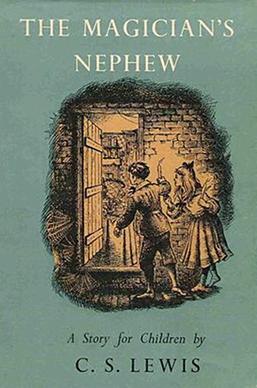
The Magician's Nephew is a portal fantasy novel by British author C. S. Lewis, published in 1955 by The Bodley Head. It is the sixth published of seven novels in The Chronicles of Narnia (1950–1956). In recent editions, which sequence the books in the chronological order of the story, it appears as the first volume of the series. Like the others, it was illustrated by Pauline Baynes whose work has been retained in many later editions. The Bodley Head was a new publisher for The Chronicles, a change from Geoffrey Bles who had published the previous five novels.
The Magician's Nephew is a prequel to the series. The middle third of the novel features the creation of the Narnia world by Aslan the lion, centred on a section of a lamp-post brought by accidental observers from London in 1900. The visitors then participate in the beginning of Narnia's history, 1000 years before The Lion, the Witch and the Wardrobe (which inaugurated the series in 1950).
The frame story, set in England, features two children ensnared in experimental travel via "the wood between the worlds". Thus, the novel shows Narnia and our middle-aged world to be only two of many in a multiverse, which changes as some worlds begin and others end. It also explains the origin of foreign elements in Narnia, not only the lamp-post but also the White Witch and a human king and queen.

Lewis began The Magician's Nephew soon after completing The Lion, the Witch and the Wardrobe, spurred by a friend's question about the lamp-post in the middle of nowhere, but he needed more than five years to complete it. The story includes several autobiographical elements and explores a number of themes with general moral and Christian implications, including atonement, original sin, temptation, and the order of nature.
Plot summary
In 1900, two children, Digory and Polly, live in the same London terrace. When exploring a crawl space joining the houses, they find themselves in the study of Digory's Uncle Andrew. Andrew tricks Polly into touching a yellow magic ring, causing her to vanish. He explains to Digory that the rings allow travel between worlds. He blackmails Digory into taking another yellow ring to follow Polly, and two green rings so that they both can return.
Digory is transported to a sleepy wood filled with pools where he reunites with Polly. They surmise that the wood is a "Wood between the Worlds", similar to the attic that links their houses back in England, and that each pool leads to a separate universe. They decide to explore a different world before returning to England, and jump into one of the nearby pools.

They find themselves in a desolate abandoned city of the ancient world of Charn. Inside the ruined palace, they find a bell with a hammer and an inscription inviting the finder to strike the bell. Despite Polly's protests, Digory rings the bell, awakening a witch-queen named Jadis, who, to avoid defeat in battle, deliberately killed every living thing in Charn by speaking the "Deplorable Word" before placing herself in an enchanted sleep that would end on the ringing of the bell.
The children attempt to flee, but Jadis follows them back to England by clinging to them as they clutch their rings. In England, she orders Uncle Andrew to fetch her a "chariot" – a hansom cab – so she can conquer Earth. She robs a jeweller's shop and returns to Kirke house pursued by police. Jadis tears an iron rod from a nearby lamp-post, using it to fight off police and onlookers when they mock her.
Polly and Digory grab Jadis and put on their rings to take her out of their world – accidentally bringing Uncle Andrew, Frank the cab-driver, and Frank's horse Strawberry, who were all touching each other when the children grabbed their rings. In the Wood between the Worlds, Strawberry, when attempting to drink from one of the ponds, accidentally brings everyone into a void. At first, Digory believes it to be Charn, but Jadis recognises it as a world not yet created. They witness the lion Aslan bringing stars, plants, and animals into existence as he creates the new world, Narnia. A terrified Jadis tries to kill Aslan with the iron rod, but it rebounds harmlessly off him, and in the creative soil of the new world it sprouts into a growing lamp-post.
Aslan gives some animals the power of speech. Frank the cabby and his wife Helen are crowned King and Queen of Narnia. Aslan confronts Digory with his responsibility for waking Jadis and for bringing her into Narnia, and tells Digory he must atone by helping to protect the new land of Narnia from her evil. Aslan transforms Strawberry into a winged horse, and Digory and Polly fly on him to a distant garden. Digory's task is to take an apple from a tree in this garden to plant in Narnia. At the garden Digory finds a sign warning not to steal the fruit.
Digory encounters Jadis in the garden, where she eats one of the apples to become immortal. She first tempts Digory to eat an apple himself, and then to take one back to Earth to heal his dying mother. Digory resists and Jadis departs for the north. Digory returns to Narnia and plants the apple, which grows into a mature tree as Aslan explains that anyone who steals the fruit for themselves will get their heart's desire, but in a form that renders it disagreeable: Jadis is now immortal, but eternally miserable. Moreover, the new tree will protect Narnia from Jadis for centuries to come. Aslan consents for Digory to take an apple from the new tree for his mother and returns Digory, Polly, and Uncle Andrew to England.
Digory's apple restores his mother's health, and he and Polly remain lifelong friends. Uncle Andrew reforms and gives up magic. Digory plants the apple's core with Uncle Andrew's rings in the back yard of his aunt's home in London, and it grows into a large tree. Soon afterwards, Digory's family inherits a mansion in the country, and many years later the apple tree blows down in a storm. Digory, now a professor, has its wood made into a wardrobe, setting up the events in The Lion, the Witch and the Wardrobe.
Principal characters
Digory Kirke: A boy who becomes the Professor in The Lion, the Witch and the Wardrobe
Polly Plummer: Digory's friend who lives next door
Mabel Kirke: Digory's mother
Andrew Ketterley: Digory's uncle, a minor magician
Letitia Ketterley: Uncle Andrew's sister, referred to in the book as "Aunt Letty"
Jadis: Empress of Charn, who becomes the White Witch appearing in The Lion, the Witch and the Wardrobe
Aslan: The Lion who creates Narnia and kills Jadis in The Lion, the Witch and the Wardrobe
King Frank: A cabby who becomes the first king of Narnia and ancestor of the kings of Archenland
Queen Helen: The wife of King Frank, the first queen of Narnia, and the ancestress of the Archenlanders
Fledge: The winged horse, formerly the cab-horse Strawberry, who carries Polly and Digory to the mountain garden
Writing
Lewis had originally intended only to write the one Narnia novel, The Lion, the Witch and the Wardrobe. However, when Roger Lancelyn Green asked him how a lamp-post came to be standing in the midst of Narnian woodland, Lewis was intrigued enough by the question to attempt to find an answer by writing The Magician's Nephew, which features a younger version of Professor Kirke from the first novel.
The Magician's Nephew seems to have been the most challenging Narnia novel for Lewis to write. While the other six Chronicles of Narnia books were written between 1948 and 1953, The Magician's Nephew was written over a five-year period between 1949 and 1954. He started in the summer of 1949 after finishing The Lion, the Witch and the Wardrobe, but came to a halt after producing 26 pages of manuscript and did not resume work until two years later. This may be as a result of the autobiographical aspects of the novel, as it reflects a number of incidents and parallels very close to his own experiences.
He returned to The Magician's Nephew late in 1950, after completing The Silver Chair. He managed to finish close to three-quarters of the novel, and then stopped work once again after Roger Green, to whom Lewis showed all his writing at the time, suggested there was a structural problem in the story. Finally he returned to the novel in 1953, after finishing The Last Battle in the spring of that year and completed early in 1954.
Lewis originally titled the novel "Polly and Digory"; his publisher changed it to The Magician's Nephew. This book is dedicated to "the Kilmer family".
The Lefay Fragment
The original opening of the novel differs greatly from the published version, and was abandoned by Lewis. It is now known as 'The Lefay Fragment', and is named after Mrs Lefay, Digory's fairy godmother, who is mentioned in the final version as Uncle Andrew's godmother, a less benevolent user of magic, who bequeathed him the box of dust used to create the magic rings.
In the Lefay Fragment, Digory is born with the ability to speak to (and understand) trees and animals; the distinction between Talking and non-Talking Beasts which was to become such a characteristic feature of the Narnian world is absent. Digory lives with an Aunt Gertrude, a former school mistress with an officious, bullying nature, who has ended up as a Government minister after a lifetime of belligerent brow-beating of others. Whenever his aunt is absent, Digory finds solace with the animals and trees, including a squirrel named Pattertwig. Polly enters the story as a girl next door who is unable to understand the speech of non-human creatures. She wants to build a raft to explore a stream which leads to an underground world. Digory helps construct the raft, but saws a branch from a tree necessary to complete it, in order not to lose face with Polly. This causes him to lose his supernatural powers of understanding the speech of trees and animals. The following day he is visited by his godmother Mrs Lefay who knows that Digory has lost his abilities and gives him a card with the address of a furniture shop which she instructs him to visit. At this point the fragment ends.
Pattertwig and Aunt Gertrude do not appear in the final version of the novel. Pattertwig does, however, appear as a Narnian creature in Prince Caspian, and Aunt Gertrude's career path is retraced by the Head of Experiment House in The Silver Chair.
Authenticity
Some doubt has been cast on the authenticity of the Lefay Fragment, as the handwriting in the manuscript differs in some ways from Lewis's usual style, and the writing is not of a similar calibre to his other work. Also in August 1963 Lewis had given instructions to Douglas Gresham to destroy all his unfinished or incomplete fragments of manuscript when his rooms at Magdalene College, Cambridge were being cleaned out, following his resignation from the college early in the month.
Autobiographical elements
A number of aspects of The Magician's Nephew are parallels with Lewis's own life. Both Digory and Lewis were children in the early 1900s, both wanted a pony, and both faced the death of their mothers in childhood. Digory is separated from his father, who is in India, and misses him. Lewis was educated in England after his mother's death, while his father remained in Ireland. He also had a brother in India. Both Lewis and Digory were voracious readers as children, and both are better with books than with numbers. Digory (and Polly) struggle with sums when trying to work out how far they must travel along the attic space to explore an abandoned house, Lewis failed the mathematics entrance exam for Oxford University. Lewis remembered rainy summer days from his youth and Digory is faced with the same woe in the novel. Additionally Digory becomes a professor when he grows up, who takes in evacuated children during World War II.
The character of Andrew Ketterley also closely resembles Robert Capron, a schoolmaster at Wynyard School, which Lewis attended with his brother, whom Lewis suggested during his teens would make a good model for a villain in a future story. Ketterley resembles Capron in his age, appearance, and behaviour.
Style
The Magician's Nephew is written in a lighter tone than other Chronicles of Narnia books, in particular The Last Battle, which was published after. It frequently makes use of humour; this perhaps reflects the sense of looking back at an earlier part of the century with affection, and Lewis as a middle-aged man recalling his childhood during those years. There are a number of humorous references to life in the old days, in particular school life. Humorous exchanges also take place between Narnian animals. Jadis's attempt to conquer London is portrayed as more comical than threatening, and further humour derives from the contrast between the evil empress and Edwardian London and its social mores, and her humiliation of bumbling Andrew Ketterley after discovering he is not as powerful a sorcerer as she is (or was). This recalls the style of Edith Nesbit's children's books. Lewis was fond of these books, which he read in childhood, a number were set in the same period and The Magician's Nephew has some apparent references or homages to them.
Reading order
The Magician's Nephew was originally published as the sixth book in the Narnia Chronicles. Most reprintings of the novels until the 1980s also reflected the order of original publication. In 1980 HarperCollins published the series ordered by the chronology of the events in the novels. This meant The Magician's Nephew was numbered as the first in the series. HarperCollins, which had previously published editions of the novels outside the United States, also acquired the rights to publish the novels in that country in 1994 and used this sequence in the uniform worldwide edition published in that year.
Laurence Krieg, a young fan, wrote to Lewis, asking him to adjudicate between his views of the correct sequence of reading the novels – according to the sequence of events, with The Magician's Nephew being placed first – and that of his mother, who thought the order of publication was more appropriate. Lewis wrote back, appearing to support the younger Krieg's views, although he did point out that perhaps it would not matter what order they were read in.
Lewis scholars Peter Schakel and Paul Ford support the publishing order. Schakel points out that the narrative of The Magician's Nephew assumes that the reader has already read The Lion, the Witch and the Wardrobe (which was written and published first) and is now being shown its beginnings. Ford writes, "most scholars disagree with this decision and find it the least faithful to Lewis's deepest intentions". From a literary standpoint, Lucy Pevensie's discovery of the wardrobe that opens onto a forest and a mysterious lamp-post creates a sense of suspense about an unknown land she is discovering for the first time. This would be anticlimactic if the reader has already been introduced to Narnia in The Magician's Nephew and already knows the origins of Narnia, the wardrobe, and the lamp-post.
Themes and interpretations
Parallels with the Book of Genesis
Lewis suggested that he did not directly intend to write his Narnia stories as Christian tales, but that these aspects appeared subconsciously as he wrote, although the books did become Christian as they progressed. He thought that the tales were not direct representations or allegory, but that they might evoke or remind readers of Biblical stories. In The Lion, the Witch and the Wardrobe, Aslan is a Christ-like figure who suffers a death of atonement and returns to life in a similar way to Christ's crucifixion and resurrection. The Magician's Nephew has similar biblical allusions, reflecting aspects of the Book of Genesis such as the creation, original sin and temptation.
Parallels with events in the Book of Genesis include the forbidden fruit represented by an Apple of Life. Jadis tempts Digory to eat one of the forbidden apples in the garden, as the serpent tempts Eve into eating a forbidden fruit in the Garden of Eden; unlike Eve however, Digory rejects the offer. (Lewis's Perelandra also features a re-enactment of the same Biblical story, which in that book also ends with the tempter foiled and the fall avoided.)
While the creation of Narnia closely echoes the creation of the Earth in the Book of Genesis, there are a number of important differences. Human beings are not created in Narnia by Aslan, they are brought into Narnia from our own world. Unlike Genesis, where souls are given only to human beings, animals and half-human half-animal creatures such as Fauns and Satyrs and even trees and watercourses are given souls and the power of rational thought and speech. This appears to suggest Lewis combined his Christian outlook with his fondness for nature, myths and fairy tales.
Parallels may also be found in Lewis's other writings. Jadis's references to "reasons of State", and her claim to own the people of Charn and to be beyond morality, represent the eclipse of the medieval Christian belief in natural law by the political concept of sovereignty, as embodied first in royal absolutism and then in modern dictatorships. Uncle Andrew represents the Faustian element in the origins of modern science.
The Holy Spirit and the breath of life
On a number of occasions in the Chronicles of Narnia, Aslan uses his breath to give strength to characters, demonstrating his benevolent power of bringing life. He specifically does so in The Magician's Nephew when a "long warm breath" gives life to Narnia. Lewis used the symbol of breath to represent the Holy Spirit, also known as the Holy Ghost. Both spirit and ghost are translations of the word for breath in Hebrew and Greek. The flash from the stars when the Narnian animals are given the ability to talk also most probably represents the Holy Spirit or "breath of life" of Genesis chapter 2, as well as (possibly) the scholastic concept of the divine active intellect that inspires human beings with rationality.
Nature and a natural order
The Magician's Nephew suggests two opposing approaches to nature, a good approach associated with Aslan as creator and an evil approach associated with human deviation from divine intentions and the harmony of a natural order. On the one hand there is the beauty of Aslan's creation of Narnia, which is suggested as having a natural order by the use of musical harmony to bring landscapes and living things into being. There is also a distinct order to the process of creation, from earth to plants to animal, which evokes the concept of The Great Chain of Being. Lewis himself was a strong believer in the intrinsic value of nature for itself, rather than as a resource to be exploited. This is perhaps reflected in how Aslan also gives speech to spiritual aspects of nature, such as naiads in the water and dryads in the trees. Andrew Ketterley and Jadis represent an opposite, evil approach of bending the forces of nature to human will for their own gain. They see nature solely as a resource to use for their plans and thus disturb and destroy the natural order.
Influences
John Milton's Paradise Lost
The sacred Garden in the west of the Narnian world is surrounded by a "high wall of green turf" with branches of trees overhanging it, and "high gates of gold, fast shut, facing due east", which must be the only entrance because the travellers "walked nearly all the way round it" before they found them. In all these points Lewis echoes John Milton's description of Eden in Paradise Lost:
The verdurous wall of Paradise up sprung...
And higher than that Wall a circling row
Of goodliest trees loaden with fairest fruit,