
The Khazars (/kəˈzɑːrz/) were a semi-nomadic Turkic people who established a major commercial empire in the late 6th century CE spanning the south of modern European Russia, southern Ukraine, and western Kazakhstan. It was the most powerful polity to emerge from the break-up of the Western Turkic Khaganate. Astride a major artery of commerce between Eastern Europe and West Asia, Khazaria became one of the foremost trading empires of the early medieval world, commanding the western marches of the Silk Road and playing a key commercial role as a crossroad between China, West Asia, and Kievan Rus'. For some three centuries (c. 650–965), the Khazars dominated the vast area extending from the Volga-Don steppes to the eastern Crimea and the northern Caucasus.
Although they were a confederation of different Turkic-speaking peoples, the precise origins and nature of the Khazars are uncertain, since there is no surviving record in the Khazar language and the state was multilingual and polyethnic. Their native religion is thought to have been Tengrism, like that of the North Caucasian Huns and other Turkic peoples, although their multiethnic population seems to have included pagans, Jews, Christians, and Muslims. Although there is evidence that the ruling elite of the Khazars had converted to Rabbinic Judaism in the 8th century, the scope of the conversion to Judaism within the khanate remains uncertain.
Effects
The Khazars are variably believed to have contributed to the ethnogenesis of numerous peoples, including the Hazaras, Hungarians, Kazakhs, the Don and Zaporozhian Cossacks, Kumyks, Krymchaks, Crimean Karaites, Csángós, Mountain Jews, and Subbotniks. The late 19th century saw the emergence of the Khazar myth, the theory that the core of today's Ashkenazi Jews are descended from a hypothetical Khazarian Jewish diaspora that migrated westward into France and Germany. Linguistic and genetic studies have not supported the theory, and despite occasional support, most scholars view it with considerable skepticism. The theory is sometimes associated with antisemitism.

In Oghuz Turkic languages, the Caspian Sea is still named the "Khazar Sea."
Etymology
Gyula Németh, following Zoltán Gombocz, derived Khazar from a hypothetical *Qasar reflecting a Turkic root qaz- ("to ramble, to roam") being an hypothetical retracted variant of Common Turkic kez-; however, András Róna-Tas objected that *qaz- is a ghost word. In the fragmentary Tes and Terkhin inscriptions of the Uyğur empire (744–840) the form Qasar is attested, although uncertainty remains whether this represents a personal or tribal name, gradually other hypotheses emerged. Louis Bazin derived it from Turkic qas- ("tyrannise, oppress, terrorise") on the basis of its phonetic similarity to the Uyğur tribal name, Qasar. Róna-Tas connects qasar with Kesar, the Pahlavi transcription of the Roman title Caesar.
D. M. Dunlop tried to link the Chinese term for "Khazars" to one of the tribal names of the Uyğur, or Toquz Oğuz, namely the Qasar (Ch. 葛薩 Gésà). The objections are that Uyğur 葛薩 Gésà/Qasar was not a tribal name but rather the surname of the chief of the 思结 Sijie tribe (Sogdian: Sikari) of the Toquz Oğuz (Ch. 九姓 jĭu xìng), and that in Middle Chinese the ethnonym "Khazars" was always prefaced with Tūjué, then still reserved for Göktürks and their splinter groups, (Tūjué Kěsà bù:突厥可薩部; Tūjué Hésà:突厥曷薩) and "Khazar's" first syllable is transcribed with different characters (可 and 曷) than 葛, which is used to render the syllable Qa- in the Uyğur word Qasar. While it is far from given that the Khazars are not signifying a multi-ethnic and multi-lingual cluster of peoples and clans, some more nomadic, some less, it doesn't exclude that some clans, or splintergroups, or even rulers has identified with the name(s) of the Khazars, in the variety of ways it has been expressed.

After their conversion it is reported that they adopted the Hebrew script, and it is likely that, although speaking a Turkic language, the Khazar chancellery under Judaism probably corresponded in Hebrew.
Linguistics
Determining the origins and nature of the Khazars is closely bound with theories of their languages, but analysis of their languages' origins is difficult, since no indigenous records in the Khazar language survive, and the state was polyglot and polyethnic. Whereas the royal or ruling elite probably spoke an eastern variety of the Common Turkic, the subject tribes appear to have spoken varieties of Oghuric languages, a language variously identified with the Bulgar, Chuvash, and the Hunnic language.
The latter is based upon the assertion of the Persian historian Istakhri that the Khazar language was different from any other known tongue, although his account also likened it to Bulğaric. Alano-As was also widely spoken. Eastern Common Turkic, the language of the royal house and its core tribes, in all likelihood remained the language of the ruling elite in the same way that Mongol continued to be used by the rulers of the Golden Horde, alongside of the Kipchak languages spoken by the bulk of the Turkic tribesmen that constituted the military force of this part of the Činggisid empire. Similarity, Oğuric, like Qipčaq Turkic in the Jočid realm, functioned as one of the languages of government. One method for tracing their origins consists in the analysis of the possible etymologies behind the ethnonym "Khazar".

History
For most of its history, Khazaria served as a buffer state between the Byzantine Empire, the nomads of the northern steppes, and the Umayyad and Abbasid Caliphates, having previously been Byzantium's proxy against the rival Sasanian Empire. Around 900, the Byzantines began encouraging the Alans to attack Khazaria; this move aimed to weaken Khazar control over Crimea and the Caucasus and facilitate imperial diplomacy and proselytising towards the powerful Kievan Rus' in the north. By 969, Sviatoslav I of Kiev, the ruler of Kievan Rus', along with his allies, conquered the Khazar capital of Atil, ushering the decline and disintegration of Khazaria by the mid 11th century.
Legendary origins
Joseph, one of the Khazar rulers, wrote in his Reply to Hasdai ibn Shaprut, that the Khazars were descendants of “Kozar”, one of the ten sons of Togarmah (the others being Uygur, Tiros, Avar, Oguz, Bisal, Tarna, Sanar, Bulgar and Savir).
Tribal origins and early history
The tribes that were to comprise the Khazar empire were not an ethnic union, but a congeries of steppe nomads and peoples who came to be subordinated, and subscribed to a core Turkic leadership. Many Turkic groups, such as Oghuric speakers, including the Saragurs, Oğurs, Onogurs, and Bulgars, who earlier formed part of the Tiele (Tiělè) confederation, are attested quite early, having been driven west by the Sabirs, who in turn fled the Pannonian Avars, and began to flow into the Volga–Caspian–Pontic zone from as early as the 4th century and are recorded by Priscus to reside in the western Eurasian Steppe as early as 463. They appear to stem from Mongolia and South Siberia in the aftermath of the fall of the Hunnic-Xiōngnú nomadic polities. A variegated tribal federation led by these Turks, probably comprising a complex assortment of Iranian peoples, proto-Mongols, Uralic speakers, and Paleosiberian peoples vanquished the Rouran Khaganate of the hegemonic Pannonian Avars in 552 who swept westwards, taking in their train other steppe nomads and peoples from Sogdia.

The ruling family of this confederation may have hailed from the Ashina tribe of the Western Turkic Khaganate, although Constantin Zuckerman regards Ashina and their pivotal role in the formation of the Khazars with scepticism. Golden notes that Chinese and Arabic reports are almost identical, making the connection a strong one, and conjectures that their leader may have been Irbis Seguy, who lost power or was killed around 651. Moving west, the confederation reached the land of the Akatziri, who had been important allies of Byzantium in fighting off Attila's army.
Rise of the Khazar state
An embryonic state of Khazaria began to form sometime after 630, when it emerged from the breakdown of the larger First Turkic Khaganate of the Göktürks. Göktürk armies had penetrated the Volga by 549, ejecting the Avars, who were then forced to flee to the sanctuary of the Pannonian Basin. The Ashina clan appeared on the scene by 552, when they overthrew the Rourans and established the First Turkic Khaganate, whose self designation was Tür(ü)k. By 568, these Göktürks were probing for an alliance with Byzantium to attack the Sasanian Empire. An internecine war broke out between the senior eastern Göktürks and the junior Western Turkic Khaganate some decades later, when on the death of Taspar Qaghan, a succession dispute led to a dynastic crisis between Taspar's chosen heir, the Apa Qaghan, and the ruler appointed by the tribal high council, Āshǐnà Shètú, the Ishbara Qaghan.
By the first decades of the 7th century, the Ashina Tong Yabghu Qaghan managed to stabilise the Western division. Upon his death, after providing crucial military assistance to Byzantium in routing the Sasanian army in the Persian heartland, the Western Turkic Qağanate dissolved under pressure from the encroaching Tang dynasty armies and split into two competing federations, each consisting of five tribes, collectively known as the "Ten Arrows" (On Oq). Both briefly challenged Tang hegemony in eastern Turkestan. To the West, two new nomadic states arose in the meantime: Old Great Bulgaria under Kubrat, the Duōlù clan leader, and the Nǔshībì subconfederation, also comprising five tribes. The Duōlù challenged the Avars in the Kuban River-Sea of Azov area while the Khazar Khaghanate consolidated further westwards, led apparently by an Ashina dynasty. With a resounding victory over the tribes in 657, engineered by General Su Dingfang, Chinese overlordship was imposed to their East after a final mop-up operation in 659, but the two confederations of Bulğars and Khazars fought for supremacy on the western steppeland, and with the ascendency of the latter, the former either succumbed to Khazar rule or, as under Asparukh of Bulgaria, Kubrat's son, shifted even further west across the Danube to lay the foundations of the First Bulgarian Empire in the Balkans (c. 679).
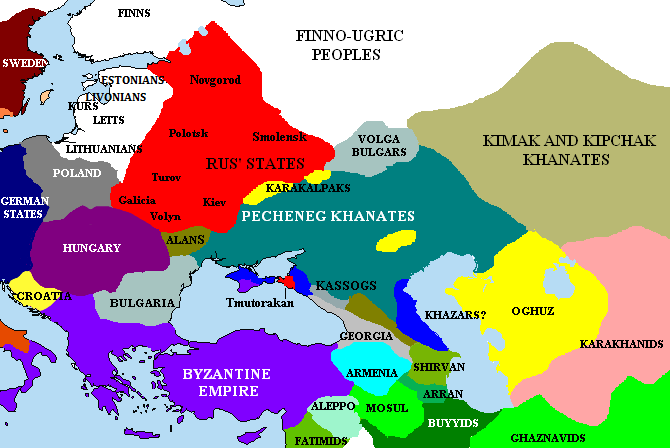
The Khazar Khaghanate thus took shape from the ruins of this nomadic empire, which broke up under pressure from the armies of the Tang dynasty to the east sometime between 630 and 650. After their conquest of the lower Volga region to the East and an area westwards between the Danube and the Dniepr, and their subjugation of the Onoghur-Bulghar union, sometime around 670, a properly constituted Khazar Khaghanate emerges, becoming the westernmost successor state of the formidable Göktürk Khaghanate after its disintegration. According to Omeljan Pritsak, the language of the Onoghur-Bulghar federation was to become the lingua franca of Khazaria as it developed into what Lev Gumilev called a "steppe Atlantis" (stepnaja Atlantida/ Степная Атлантида). Historians have often referred to this period of Khazar domination as the Pax Khazarica because the state became an international trading hub that permitted Western Eurasian merchants safe passage across it to conduct business without interference. The high status soon to be accorded this empire to the north is attested by the Fars-Nama (c. 1100), which relates that the Sasanian emperor, Khosrau I, placed three thrones by his own, one for the King of China, a second for the King of Byzantium, and a third for the King of the Khazars. Although anachronistic in retrodating the Khazars to this period, the legend, by placing the Khazar khagan on a throne of equal status to the rulers of the other two superpowers, attests to the reputation the Khazars had long enjoyed.
Khazar state: culture and institutions
Royal Diarchy with sacral Qağanate
Khazaria developed a diarchy (dual leadership) typical among Turkic nomads, consisting of a khagan-bek and a khagan. The emergence of this system may be deeply entwined with the conversion to Judaism. According to Arabic sources, the khagan-bek was called an ʾīšā and the greater a khagan (Arabic: خاقان, romanised: ḫāqān); the former managed and commanded the military, while the greater king's role was primarily sacral, less concerned with daily affairs.
The greater king was recruited from the Khazar house of notables (ahl bayt maʿrūfīn) and, in an initiation ritual, was nearly strangled until he declared the number of years he wished to reign, on the expiration of which he would be ritually killed by the nobles. Similarly, Ahmad ibn Fadlan wrote that there was a maximum limit on the number of years of a king's reign. If a khagan had reigned for at least forty years, his courtiers and subjects felt his ability to reason would become impaired by old age. They would then execute him. The deputy ruler would enter the presence of the reclusive greater king only with great ceremony, approaching him barefoot to prostrate himself in the dust and then light a piece of wood as a purifying fire, while waiting humbly and calmly to be summoned.

Particularly elaborate rituals accompanied a royal burial. At one period, travellers had to dismount, bow before the ruler's tomb, and then walk away on foot. Subsequently, the charismatic sovereign's burial place was hidden from view, with a palatial structure ("Paradise") constructed and then hidden under rerouted riverwater to avoid disturbance by evil spirits and later generations. Such a qoruq 'taboo' royal burial ground is typical of inner Asian peoples.
Both the ʾīšā and the ḫāqān converted to Rabbinic Judaism sometime in the 8th century, while the rest, according to the Persian traveller Ahmad ibn Rustah, probably continued to follow traditional religion.
Ruling elite
The ruling stratum, like that of the later Činggisids within the Golden Horde, was a relatively small group that differed ethnically and linguistically from its subject peoples, meaning the Alano-As and Oğuric Turkic tribes, who were numerically superior within Khazaria. The Khazar Qağans, while taking wives and concubines from the subject populations, were protected by a Khwarazmian guard corps, or comitatus 'warband' called the Arsiyah. But unlike many other local polities, they hired mercenary soldiers (the junūd murtazīqa in al-Masudi).
At the peak of their empire, the Khazars ran a centralised fiscal administration, with a standing army of some 7–12,000 men, which could, at need, be multiplied two or three times that number by inducting reserves from noble retinues. Other figures for the permanent standing army indicate that it numbered as many as one hundred thousand. They controlled and exacted tribute from 25 to 30 different nations and tribes inhabiting the vast territories between the Caucasus, the Aral Sea, the Ural Mountains, and the Ukrainian steppes. Khazar armies were led by the khagan-bek and commanded by subordinate officers known as tarkhans. When the bek sent out a body of troops, they would not retreat under any circumstances. If they were defeated, survivors were executed.
Settlements were governed by administrative officials known as tuduns. In some cases, such as the Byzantine settlements in southern Crimea, a tudun would be appointed for a town nominally within another polity's sphere of influence. Other officials in the Khazar government included dignitaries referred to by ibn Fadlan as jāwashīghar and kündür, but their responsibilities are unknown.
Demographics
It has been estimated that 25 to 28 distinct ethnic groups made up the population of the Khazar Qağanate, aside from the ethnic elite. The ruling elite seems to have been constituted out of nine tribes/clans, themselves ethnically heterogeneous, spread over perhaps nine provinces or principalities, each of which would have been allocated to a clan. In terms of caste or class, some evidence suggests that there was a distinction, whether racial or social is unclear, between "White Khazars" (ak-Khazars) and "Black Khazars" (qara-Khazars). The 10th-century Muslim geographer al-Iṣṭakhrī claimed that the White Khazars were strikingly handsome with reddish hair, white skin, and blue eyes, while the Black Khazars were swarthy, verging on deep black as if they were "some kind of Indian". Many Turkic nations had a similar (political, not racial) division between a "white" ruling warrior caste and a "black" class of commoners; the consensus among mainstream scholars is that Istakhri was confused by the names given to the two groups. However, Khazars are generally described by early Arab sources as having a white complexion, blue eyes, and reddish hair. The ethnonym in the Tang Chinese annals, Ashina, often accorded a key role in the Khazar leadership, may reflect an Eastern Iranian or Tokharian word (Khotanese Saka âşşeina-āššsena "blue"): Middle Persian axšaêna ("dark-coloured"): Tokharian A âśna ("blue", "dark"). The distinction appears to have survived the collapse of the Khazarian empire. Later Russian chronicles, commenting on the role of the Khazars in the magyarisation of Hungary, refer to them as "White Oghurs" and Magyars as "Black Oghurs". Studies of the physical remains, such as skulls at Sarkel, have revealed individuals belonging to the Slavic, other European, and a few Mongolian types.
Economy
The import and export of foreign wares, and the revenues derived from taxing their transit, was a hallmark of the Khazar economy, although it is said also to have produced isinglass. Distinctively among the nomadic steppe polities, the Khazar Qağanate developed a self-sufficient domestic Saltovo economy, a combination of traditional pastoralism – allowing sheep and cattle to be exported – extensive agriculture, abundant use of the Volga's rich fishing stocks, together with craft manufacture, with diversification in lucrative returns from taxing international trade given its pivotal control of major trade routes.
The Khazar slave trade constituted one of the two great furnishers of slaves to the Muslim market to slavery in the Abbasid Caliphate (the other being the Iranian Sâmânid amîrs), supplying it with captured Slavs and tribesmen from the Eurasian northlands. It profited from the latter which enabled it to maintain a standing army of Khwarezm Muslim troops. The capital Atil reflected the division: Kharazān on the western bank where the king and his Khazar elite, with a retinue of some 4,000 attendants, dwelt, and Itil proper to the East, inhabited by Jews, Christians, Muslims and slaves and by craftsmen and foreign merchants.
The Khazar Khaghanate played a key role in the trade between Europe and the Muslim world in the early Middle Ages. People taken captive during the Viking raids in Europe, such as Ireland, could be transported to Hedeby or Brännö in Scandinavia and from there via the Volga trade route to Russia, where slaves and furs were sold to Muslim merchants in exchange for Arab silver dirham and silk, which have been found in Birka, Wollin and Dublin; during the 8th- and 9th-century this trade route between Europe and the Abbasid Caliphate passed via the Khazar Kaghanate, until it was supplanted in the 10th-century by the route of Volga Bulgaria, Khwarazm, and the Samanid slave trade.
The ruling elite wintered in the city and spent from spring to late autumn in their fields. A large irrigated greenbelt, drawing on channels from the Volga river, lay outside the capital, where meadows and vineyards extended for some 20 farsakhs (c. 60 miles). While customs duties were imposed on traders, and tribute and tithes were exacted from 25 to 30 tribes, with a levy of one sable skin, squirrel pelt, sword, dirham per hearth or ploughshare, or hides, wax, honey and livestock, depending on the zone. Trade disputes were handled by a commercial tribunal in Atil consisting of seven judges, two for each of the monotheistic inhabitants (Jews, Muslims, Christians) and one for the pagans.
Khazars and Byzantium
Byzantine diplomatic policy towards the steppe peoples generally consisted of encouraging them to fight among themselves. The Pechenegs provided great assistance to the Byzantines in the 9th century in exchange for regular payments. Byzantium also sought alliances with the Göktürks against common enemies: in the early 7th century, one such alliance was brokered with the Western Tűrks against the Persian Sasanians in the Byzantine–Sasanian War of 602–628. The Byzantines called Khazaria Tourkía, and by the 9th century referred to the Khazars as "Turks". During the period leading up to and after the siege of Constantinople in 626, Heraclius sought help via emissaries, and eventually personally, from a Göktürk chieftain of the Western Turkic Khaganate, Tong Yabghu Qağan, in Tiflis, plying him with gifts and the promise of marriage to his daughter, Epiphania. Tong Yabghu responded by sending a large force to ravage the Persian empire, marking the start of the Third Perso-Turkic War. A joint Byzantine-Tűrk operation breached the Caspian gates and sacked Derbent in 627. Together they then besieged Tiflis, where the Byzantines may have deployed an early variety of traction trebuchets (ἑλέπόλεις) to breach the walls. After the campaign, Tong Yabghu is reported, perhaps with some exaggeration, to have left some 40,000 troops behind with Heraclius. Although occasionally identified with Khazars, the Göktürk identification is more probable since the Khazars only emerged from that group after the fragmentation of the former sometime after 630. Some scholars argued that Sasanian Persia never recovered from the devastating defeat wrought by this invasion.
Once the Khazars emerged as a power, the Byzantines also began to form alliances with them, dynastic and military. In 695, the last Heraclian emperor, Justinian II, nicknamed "the slit-nosed" (ὁ ῥινότμητος) after he was mutilated and deposed, was exiled to Cherson in the Crimea, where a Khazar governor (tudun) presided. He escaped into Khazar territory in 704 or 705 and was given asylum by khagan Busir Glavan (Ἰβουζῆρος Γλιαβάνος), who gave him his sister in marriage, perhaps in response to an offer by Justinian, who may have thought a dynastic marriage would seal by kinship a powerful tribal support for his attempts to regain the throne. The Khazarian spouse thereupon changed her name to Theodora. Busir was offered a bribe by the Byzantine usurper, Tiberius III, to kill Justinian. Warned by Theodora, Justinian escaped, murdering two Khazar officials in the process. He fled to Bulgaria, whose Khan Tervel helped him regain the throne. Upon his reinstalment, and despite Busir's treachery during his exile, he sent for Theodora; Busir complied, and she was crowned as Augusta, suggesting that both prized the alliance.
Decades later, Leo III (ruled 717–741) made a similar alliance to co-ordinate strategy against a common enemy, the Muslim Arabs. He sent an embassy to the Khazar khagan Bihar and married his son, the future Constantine V (ruled 741–775), to Bihar's daughter, a princess referred to as Tzitzak, in 732. On converting to Christianity, she took the name Irene. Constantine and Irene had a son, the future Leo IV (775–780), who thereafter bore the sobriquet, "the Khazar". Leo died in mysterious circumstances after his Athenian wife bore him a son, Constantine VI, who on his majority co-ruled with his mother, the dowager. He proved unpopular, and his death ended the dynastic link of the Khazars to the Byzantine throne. By the 8th century, Khazars dominated the Crimea (650–c. 950), and even extended their influence into the Byzantine peninsula of Cherson until it was wrested back in the 10th century. Khazar and Farghânian (Φάργανοι) mercenaries constituted part of the imperial Byzantine Hetaireia bodyguard after its formation in 840, a position that could openly be purchased by a payment of seven pounds of gold.
Arab–Khazar wars
During the 7th and 8th centuries, the Khazars fought a series of wars against the Umayyad Caliphate and its Abbasid successor. The First Arab-Khazar War began during the first phase of Muslim expansion. By 640, Muslim forces had reached Armenia; in 642 they launched their first raid across the Caucasus under Abd ar-Rahman ibn Rabiah. In 652 Arab forces advanced on the Khazar capital, Balanjar, but were defeated, suffering heavy losses; according to Persian historians such as al-Tabari, both sides in the battle used catapults against the opposing troops. A number of Russian sources give the name of a Khazar khagan from this period as Irbis and describe him as a scion of the Göktürk royal house, the Ashina. Whether Irbis ever existed is open to debate, as is whether he can be identified with one of the many Göktürk rulers of the same name.
Due to the outbreak of the First Muslim Civil War and other priorities, the Arabs refrained from repeating an attack on the Khazars until the early 8th century. The Khazars launched a few raids into Transcaucasian principalities under Muslim dominion, including a large-scale raid in 683–685 during the Second Muslim Civil War that rendered much booty and many prisoners. There is evidence from the account of al-Tabari that the Khazars formed a united front with the remnants of the Göktürks in Transoxiana.
The Second Arab-Khazar War began with a series of raids across the Caucasus in the early 8th century. The Umayyads tightened their grip on Armenia in 705 after suppressing a large-scale rebellion. In 713 or 714, the Umayyad general Maslamah conquered Derbent and drove deeper into Khazar territory. The Khazars launched raids in response into Caucasian Albania and Iranian Azerbaijan but were driven back by the Arabs under Hasan ibn al-Nu'man. The conflict escalated in 722 with an invasion by 30,000 Khazars into Armenia inflicting a crushing defeat on the Arabs. Caliph Yazid II responded, sending 25,000 Arab troops north, swiftly driving the Khazars back across the Caucasus, recovering Derbent, and advancing on Balanjar. The Arabs broke through the Khazar defence and stormed the city; most of its inhabitants were killed or enslaved, but a few of them managed to flee north. Despite their success, the Arabs had not yet defeated the Khazar army, and they retreated south of the Caucasus.
In 724, the Arab general al-Jarrah ibn Abdallah al-Hakami inflicted a crushing defeat on the Khazars in a long battle between the rivers Cyrus and Araxes, then moved on to capture Tiflis, bringing Caucasian Iberia under Muslim suzerainty. The Khazars struck back in 726, led by a prince named Barjik, launching a major invasion of Albania and Azerbaijan; by 729, the Arabs had lost control of northeastern Transcaucasia and were thrust again into the defensive. In 730, Barjik invaded Iranian Azerbaijan and defeated Arab forces at Ardabil, killing the general al-Djarrah al-Hakami and briefly occupying the town. Barjik was defeated and killed the next year at Mosul, where he directed Khazar forces from a throne mounted with al-Djarrah's severed head . In 737, Marwan Ibn Muhammad entered Khazar territory under the guise of seeking a truce. He then launched a surprise attack in which The Qaghan fled north and the Khazars surrendered. The Arabs did not have enough resources to influence the affairs of Transcaucasia. The Qağan was forced to accept terms involving his conversion to Islam, and subject himself to the rule of the Caliphate, but the accommodation was short-lived because a combination of internal instability among the Umayyads and Byzantine support undid the agreement within three years, and the Khazars re-asserted their independence. The suggestion that the Khazars adopted Judaism as early as 740 is based on the idea that, in part, it was, a re-assertion of their independence from the rule of both regional powers, Byzantium and the Caliphate, while it also conformed to a general Eurasian trend to embrace a world religion.
Whatever the impact of Marwan's campaigns was, warfare between the Khazars and the Arabs ceased for more than two decades after 737. Arab raids continued to occur until 741, but their control of the region was limited because maintaining a large garrison at Derbent further depleted their already overstretched army. A third Muslim civil war soon broke out, leading to the Abbasid Revolution and the fall of the Umayyad dynasty in 750.
In 758, the Abbasid Caliph al-Mansur attempted to strengthen diplomatic ties with the Khazars, ordering Yazid ibn Usayd al-Sulami, one of his nobles and the military governor of Armenia, to take a royal Khazar bride. Yazid married a daughter of Khazar Khagan Baghatur, but she died inexplicably, possibly during childbirth. Her attendants returned home, convinced that some members of another Arab faction had poisoned her, and her father was enraged. The Khazar general Ras Tarkhan invaded regions which were located south of the Caucasus in 762–764, devastating Albania, Armenia, and Iberia, and capturing Tiflis. Thereafter, relations between the Khazars and the Abbasids became increasingly cordial, because the foreign policies of the Abbasids were generally less expansionist than the foreign policies of the Umayyads, relations between the Khazars and the Abbasids were ultimately broken by a series of raids which occurred in 799, the raids occurred after another marriage alliance failed.
After the Khazars assumed control of Transcaucasia, at some time they set up towns including Samiran, Samsakly, Sambalut, Samakha, and Samkalak - with the common fragment "Sam" meaning "top" or "high" or "main".
Khazars and Hungarians
Around 830, a rebellion broke out in the Khazar khaganate. As a result, three Kabar tribes of the Khazars (probably the majority of ethnic Khazars) joined the Hungarians and moved through Levedia to what the Hungarians call the Etelköz, the territory between the Carpathians and the Dnieper River. The Hungarians faced their first attack by the Pechenegs around 854, though other sources state that an attack by Pechenegs was the reason for their departure to Etelköz. The new neighbours of the Hungarians were the Varangians and the eastern Slavs. From 862 onwards, the Hungarians (already referred to as the Ungri) along with their allies, the Kabars, started a series of raids from the Etelköz into the Carpathian Basin, mostly against the Eastern Frankish Empire (Germany) and Great Moravia, but also against the Lower Pannonian principality and Bulgaria. Then they together ended up at the outer slopes of Carpathians, and settled there.
Rise of the Rus' and the collapse of the Khazarian state
By the 9th century, groups of Varangian Rus', developing a powerful warrior-merchant system, began probing south down the waterways controlled by the Khazars and their protectorate, the Volga Bulgarians, partially in pursuit of the Arab silver that flowed north for hoarding through the Khazarian-Volga Bulgarian trading zones, partially to trade in furs and ironwork. Northern mercantile fleets passing Atil were tithed, as they were at Byzantine Cherson. Their presence may have prompted the formation of a Rus' state by convincing the Slavs, Merja and the Chud' to unite to protect common interests against Khazarian exactions of tribute. It is often argued that a Rus' Khaganate modelled on the Khazarian state had formed to the east and that the Varangian chieftain of the coalition appropriated the title of khagan as early as the 830s: the title survived to denote the princes of Kievan Rus', whose capital, Kiev, is often associated with a Khazarian foundation. The construction of the Sarkel fortress, with technical assistance from Khazaria's Byzantine ally at the time, together with the minting of an autonomous Khazar coinage around the 830s, may have been a defensive measure against emerging threats from Varangians to the north and from the Magyars on the eastern steppe. By 860, the Rus' had penetrated as far as Kiev and, via the Dnieper, Constantinople.
Alliances often shifted. Byzantium, threatened by Varangian Rus' raiders, would assist Khazaria, and Khazaria at times allowed the northerners to pass through their territory in exchange for a portion of the booty. From the beginning of the 10th century, the Khazars found themselves fighting on multiple fronts as nomadic incursions were exacerbated by uprisings by former clients and invasions from former allies. The pax Khazarica was caught in a pincer movement between steppe Pechenegs and the strengthening of an emergent Rus' power to the north, both undermining Khazaria's tributary empire. According to the Schechter Text, the Khazar ruler King Benjamin (ca.880–890) fought a battle against the allied forces of five lands whose moves were perhaps encouraged by Byzantium. Although Benjamin was victorious, his son Aaron II faced another invasion, this time led by the Alans, whose leader had converted to Christianity and entered into an alliance with Byzantium, which, under Leo VI the Wise, encouraged them to fight against the Khazars.
By the 880s, Khazar control of the Middle Dnieper from Kiev, where they collected tribute from Eastern Slavic tribes, began to wane as Oleg of Novgorod wrested control of the city from the Varangian warlords Askold and Dir, and embarked on what was to prove to be the foundation of a Rus' empire. The Khazars had initially allowed the Rus' to use the trade route along the Volga River, and raid southwards. According to Al-Mas'udi, the khagan is said to have given his assent on the condition that the Rus' give him half of the booty. In 913, however, two years after Byzantium had concluded a peace treaty with the Rus', a Varangian foray, with Khazar connivance, through Arab lands led to a request to the Khazar throne by the Khwârazmian Islamic guard for permission to retaliate against the large Rus' contingent on its return. The purpose was to revenge the violence the Rus' razzias had inflicted on their fellow Muslim believers. The Rus' force was thoroughly routed and massacred. The Khazar rulers closed the passage down the Volga to the Rus', sparking a war. In the early 960s, Khazar ruler Joseph wrote to Hasdai ibn Shaprut about the deterioration of Khazar relations with the Rus': "I protect the mouth of the river (Itil-Volga) and prevent the Rus arriving in their ships from setting off by sea against the Ishmaelites and (equally) all (their) enemies from setting off by land to Bab."
The Rus' warlords launched several wars against the Khazar Qağanate, and raided down to the Caspian Sea. The Schechter Letter relates the story of a campaign against Khazaria by HLGW (recently identified as Oleg of Chernigov) around 941 in which Oleg was defeated by the Khazar general Pesakh. The Khazar alliance with the Byzantine empire began to collapse in the early 10th century. Byzantine and Khazar forces may have clashed in the Crimea, and by the 940s emperor Constantine VII Porphyrogenitus was speculating in De Administrando Imperio about ways in which the Khazars could be isolated and attacked. The Byzantines during the same period began to attempt alliances with the Pechenegs and the Rus', with varying degrees of success. A further factor undermining the Khazar Qağanate was a shift in Islamic routes at this time, as Muslims in Khwarazmia forged trade links with the recently converted Volga Bulgarian Muslims, a move which may have caused a drastic drop, perhaps up to 80%, in the revenue base of Khazaria, and consequently, a crisis in its ability to pay for its defence.
Sviatoslav I finally succeeded in destroying Khazar imperial power in the 960s, in a circular sweep that overwhelmed Khazar fortresses like Sarkel and Tamatarkha, and reached as far as the Caucasian Kassogians/Circassians and then back to Kiev. Sarkel fell in 965, with the capital city of Atil following, c. 968 or 969.