
The John F. Kennedy Space Center (KSC, originally known as the NASA Launch Operations Center), located on Merritt Island, Florida, is one of the ten field centers of NASA. Since 1968, KSC has been NASA's primary launch center of American spaceflight, research, and technology. Launch operations for the Apollo, Skylab, Space Shuttle and Artemis programs were carried out from Kennedy Space Center Launch Complex 39 and managed by KSC. Located on the east coast of Florida, KSC is adjacent to Cape Canaveral Space Force Station (CCSFS). The management of the two entities work very closely together, share resources, and operate facilities on each other's property.
Though the first Apollo flights and all Project Mercury and Project Gemini flights took off from the then-Cape Canaveral Air Force Station, the launches were managed by KSC and its previous organization, the Launch Operations Directorate. Starting with the fourth Gemini mission, the NASA launch control center in Florida (Mercury Control Center, later the Launch Control Center) began handing off control of the vehicle to the Mission Control Center in Houston, shortly after liftoff; in prior missions it held control throughout the entire mission.
Additionally, the center manages launch of robotic and commercial crew missions and researches food production and in-situ resource utilization for off-Earth exploration. Since 2010, the center has worked to become a multi-user spaceport through industry partnerships, even adding a new launch pad (LC-39C) in 2015.

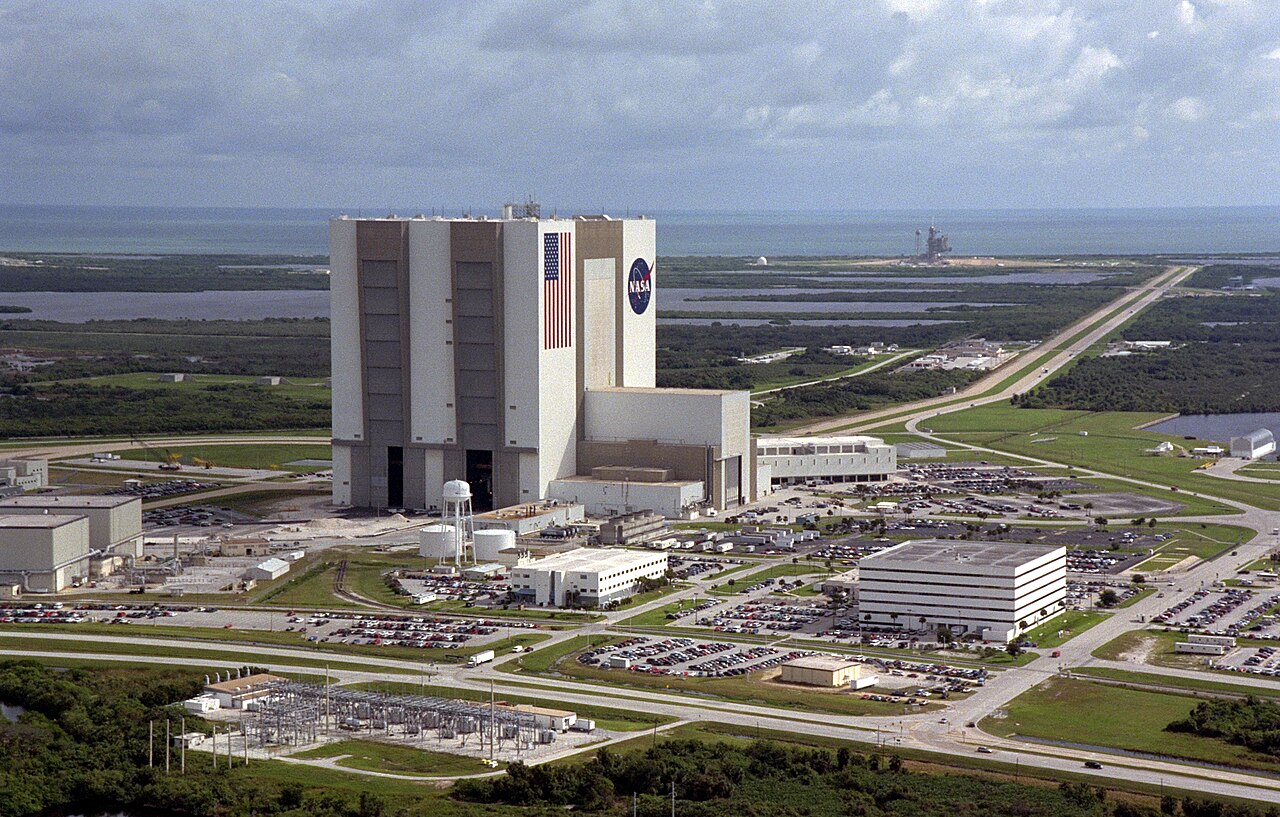
There are about 700 facilities and buildings grouped throughout the center's 144,000 acres (580 km2). Among the unique facilities at KSC are the 525-foot (160 m) tall Vehicle Assembly Building for stacking NASA's largest rockets, the Launch Control Center, which conducts space launches at KSC, the Operations and Checkout Building, which houses the astronauts' dormitories and suit-up area, a Space Station factory, and a 3-mile (4.8 km) long Shuttle Landing Facility. There is also a Visitor Complex on site that is open to the public.
Formation
Since 1949, the military had been performing launch operations at what would become Cape Canaveral Space Force Station. In December 1959, the Department of Defense transferred 5,000 personnel and the Missile Firing Laboratory to NASA to become the Launch Operations Directorate under NASA's Marshall Space Flight Center.
President John F. Kennedy's 1961 goal of a crewed lunar landing by 1970 required an expansion of launch operations. On July 1, 1962, the Launch Operations Directorate was separated from MSFC to become the Launch Operations Center (LOC). Also, Cape Canaveral was inadequate to host the new launch facility design required for the mammoth 363-foot (111 m) tall, 7,500,000-pound-force (33,000 kN) thrust Saturn V rocket, which would be assembled vertically in a large hangar and transported on a mobile platform to one of several launch pads. Therefore, the decision was made to build a new LOC site located adjacent to Cape Canaveral on Merritt Island.
In 1961, NASA formally announced its intent to acquire approximately 88,000 acres of land (about 138 square miles) along Florida's east coast, marking the beginning of what would become a much larger acquisition effort. NASA began land acquisition in 1962; in the years-long effort, NASA bought title to 131 square miles (340 km2) and negotiated with the state of Florida for an additional 87 square miles (230 km2). The U.S. Army
NASA Railroad (Wilson Junction)Corps of Engineers oversaw the land acquisition process. They directly negotiated with property owners before resorting to condemnations when negotiations were inefficient. Much of the land NASA acquired was in agricultural use, particularly for citrus farming. In Merritt Island, citrus groves were purchased by mid-1963. Still, in an effort to manage the transition, NASA allowed many farmers to lease back their properties temporarily, allowing them to operate and reap harvest from the groves until summer 1964. To regulate activity in what was newly federally acquired land, all personnel required clearance to enter the controlled zone and special security badges were even issued to grove workers.
The major buildings in KSC's Industrial Area were designed by architect Charles Luckman. Construction began in November 1962, and Kennedy visited the site twice in 1962, and again just a week before his assassination on November 22, 1963.

On November 29, 1963, the facility was named by President Lyndon B. Johnson under Executive Order 11129. Johnson's order joined both the civilian LOC and the military Cape Canaveral station ("the facilities of Station No. 1 of the Atlantic Missile Range") under the designation "John F. Kennedy Space Center", spawning some confusion joining the two in the public mind. NASA administrator James E. Webb clarified this by issuing a directive stating the Kennedy Space Center name applied only to the LOC, while the Air Force issued a general order renaming the military launch site Cape Kennedy Air Force Station.
Location
Located on Merritt Island, Florida, the center is north-northwest of Cape Canaveral on the Atlantic Ocean, midway between Miami and Jacksonville on Florida's Space Coast, due east of Orlando. It is 34 miles (55 km) long and roughly six miles (9.7 km) wide, covering 219 square miles (570 km2). KSC is a major central Florida tourist destination and is approximately one hour's drive from the Orlando area. The Kennedy Space Center Visitor Complex offers public tours of the center and Cape Canaveral Space Force Station.
Before NASA's acquisition, the region consisted of a landscape that included swampland, citrus groves, and coastal beaches – features that are typical of Florida's undeveloped east coast. Parts of the land had to be dredged to support the construction of the Center's facilities. In addition to environmental transformation, the acquisition also led to the displacement of several small communities, including the towns of Shiloh and Allenhurst, which were completely enveloped by NASA. KSC's Environmental Management Branch has rescued over 100 mangrove seedlings during a living-shoreline restoration project, replanting them to stabilize the shoreline and reduce erosion while supporting local wildlife. KSC developed an "Indian River Lagoon Health Initiative Plan" in coordination with the Merritt Island National Wildlife Refuge and Canaveral National Seashore to monitor and restore ecological health through seagrass mapping, manatee and bird surveys, and shoreline resiliency projects. Within its 140,000-acre property, KSC includes a variety of habitats – such as coastal dunes, saltwater estuaries, marshes, pine flatwoods, and hardwood hammocks – which support more than 1,500 species of plants and animals, including dozens of federally or state‑listed species.

Historical programs
Apollo program
From 1967 through 1973, there were 13 Saturn V launches, including the ten remaining Apollo missions after Apollo 7. The first of two uncrewed flights, Apollo 4 (Apollo-Saturn 501) on November 9, 1967, was also the first rocket launch from KSC. The Saturn V's first crewed launch on December 21, 1968, was Apollo 8's lunar orbiting mission. The next two missions tested the Lunar Module: Apollo 9 (Earth orbit) and Apollo 10 (lunar orbit). Apollo 11, launched from Pad A on July 16, 1969, made the first Moon landing on July 20. The Apollo 11 launch included crewmembers Neil Armstrong, Michael Collins, and Buzz Aldrin, and attracted a record-breaking 650 million television viewers. Apollo 12 followed four months later. From 1970 to 1972, the Apollo program concluded at KSC with the launches of missions 13 through 17.
Skylab
On May 14, 1973, the last Saturn V launch put the Skylab space station in orbit from Pad 39A. By this time, the Cape Kennedy pads 34 and 37 used for the Saturn IB were decommissioned, so Pad 39B was modified to accommodate the Saturn IB, and used to launch three crewed missions to Skylab that year, as well as the final Apollo spacecraft for the Apollo–Soyuz Test Project in 1975.
Space Shuttle
As the Space Shuttle was being designed, NASA received proposals for building alternative launch-and-landing sites at locations other than KSC, which demanded study. KSC had important advantages, including its existing facilities; location on the Intracoastal Waterway; and its southern latitude, which gives a velocity advantage to missions launched in easterly near-equatorial orbits. Disadvantages included: its inability to safely launch military missions into polar orbit, since spent boosters would be likely to fall on the Carolinas or Cuba; corrosion from the salt air; and frequent cloudy or stormy weather. Although building a new site at White Sands Missile Range in New Mexico was seriously considered, NASA announced its decision in April 1972 to use KSC for the shuttle. Since the Shuttle could not be landed automatically or by remote control, the launch of Columbia on April 12, 1981, for its first orbital mission STS-1, was NASA's first crewed launch of a vehicle that had not been tested in prior uncrewed launches.

In 1976, the VAB's south parking area was the site of Third Century America, a science and technology display commemorating the U.S. Bicentennial. Concurrent with this event, the U.S. flag was painted on the south side of the VAB. During the late 1970s, LC-39 was reconfigured to support the Space Shuttle. Two Orbiter Processing Facilities were built near the VAB as hangars with a third added in the 1980s.
KSC's 2.9-mile (4.7 km) Shuttle Landing Facility (SLF) was the orbiters' primary end-of-mission landing site, although the first KSC landing did not take place until the tenth flight, when Challenger completed STS-41-B on February 11, 1984; the primary landing site until then was Edwards Air Force Base in California, subsequently used as a backup landing site. The SLF also provided a return-to-launch-site (RTLS) abort option, which was not used. The SLF is among the longest runways in the world.
Constellation
On October 28, 2009, the Ares I-X launch from Pad 39B was the first uncrewed launch from KSC since the Skylab workshop in 1973.

Expendable launch vehicles (ELVs)
Beginning in 1958, NASA and military worked side by side on robotic mission launches (previously referred to as unmanned), cooperating as they broke ground in the field. In the early 1960s, NASA had as many as two robotic mission launches a month. The frequent number of flights allowed for quick evolution of the vehicles, as engineers gathered data, learned from anomalies and implemented upgrades. In 1963, with the intent of KSC ELV work focusing on the ground support equipment and facilities, a separate Atlas/Centaur organization was formed under NASA's Lewis Center (now Glenn Research Center (GRC)), taking that responsibility from the Launch Operations Center (aka KSC).
Though almost all robotics missions launched from the Cape Canaveral Space Force Station (CCSFS), KSC "oversaw the final assembly and testing of rockets as they arrived at the Cape." In 1965, KSC's Unmanned Launch Operations directorate became responsible for all NASA uncrewed launch operations, including those at Vandenberg Space Force Base. From the 1950s to 1978, KSC chose the rocket and payload processing facilities for all robotic missions launching in the U.S., overseeing their near launch processing and checkout. In addition to government missions, KSC performed this service for commercial and foreign missions also, though non-U.S. government entities provided reimbursement. NASA also funded Cape Canaveral Space Force Station launch pad maintenance and launch vehicle improvements.
All this changed with the Commercial Space Launch Act of 1984, after which NASA only coordinated its own and National Oceanic and Atmospheric Administration (NOAA) ELV launches. Companies were able to "operate their own launch vehicles" and use NASA's launch facilities. Payload processing handled by private firms also started to occur outside KSC. Reagan's 1988 space policy furthered the movement of this work from KSC to commercial companies. That same year, launch complexes on Cape Canaveral Air Force Force Station started transferring from NASA to Air Force Space Command management.
In the 1990s, though KSC was not performing the hands-on ELV work, engineers still maintained an understanding of ELVs and had contracts allowing them insight into the vehicles so they could provide knowledgeable oversight. KSC also worked on ELV research and analysis and the contractors were able to use KSC personnel as a resource for technical issues. KSC, with the payload and launch vehicle industries, developed advances in automation of the ELV launch and ground operations to enable competitiveness of U.S. rockets against the global market.
In 1998, the Launch Services Program (LSP) formed at KSC, pulling together programs (and personnel) that already existed at KSC, GRC, Goddard Space Flight Center, and more to manage the launch of NASA and NOAA robotic missions. Cape Canaveral Space Force Station and VAFB are the primary launch sites for LSP missions, though other sites are occasionally used. LSP payloads such as the Mars Science Laboratory have been processed at KSC before being transferred to a launch pad on Cape Canaveral Space Force Station.
Artemis program
On November 16, 2022, at 06:47:44 UTC the Space Launch System (SLS) was launched from Complex 39B as part of the Artemis I mission. On April 1, 2026, at 6:35:12 EST the SLS was launched from the same location as part of the Artemis II mission.
Space station processing
As the International Space Station modules design began in the early 1990s, KSC began to work with other NASA centers and international partners to prepare for processing before launch onboard the Space Shuttles. KSC used its hands-on experience processing the 22 Spacelab missions in the Operations and Checkout Building to gather expectations of ISS processing. These experiences were incorporated into the design of the Space Station Processing Facility (SSPF), which began construction in 1991. The Space Station Directorate formed in 1996. KSC personnel were embedded at station module factories for insight into their processes.
From 1997 to 2007, KSC planned and performed on the ground integration tests and checkouts of station modules: three Multi-Element Integration Testing (MEIT) sessions and the Integration Systems Test (IST). Numerous issues were found and corrected that would have been difficult to nearly impossible to do on-orbit.
In January 2025, NASA's Kennedy Space Center signed a memorandum of understanding with the University of Florida, University of Central Florida, and Embry‑Riddle Aeronautical University to form the Florida University Space Research Consortium, advancing Moon-to-Mars research. A Systems Engineering & Integration (SE&I) bootcamp, backed by a three-year grant, was launched at KSC in 2025 by FAMU‑FSU College of Engineering in partnership with NASA to train 30 professionals in systems engineering for the Artemis campaign.
The second "SpaceU Symposium" was held in November 2025 at UCF, involving KSC researchers, university students, and space industry leaders to showcase innovation, research, and job opportunities in partnership with NASA.
The Florida University Space Research Consortium is part of a broader Florida Space Grant program that includes dozens of universities, which provides research funding and strong ties between KSC and higher education institutions to support NASA's missions.
Today KSC continues to process ISS payloads from across the world before launch along with developing its experiments for on orbit. The proposed Lunar Gateway would be manufactured and processed at the Space Station Processing Facility.
Current programs and initiatives
The following are current programs and initiatives at Kennedy Space Center:
Commercial Crew Program
Exploration Ground Systems Program
Launch Services Program
Educational Launch of Nanosatellites (ELaNa)
Research and Technology
Artemis program
Lunar Gateway
International Space Station Payloads
Camp KSC: educational camps for schoolchildren in spring and summer, with a focus on space, aviation and robotics.
Facilities
The KSC Industrial Area, where many of the center's support facilities are located, is 5 miles (8 km) south of LC-39. It includes the Headquarters Building, the Operations and Checkout Building and the Central Instrumentation Facility. The astronaut crew quarters are in the O&C; before it was completed, the astronaut crew quarters were located in Hangar S at the Cape Canaveral Missile Test Annex (now Cape Canaveral Space Force Station). Located at KSC was the Merritt Island Spaceflight Tracking and Data Network station (MILA), a key radio communications and spacecraft tracking complex.
Facilities at the Kennedy Space Center are directly related to its mission to launch and recover missions. Facilities are available to prepare and maintain spacecraft and payloads for flight. The Headquarters (HQ) Building houses offices for the Center Director, library, film and photo archives, a print shop and security. When the KSC Library first opened, it was part of the Army Ballistic Missile Agency. However, in 1965, the library moved into three separate sections in the newly opened NASA headquarters before eventually becoming a single unit in 1970. The library contains over four million items related to the history and the work at Kennedy. As one of ten NASA center libraries in the country, their collection focuses on engineering, science, and technology. The archives contain planning documents, film reels, and original photographs covering the history of KSC. The library is not open to the public but is available for KSC, Space Force, and Navy employees who work on site.
A new Headquarters Building was completed in 2019 as part of the Central Campus consolidation. Groundbreaking began in 2014.
The center operated its own 17-mile (27 km) short-line railroad. This operation was discontinued in 2015, with the sale of its final two locomotives. A third had already been donated to a museum. The line was costing $1.3 million annually to maintain.
Payload manufacture and processing
The Neil Armstrong Operations and Checkout Building (O&C) (previously known as the Manned Spacecraft Operations Building) is a historic site on the U.S. National Register of Historic Places dating back to the 1960s and was used to receive, process, and integrate payloads for the Gemini and Apollo programs, the Skylab program in the 1970s, and for initial segments of the International Space Station through the 1990s. The Apollo and Space Shuttle astronauts would board the astronaut transfer van to launch complex 39 from the O&C building.
The three-story, 457,000-square-foot (42,500 m2) Space Station Processing Facility (SSPF) consists of two enormous processing bays, an airlock, operational control rooms, laboratories, logistics areas and office space for support of non-hazardous Space Station and Shuttle payloads to ISO 14644-1 class 5 standards. Opened in 1994, it is the largest building in the KSC industrial area.
The Multi-Payload Processing Facility is a 19,647 square feet (1,825.3 m2) building used for Orion spacecraft and payload processing.