
Kanchanaburi (กาญจนบุรี, pronounced [kāːn.t͡ɕā.ná(ʔ).bū.rīː]) is the largest province (changwat) of Western Thailand. Tourists are attracted by the history of its ancient civilization and the World War II Bridge over the River Kwai, originally spelt "Khwae" but officially changed to Kwai to accommodate the expectations of tourists.
History
Archaeological remains found in Kanchanaburi date back to the 4th century, with evidence of trade with surrounding regions at that time. Very little is known about the historical Khmer influence in Kanchanaburi, but Prasat Muang Sing, one of the country's most well-known Khmer sites, provides evidence of their occupation.
Not much was historically recorded about Kanchanaburi province before the reign of King Rama I, but some historians believe that the province was of strategic importance during the Ayutthaya period, since it was on the invasion route from Burma. In 1982, many human and elephant skeletons and swords were found in Phanom Thuan district, leading to speculation that this site might even have been the site of the famous battle of King Naresuan against the Burmese crown prince, most commonly assigned to the Don Chedi district in nearby Suphanburi province.
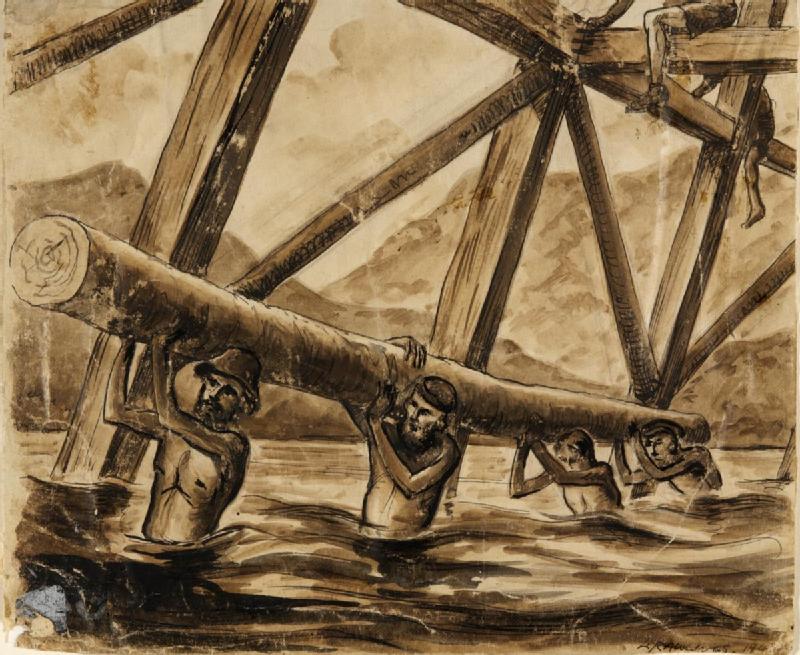
Most foreigners are mainly aware of Kanchanaburi's recent history with the Burma Railway. During the Japanese occupation of Thailand in 1942, both allied POWs and Asian labourers were ordered by the Japanese to build a Thailand-Burma railway. Eventually, more than 100,000 people (16,000 allied POWs and 90,000 local Asian labourers) died from horrific working conditions.
Geography
The province is in the west of Thailand, 129 km from Bangkok, and covers a total area of approximately 19,482 km2 (7,522 sq mi). It is the country's third largest province, after Nakhon Ratchasima and Chiang Mai. Topographically, it is covered with timber and evergreen forests. The total forest area is 11,990 km2 (4,630 sq mi) or 61.5 percent of provincial area. The district covers the source valleys of the rivers Kwae Yai and Kwae Noi ("River Kwai"), which merge at Kanchanaburi city to form the Mae Klong River.
The neighboring provinces are (clockwise, from the north) Tak, Uthai Thani, Suphan Buri, Nakhon Pathom, and Ratchaburi. In the west it borders Kayin State, Mon State, and the Tanintharyi Region of Myanmar.

Bong Ti is a transnational border crossing point, which is expected to gain in importance if the planned Dawei deepwater port project goes ahead, along with a highway and a railway line between Bangkok and the port.
National parks
Seven of the nine national parks in the mountainous areas of the Tenasserim Hills from region 3 (Ban Pong), Phu Toei and Thai Prachan national parks are not in Kanchanaburi province, form protected areas in Kanchanaburi province.(visitors in fiscal year 2024)
Wildlife sanctuaries
Two of three wildlife sanctuaries from region 3 (Ban Pong), Mae Nam Phachi is not in Kanchanaburi province, are the protected areas of Kanchanaburi province.

Climate
Kanchanaburi province has a tropical savanna climate (Köppen climate classification Aw). Winters are dry and very warm. Temperatures rise until April, which is very hot with the average daily maximum at 37.8 °C (100.0 °F). The monsoon season runs from May through October, with heavy rain and somewhat cooler temparatures during the day, although nights remain warm.
Symbols
The seal of the province shows the three stupas on Bantadthong Mountain. They give the name to the mountain pass to Myanmar, called "Three Pagodas Pass".
The provincial flower is the night-flowering jasmine (Nyctanthes arbortristis). The provincial tree is the Moulmein lancewood (Homalium tomentosum). The provincial aquatic animal is the Jullien's golden carp (Probarbus jullieni).

The provincial motto is "The ancient province. The (Three) Pagodas Pass Checkpoint, Gems of Kan, Bridge on the River Kwai. Source of minerals and waterfalls."
Demographics
Population
Population history of Kanchanaburi province is as follows:
Religion
There are total 613 Theravada Buddhist temples in the province.

79 in Mueang Kanchanaburi, 68 in Lao Khwan, 68 in Sai Yok, 59 in Thong Pha Phum, 55 in Tha Muang,46 in Tha Maka, 43 in Bo Phloi,
40 in Phanom Thuan, 37 in Si Sawat, 36 in Nong Prue, 32 in Dan Makham Tia,32 in Huai Krachao, 18 in Sangkhla Buri.
There are 36 Christian churches and seven Mosques.

Administration
Provincial administration
Kanchanaburi is divided into 13 districts (amphoe). The districts are further divided into 107 subdistricts (tambon).
Local government
As of December 2024 there are: one Kanchanaburi provincial administrative organization - PAO (ongkan borihan suan changwat - o bo toh) and 46 municipal (thesaban) areas in the province. Mueang Kanchanaburi, Pak Phraek and Tha Ruea Phra Thaen are town municipalities (thesaban mueang) and 43 are subdistrict municipalities (thesaban tambon).
The non-municipal areas are administered by 72 Subdistrict Administrative Organizations (SAO) (ongkan borihan suan tambon):
Population
The total population of Kanchanaburi province is 896,351, of which Mueang Kanchanaburi district is the most populated with 168,541 people. Tha Maka and Tha Muang districts also have a population exceeding 100,000 people. The remaining ten districts have populations of 27,000 to 71,000, of which Si Sawat district is the least populated district with 26,857 people.
The population density of Kanchanaburi province is 46 people per square kilometer (119 people per sq mile, of which Tha Maka district has the highest density with 386 people per square km (1,006 people per sq mile) and Si Sawat district the lowest density with 8 people per square km (21 people per sq mile)
Health
Government hospitals
There are seventeen government hospitals in Kanchanaburi provinces, of which Mueang Kanchanaburi district has two hospitals:
Phaholpolpayuhasena Hospital with 597 beds
Fort Surasi Hospital with 80 beds
The other twelve districts each have a hospital, but Nong Prue, Sai Yok and Si Sawat districts each have two hospitals as an exception.
Private hospitals
There are four private hospitals in Kanchanaburi province, of which Mueang Kanchanaburi district has two hospitals:
Synphaet Kanchanaburi Hospital with 100 beds
Thanakan Hospital with 74 beds
The other two hospitals are:
in Sangkhla Buri district:
Christian Hospital of the Sangkhla Buri Christian Center with 30 beds.
In Tha Maka district:
Tha Ruea Hospital with 29 beds.
Health promoting hospitals
There are total 142 health-promoting hospitals in the province, of which: 22 in Mueang Kanchanaburi, 15 in Tha Maka, 14 in Tha Muang, 13 in Lao Khwan, 13 in Thong Pha Phum, 12 in Sai Yok, 10 in Bo Phloi, 9 in Phanom Thuan, 9 in Si Sawat, 7 in Nong Prue, 6 in Dan Makham Tia, 6 in Sangkhla Buri and 6 in Huai Krachao.
Clinics
Around 234 clinics are in Kanchanaburi province, of which 89 clinics (38%) in Mueang Kanchanaburi district, 43 in Tha Muang, 39 in Tha Maka, 12 in Bo Phloi, 10 in Thong Pha Phum, 9 in Lao Khwan, 7 in Dan Makham Tia, 7 in Phanom Thuan, 5 in Si Sawat, 4 in Nong Prue, 4 in Sangkhla Buri, 3 in Sai Yok and 2 in Huai Krachao.
Education
In Kanchanaburi province there are many educational institutions at all levels, from kindergarten to university level, both government and private.
Higher education
There are four higher education institutes in the province with 12,984 students:
Kanchanaburi Rajabhat University