
KLM Royal Dutch Airlines, or simply KLM (an abbreviation for their official name Koninklijke Luchtvaart Maatschappij N.V. [ˈkoːnɪŋkləkə ˈlʏxtfaːrt ˌmaːtsxɑˈpɛi ˌɛnˈveː], lit. 'Royal Aviation Company'), is the flag carrier of the Netherlands. KLM's headquarters are located in Amstelveen, with its hub at nearby Amsterdam Airport Schiphol. It is a subsidiary of the Air France–KLM group and a member of the SkyTeam airline alliance. Founded in 1919, KLM is the oldest operating airline still using its original name, having gone through significant changes in its ownership and legal structure over its history, including a period of majority government ownership. The company had a fleet of 110 aircraft (excluding subsidiaries) and 35,488 employees as of 2021. KLM operates scheduled passenger and cargo services to 145 destinations.
Historically, KLM established some of the earliest scheduled intercontinental flights, including interwar routes to the Dutch East Indies (now Indonesia). In 2004, the airline merged with Air France to form the Air France–KLM holding company, though both carriers continue to operate under their separate brand identities. The airline's mainline network is supported by several subsidiaries. Regional European feeder routes are operated by KLM Cityhopper, while low-cost services are managed by Transavia. Freight operations are handled by KLM Cargo and its subsidiary Martinair.
History
Early years
In 1919, young aviator lieutenant Albert Plesman sponsored the ELTA aviation exhibition in Amsterdam. Attendance at the exhibition was over half a million, and after it closed, several Dutch commercial interests intended to establish a Dutch airline, which Plesman was nominated to head. In September 1919, Queen Wilhelmina awarded the yet-to-be-founded KLM its "Royal" ("Koninklijke") predicate. On 7 October 1919, eight Dutch businessmen, including Frits Fentener van Vlissingen, founded KLM as one of the first commercial airline companies. Plesman became its first administrator and director.

The first KLM flight took place on 17 May 1920. KNLM's first pilot, Jerry Shaw, flew from Croydon Airport, London, to Amsterdam. The flight was flown using a leased Aircraft Transport and Travel de Havilland DH-16, registration G-EALU, which was carrying two British journalists and some newspapers. In 1920, KLM carried 440 passengers and 22 tons of freight. In April 1921, after a winter hiatus, KLM resumed its services using Fokker F.II and Fokker F.III aircraft. In 1921, KLM started scheduled services.
KLM's first experimental intercontinental flight took off on 1 October 1924. The final destination was Batavia, Dutch East Indies on Java, now Jakarta, Indonesia, into what would become Halim Perdanakusuma International Airport. The flight used a Fokker F.VII with registration H-NACC and was piloted by Jan Thomassen à Thuessink van der Hoop. In 1927, Baltimore millionaire Van Lear Black, who had heard about the 1924 flight, chartered H-NADP to do the same flight, which departed 15 June and went successfully (16 days), and flew back to much rejoicing. This inspired KLM to make a second test flight, which left on 1 October, returning successfully with much experience gained. In September 1929, regular scheduled services between Amsterdam and Batavia commenced. Until the outbreak of the Second World War in 1939, this was the world's longest-distance scheduled service by airplane. By 1926, it was offering flights to Amsterdam, Rotterdam, Brussels, Paris, London, Bremen, Copenhagen, and Malmö, using primarily Fokker F.II and Fokker F.III aircraft.
In 1930, KLM carried 15,143 passengers. The Douglas DC-2 was introduced on the Batavia service in 1934. The first experimental transatlantic KLM flight was between Amsterdam and Curaçao in December 1934 using the Fokker F.XVIII "Snip".

In July 1935, KLM had three major international passenger flight crashes in one week. The "Kwikstaart" crashed in Amsterdam on 14 July, the "Maraboe" in Bushir on 17 July, and the “Gaai” in San Giacomo on 20 July. The week of 14 to 20 July 1935 came to be known as a "black week" for KLM. In these three crashes, KLM lost three airplanes as well as crew in two of them. Together with an earlier crash in April of the "Leeuwerik", KLM had lost around 15% of its pilots in 1935. As a result, there was a shortage of crew members and airplanes, and the Amsterdam—Milan flight service was taken over by Deutsche Lufthansa.
The first of the airline's Douglas DC-3 aircraft were delivered by ship, on the Holland America Line ocean liner Statendam on 11 September 1936; these replaced the DC-2s on the service via Batavia to Sydney. KLM was the first airline to serve Manchester's new Ringway airport, starting in June 1938. KLM was the only civilian airline to receive the Douglas DC-5; the airline used two of them in the West Indies and sold two to the East Indies government, and is thus the only airline to have operated all Douglas 'DC' models other than the DC-1.
Second World War
The outbreak of the Second World War in September 1939 restricted KLM's operations, with flights over France and Germany prohibited, and many of its aircraft painted in overall orange to limit the potential for confusion with military aircraft. European routes were limited to services to Scandinavia, Belgium and the UK, with flights to Lisbon (bypassing both British and French airspace) starting in April 1940.

When Germany invaded the Netherlands on 10 May 1940, several KLM aircraft—mostly DC-3s and a few DC-2s—were en route to or from the Far East, or were operating services in Europe. Five DC-3s and one DC-2 were taken to Britain. During the war, these aircraft and crew members flew scheduled passenger flights between Bristol and Lisbon under BOAC flight numbers and registration.
On 3 March 1942, Douglas DC-3 PH-ALP "Pelikaan", then registered as PK-AFV, was shot down over Western Australia by Imperial Japanese Navy Air Service Mitsubishi A6M Zeros during the attack on Broome while carrying a package of diamonds. The DC-3 crash landed at Carnot Bay, 80 kilometers from Broome. Pelikaan was subsequently strafed by the Zeros that had shot it down, killing three passengers and the flight engineer. Diamonds worth an estimated 150,000–300,000 Australian pounds were stolen from the wreckage of the aircraft, and nobody has been convicted of the crime.
Douglas DC-3 PH-ALI "Ibis", then registered as G-AGBB, was attacked by the Luftwaffe on 15 November 1942, 19 April 1943, and finally shot down on 1 June 1943 as BOAC Flight 777, killing all passengers and crew.
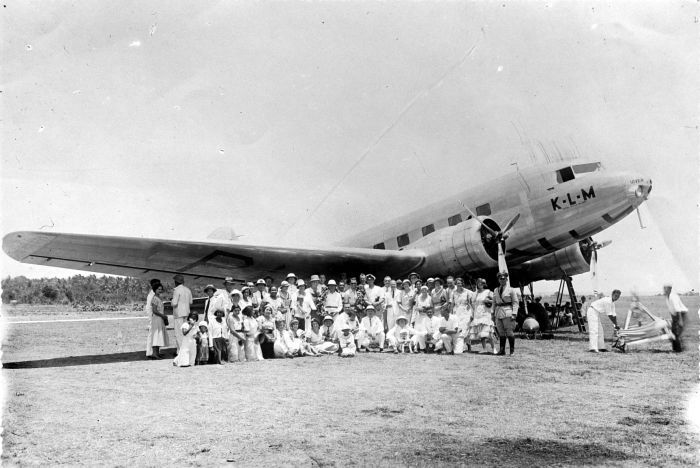
Some KLM aircraft and their crews ended up in the Australia-Dutch East Indies region, where they helped transport refugees from Japanese aggression in that area.
Although operations paused in Europe, KLM continued to fly and expand in the Caribbean.
Post-World War II
After the end of the Second World War in August 1945, KLM immediately started to rebuild its network. Since the Dutch East Indies were in a state of revolt, Plesman prioritised re-establishing KLM's route to Batavia. This service was reinstated by the end of 1945. Domestic and European flights resumed in September 1945, initially with a fleet of Douglas DC-3s and Douglas DC-4s. On 21 May 1946, KLM was the first continental European airline to start scheduled transatlantic flights between Amsterdam and New York City using Douglas DC-4 aircraft. By 1948, KLM had reconstructed its network and services to Africa, North and South America, and the Caribbean resumed.

Long-range, pressurized Lockheed Constellations and Douglas DC-6s joined KLM's fleet in the late 1940s; the Convair 240 short-range pressurized twin-engine airliner began European flights for the company in late 1948.
During the immediate post-war period, the Dutch government expressed interest in gaining a majority stake in KLM, thus partially nationalizing it. Plesman wanted KLM to remain a private company under private control; he allowed the Dutch government to acquire a minority stake in the airline. In 1950, KLM carried 356,069 passengers. The expansion of the network continued in the 1950s with the addition of several destinations in western North America. KLM's fleet expanded with the addition of new versions of the Lockheed Constellation and Lockheed Electra, of which KLM was the first European airline to fly.
On 31 December 1953, the founder and president of KLM, Albert Plesman, died at the age of 64. He was succeeded as president by Fons Aler. After Plesman's death, the company and other airlines entered a difficult economic period. The conversion to jet aircraft placed a further financial burden on KLM. The Netherlands government increased its ownership of the company to two-thirds, thus partly nationalizing it. The board of directors remained under the control of private shareholders.

On 25 July 1957, the airline introduced its flight simulator for the Douglas DC-7C – the last KLM aircraft with piston engines – which opened the transpolar route from Amsterdam via Anchorage to Tokyo on 1 November 1958. Each crew flying the transpolar route over the Arctic was equipped with a winter survival kit, including a 7.62 mm selective-fire AR-10 carbine for use against polar bears, in the event the plane was forced down onto the polar ice. The four-engine turboprop Vickers Viscount 800 was introduced on European routes in 1957. Beginning in September 1959, KLM introduced the four-engine turboprop Lockheed L-188 Electra onto some of its European and Middle Eastern routes.
1960s–1970s: Jet age
In March 1960, the airline introduced the first Douglas DC-8 jet into its fleet. In 1961, KLM reported its first year of losses. In 1961, the airline's president Fons Aler was succeeded by Ernst van der Beugel. However, This leadership change did not lead to a reversal of KLM's financial difficulties. Van der Beugel resigned as president in 1963 for health reasons. Horatius Albarda was appointed to succeed Ernst van der Beugel as president of KLM in 1963. Albarda initiated a reorganization of the company, which led to the reduction of staff and air services. In 1965, Albarda died in an air crash and was succeeded as president by Dr. Gerrit van der Wal. Van der Wal forged an agreement with the Dutch government that KLM would be once again run as a private company. By 1966, the stake of the Dutch government in KLM was reduced to a minority stake of 49.5%. In 1966, KLM introduced the Douglas DC-9 on European and Middle East routes.
The new terminal buildings at Amsterdam Airport Schiphol opened in April 1967, and in 1968 the stretched Douglas DC-8-63 ("Super DC-8") entered service. With 244 seats, the Super DC-8 was the largest airliner in scheduled passenger service at the time, although its size was surpassed by that of the Boeing 747 first flown in 1969. On 6 March 1967, KLM ordered the 747 as its first Boeing aircraft, which marked the beginning of its use of widebody aircraft and an improved relationship between the airline and Boeing since the 1939 crash of a Boeing 307 Stratoliner carrying KLM representatives on a demonstration flight. To negotiate for lower unit prices and form a maintenance pool for its 747 fleet, KLM formed the KSS maintenance consortium in 1969 with Scandinavian Airlines and Swissair. Despite showing initial interest in the prototype 747-100 variant, KLM instead acquired the higher-gross-weight 747-200B powered by Pratt & Whitney JT9D engines, becoming the first airline to put the type into service on 14 February 1971. In March 1971, KLM opened its current headquarters in Amstelveen. In 1972, it purchased the first of several McDonnell Douglas DC-10 aircraft—McDonnell Douglas's response to the 747.
In 1973, Sergio Orlandini was appointed to succeed Gerrit van der Wal as president of KLM. At the time, KLM, as well as other airlines, had to deal with overcapacity. Orlandini proposed to convert KLM 747s to "combis" that could carry a combination of passengers and freight in a mixed configuration on the main deck of the aircraft. In November 1975, the first of these seven Boeing 747-200BM Combi aircraft were added to the KLM fleet. The airline previously operated DC-8 passenger and freight combi aircraft as well and later operated Boeing 747-400 combi aircraft.
The 1973 oil crisis, which caused difficult economic conditions, led KLM to seek government assistance in arranging debt refinancing. The airline issued additional shares of stock to the government in return for its money. In the late 1970s, the government's stake had again increased to a majority of 78%, effectively re-nationalizing it. The company management remained under the control of private stakeholders.
1980s–1990s: International expansion
In 1980, KLM carried 9,715,069 passengers. In 1983, it reached an agreement with Boeing to upgrade ten of its Boeing 747-200 aircraft (Three 747-200Bs and seven 747-200Ms) with the stretched-upper-deck modification. The work started in 1984 at the Boeing factory in Everett, Washington, and finished in 1986. The converted aircraft were called Boeing 747-200SUD or 747-300, which the airline operated in addition to three newly built Boeing 747-300s manufactured from the ground up. In 1983, KLM took delivery of the first of ten Airbus A310 passenger jets. Sergio Orlandini retired in 1987 and was succeeded as president of KLM by Jan de Soet. In 1986, the Dutch government's shareholding in KLM was reduced to 54.8 percent. It was expected that this share would be further reduced during the decade. The Boeing 747-400 was introduced into KLM's fleet in June 1989.
With the liberalization of the European market, KLM started developing its hub at Amsterdam Airport Schiphol by feeding its network with traffic from affiliated airlines. As part of its development of a worldwide network, KLM acquired a 20% stake in Northwest Airlines in July 1989. In 1990, KLM carried 16,000,000 passengers. KLM president Jan de Soet retired at the end of 1990 and was succeeded in 1991 by Pieter Bouw. In December 1991, KLM was the first European airline to introduce a frequent flyer loyalty program, which was called Flying Dutchman.
Joint venture with Northwest Airlines
In January 1993, the United States Department of Transportation granted KLM and Northwest Airlines anti-trust immunity, which allowed them to intensify their partnership. As of September 1993, the airlines operated their flights between the United States and Europe as part of a joint venture. In March 1994, KLM and Northwest Airlines introduced World Business Class on intercontinental routes. KLM's stake in Northwest Airlines was increased to 25% in 1994.
KLM introduced the Boeing 767-300ER in July 1995. In January 1996, KLM acquired a 26% share in Kenya Airways, the flag-carrier airline of Kenya. In 1997, Pieter Bouw resigned as president of KLM and was succeeded by Leo van Wijk. In August 1998, KLM repurchased all regular shares from the Dutch government to make KLM a private company. On 1 November 1999, KLM founded AirCares, a communication and fundraising platform supporting worthy causes and focusing on underprivileged children.
KLM renewed its intercontinental fleets by replacing the Boeing 767s, Boeing 747-300s, and eventually, the McDonnell Douglas MD-11s with Boeing 777-200ERs and Airbus A330-200s. Some 747s were withdrawn from service first. The MD-11s remained in service until October 2014. The first Boeing 777 was received on 25 October 2003, while the first Airbus A330-200 was introduced on 25 August 2005.
2000s: Air France-KLM merger
On 30 September 2003, Air France and KLM agreed to a merger plan in which Air France and KLM would become subsidiaries of a holding company called Air France-KLM. Both airlines would retain their own brands; both Charles de Gaulle Airport and Amsterdam Airport Schiphol would become key hubs. In February 2004, the European Commission and United States Department of Justice approved the proposed merger of the airlines. In April 2004, an exchange offer in which KLM shareholders exchanged their KLM shares for Air France shares took place. Since 5 May 2004, Air France-KLM has been listed on the Euronext exchanges in Paris, Amsterdam and New York. In September 2004, the merger was completed by creation of the Air France-KLM holding company. The merger resulted in the world's largest airline group and should have led to an estimated annual cost-saving of between €400 million and €500 million.
It did not appear that KLM's longstanding joint venture with Northwest Airlines—which merged with Delta Air Lines in 2008—was affected by the merger with Air France. KLM and Northwest joined the SkyTeam alliance in September 2004. Also in 2004, senior management came under fire for providing itself with controversial bonuses after the merger with Air France, while 4,500 jobs were lost at KLM. After external pressure, management gave up on these bonuses.
In March 2007, KLM started to use the Amadeus CRS reservation system, along with partner Kenya Airways. After 10 years as president of the airline, Leo van Wijk resigned from his position and was succeeded by Peter Hartman.
2010s
Beginning in September 2010, KLM integrated the passenger division of Martinair into KLM, transferring all personnel and routes. By November 2011, Martinair consisted of only the cargo and maintenance division. In March 2011, KLM and InselAir reached an agreement for cooperation on InselAir destinations, thus expanding its passenger services. Beginning 27 March 2011, KLM passengers could fly to all InselAir destinations through InselAir's hubs in Curaçao and Sint Maarten. This cooperation was extended to a code share agreement in 2012. In early 2018, the cooperation with Inselair was terminated, including any interlining agreements, after Inselair found itself in financial difficulties which forced the airline to sell off part of its fleet and cancel some of its routes.
On 20 February 2013, KLM announced that Peter Hartman would resign as president and CEO of KLM on 1 July 2013. He was succeeded by Camiel Eurlings. Hartman remained employed by the company until he retired on 1 January 2014. On 15 October 2014, KLM announced that Eurlings, in joint consultation with the supervisory board, had decided to immediately resign as president and CEO. As of this date, he was succeeded by Pieter Elbers. KLM received the award for "Best Airline Staff Service" in Europe at the World Airline Awards 2013. This award represents the rating for an airline's performance across both airport staff and cabin staff combined. It is the second consecutive year that KLM won this award; in 2012 it was awarded this title as well. On 19 June 2012, KLM made the first transatlantic flight fueled partly by sustainable biofuels to Rio de Janeiro. This was the longest distance any aircraft had flown on biofuels.
In 2019, KLM celebrated its centennial, as it was founded in 1919. Since it is the oldest airline still operating under its original name, it was the first airline to achieve this feat.
2020s
Being heavily affected by the COVID-19 pandemic, KLM cut at least 6,000 jobs in total. It also said that the decision of the government to have all the passengers and crew COVID-19 tested before flying will have an impact on its flights. On 16 December 2021, Air France-KLM announced an order for 100 Airbus A320neos to be divided between Transavia and KLM. In July 2022, KLM was forced to cut their summer schedule due to disruption at airports across Europe.
Corporate affairs and identity
Business trends
Key business and operating results of KLM are shown below (as at year ending 31 December):
Management
As of July 2022, KLM's corporate leader is its president and chief executive officer (CEO) Marjan Rintel, who succeeded Pieter Elbers. The president and CEO is part of the larger Executive Committee, which manages KLM and consists of the statutory managing directors and executive vice-presidents of KLM's business units that are represented in the Executive Committee. The supervision and management of KLM are structured following the two-tier model; the Board of Managing Directors is supervised by a separate and independent Supervisory Board. The Supervisory Board also supervises the general performance of KLM. The Board of Managing Directors is formed by the four Managing Directors, including the CEO. Nine Supervisory Directors compose the Supervisory Board.
Head office
KLM's head office is located in Amstelveen, on a 6.5-hectare (16-acre) site near Schiphol Airport. The airline's current headquarters was built between 1968 and 1970. Before the opening of the new headquarters, the airline's head office was on the property of Schiphol Airport in Haarlemmermeer.
Subsidiaries
Companies in which KLM has a stake include:
Former subsidiaries
Subsidiaries, associates, and joint ventures of KLM in the past include:
KLM also worked closely with ALM Antillean Airlines in the Caribbean to provide air service for the Dutch-controlled islands in the region with KLM aircraft such as the Douglas DC-8 and McDonnell Douglas DC-9-30 being operated by KLM flight crews on behalf of ALM.
KLM Asia
KLM Asia (Chinese: 荷蘭亞洲航空公司; pinyin: Hélán Yàzhōu Hángkōng Gōngsī) is a wholly owned subsidiary registered in Taiwan. The subsidiary was established in 1995 to allow KLM to continue operating flights to Taipei without compromising the mainline KLM's traffic rights for destinations in the People's Republic of China. Aircraft operated by the subsidiary retain their Dutch registration and the basic KLM livery but receive several modifications: the flags of both the Netherlands and European Union are removed while the Dutch Crown logo is replaced with the KLM Asia wordmark.
The fleet of aircraft operated by the subsidiary consists of seven Boeing 777-200ER and two Boeing 777-300ER aircraft as of March 2020. As of 2012, KLM used the "KLM Asia" brand to fly to Taipei and the aircraft had to fly over China. Previously, KLM used Boeing 747s for its services to Taiwan. In 2012, it started operating the revised Amsterdam-Taipei-Manila route with Boeing 777-200ER aircraft.