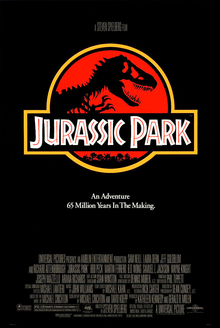
Jurassic Park is a 1993 American science fiction adventure film directed by Steven Spielberg and written by Michael Crichton and David Koepp, based on Crichton's 1990 novel. Starring Sam Neill, Laura Dern, Jeff Goldblum, and Richard Attenborough, the film is set on the fictional island of Isla Nublar near Costa Rica, where wealthy businessman John Hammond (Attenborough) and a team of genetic scientists have created a wildlife park of de-extinct dinosaurs. When industrial sabotage leads to a catastrophic shutdown of the park's power facilities and security precautions, a small group of visitors struggle to survive and escape the now perilous island.
Before Crichton's novel was published, four studios put in bids for its film rights. With the backing of Universal Pictures, Spielberg acquired the rights for $1.5 million. Crichton was hired for an additional $500,000 to adapt the novel for the screen. Koepp wrote the final draft, which left out much of the novel's exposition and violence, and featured numerous changes to the characters. Filming took place in California and Hawaii from August to November 1992. Post-production lasted until May 1993, supervised by Spielberg in Poland as he filmed Schindler's List. The dinosaurs were created with groundbreaking computer-generated imagery by Industrial Light & Magic, and with life-sized animatronic dinosaurs built by Stan Winston's team. To showcase the film's sound design, which included a mixture of various animal noises for the dinosaur sounds, Spielberg invested in the creation of DTS, a company specializing in digital surround sound formats. The film was backed by an extensive $65 million marketing campaign, which included licensing deals with over 100 companies.
Jurassic Park premiered on June 9, 1993, at the Uptown Theater in Washington, D.C., and was released two days later throughout the United States. It was a blockbuster hit and went on to gross over $914 million worldwide in its original theatrical run, surpassing Spielberg's own E.T. the Extra-Terrestrial to become the highest-grossing film of all time until the release of Titanic (1997). The film received critical acclaim, with praise to its special effects, sound design, action sequences, John Williams's score, and Spielberg's direction. The film won 20 awards, including three Academy Awards for technical achievements in visual effects and sound design. Following its 20th anniversary re-release in 2013, Jurassic Park became the oldest film in history to surpass $1 billion in ticket sales and the 17th overall.

Since its release, many film critics and industry professionals have regarded Jurassic Park as one of the greatest films ever made. Its groundbreaking use of computer-generated imagery is widely seen as a turning point that shaped the visual effects techniques used in modern cinema. In 2018, it was selected for preservation in the United States National Film Registry by the Library of Congress as "culturally, historically, or aesthetically significant". The film spawned a multimedia franchise that includes six sequels, video games, theme park attractions, comic books, and various merchandise.
Plot
Industrialist John Hammond has created Jurassic Park, a theme park featuring de-extinct dinosaurs, on the tropical island Isla Nublar, off the coast of Costa Rica. After a Velociraptor kills a dinosaur handler, the park's investors, represented by lawyer Donald Gennaro, threaten to pull funding unless experts certify the island's safety. Gennaro invites the chaotician Ian Malcolm, while Hammond invites the paleontologist Alan Grant and the paleobotanist Ellie Sattler. Upon arrival, the group is shocked to see living Brachiosaurus and Parasaurolophus. At the park's visitor center, the group learns that the cloning was accomplished by extracting dinosaur DNA from prehistoric mosquitoes preserved in amber. DNA from frogs and other animals was used to fill in gaps in the dinosaurs' genome. To prevent the dinosaurs from breeding, they are all made female by chromosome manipulation.
The group witnesses the hatching of a baby Velociraptor and visits the raptor enclosure. During lunch, they debate the ethics of cloning and of the park in general. Malcolm warns of the implications of genetic engineering while Grant and Sattler express uncertainty over the ability of humans and dinosaurs to coexist. Hammond's grandchildren, Lex and Tim, join the others for a park tour in two self-driving electric vehicles, while Hammond observes them from the control room. Most of the dinosaurs fail to appear, and the group encounters a sick Triceratops. The tour is cut short as a tropical storm approaches. The park employees leave for the mainland on a boat while the visitors return to their vehicles; Sattler stays behind to study the Triceratops.

Jurassic Park's disgruntled computer programmer, Dennis Nedry, was previously bribed to steal frozen dinosaur embryos by Lewis Dodgson, a man working for Hammond's corporate rival. To access the embryo storage room, Nedry deactivates the park's security system, cutting power to the tour vehicles. Most of the park's electric fences have been deactivated, which allows a Tyrannosaurus rex to escape and attack the touring group. The Tyrannosaurus devours Gennaro and injures Malcolm while Grant, Lex, and Tim escape. On his way to deliver the embryos to the island's docks, Nedry gets lost in the rain, crashes his jeep, and is killed by a venom-spitting Dilophosaurus.
Sattler helps the game warden Robert Muldoon search for survivors; they find Malcolm just before the Tyrannosaurus returns and chases them away. Grant, Lex and Tim take shelter in a tree and encounter a Brachiosaurus herd, then discover the broken shells of dinosaur eggs the following morning. Grant concludes that the dinosaurs are breeding, which is possible because of their amphibian DNA—animals like West African frogs can change their sex in a single-sex environment.
Unable to decipher Nedry's code to reactivate the security system, Hammond and chief engineer Ray Arnold decide to reboot the park's systems. They shut down the power grid and retreat to an emergency bunker while Arnold heads to a maintenance shed to complete the rebooting process. When Arnold fails to return, Sattler and Muldoon go to the shed, and discover that the shutdown has released the Velociraptors. Sattler turns the power back on before being attacked by a raptor and discovering Arnold's severed arm. While she escapes, Muldoon is killed by another Velociraptor.

Grant, Lex and Tim reach the visitor center. Grant leaves to look for Sattler, leaving Lex and Tim inside. The raptors appear and pursue the children through a kitchen, but they escape and join Grant and Sattler. The group reaches the control room, and Lex restores the park's systems, allowing them to contact Hammond, who radios for a helicopter to take them off the island. As the group tries to leave they are cornered by the two raptors, but the Tyrannosaurus appears and fights the velociraptors. It kills the first by biting it, and throws the second into a skeleton on exhibit, killing it as well.
The group flees and boards the helicopter, and Grant and Hammond agree not to endorse the park.
Cast
Production
Development
Michael Crichton's 1990 novel Jurassic Park was originally conceived as a screenplay in the 1980s, and went through numerous changes before being published as a book. In the late 1970s, a bidding war began for the film rights to Crichton's then-upcoming novel Congo, which would not be made into a film until 1995. With Jurassic Park, Crichton hoped to avoid another bidding war and the same protracted outcome by offering the film rights at a fixed price of $1.5 million, as he was primarily concerned with ensuring that a film actually be produced; he was less interested in receiving a top offer.

Crichton submitted the Jurassic Park manuscript to his publisher in May 1990. Director Steven Spielberg learned of the novel that month while he was discussing a screenplay with Crichton that would become the television series ER. Spielberg, who had a life-long fascination with dinosaurs and had long admired the work of Ray Harryhausen, expressed interest in Jurassic Park. After reading the galleys, he committed to direct the film adaptation. He liked the novel's sense of adventure and its scientific explanation for dinosaur resurrection, saying it provided "a really credible look at how dinosaurs might someday be brought back alongside modern mankind".
Crichton was represented by agent Michael Ovitz at Creative Artists Agency. Spielberg recalled that "the agency got ahold of it; and they, of course, encouraged a bidding war, even though Michael had kind of promised me the book privately". Major studios bid for the film rights, each with a director in mind. This included Warner Bros. and Tim Burton, Columbia Pictures and Richard Donner, and 20th Century Fox and Joe Dante. Crichton spoke with each director and endorsed Spielberg as the most likely candidate to get the film made, noting it would be "a very difficult picture" and calling Spielberg "arguably the most experienced and most successful director of these kinds of movies". Universal Pictures, also backing Spielberg as director, acquired the rights on May 15, 1990, less than a week after they were offered for sale and six months before the novel's publication. The film was announced on May 25, 1990.
James Cameron revealed in 2012 that he had tried to purchase the rights, only to discover that Spielberg had acquired them a few hours prior. Cameron said his version of Jurassic Park would have been "much nastier", comparing it with his film Aliens. He realized he was not the right director for Jurassic Park after seeing the finished product, commending Spielberg for making a film which could be enjoyed by children. Dante also praised it, but disagreed with Spielberg's decision to make Hammond more of a protagonist, a departure from the novel.

Storyboards and sketches were already being produced weeks after the rights were acquired. In order to ensure the scenes would work in 3D space, the storyboards were later expanded by Amblin employee Stefan Dechant into simple animatics made with an Amiga 2000 and the Video Toaster. Because of the island setting and abundance of dinosaurs, Spielberg believed it would be advantageous to hire a production designer as soon as possible, choosing Rick Carter about two years before the start of filming. They both read the galleys and held many meetings to discuss which scenes would work best in the film adaptation.
Spielberg, who, as a child, had been fascinated with dinosaurs and imagined what it would be like to meet one, felt that it was important to channel that childlike sense of wonder for the film. Spielberg said that with Jurassic Park, he "was really just trying to make a good sequel to Jaws, on land". He was also heavily inspired by King Kong, calling it the "high-water mark" for special effects and for imagining "what it would be like to do a King Kong of today". He cited Hatari! as another inspiration, calling it "the high-water mark of man versus the natural in a feature film". Spielberg described Godzilla, King of the Monsters! as the most masterful dinosaur film of his youth, stating that it made him and viewers believe it was really happening. Although he did not set out to make a dinosaur film better than any others, he did want Jurassic Park to be "the most realistic of them all".
It eventually became clear to Spielberg that Jurassic Park would require more time in development, in order to determine the effects needed to create the dinosaurs. He shifted focus to his film Hook, while continuing to monitor progress on Jurassic Park, including script revisions. The art department went on an eight-month hiatus from Jurassic Park to work on Death Becomes Her, another Universal film. After completing Hook, Spielberg wanted Schindler's List to be his next film. Sid Sheinberg, president of Music Corporation of America (Universal's parent company at the time) gave the greenlight to Schindler's List on the condition that Spielberg make Jurassic Park first. Set designs began to be finalized in January 1992; a hotel was among locations at the fictional park that would be cut from the film. The film's budget is disputed; some sources place it at $63 million, while others, including Spielberg, have stated that the budget was $56 million.
Kathleen Kennedy, who co-founded Amblin Entertainment with Spielberg, would serve as a producer on Jurassic Park alongside Gerald Molen, who had worked with Amblin in the past. Kennedy handled the creative aspects of the project, while Molen managed production-related elements. Dean Cundey, the cinematographer for Hook, would rejoin Spielberg for Jurassic Park, signing on to the project relatively late in pre-production. However, he had followed the film's progress through an association with Carter; both had worked on Death Becomes Her. Cundey described his cinematography as "a realistic, crisp, color-saturated look," aligning with Spielberg's vision for the film. He described the look of the film as "heightened reality", with unrealistically dramatic lighting and imagery, but without diffusion or camera filters. He explained that one of his largest challenges working on the film was balancing the necessity of the effects crew of placing dinosaurs primarily in shadow, Spielberg's penchant for dramatic imagery, and the audience's expectation of realism. Michael Kahn, Spielberg's longtime film editor, would also return for Jurassic Park.
Writing
Crichton had mixed feelings about being offered a further $500,000 to write the film adaptation: "I was so tired of the whole area that I didn't really want to do the screenplay. I was sick of Malcolm and I was sick of Grant–and I was even sick of the dinosaurs. But I really felt that I knew the dimensions of the story." Crichton recognized that, by writing the screenplay himself, the project could avoid the same issues he experienced while developing the novel.
Before writing the film, he met several times with Spielberg to discuss which aspects of the book he liked and disliked. Crichton completed his first draft on September 7, 1990, but said "nobody was happy with it at all"; the draft skipped ahead to action rather than building up to it, as in the novel. At Spielberg's suggestion, Crichton rewrote the script in 40-page increments, with the first batch being better received. Crichton was aided by existing storyboards and sketches as he continued to rework the script, with the remaining 80 pages completed on January 19, 1991. Production designer Rick Carter held story meetings with Crichton while he wrote, suggesting ideas for Crichton to implement. Some notable ways Crichton's early drafts differ from the finished film include Hammond initially being less sympathetic and having a much less prominent role and Malcolm lacking a sense of humor.
New writers
Crichton had agreed only to write a preliminary version of the film: "I told Steven, 'I'll do a draft for you and cut it down to budgetable size; but then you're going to want somebody else to polish the characters.' I think that sort of surprised him, because writers never say, 'Get somebody else.'" After Crichton's departure, Carter modified Crichton's revised draft, incorporating into it a number of ideas that they had discussed together. Several key elements of the finished film began with Carter's edits, including Hammond recruiting Grant and Sattler, as well as Hammond's general demeanor and the development of his character arc. Meanwhile, the production crew searched for a new writer, considering, among others, playwright Tom Stoppard, who had written the screenplay for Spielberg and Kennedy's film Empire of the Sun.
During this time, Spielberg was filming Hook, which was co-written by Malia Scotch Marmo and produced by Kennedy. While on the set of Hook, Scotch Marmo was reading the Jurassic Park novel and learned from Kennedy about the film adaptation, accepting an offer to work on its screenplay. Scotch Marmo began writing Jurassic Park in October 1991. She chose to start from scratch, with the novel as her basis, although she did read Crichton's screenplay and consulted with him. Spielberg also agreed to provide her with his own copy of the novel, which contained highlighted aspects of the book that he enjoyed. In addition, she looked at the numerous storyboards produced up to that point.
Scotch Marmo focused on building up the characters "to give them more life and more purpose" than in Crichton's novel and screenplay. She removed Malcolm from the story and tried to incorporate his characteristics into Grant, whom she found to be underdeveloped. She added a romance between Grant and Sattler, an element that was not present in either the novel or Crichton's screenplays. She also sought to emphasize the major themes of the novel, specifically the "fatal flaw of trying to control nature," for instance by showing jungle vegetation creeping into the park's unfinished visitor center: "The idea was that nature was always in the way, always pushing hard against the intrusion." In the novel, Hammond is killed by a pack of Procompsognathus. Both of Crichton's drafts had also included death scenes, with Hammond dying in a similar way as in the novel in the first draft, and, in the second, being killed by Velociraptors at the visitor center theater as his narration in the tour's introductory video plays over his screams. Carter's version had Hammond killed by falling onto a model of the park after being clawed by a raptor. In Scotch Marmo's draft, Hammond chooses to stay behind on Isla Nublar, and then drowns in a puddle, with the film's final shot being a mosquito landing on his arm.
Scotch Marmo spent five months writing her draft and worked closely with Spielberg, noting that their collaboration was unlike most films in which writers "get an assignment, go home, write it and turn it in". She would send him 15 pages at a time, and then would rework them to his liking, sending the revised pages back along with the next 15. She completed her draft on March 14, 1992; Spielberg read it twice and was dissatisfied. She recalled later, "As a writer, that's a terrible feeling. The natural urge is to say: 'Give me another week. I can work it out. I know I can.' But the truth is, sometimes you do hit and sometimes you miss. It's just a shame that it takes so long to find out."
Spielberg immediately began searching for a new writer, and Universal president Casey Silver recommended David Koepp, who co-wrote Death Becomes Her. Koepp had not read the novel, but quickly obtained a copy, and later discussed the book with Spielberg. Koepp disliked doing rewrites because "it's very hard to get into the mind of somebody else and try to follow what they were doing". Spielberg told Koepp he could start from scratch, allowing his own ideas to fully develop. He read through the novel four times before he began writing the screenplay, and chose not to read the earlier drafts until he finished his own. Two sequences from the novel were mandated: the T. rex attack on a tour vehicle, and the raptors in the kitchen. Otherwise, Koepp was generally allowed to make his own creative choices. Spielberg instructed Koepp to be unconcerned with what technology allowed, so Koepp wrote sequences without knowing if they would be possible to film. He drew from the considerable volume of storyboards and script ideas that had been generated from the film's two-year development process.
Koepp found it difficult to condense the novel's scientific exposition, especially the dialogue that explains how the dinosaurs were created. Spielberg devised an idea to easily convey the cloning process through a short, animated film shown to the park visitors, inspired by the educational television special Hemo the Magnificent. Koepp named the film's cartoon narrator "Mr. DNA", after Spielberg jokingly referred to the character as such. In the same scene, Hammond interacting with the on-screen version of himself is a homage to Gertie the Dinosaur, which was similarly interacted with live by its animator Winsor McCay. Koepp found Malcolm difficult to write due to the character's dialogue being heavy on math and chaos theory; he initially thought to use graphics to visually represent Malcolm's ideas while he talks, an approach inspired by the documentary A Brief History of Time, but Spielberg shot him down, explaining that this approach would break the film's visual style. He decided to solve the problem by removing the character and merging his traits into Grant, just as Scotch Marmo had.
After Koepp finished his first draft in April–May of 1992, Spielberg sent it to Scotch Marmo for her opinion, and she replied with 12 pages of input; these were forwarded to Koepp, who found them helpful. He continued to work closely with Spielberg and with additional feedback from Scotch Marmo. Malcolm was written in at Spielberg's insistence, after Jeff Goldblum auditioned for the film and was deemed perfect for the role. Koepp tried to make the characters interesting by adding moments such as Malcolm flirting with Sattler, leading to Grant's jealousy. Koepp, partially drawing inspiration from Goldblum's casting, made Malcolm into a more comedic character, and also modeled Hammond on Walt Disney and refocused his motivation towards a desire to entertain. Sattler's characterization and dialogue were modified to have feminist qualities through the input of Laura Dern, her actress. Koepp also tried to avoid excessive character detail because "whenever they started talking about their personal lives, you couldn't care less". He described one scene, in which Sattler and Hammond discuss the park while eating ice cream, as the hardest in the film to write; Spielberg and both actors provided input to the scene, which had to be rewritten 27 times, including during filming. During some scenes, he wrote several dialogue variations to give Spielberg line options to choose from during filming. Drawing inspiration from Spielberg's earlier film Jaws, Koepp kept the T. rex offscreen prior to its breakout scene, instead implying the violence it caused, in order to increase tension. Spielberg suggested modifying that scene so that the T. rex pursues the characters in a Jeep; originally, it only depicted them driving away after hearing the dinosaur's footsteps.
Rewrites continued until just before the start of filming, although Spielberg and Koepp continued revising the script well afterwards. Crichton noted that the final draft differed drastically from his earlier script, but praised the changes and said the new screenplay "seems very compatible with my way of thinking—it fits in my mind". Scotch Marmo did not receive credit for her work.
Changes from the novel
Crichton said that because the novel was "fairly long," at nearly 400 pages, the film adaptation would only have about 10-20% of its content; scenes were dropped for budgetary and practical reasons, and the violence was toned down. Spielberg said, "What I wanted to do was boil the book down and choose my seven or eight favorite scenes and base the script around those." In a departure from the novel, Spielberg sought to reduce the number of dinosaurs, believing it would not be "physically possible" to make the film otherwise. Koepp said the novel was written "more or less like a movie," making it one of the easier book-to-film adaptations he had worked on. He commented that, like with any adaptation, the most difficult part of his writing assignment was to determine the overall structure of the story. The film was also considerably less graphically violent than the novel. Crichton explained that he had made the novel graphic to force readers to take the dinosaurs seriously, which the film was able to naturally accomplish through the appearance of the dinosaurs, rendering the novel's gore unnecessary. He additionally attributed the film's reduced violence to his view that onscreen graphic violence breaks the audience's suspension of disbelief. Crichton was accepting of changes to his novel, stating that because novels and films were different mediums, changes to the novel sometimes improved the film, and that his goal was not accuracy to the source material, but rather creating the best film possible.
Spielberg removed an early scene in the novel, in which a pack of Procompsognathus kill a baby, as he found it too horrific. A major sequence, present in the novel and the two earlier screenplays, involved the T. rex chasing Grant and Hammond's grandchildren in a raft down a river. Koepp chose not to include this in his script: "I never wanted the raft sequence. It seemed to me that at certain points in the book we were being taken on sort of an obligatory tour past every dinosaur the park had to offer." He said the omission was an easy choice, calling the sequence redundant and noting that it would have been "monstrously expensive" to shoot. Computer-generated imagery would be used to create some of the film's dinosaurs, and the technology's limitations at that time were another factor in removing the raft sequence. Koepp said that "making a T. rex, period, was going to be this enormous challenge. In the early '90s, water was still a big challenge for CG, and so the idea of making a T. rex and then having it swim was a bridge too far." Scenes from the novel that were cut from the film adaptation would gradually be included in sequels, with the raft sequence being featured in Jurassic World Rebirth. Other novel sequences featured in sequels include one set in a pterosaur aviary, which was removed as it did not move the plot along and was repurposed for Jurassic Park III and another scene involving characters being trapped behind a waterfall by a T. rex, which was adapted in The Lost World: Jurassic Park.
The film's opening changed several times across various drafts of the screenplay. The novel's opening scene involved an injured park worker being brought to a medic by staff, who attempt to cover up that he was attacked by a dinosaur. Crichton's first draft skipped this, jumping straight to Grant and Sattler's introduction in Montana. His revised script opened with a different sequence pulled from the novel, featuring the daughter of a beachgoing family getting attacked by dinosaurs, which later got retooled into the opening of The Lost World. Scotch Marmo's draft began with a shot of blood being extracted from a mosquito encased in amber, followed by Grant and Sattler's introduction. Koepp liked the novel's opening, and used a slightly modified version of it to open his first draft. Spielberg, however, found it too reminiscent of a similar scene in Jaws, so Koepp pivoted the scene to focus on the dinosaur attack itself.
Several characters were modified for the film. Hammond, who was originally a ruthless and greedy businessman in the novel, was rewritten to be sympathetic, as Spielberg related to the character's obsession with showmanship. The ages of Tim and Lex were switched; Spielberg did this because he wanted to work with the younger Joseph Mazzello, and it allowed him to introduce the subplot of Lex's adolescent crush on Grant. For the film, Lex would also take on Tim's interest in computers. In another change, Grant and Sattler are made a couple for the film, adding subtle romance. Koepp changed Grant's relationship with the children, making him initially hostile to them to allow for more character development. This is partly reflected through his relationship with Sattler, who wants them to have children of their own. Following Malcolm's reinsertion into the script, Ed Regis, the park's public relations chief, was cut to avoid overcrowding the film. Regis's cowardly traits, as well as his intended death by being eaten by the T. rex on a toilet, were transferred to Donald Gennaro. Several other characters were reduced to one scene each, including Henry Wu, Dr. Harding, and Dodgson. The name of InGen's corporate rival and Dodgson's employer, Biosyn, is also omitted and was eventually featured in Jurassic World Dominion.
Casting
Because much of the film's budget was going toward its dinosaur effects, Spielberg sought to cast relatively unknown actors, saying: "Basically, I wanted good, solid actors who weren't going to charge outrageous prices. I didn't want to spend three to five million dollars apiece on actors." Kurt Russell and Richard Dreyfuss were considered for the role of Alan Grant, but were deemed too expensive. William Hurt, Harrison Ford, and Tim Robbins turned down the role, which eventually went to Sam Neill. Laura Dern was cast as Ellie Sattler, after Robin Wright and Juliette Binoche turned down offers to play the character. Embeth Davidtz, Gwyneth Paltrow, and Helen Hunt had also auditioned for the role. Spielberg initially compiled a group of young actresses to be considered for Sattler, but Scotch Marmo felt that they were ingénues, and wouldn't be realistic for the role of a scientist, instead suggesting Dern, who she felt would be more believable. Despite a 20-year age difference between Neill and Dern, they found their onscreen romance appropriate for the time. Upon reuniting for Jurassic World Dominion, Dern said she was surprised to realize how much of an age gap there is between them.
Casting director Janet Hirshenson felt that Jeff Goldblum was right to play Ian Malcolm after reading the novel, although Jim Carrey also auditioned for the role. According to Hirshenson, Carrey "was terrific, too, but I think pretty quickly we all loved the idea of Jeff". Other actors considered for the part included Tim Curry, Albert Brooks, Fisher Stevens, Barry Miller, Judd Nelson, Kevin Pollak, Timothy Hutton, and Charles Grodin. Richard Attenborough was cast as John Hammond, but was initially hesitant to join the project, which marked his first acting role in 14 years. He eventually signed on at the insistence of Spielberg, who told him, "I can't see anyone else playing it but you". Sean Connery, who Crichton had previously worked with on The First Great Train Robbery, was also a top choice for Hammond, but Connery's fee was too high. Neill, Dern, Goldblum, and Attenborough were cast late in pre-production, with only a few weeks to prepare for their roles. According to Neill, the process "all happened real quick. I hadn't read the book, knew nothing about it, hadn't heard anything about it, and in a matter of weeks I'm working with Spielberg." The start of filming was delayed a month to accommodate Neill's schedule.
Ariana Richards, who plays Lex Murphy, said: "I was called into a casting office, and they just wanted me to scream. I heard later on that Steven had watched a few girls on tape that day, and I was the only one who ended up waking his sleeping wife off the couch, and she came running through the hallway to see if the kids were all right." Christina Ricci also auditioned to play Lex. Joseph Mazzello had screen-tested for a role in Hook, but was deemed too young. Spielberg promised him they would work together on a future film, subsequently casting him for the role of Tim.
Hirshenson, who previously cast Whoopi Goldberg in the film Ghost, had Samuel L. Jackson audition as Ray Arnold after Goldberg noted his performance in the film Jungle Fever. Spielberg and Hirshenson were instantly impressed with Jackson and gave him the role. Spielberg chose Wayne Knight to play Dennis Nedry after seeing him in Basic Instinct; Spielberg only met Knight after he arrived for filming. BD Wong was cast as Dr. Henry Wu, both of Asian descent. He was disappointed by how small the role turned out to be compared with the novel, believing the character's reduced screentime to be the result of racism. Cameron Thor had worked with Spielberg on Hook, and initially auditioned to play Malcolm, before being cast as Dodgson. Molen took on the small role of Dr. Harding. In the novel, Richard Kiley provides the voice of the guide for the park's tour vehicles. For the film, Kiley was cast in the same role, although James Earl Jones was also considered; Jones later hosted the documentary The Making of Jurassic Park.
Design
Production designer Rick Carter did not want the fictional theme park to have "a lot of commercialized edifices that feel shallow and overly bright and overly energetic. Even though that is something that the park would probably evolve into if it were finished, I thought as a film it would feel shallow. This is, after all, not Disneyland." Carter designed the theme park to incorporate building designs characteristic of the film's setting of Costa Rica. The exterior design of the park's visitor center was loosely based on a Jerusalem temple. The interior design featured a dinosaur theme, including skeletons and a mural, the latter by artist Doug Henderson.
For the control room, set designer Lauren Cory referred to computer environments at several theme parks as well as the Massachusetts Institute of Technology. The set included a wall-mounted 6-by-8-foot (1.8 m × 2.4 m) screen and numerous computers, lent by Apple, Silicon Graphics, Supermac Technologies, and Thinking Machines Corporation, together worth over $1.7 million. Jurassic Park was the first film to have computer screens running on-camera in real time. In previous films, CRT monitors failed to display correctly on film due to technical issues, resulting in computer screens needing to be inserted in post-production. The film crew solved this issue by dropping the refresh rate in the screens displayed in the film to 48 hertz. A second room was built adjacent to the control room, in which a team managed by graphics supervisor Michael Backes controlled the graphics seen on the screens in the control room. A full 3D model of Isla Nublar was created to display on the main projection screen, and Earthwatch, a company that made 3D visualizations for computer stations, provided a hurricane model to use on the projection screen.
The park's vehicles were designed by art director John Bell. The novel has electric-powered Toyota Land Cruisers as the tour vehicles, but Spielberg made a deal with the Ford Motor Company, which provided seven Ford Explorers. They received a custom paint job and a plexiglass roof. Like in the novel, the vehicles are presented as autonomous cars. They travel on a track that, in reality, was non-functional. Industrial Light & Magic, along with veteran customizer George Barris, modified the Explorers to be controlled by drivers hidden in the trunk of the vehicles, with front-mounted cameras allowing them to see the road. Barris also customized the Jeep Wranglers used by the park's workers. For the sequence in which the Explorers are attacked by the T. rex, special effects supervisor Michael Lantieri used a complicated system of cables, winches, and rams to rig the vehicles to essentially crush themselves.
In the film, Dodgson gives Nedry a container, disguised as a can of shaving cream, which is used to transport the stolen dinosaur embryos. According to Bell, the script did not specify a brand of shaving cream, so he browsed at a drug store and eventually chose Barbasol for its distinctive design. In addition, Bell designed prop night vision goggles used by Tim prior to the T. rex breakout, which were in reality nonfunctional.
The decision was made to forgo a costume designer. Instead, Molen brought on the costume supervisors from Hook, who selected ready-to-wear clothing for the cast from various retailers. Malcolm's all-black outfit was an aspect lifted from the novel, and Goldblum added to it by wearing a black leather jacket. Hammond's all-white outfit was meant to evoke him as a sort of religious figure or deity. Their outfits are meant to form a dichotomy, with Malcolm and his dark clothing symbolizing Crichton's cynicism and Hammond and his white clothing symbolizing Spielberg's optimism.
Filming
Hawaii
The film's fictional setting of Isla Nublar is located near Costa Rica, which was briefly considered as a filming location early on; this idea was scrapped as production would have occurred during the country's rainy season. Puerto Rico was seriously considered as well, until Spielberg settled on Kauaʻi, Hawaii. He attributed this decision to his age: "Had I been twenty-six instead of forty-five, I might have gone to Yucatan or the Philippines or Costa Rica–someplace really rugged." He also liked the idea of "staying in a nice Hawaiian hotel with room service and a pool", while stating that the tropical landscapes were as good as, or better than, the alternative sites. In addition, Spielberg was familiar with Hawaii, having filmed there in the past, and was concerned about infrastructure and accessibility at the other locations. Set construction began in early June 1992, nearly three months before the start of filming. Some of the locations were remote and only accessible with off-road vehicles.
After 25 months of pre-production, filming began on August 24, 1992, at Olokele Canyon. Richards and Mazzello attended school during filming, and Spielberg would sometimes pull Mazzello, who had expressed interest in directing, out of classes to give him lessons about the profession. The three-week Kauaʻi shoot was focused on exterior scenes, many of them set on Isla Nublar during daytime. Spontaneous cloud coverage occurred frequently, necessitating the use of lighting and film exposure tricks in order to match with previously shot footage. Scenes of the park's visitors arriving and departing Isla Nublar, via helicopter, were filmed at Mānāwaiopuna Falls, which became commonly known as Jurassic Falls after the film's release. Keōpuka Rock, alternatively known as Jurassic Rock, was used for an early shot of the helicopter as it approaches Isla Nublar. The rock is located near the island of Maui, but filming otherwise continued on Kauaʻi.
The exterior of the Jurassic Park visitor center was built on the grounds of the Valley House Plantation Estate. It was constructed as a 60-foot (18 m) high facade, nearly 200 feet (61 m) in length. A Jurassic Park gate, marking the start of the theme park tour, was built at the base of Mount Waiʻaleʻale.
An early scene, set at an amber mine in the Dominican Republic, was filmed near Hoʻopiʻi Falls. A meeting between Nedry and Dodgson was shot in Kapaʻa, standing in for San José, Costa Rica. The raptor enclosure set was built at Limahuli Garden and Preserve, operated by the National Tropical Botanical Garden (NTBG). Allerton Garden, another NTBG property, was used in two instances: a set depicting the maintenance shed exterior, and a scene in which Grant discovers a dinosaur nest and realizes the animals are breeding.
Towering fences, standing 24 feet (7.3 m), were among the on-site construction work, representing the electrified perimeters of the T. rex enclosure during daytime scenes. Despite the simple design of the fencing, the project proved to be one of the most difficult for the production crew, as one of the filming sites was the remote Olokele Canyon. Lantieri said the crew "had to haul all of this steel up there, drill holes like you would for telephone poles, pour concrete, and then pull all of the cables, which were three-quarter-inch aluminum with steel in the middle".
The longest stretch of fence measured over 200 feet (61 m), and more than 6 miles (9.7 km) of cable were used in total. Spielberg wanted to avoid sagging in the cables, so the crew hired workers from a local company that was experienced with power lines. Lantieri called the project "an enormous job—and for very little payoff. People will look at the movie and say, 'Oh, there's a fence,' never realizing what it took to get it there." The canyon location was used for a scene in which Grant and the children, on their way to the visitor center, must climb over the fence to proceed.
On September 11, 1992, the last scheduled day of the Kauaʻi shoot, Hurricane Iniki passed directly over the island. The cast and crew found out too late about the impending hurricane and took shelter at their hotel. Spielberg and a small crew ventured outside during the hurricane to capture brief footage, used in the film to depict the storm that hits Isla Nublar. A scene depicting a Gallimimus herd was to be shot on Kauaʻi, but the island was ravaged by the hurricane. The scene was instead filmed two weeks later at Kualoa Ranch, located on the island of Oʻahu. With its high cliffs, the ranch was considered more attractive than the empty plain that was originally planned for the scene. The hurricane also prevented an onscreen death for Ray Arnold, who was supposed to be chased down and killed by a Velociraptor; in the final film, he dies offscreen. Despite the hurricane, the Hawaiian shoot came in essentially on budget and on schedule.