
Julian (Latin: Flavius Claudius Julianus; Ancient Greek: Ἰουλιανός Ioulianos; 331 – 26 June 363) was the Caesar of the West from 355 to 360 and Roman emperor from 361 to 363, as well as a notable philosopher and author in Greek. His rejection of Christianity, and his promotion of Neoplatonic Hellenism caused him to be remembered as Julian the Apostate in the Christian tradition.
A nephew of Constantine the Great, Julian was one of few in the imperial family to survive the purges and civil wars during the reign of Constantius II, his cousin. Julian became an orphan as a child after his father was executed in 337, and spent much of his life under Constantius's close supervision. However, the emperor allowed Julian freedom to pursue an education in the Greek-speaking east. In 355, Constantius II summoned Julian to court and appointed him to rule Gaul. Julian was successful in his rule, defeating and counterattacking Germanic raids across the Rhine and encouraging the provinces' return to prosperity. In 360, he was proclaimed emperor by his soldiers at Lutetia (Paris), sparking a civil war with Constantius. However, Constantius died before the two could face each other in battle, having named Julian as his successor to prevent further bloodshed.
In 363, Julian embarked on an ambitious campaign against the Sasanian Empire. The campaign was initially successful, securing a victory outside Ctesiphon in Mesopotamia. However, he did not attempt to besiege the capital. Julian instead moved into Persia's heartland, but he soon faced supply problems and was forced to retreat northwards while being ceaselessly harassed by Persian skirmishers. During the Battle of Samarra, Julian was mortally wounded. He was succeeded by Jovian, a senior officer in the imperial guard, who was obliged to cede territory, including Nisibis, in order to save the trapped Roman forces. Julian and Jovian were the last sole emperors to rule the whole Empire for their entire reign, after which it was permanently divided between a Western and Eastern court.

Julian was the last non-Christian ruler of the Roman Empire, and he believed that it was necessary to restore the Empire's ancient Roman values and traditions in order to save it from dissolution. He purged the top-heavy state bureaucracy, and attempted to revive traditional Roman religious practices at the expense of Christianity. His efforts to build a Third Temple in Jerusalem were probably intended to harm Christianity rather than please Jews. Julian also forbade Christians from teaching and learning classical texts.
Early life
Julian, whose full name was Flavius Claudius Julianus, was born at Constantinople, probably in 331, into the family of the reigning emperor, Constantine I, and was the first attested individual to be born in that city after its refounding. His father was Julius Constantius, Constantine's younger half-brother, and his mother was a Bithynian noble named Basilina, daughter of a high-ranking bureaucrat, Julianus, who had served as praetorian prefect and head of government under the late emperor Licinius. Julian's mother died shortly after he was born, and he spent his childhood in Constantinople, forming a lasting attachment to the city. Julian was probably raised with Greek as his first language, and, being the nephew of Rome's first Christian emperor, he was brought up under the Christian faith. In his satirical Misopogon, Julian first says that his ancestors were Moesians from the banks of the Danube, and later describes his family as Thracian.
In the turmoil after the death of Constantine in 337, in order to establish himself and his brothers, Julian's cousin Constantius II appears to have led a massacre of most of Julian's close relatives. Constantius II allegedly ordered the murders of many descendants from the second marriage of Constantius Chlorus and Theodora, leaving only Constantius and his brothers Constantine II and Constans I, and their cousins, Julian and Constantius Gallus (Julian's half-brother), as the surviving males related to Emperor Constantine. Constantius II, Constans I, and Constantine II were proclaimed joint emperors, each ruling a portion of Roman territory. Julian and Gallus were excluded from public life, were strictly guarded in their youth, and given a Christian education. They were likely saved by their youth. If Julian's later writings are to be believed, Constantius would later be tormented with guilt at the massacre of 337.

Initially growing up in Bithynia, raised by his maternal grandmother, at the age of seven Julian was under the guardianship of Eusebius, the semi-Arian Christian Bishop of Nicomedia, and taught by Mardonius, a Gothic eunuch, about whom he later wrote warmly. After Eusebius died in 342, both Julian and Gallus were transferred to the imperial estate of Macellum in Cappadocia. Here Julian met the Christian bishop George of Cappadocia, who lent him books from the classical tradition. At the age of 18, the exile was lifted and he dwelt briefly in Constantinople and Nicomedia. He became a lector, a minor office in the Christian church, and his later writings show a detailed knowledge of the Bible, likely acquired in his early life.
Julian's conversion from Christianity to paganism happened at around the age of 20. Looking back on his life in 362, Julian wrote that he had spent twenty years in the way of Christianity and twelve in the true way, i.e., the way of Helios. Julian began his study of Neoplatonism in Asia Minor in 351, at first under Aedesius, the philosopher, and then Aedesius' student Eusebius of Myndus. It was from Eusebius that Julian learned of the teachings of Maximus of Ephesus, whom Eusebius criticized for his more mystical form of Neoplatonic theurgy. Eusebius related his meeting with Maximus, in which the theurgist invited him into the temple of Hecate and, chanting a hymn, caused a statue of the goddess to smile and laugh, and her torches to ignite. Eusebius reportedly told Julian that he "must not marvel at any of these things, even as I marvel not, but rather believe that the thing of the highest importance is that purification of the soul which is attained by reason." In spite of Eusebius' warnings regarding the "impostures of witchcraft and magic that cheat the senses" and "the works of conjurers who are insane men led astray into the exercise of earthly and material powers", Julian was intrigued, and sought out Maximus as his new mentor. According to the historian Eunapius, when Julian left Eusebius, he told his former teacher "farewell, and devote yourself to your books. You have shown me the man I was in search of."
Constantine II died in 340 when he attacked his brother Constans. Constans in turn fell in 350 in the war against the usurper Magnentius. This left Constantius II as the sole remaining emperor. In need of support, in 351 he made Julian's half-brother, Gallus, caesar of the East, while Constantius II himself turned his attention westward to Magnentius, whom he defeated decisively that year. In 354 Gallus, who had imposed a rule of terror over the territories under his command, was executed. Julian was summoned to Constantius' court in Mediolanum (Milan) in 354, and held for a year, under suspicion of treasonable intrigue, first with his brother and then with Claudius Silvanus; he was cleared, in part because Empress Eusebia intervened on his behalf, and he was permitted to study in Athens (Julian expresses his gratitude to the empress in his third oration). While there, Julian became acquainted with two men who later became both bishops and saints: Gregory of Nazianzus and Basil the Great. In the same period, Julian was also initiated into the Eleusinian Mysteries, which he would later try to restore.
Caesar in Gaul
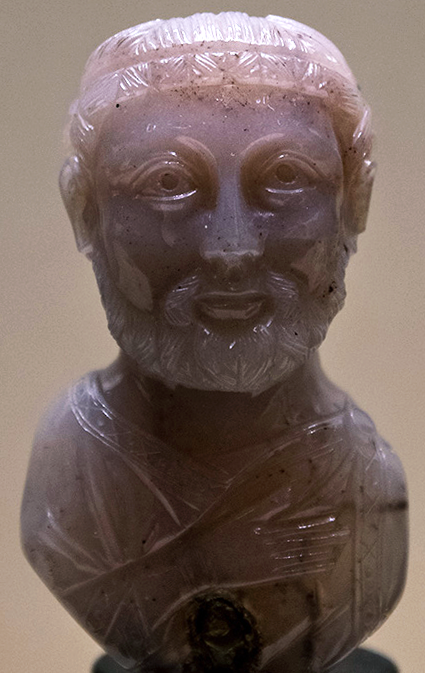
After dealing with the rebellions of Magnentius and Silvanus, Constantius felt he needed a permanent representative in Gaul. In 355, Julian was summoned to appear before the emperor in Mediolanum and on 6 November was made Caesar of the West, marrying Constantius' sister, Helena. Constantius, after his experience with Gallus, intended his representative to be more a figurehead than an active participant in events, so he packed Julian off to Gaul with a small retinue, assuming his prefects in Gaul would keep Julian in check. At first reluctant to trade his scholarly life for war and politics, Julian eventually took every opportunity to involve himself in the affairs of Gaul. In the following years he learned how to lead and then run an army, through a series of campaigns against the Germanic tribes that had settled on both sides of the Rhine.
Campaigns against Germanic kingdoms
During his first campaign in 356, Julian led an army to the Rhine, where he engaged the inhabitants and recovered several towns that had fallen into Frankish hands, including Colonia Agrippina (Cologne). With success under his belt he withdrew for the winter to Gaul, distributing his forces to protect various towns, and choosing the small town of Senon near Verdun to await the spring. This turned out to be a tactical error, for he was left with insufficient forces to defend himself when a large contingent of Franks besieged the town and Julian was virtually held captive there for several months, until his general Marcellus deigned to lift the siege. Relations between Julian and Marcellus seem to have been poor. Constantius accepted Julian's report of events and Marcellus was replaced as magister equitum by Severus.
The following year saw a combined operation planned by Constantius to regain control of the Rhine from the Germanic peoples who had spilt across the river onto the west bank. From the south his magister peditum Barbatio was to come from Milan and amass forces at Augst (near the Rhine bend), then set off north with 25,000 soldiers; Julian with 13,000 troops would move east from Durocortorum (Rheims). However, while Julian was in transit, a group of Laeti attacked Lugdunum (Lyon) and Julian was delayed in order to deal with them. This left Barbatio unsupported and deep in Alamanni territory, so he felt obliged to withdraw, retracing his steps. Thus ended the coordinated operation against the Germanic peoples.

With Barbatio safely out of the picture, King Chnodomarius led a confederation of Alamanni forces against Julian and Severus at the Battle of Argentoratum. The Romans were heavily outnumbered and during the heat of battle a group of 600 horsemen on the right wing deserted, yet, taking full advantage of the limitations of the terrain, the Romans were overwhelmingly victorious. The enemy was routed and driven into the river. King Chnodomarius was captured and later sent to Constantius in Mediolanum. Ammianus, who was a participant in the battle, portrays Julian in charge of events on the battlefield and describes how the soldiers, because of this success, acclaimed Julian attempting to make him Augustus, an acclamation he rejected, rebuking them. He later rewarded them for their valor.
Rather than chase the routed enemy across the Rhine, Julian now proceeded to follow the Rhine north, the route he followed the previous year on his way back to Gaul. At Moguntiacum (Mainz), however, he crossed the Rhine in an expedition that penetrated deep into what is today Germany, and forced three local kingdoms to submit. This action showed the Alamanni that Rome was once again present and active in the area. On his way back to winter quarters in Paris he dealt with a band of Franks who had taken control of some abandoned forts along the river Meuse.
In 358, Julian gained victories over the Salian Franks on the Lower Rhine, settling them in Toxandria in the Roman Empire, north of today's city of Tongeren, and over the Chamavi, who were expelled back to Hamaland.

Taxation and administration
At the end of 357 Julian, with the prestige of his victory over the Alamanni to give him confidence, prevented a tax increase by the Gallic praetorian prefect Florentius and personally took charge of the province of Belgica Secunda. This was Julian's first experience with civil administration, where his views were influenced by his liberal education in Greece. Properly it was a role that belonged to the praetorian prefect. However, Florentius and Julian often clashed over the administration of Gaul. Julian's first priority, as Caesar and nominal ranking commander in Gaul, was to drive out the barbarians who had breached the Rhine frontier. He sought to win over the support of the civil population, which was necessary for his operations in Gaul, and also to show his largely Germanic army the benefits of Imperial rule. Julian therefore felt it was necessary to rebuild stable and peaceful conditions in the devastated cities and countryside. For this reason, Julian clashed with Florentius over the latter's support of tax increases, as mentioned above, and Florentius's own corruption in the bureaucracy.
Constantius attempted to maintain some modicum of control over his Caesar, which explains his removal of Julian's close adviser Saturninius Secundus Salutius from Gaul. His departure stimulated the writing of Julian's oration, "Consolation Upon the Departure of Salutius".
Rebellion in Paris
In the fourth year of Julian's stay in Gaul, the Sassanid emperor, Shapur II, invaded Mesopotamia and took the city of Amida after a 73-day siege. In February 360, Constantius II ordered more than half of Julian's Gallic troops to join his eastern army, the order by-passing Julian and going directly to the military commanders. Although Julian at first attempted to expedite the order, it provoked an insurrection by troops of the Petulantes, who had no desire to leave Gaul. According to the historian Zosimus, the army officers were those responsible for distributing an anonymous tract expressing complaints against Constantius as well as fearing for Julian's ultimate fate. Notably absent at the time was the prefect Florentius, who was seldom far from Julian's side, though now he was kept busy organizing supplies in Vienne and away from any strife that the order could cause. Julian would later blame him for the arrival of the order from Constantius. Ammianus Marcellinus even suggested that the fear of Julian gaining more popularity than himself caused Constantius to send the order on the urging of Florentius.
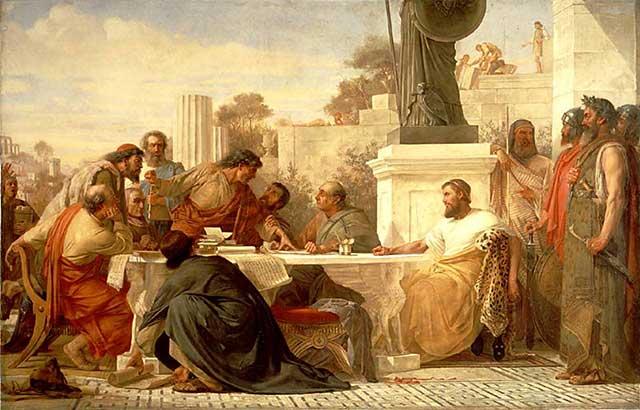
The troops proclaimed Julian Augustus in Paris, and this in turn led to a very swift military effort to secure or win the allegiance of others. Although the full details are unclear, there is evidence to suggest that Julian may have at least partially stimulated the insurrection. If so, he went back to business as usual in Gaul, for, from June to August of that year, Julian led a successful campaign against the Attuarian Franks. In November, Julian began openly using the title Augustus, even issuing coins with the title, sometimes with Constantius, sometimes without. He celebrated his fifth year in Gaul with a big show of games.
In the spring of 361, Julian led his army into the territory of the Alamanni, where he captured their king, Vadomarius. Julian claimed that Vadomarius had been in league with Constantius, encouraging him to raid the borders of Raetia. Julian then divided his forces, sending one column to Raetia, one to northern Italy and the third he led down the Danube on boats. His forces claimed control of Illyricum and his general, Nevitta, secured the pass of Succi into Thrace. He was now well out of his comfort zone and on the road to civil war. (Julian would state in late November that he set off down this road "because, having been declared a public enemy, I meant to frighten him [Constantius] merely, and that our quarrel should result in intercourse on more friendly terms...")
However, in June, forces loyal to Constantius captured the city of Aquileia on the north Adriatic coast, an event that threatened to cut Julian off from the rest of his forces, while Constantius's troops marched towards him from the east. Aquileia was subsequently besieged by 23,000 men loyal to Julian. All Julian could do was sit it out in Naissus, the city of Constantine's birth, waiting for news and writing letters to various cities in Greece justifying his actions (of which only the letter to the Athenians has survived in its entirety). Civil war was avoided only by the death on 3 November of Constantius, who, in his last will, is alleged by some sources to have recognized Julian as his rightful successor.
Reign
On 11 December 361, Julian entered Constantinople as sole emperor and, despite his rejection of Christianity, his first political act was to preside over Constantius' Christian burial, escorting the body to the Church of the Apostles, where it was placed alongside that of Constantine. This act was a demonstration of his lawful right to the throne. He is also now thought to have been responsible for the building of Santa Costanza on a Christian site just outside Rome as a mausoleum for his wife Helena and sister-in-law Constantina.
The new Emperor rejected the style of administration of his immediate predecessors. He blamed Constantine for the state of the administration and for having abandoned the traditions of the past. He made no attempt to restore the tetrarchal system begun under Diocletian, nor did he seek to rule as an absolute autocrat. His own philosophic notions led him to idealize the reigns of Hadrian and Marcus Aurelius. In his first panegyric to Constantius, Julian described the ideal ruler as being essentially primus inter pares ("first among equals"), operating under the same laws as his subjects. While in Constantinople, therefore, it was not strange to see Julian frequently active in the Senate, participating in debates and making speeches, placing himself at the level of the other members of the Senate.
He viewed the royal court of his predecessors as inefficient, corrupt and expensive. Thousands of servants, eunuchs and superfluous officials were therefore summarily dismissed. He set up the Chalcedon tribunal to deal with the corruption of the previous administration under the supervision of magister militum Arbitio. Several high-ranking officials under Constantius, including the chamberlain Eusebius, were found guilty and executed. (Julian was conspicuously absent from the proceedings, perhaps signalling his displeasure at their necessity.) He continually sought to reduce what he saw as a burdensome and corrupt bureaucracy within the Imperial administration whether it involved civic officials, secret agents or the imperial postal service.
Another effect of Julian's political philosophy was that the authority of the cities was expanded at the expense of the imperial bureaucracy as Julian sought to reduce direct imperial involvement in urban affairs. For example, city land owned by the imperial government was returned to the cities, city council members were compelled to resume civic authority, often against their will, and the tribute in gold by the cities called the aurum coronarium was made voluntary rather than a compulsory tax. Additionally, arrears of land taxes were cancelled. This was a key reform reducing the power of corrupt imperial officials, as the unpaid taxes on land were often hard to calculate or higher than the value of the land itself. Forgiving back taxes both made Julian more popular and allowed him to increase collections of current taxes.
While he ceded much of the authority of the imperial government to the cities, Julian also took more direct control himself. For example, new taxes and corvées had to be approved by him directly rather than left to the judgement of the bureaucratic apparatus. Julian certainly had a clear idea of what he wanted Roman society to be, both in political as well as religious terms. The terrible and violent dislocation of the 3rd century meant that the Eastern Mediterranean had become the economic locus of the Empire. If the cities were treated as relatively autonomous local administrative areas, it would simplify the problems of imperial administration, which as far as Julian was concerned, should be focused on the administration of the law and defense of the empire's vast frontiers.
In replacing Constantius's political and civil appointees, Julian drew heavily from the intellectual and professional classes, or kept reliable holdovers, such as the rhetorician Themistius. His choice of consuls for the year 362 was more controversial. One was the very acceptable Claudius Mamertinus, previously the Praetorian prefect of Illyricum. The other, more surprising choice was Nevitta, Julian's trusted Frankish general. This latter appointment made overt the fact that an emperor's authority depended on the power of the army. Julian's choice of Nevitta appears to have been aimed at maintaining the support of the Western army which had acclaimed him.
Clash with the Antiochenes
After five months of dealings at the capital, Julian left Constantinople in May and moved to Antioch, arriving in mid-July and staying there for nine months before launching his fateful campaign against Persia in March 363. Antioch was a city favored by splendid temples along with a famous oracle of Apollo in nearby Daphne, which may have been one reason for his choosing to reside there. It had also been used in the past as a staging place for amassing troops, a purpose which Julian intended to follow.
His arrival on 18 July was well received by the Antiochenes, though it coincided with the celebration of the Adonia, a festival which marked the death of Adonis, so there was wailing and moaning in the streets—not a good omen for an arrival.
Julian soon discovered that wealthy merchants were causing food problems, apparently by hoarding food and selling it at high prices. He hoped that the curia would deal with the issue for the situation was headed for a famine. When the curia did nothing, he spoke to the city's leading citizens, trying to persuade them to take action. Thinking that they would do the job, he turned his attention to religious matters.
He tried to resurrect the ancient oracular spring of Castalia at the temple of Apollo at Delphi. After being advised that the bones of 3rd-century bishop Babylas were suppressing the god, he made a public-relations mistake in ordering the removal of the bones from the vicinity of the temple. The result was a massive Christian procession. Shortly after that, when the temple was destroyed by fire, Julian suspected the Christians and ordered stricter investigations than usual. He also shut up the chief Christian church of the city, before the investigations proved that the fire was the result of an accident.
When the curia still took no substantial action in regards to the food shortage, Julian intervened, fixing the prices for grain and importing more from Egypt. Then landholders refused to sell theirs, claiming that the harvest was so bad that they had to be compensated with fair prices. Julian accused them of price gouging and forced them to sell. Various parts of Libanius' orations may suggest that both sides were justified to some extent; while Ammianus blames Julian for "a mere thirst for popularity".
Julian's ascetic lifestyle was not popular either, since his subjects were accustomed to the idea of an all-powerful Emperor who placed himself well above them. Nor did he improve his dignity with his own participation in the ceremonial of bloody sacrifices.
David Stone Potter said after nearly two millennia:
They expected a man who was both removed from them by the awesome spectacle of imperial power, and would validate their interests and desires by sharing them from his Olympian height [...] He was supposed to be interested in what interested his people, and he was supposed to be dignified. He was not supposed to leap up and show his appreciation for a panegyric that it was delivered, as Julian had done on January 3, when Libanius was speaking, and ignore the chariot races.
He then tried to address public criticism and mocking of him by issuing a satire ostensibly on himself, called Misopogon or "Beard Hater". There he blames the people of Antioch for preferring that their ruler have his virtues in the face rather than in the soul.
Julian's fellow pagans were of a divided mind about this habit of talking to his subjects on an equal footing: Ammianus Marcellinus saw in that only the foolish vanity of someone "excessively anxious for empty distinction", whose "desire for popularity often led him to converse with unworthy persons".
On leaving Antioch he appointed Alexander of Heliopolis as governor, a violent and cruel man whom the Antiochene Libanius, a friend of the emperor, admits on first thought was a "dishonourable" appointment. Julian himself described the man as "undeserving" of the position, but appropriate "for the avaricious and rebellious people of Antioch".
Persian campaign
Julian's rise to Augustus was the result of military insurrection eased by Constantius's sudden death. This meant that, while he could count on the wholehearted support of the Western army which had aided his rise, the Eastern army was an unknown quantity originally loyal to the Emperor he had risen against; and though he had tried to woo it through the Chalcedon tribunal, to solidify his position in the eyes of the eastern army, he needed to lead its soldiers to victory. A campaign against the Sassanid Persians offered such an opportunity.
An audacious plan was formulated, the goal of which was to lay siege to the Sassanid capital city of Ctesiphon and definitively secure the eastern border. Yet the full motivation for this ambitious operation is, at best, unclear; there was no direct necessity for an invasion, as the Sassanids sent envoys in the hope of settling matters peacefully. Julian rejected this offer. Ammianus states that Julian longed for revenge on the Persians and that a certain desire for combat and glory also played a role in his decision to go to war.
Into enemy territory
On 5 March 363, despite a series of omens against the campaign, Julian departed from Antioch with about 65,000–83,000, or 80,000–90,000 men (the traditional number accepted by Gibbon is 95,000 effectives total), and headed north toward the Euphrates. En route he was met by embassies from various small powers offering assistance, none of which he accepted, though he did order the Armenian King Arsaces to muster an army and await instructions. He crossed the Euphrates near Hierapolis and moved eastward to Carrhae, giving the impression that his chosen route into Persian territory was down the Tigris. For this reason it seems he sent a force of 30,000 soldiers under Procopius and Sebastianus further eastward to devastate Media in conjunction with Armenian forces. This was where two earlier Roman campaigns had concentrated and where the main Persian forces were soon directed. Julian's strategy lay elsewhere, however. He had had a fleet built of over 1,000 ships at Samosata in order to supply his army for a march down the Euphrates and of 50 pontoon ships to facilitate river crossings. Procopius and the Armenians would march down the Tigris to meet Julian near Ctesiphon. Julian's ultimate aim seems to have been "regime change" by replacing king Shapur II with his brother Hormisdas.
After feigning a march further eastward, Julian's army turned south to Circesium at the confluence of the Abora (Khabur) and the Euphrates arriving at the beginning of April. Passing Dura on 6 April, the army made good progress, bypassing towns after negotiations or besieging those which chose to oppose him. At the end of April the Romans captured the fortress of Pirisabora, which guarded the canal approach from the Euphrates to Ctesiphon on the Tigris. As the army marched toward the Persian capital, the Sassanids broke the dikes which crossed the land, turning it into marshland, slowing the progress of the Roman army.
Ctesiphon
By mid-May, the army had reached the vicinity of the heavily fortified Persian capital, Ctesiphon, where Julian partially unloaded some of the fleet and had his troops ferried across the Tigris by night.
The Romans gained a tactical victory over the Persians before the gates of the city, driving them back into the city. However, the Persian capital was not taken. Concerned with the risk of becoming encircled and trapped within the city's walls, master-general Victor ordered his soldiers not to enter the open gates of the city in pursuit of the defeated Persians. Resultantly, the main Persian army was still at large and approaching, while the Romans lacked a clear strategic objective. In the council of war which followed, Julian's generals persuaded him not to mount a siege against the city, given the impregnability of its defenses and the fact that Shapur would soon arrive with a large force. Julian, not wanting to give up what he had gained and probably still hoping for the arrival of the column under Procopius and Sebastianus, set off east into the Persian interior, ordering the destruction of the fleet. This proved to be a hasty decision, for they were on the wrong side of the Tigris with no clear means of retreat and the Persians had begun to harass them from a distance, burning any food in the Romans' path. Julian had not brought adequate siege equipment, so there was nothing he could do when he found that the Persians had flooded the area behind him, forcing him to withdraw. A second council of war on 16 June 363 decided that the best course of action was to lead the army back to the safety of Roman borders, not through Mesopotamia, but northward to Corduene.
Death
During the withdrawal, Julian's forces suffered several attacks from Sasanian forces. In one such engagement on 26 June 363, the Battle of Samarra near Maranga in Mesopotamia, Julian was wounded when the Sassanid army raided his column. In the haste of pursuing the retreating enemy, Julian chose speed rather than caution, taking only his sword and leaving his coat of mail. He received a wound from a spear that reportedly pierced the lower lobe of his liver and intestines. The wound was not immediately deadly. Julian was treated by his personal physician, Oribasius of Pergamum, who seems to have made every attempt to treat the wound; this probably included the irrigation of the wound with a dark wine, and a procedure known as gastrorrhaphy—i.e., suturing of the damaged intestine. Despite these efforts, on the third day a major hemorrhage occurred and the emperor died during the night. Some Christian writers reported that his final words were "Thou hast conquered, Galilean.” As Julian wished, his body was buried outside Tarsus, though it was later moved to Constantinople.
In 364, Libanius stated that Julian was assassinated by a Christian who was one of his own soldiers; this charge is not corroborated by Ammianus Marcellinus or other contemporary historians. John Malalas reports that the supposed assassination was commanded by Basil of Caesarea. Fourteen years later, Libanius said that Julian was killed by a Saracen (Lakhmid) and this may have been confirmed by Julian's doctor Oribasius who, having examined the wound, said that it was from a spear used by a group of Lakhmid auxiliaries in Persian service. Later Christian historians propagated the tradition that Julian was killed by Saint Mercurius.
Legacy
Julian was succeeded by the short-lived Emperor Jovian, who reestablished Christianity's privileged position throughout the Empire.
Libanius says in his epitaph of the deceased emperor (18.304) that "I have mentioned representations (of Julian); many cities have set him beside the images of the gods and honour him as they do the gods. Already a blessing has been besought of him in prayer, and it was not in vain. To such an extent has he literally ascended to the gods and received a share of their power from him themselves." However, no similar action was taken by the Roman central government, which would be more and more dominated by Christians in the ensuing decades.