
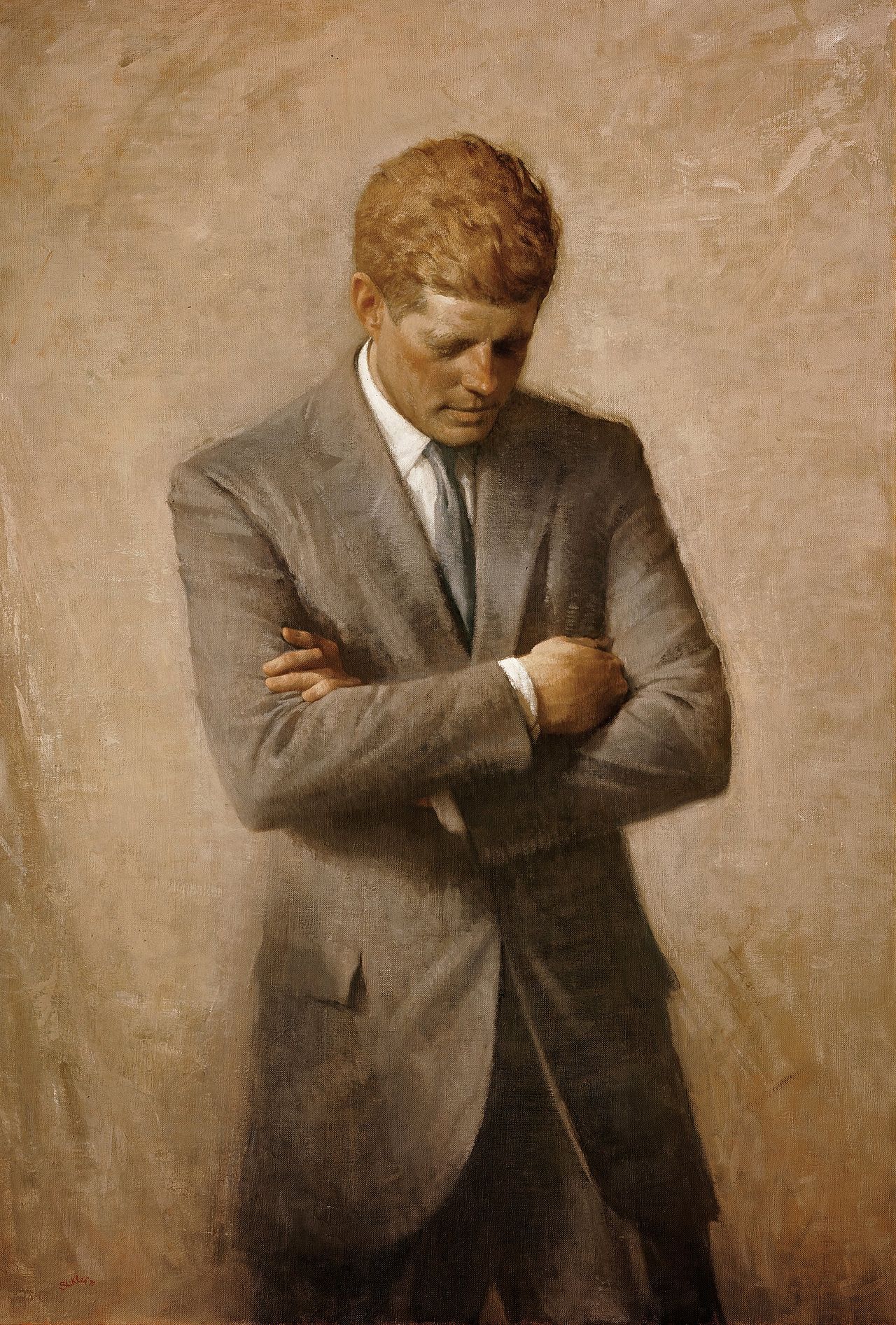
John Fitzgerald Kennedy (May 29, 1917 – November 22, 1963), also known as JFK, was the 35th president of the United States, serving from 1961 until his assassination in 1963. He was the youngest person elected president, at 43 years, and the first Catholic president. Kennedy served at the height of the Cold War, and the majority of his foreign policy concerned relations with the Soviet Union and Cuba. A member of the Democratic Party, Kennedy represented Massachusetts in both houses of the United States Congress before his presidency.
Born into the prominent Kennedy family in Brookline, Massachusetts, Kennedy graduated from Harvard University in 1940, joining the U.S. Naval Reserve the following year. During World War II, he commanded PT boats in the Pacific theater. Kennedy's survival following the sinking of PT-109 and his rescue of his fellow sailors made him a war hero and earned the Navy and Marine Corps Medal, but left him with serious injuries. After a brief stint in journalism, Kennedy represented a working-class Boston district in the U.S. House of Representatives from 1947 to 1953. He was subsequently elected to the U.S. Senate, serving as the junior senator from Massachusetts from 1953 to 1960. While in the Senate, Kennedy published his book Profiles in Courage, which won a Pulitzer Prize. Kennedy ran in the 1960 presidential election. His campaign gained momentum after the first televised presidential debates in American history, and he was elected president, narrowly defeating Republican opponent Richard Nixon, the incumbent vice president.
Kennedy's presidency saw high tensions with communist states in the Cold War. He increased the number of American military advisers in South Vietnam, and the Strategic Hamlet Program began during his presidency. In 1961, he authorized attempts to overthrow the Cuban government of Fidel Castro in the failed Bay of Pigs Invasion and Operation Mongoose. In October 1962, U.S. spy planes discovered Soviet missile bases had been deployed in Cuba. The resulting period of tensions, termed the Cuban Missile Crisis, nearly resulted in nuclear war. In August 1961, after East German troops erected the Berlin Wall, Kennedy sent an army convoy to reassure West Berliners of U.S. support, and delivered one of his most famous speeches in West Berlin in June 1963. In 1963, Kennedy signed the first nuclear weapons treaty. He presided over the establishment of the Peace Corps, Alliance for Progress with Latin America, and the continuation of the Apollo program with the goal of landing a man on the Moon before 1970. He supported the civil rights movement but was only somewhat successful in passing his New Frontier domestic policies.

On November 22, 1963, Kennedy was assassinated in Dallas. His vice president, Lyndon B. Johnson, assumed the presidency. Lee Harvey Oswald was arrested for the assassination, but he was shot and killed by Jack Ruby two days later. The Federal Bureau of Investigation (FBI) and the Warren Commission both concluded Oswald had acted alone, but conspiracy theories about the assassination persist. After Kennedy's death, Congress enacted many of his proposals, including the Civil Rights Act of 1964 and the Revenue Act of 1964. He ranks highly in polls of U.S. presidents with historians and the general public. His personal life has been the focus of considerable sustained interest following public revelations in the 1970s of his chronic health ailments and extramarital affairs. Kennedy is the most recent U.S. president to have died in office.
Early life and education
John Fitzgerald Kennedy was born on May 29, 1917, outside Boston in Brookline, Massachusetts, to Joseph P. Kennedy Sr., a businessman and politician, and Rose Kennedy (née Fitzgerald), a philanthropist and socialite. His paternal grandfather, P. J. Kennedy, was an East Boston ward boss and Massachusetts state legislator. Kennedy's maternal grandfather and namesake, John F. Fitzgerald, was a U.S. congressman and two-term mayor of Boston. All four of his grandparents were children of Irish immigrants. Kennedy had an older brother, Joseph Jr., and seven younger siblings: Rosemary, Kathleen, Eunice, Patricia, Robert, Jean, and Ted.
Kennedy's father amassed a private fortune and established trust funds for his nine children, guaranteeing them lifelong financial independence. His business kept him away from home for long stretches, but Joe Sr. was a formidable presence in his children's lives. He encouraged them to be ambitious, emphasized political discussions at the dinner table, and demanded a high level of academic achievement. John's first exposure to politics came in 1922, when he toured Boston wards with his grandfather Fitzgerald during his unsuccessful gubernatorial campaign. In September 1927, due to an outbreak of polio in Massachusetts and Joe Sr.'s business interests in Wall Street and Hollywood, the family relocated from Boston to the Riverdale neighborhood of New York City. Several years later, his brother Robert told Look magazine that his father left Boston because of job signs that read: "No Irish Need Apply." The Kennedys spent summers and early autumns at their home in Hyannis Port, Massachusetts, a village on Cape Cod, where they engaged in various outdoor activities. Christmas and Easter holidays were spent at their winter retreat in Palm Beach, Florida. In September 1930, Kennedy, 13 years old, was sent to the Canterbury School in New Milford, Connecticut, for 8th grade. In April 1931, he had an appendectomy, after which he withdrew from Canterbury and recuperated at home.
In September 1931, Kennedy began attending Choate, a preparatory boarding school in Wallingford, Connecticut. Rose had wanted John and Joe Jr. to attend a Catholic school, but Joe Sr. believed that if they were to compete in the political world, they needed to be among boys from prominent Protestant families. John spent his first years at Choate in his older brother's shadow and compensated with rebellious behavior that attracted a clique. Their most notorious stunt was exploding a toilet seat with a firecracker. In the next chapel assembly, the headmaster, George St. John, brandished the toilet seat and spoke of "muckers" who would "spit in our sea," leading Kennedy to name his group "The Muckers Club." It included his roommate and lifelong friend Lem Billings. Kennedy graduated from Choate in June 1935, finishing 64th of 112 students. He had been the business manager of the school yearbook and was voted the "most likely to succeed."
Kennedy intended to study under Harold Laski at the London School of Economics, as his older brother had done. However, ill health forced his return to the United States in October 1935, when he enrolled late at Princeton University, but had to withdraw after two months due to gastrointestinal illness.
In September 1936, Kennedy enrolled at Harvard College. He wrote occasionally for The Harvard Crimson, the campus newspaper, but had little involvement with campus politics, preferring to concentrate on athletics and his social life. Kennedy played football and was on the junior varsity squad during his sophomore year, but an injury forced him off the team, and left him with back problems that plagued him for the rest of his life. He earned membership in the Hasty Pudding Club and the Spee Club, one of Harvard's elite "final clubs".

In July 1938, Kennedy sailed overseas with his older brother to work at the American embassy in London, where their father was serving as President Franklin D. Roosevelt's ambassador to the Court of St. James's. The following year, Kennedy traveled throughout Europe, the Soviet Union, the Balkans, and the Middle East in preparation for his Harvard senior honors thesis. He then went to Berlin, where a U.S. diplomatic representative gave him a secret message about war breaking out soon to pass on to his father, and to Czechoslovakia before returning to London on September 1, 1939—the day that Germany invaded Poland; the start of World War II. Two days later, the family was in the House of Commons for speeches endorsing the United Kingdom's declaration of war on Germany. Kennedy was sent as his father's representative to assist with arrangements for American survivors of the torpedoing of SS Athenia before flying back to the United States on his first transatlantic flight.
While an upperclassman at Harvard, Kennedy began to take his studies more seriously and developed an interest in political philosophy. He made the dean's list in his junior year. In 1940, Kennedy completed his thesis, "Appeasement in Munich", about British negotiations during the Munich Agreement. The thesis was released on July 24, under the title Why England Slept. The book was one of the first to offer information about the war and its origins, and quickly became a bestseller. In addition to addressing Britain's unwillingness to strengthen its military in the lead-up to the war, the book called for an Anglo-American alliance against the rising totalitarian powers. Kennedy became increasingly supportive of U.S. intervention in World War II, and his father's isolationist beliefs resulted in the latter's dismissal as ambassador.
In 1940, Kennedy graduated cum laude from Harvard with a Bachelor of Arts in government, concentrating on international affairs. That fall, he enrolled at the Stanford Graduate School of Business and audited classes, but he left after a semester to help his father complete his memoirs as an American ambassador. In early 1941, Kennedy toured South America.

U.S. Naval Reserve (1941–1945)
Kennedy planned to attend Yale Law School, but canceled those plans when American entry into World War II seemed imminent. In 1940, Kennedy attempted to enter the Army's Officer Candidate School. Despite months of training, he was medically disqualified due to chronic back problems. On September 24, 1941, with the help of Alan Goodrich Kirk—the director of the Office of Naval Intelligence (ONI) and former naval attaché to Joe Sr.—Kennedy joined the United States Naval Reserve. He was commissioned as an ensign on October 26, 1941, and joined the ONI staff in Washington, D.C.
In January 1942, Kennedy was assigned to the ONI field office at Headquarters, Sixth Naval District, in Charleston, South Carolina. He hoped to command a PT (patrol torpedo) boat, but his health problems seemed almost certain to prevent active duty. Kennedy's father intervened by providing misleading medical records and convincing PT officers that his presence would bring publicity to the fleet. Kennedy completed six months of training at the Naval Reserve Officer Training School in Chicago and at the Motor Torpedo Boat Squadrons Training Center in Melville, Rhode Island. His first command was PT-101 from December 7, 1942, until February 23, 1943. Unhappy with his assignment to the Panama Canal, far from the fighting, Kennedy appealed to Senator David I. Walsh of Massachusetts, who arranged for him to be reassigned to the South Pacific.
Commanding PT-109 and PT-59
In April 1943, Kennedy was assigned to Motor Torpedo Squadron TWO, and on April 24 he took command of PT-109, then based on Tulagi Island in the Solomons. On the night of August 1–2, in support of the New Georgia campaign, PT-109 and fourteen other PTs were ordered to block or repel four Japanese destroyers and floatplanes carrying food, supplies, and 900 Japanese soldiers to the Vila Plantation garrison on the southern tip of the Solomon's Kolombangara Island. Intelligence had been sent to Kennedy's commander, Thomas G. Warfield, who, as a result, was expecting the arrival of the large Japanese naval force that would pass on the evening of August 1. Of the 24 torpedoes fired that night by eight of the American PTs, not one hit the Japanese convoy. On that moonless night, Kennedy spotted a Japanese destroyer heading north on its return from the base of Kolombangara around 2:00 a.m., and attempted to turn to attack, when PT-109 was suddenly rammed at an angle and cut in half by the destroyer Amagiri, killing two PT-109 crew members. Avoiding surrender, the remaining crew swam toward Plum Pudding Island, 3.5 miles (5.6 km) southwest of the remains of PT-109, on August 2. Despite re-injuring his back in the collision, Kennedy towed a badly burned crewman named Patrick McMahon to the island with a life jacket strap clenched between his teeth. From there, Kennedy and his subordinate, Ensign George Ross, made forays through the coral islands, searching for help. When they encountered an English-speaking native with a canoe, Kennedy carved his location on a coconut shell and requested a boat rescue. Seven days after the collision, with the coconut message delivered, the PT-109 crew was rescued.
Almost immediately, the PT-109 rescue became a highly publicized event. The story was chronicled by John Hersey in The New Yorker in 1944; decades later, it was the basis of a successful film. It followed Kennedy into politics and provided a strong foundation for his appeal as a leader. Hersey portrayed Kennedy as a modest, self-deprecating hero. For his courage and leadership, Kennedy was awarded the Navy and Marine Corps Medal, and the injuries he suffered during the incident qualified him for a Purple Heart.
After a month's recovery, Kennedy returned to duty, commanding PT-59. On November 2, Kennedy's PT-59, along with two other PT boats, took part in the rescue of 40 to 50 Marines. The 59 acted as a shield from shore fire as they escaped on two rescue landing craft at the base of the Warrior River on Choiseul Island, taking ten Marines aboard and delivering them to safety. Under doctor's orders, Kennedy was relieved of his command on November 18, and sent to the hospital on Tulagi. By December 1943, with his health deteriorating, Kennedy left the Pacific front and arrived in San Francisco in early January 1944. After receiving treatment for his back injury at the Chelsea Naval Hospital in Massachusetts from May to December 1944, he was released from active duty. Beginning in January 1945, Kennedy spent three months recovering from his back injury at Castle Hot Springs, a resort and temporary military hospital in Arizona. On March 1, 1945, Kennedy retired from the Navy Reserve on physical disability and was honorably discharged with the full rank of lieutenant. When later asked how he became a war hero, Kennedy joked: "It was easy. They cut my PT boat in half."
On August 12, 1944, Kennedy's older brother, Joe Jr., a Navy pilot, was killed during an air mission. His body was never recovered. News of his death reached the family's home in Hyannis Port, Massachusetts, a day later. Kennedy felt that Joe Jr.'s reckless flight was partly an effort to outdo him. To console himself, Kennedy set out to assemble a privately published book of remembrances of his brother, As We Remember Joe.

Journalism (1945)
In April 1945, Kennedy's father, who was a friend of William Randolph Hearst, arranged a position for his son as a special correspondent for Hearst Newspapers; the assignment kept Kennedy's name in the public eye and "expose[d] him to journalism as a possible career". He covered the United Nations Conference on International Organization in San Francisco, the British elections, and the Potsdam Conference in Germany.
U.S. House of Representatives (1947–1953)
Kennedy's elder brother, Joe Jr., had been the family's political standard-bearer and was tapped by their father to seek the presidency. After Joe's death, the assignment fell to John as the second eldest. Boston mayor Maurice J. Tobin discussed the possibility of John becoming his running mate in 1946 as a candidate for Massachusetts lieutenant governor, but Joe Sr. preferred a congressional campaign that could send John to Washington, where he could have national visibility.
At the urging of Joe Sr., U.S. Representative James Michael Curley vacated his seat in the solidly Democratic 11th congressional district of Massachusetts to become mayor of Boston in 1946. Kennedy established legal residency at 122 Bowdoin Street across from the Massachusetts State House. He won the Democratic primary with 42 percent of the vote, defeating nine other candidates. According to Fredrik Logevall, Joe Sr. spent hours on the phone with reporters and editors, seeking information, trading confidences, and cajoling them into publishing puff pieces on John, ones that invariably played up his war record in the Pacific. He oversaw a professional advertising campaign that ensured ads went up in just the right places. The campaign had a virtual monopoly on [Boston] subway space, and on window stickers ("Kennedy for Congress") for cars and homes, and was the force behind the mass mailing of Hersey's PT-109 article. Though Republicans took control of the House in the 1946 elections, Kennedy defeated his Republican opponent in the general election, taking 73 percent of the vote.
As a congressman, Kennedy had a reputation for taking little interest in the management of his office or his constituents' concerns, with one of the highest absenteeism rates in the House, although much was explained by illness. George Smathers, one of his few political friends at the time, claimed that he was more interested in being a writer than a politician, and at that time, he suffered from extreme shyness. Kennedy found "most of his fellow congressmen boring, preoccupied as they all seemed to be with their narrow political concerns". The arcane House rules and customs, which slowed legislation, exasperated him.
Kennedy served in the House for six years, joining the influential Education and Labor Committee and the Veterans' Affairs Committee. He concentrated his attention on international affairs, supporting the Truman Doctrine as an appropriate response to the emerging Cold War. He also supported public housing and opposed the Labor Management Relations Act of 1947, which restricted the power of labor unions. Though not as vocally anti-communist as Joseph McCarthy, Kennedy supported the Internal Security Act of 1950, which required communists to register with the government, and he deplored the "loss of China". Kennedy denounced Truman and the State Department during a speech in Salem, Massachusetts on January 30, 1949, for contributing to the "tragic story of China whose freedom we once fought to preserve. What our young men had saved [in World War II], our diplomats and our President have frittered away." Having served as a Boy Scout during his childhood, Kennedy was active in the Boston Council from 1946 to 1955 as district vice chairman, member of the executive board, vice-president, and National Council Representative.
To appeal to the large Italian-American voting bloc in Massachusetts, Kennedy delivered a speech in November 1947 supporting a $227 million aid package to Italy. He maintained that Italy was in danger from an "onslaught of the communist minority" and that the country was the "initial battleground in the communist drive to capture Western Europe." To counter Soviet efforts to take control in Middle Eastern and Asian countries like Indochina, Kennedy wanted the United States to develop nonmilitary techniques of resistance that would not create suspicions of neoimperialism or add to the country's financial burden. The problem, as he saw it, was not simply to be anti-communist but to stand for something that these emerging nations would find appealing.
Almost every weekend that Congress was in session, Kennedy would fly back to Massachusetts to give speeches to veteran, fraternal, and civic groups, while maintaining an index card file on individuals who might be helpful in a future statewide campaign. Contemplating whether to run for Massachusetts governor or the U.S. Senate, Kennedy abandoned interest in the former, believing that the governor "sat in an office, handing out sewer contracts".
U.S. Senate (1953–1960)
As early as 1949, Kennedy began preparing to run for the Senate in 1952 against Republican three-term incumbent Henry Cabot Lodge Jr. with the campaign slogan "KENNEDY WILL DO MORE FOR MASSACHUSETTS". Joe Sr. again financed his son's candidacy—persuading the Boston Post to switch its support to Kennedy by promising the publisher a $500,000 loan—while John's younger brother Robert emerged as campaign manager. Kennedy's mother and sisters were also highly effective canvassers, hosting a series of "teas" at hotels and parlors across Massachusetts to reach out to women voters. In the presidential election, Republican Dwight D. Eisenhower carried Massachusetts by 208,000 votes, but Kennedy narrowly defeated Lodge by 70,000 votes for the Senate seat. The following year, he married Jacqueline Bouvier.
Kennedy underwent several spinal operations over the next two years. Often absent from the Senate, he was at times critically ill and received Catholic last rites. During his convalescence in 1956, he published Profiles in Courage, a book about U.S. senators who risked their careers for their personal beliefs, for which he won the Pulitzer Prize for Biography in 1957. Rumors that this work was ghostwritten by his close adviser and speechwriter, Ted Sorensen, were confirmed in Sorensen's 2008 autobiography.
At the start of his first term, Kennedy focused on fulfilling the promise of his campaign to do "more for Massachusetts" than his predecessor. Although Kennedy's and Lodge's legislative records were similarly liberal, Lodge voted for the Taft-Hartley Act of 1947 and Kennedy voted against it. On NBC's Meet the Press, Kennedy excoriated Lodge for not doing enough to prevent the increasing migration of manufacturing jobs from Massachusetts to the South, and blamed the right-to-work provision for giving the South an unfair advantage over Massachusetts in labor costs. In May 1953, Kennedy introduced "The Economic Problems of New England", a 36-point program to help Massachusetts industries such as fishing, textile manufacturing, watchmaking, and shipbuilding, as well as the Boston seaport. Kennedy's policy agenda included protective tariffs, preventing excessive speculation in raw wool, stronger efforts to research and market American fish products, an increase in the Fish and Wildlife Service budget (including funds for US FWS Albatross III), funds to rehabilitate the South Boston Army Base, shipbuilding contracts at the Fore River Shipyard in Quincy, Massachusetts, and the development of hydroelectric and nuclear power in New England—such as the Yankee Rowe Nuclear Power Station in Rowe, Massachusetts, which began construction in 1958. Kennedy's suggestions for stimulating the region's economy appealed to both parties by offering benefits to business and labor, and promising to serve national defense. Congress would eventually enact most of the program. A Massachusetts Audubon Society supporter, Kennedy wanted to make sure that the shorelines of Cape Cod remained unsullied by industrialization. On September 3, 1959, Kennedy co-sponsored the Cape Cod National Seashore bill with his Republican colleague Senator Leverett Saltonstall.
As a senator, Kennedy quickly won a reputation for responsiveness to requests from constituents (i.e., co-sponsoring legislation to provide federal loans to help rebuild communities damaged by the 1953 Worcester tornado), except on certain occasions when the national interest was at stake. In 1954, Kennedy voted in favor of the Saint Lawrence Seaway which would connect the Great Lakes to the Atlantic Ocean, despite opposition from Massachusetts politicians who argued that the project would hurt the Port of Boston economically.
In 1954, when the Senate voted to condemn Joseph McCarthy for breaking Senate rules and abusing an Army general, Kennedy was the only Democrat not to cast a vote against him. Kennedy drafted a speech supporting the censure. However, it was not delivered because Kennedy was hospitalized for back surgery in Boston. Although Kennedy never indicated how he would have voted, the episode damaged his support among members of the liberal community in the 1956 and 1960 elections.
In 1956, Kennedy gained control of the Massachusetts Democratic Party, and delivered the state delegation to the party's presidential nominee, Adlai Stevenson II, at the Democratic National Convention in August. Stevenson let the convention select the vice presidential nominee. Kennedy finished second in the balloting, losing to Senator Estes Kefauver of Tennessee, but receiving national exposure.
In 1957, Kennedy joined the Senate's Select Committee on Labor Rackets (also known as the McClellan Committee) with his brother Robert, who was chief counsel, to investigate racketeering in labor-management relations. The hearings attracted extensive radio and television coverage where the Kennedy brothers engaged in dramatic arguments with controversial labor leaders, including Jimmy Hoffa of the Teamsters Union. The following year, Kennedy introduced a bill to prevent the expenditure of union dues for improper purposes or private gain; to forbid loans from union funds for illicit transactions; and to compel audits of unions, which would ensure against false financial reports. It was the first major labor relations bill to pass either house since the Taft–Hartley Act of 1947 and dealt largely with the control of union abuses exposed by the McClellan Committee, but did not incorporate tough Taft–Hartley amendments requested by President Eisenhower. It survived Senate floor attempts to include Taft-Hartley amendments and passed but was rejected by the House. "Honest union members and the general public can only regard it as a tragedy that politics has prevented the recommendations of the McClellan committee from being carried out this year," Kennedy announced.
That same year, Kennedy joined the Senate's Foreign Relations Committee. There he supported Algeria's effort to gain independence from France and sponsored an amendment to the Mutual Defense Assistance Act that would provide aid to Soviet satellite nations. Kennedy in 1959 introduced a controversial bill to eliminate from the National Defense Education Act of 1958 a provision requiring loyalty oaths and affidavits from aid recipients.
Kennedy cast a procedural vote against President Eisenhower's bill for the Civil Rights Act of 1957, and this was considered by some to be an appeasement of Southern Democratic opponents of the bill. Kennedy did vote for Title III of the act, which would have given the Attorney General powers to enjoin, but Majority Leader Lyndon B. Johnson agreed to let the provision die as a compromise measure. Kennedy also voted for the "Jury Trial Amendment." Many civil rights advocates criticized the vote as one that would weaken the Act. A final compromise bill, which Kennedy supported, was passed in September 1957. As a senator from Massachusetts, which lacked a sizable Black population, Kennedy was not particularly sensitive to the problems of African Americans. Robert Kennedy later reflected, "We weren't thinking of the Negroes of Mississippi or Alabama—what should be done for them. We were thinking of what needed to be done in Massachusetts."
Most historians and political scientists who have written about Kennedy refer to his U.S. Senate years as an interlude. According to historian Robert Dallek, Kennedy called being a senator "the most corrupting job in the world." He complained that they were all too quick to cut deals and please campaign contributors to ensure their political futures. Kennedy, with the luxury of a rich father who could finance his campaigns, could remain independent of any special interest, except for those in his home state of Massachusetts that could align against his reelection. According to author Robert Caro, Majority Leader Lyndon Johnson viewed Kennedy as a "playboy", describing his performance in the Senate and the House as "pathetic" on another occasion, saying that he was "smart enough, but he doesn't like the grunt work". Author John T. Shaw acknowledges that while his Senate career is not associated with acts of "historic statesmanship" or "novel political thought," Kennedy made modest contributions as a legislator, drafting more than 300 bills to benefit Massachusetts and the New England region, some of which became law.
In 1958, Kennedy was re-elected to the Senate, defeating his Republican opponent, Boston lawyer Vincent J. Celeste, with 73.6 percent of the vote, the largest winning margin in the history of Massachusetts politics. In the aftermath of his re-election, Kennedy began preparing to run for president by traveling throughout the U.S. to build his candidacy for 1960.
1960 presidential election
On January 2, 1960, Kennedy announced his candidacy for the Democratic presidential nomination. Though some questioned Kennedy's age and experience, his charisma and eloquence earned him numerous supporters. Kennedy faced several potential challengers, including Senate Majority Leader Lyndon Johnson, Adlai Stevenson II, and Senator Hubert Humphrey.
Kennedy traveled extensively to build his support. His campaign strategy was to win several primaries to demonstrate his electability to the party bosses, who controlled most of the delegates, and to prove to his detractors that a Catholic could win popular support. Victories over Senator Humphrey in the Wisconsin and West Virginia primaries gave Kennedy momentum as he moved on to the 1960 Democratic National Convention in Los Angeles.
When Kennedy entered the convention, he had the most delegates, but not enough to ensure that he would win the nomination. Stevenson—the 1952 and 1956 presidential nominee—remained very popular, while Johnson also hoped to win the nomination with support from party leaders. Kennedy's candidacy also faced opposition from former President Harry S. Truman, who was concerned about Kennedy's lack of experience. Kennedy knew that a second ballot could give the nomination to Johnson or someone else, and his well-organized campaign was able to earn the support of just enough delegates to win the presidential nomination on the first ballot.
Kennedy ignored the opposition of his brother Robert, who wanted him to choose labor leader Walter Reuther, and other liberal supporters when he chose Johnson as his vice-presidential nominee. He believed that the Texas senator could help him win support from the South. In accepting the presidential nomination, Kennedy gave his well-known "New Frontier" speech: For the problems are not all solved and the battles are not all won—and we stand today on the edge of a New Frontier. ... But the New Frontier of which I speak is not a set of promises—it is a set of challenges. It sums up not what I intend to offer the American people, but what I intend to ask of them.
At the start of the fall general election campaign, the Republican nominee and incumbent Vice President Richard Nixon held a six-point lead in the polls. Major issues included how to get the economy moving again, Kennedy's Catholicism, the Cuban Revolution, and whether the space and missile programs of the Soviet Union had surpassed those of the U.S. To address fears that his Catholic faith would impact his decision-making, he told the Greater Houston Ministerial Association on September 12: "I am not the Catholic candidate for president. I am the Democratic Party candidate for president who also happens to be a Catholic. I do not speak for my Church on public matters—and the Church does not speak for me." He promised to respect the separation of church and state, and not to allow Catholic officials to dictate public policy.
The Kennedy and Nixon campaigns agreed to a series of televised debates. An estimated 70 million Americans, about two-thirds of the electorate, watched the first debate on September 26. Kennedy had met the day before with the producer to discuss the set design and camera placement. Nixon, recently released from the hospital after a painful knee injury, did not take advantage of this opportunity and, during the debate, looked at the reporters asking questions and not at the camera. Kennedy wore a blue suit and shirt to reduce glare and appeared sharply focused against the gray studio background. Nixon wore a light-colored suit that blended into the gray background; in combination with the harsh studio lighting that left Nixon perspiring, he offered a less-than-commanding presence. By contrast, Kennedy appeared relaxed, tanned, and telegenic, looking into the camera while answering questions. It is often claimed that television viewers overwhelmingly believed Kennedy, appearing to be the more attractive of the two, had won, while radio listeners (a smaller audience) thought Nixon had defeated him. However, only one poll split TV and radio voters like this and the methodology was poor. Pollster Elmo Roper concluded that the debates raised interest, boosted turnout, and gave Kennedy an estimated two million additional votes, largely due to the first debate. The debates are now considered a milestone in American political history—the point at which the medium of television began to play a dominant role.
Kennedy's campaign gained momentum after the first debate, and he pulled slightly ahead of Nixon in most polls. On Election Day, Kennedy defeated Nixon in one of the closest presidential elections of the 20th century. In the national popular vote, by most accounts, Kennedy led Nixon by just two-tenths of one percent (49.7% to 49.5%), while in the Electoral College, he won 303 votes to Nixon's 219 (269 were needed to win). Fourteen electors from Mississippi and Alabama refused to support Kennedy because he supported the civil rights movement; they voted for Senator Harry F. Byrd of Virginia, as did an elector from Oklahoma. Forty-three years old, Kennedy was the youngest person ever elected to the presidency (though Theodore Roosevelt was a year younger when he succeeded to the presidency after the assassination of William McKinley in 1901).
Presidency (1961–1963)
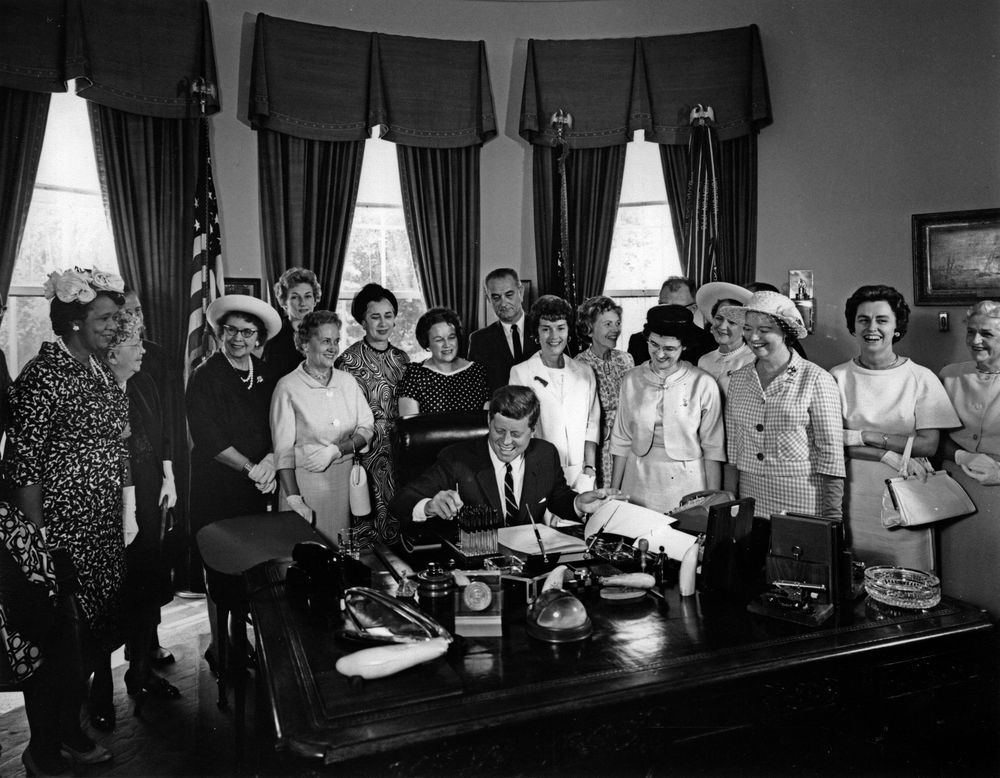
Kennedy was sworn in as the 35th president at noon on January 20, 1961. In his inaugural address, he spoke of the need for all Americans to be active citizens: "Ask not what your country can do for you—ask what you can do for your country." He asked the nations of the world to join to fight what he called the "common enemies of man: tyranny, poverty, disease, and war itself." He added:
"All this will not be finished in the first one hundred days. Nor will it be finished in the first one thousand days, nor in the life of this Administration, nor even perhaps in our lifetime on this planet. But let us begin." In closing, he expanded on his desire for greater internationalism: "Finally, whether you are citizens of America or citizens of the world, ask of us here the same high standards of strength and sacrifice which we ask of you."
The address reflected Kennedy's confidence that his administration would chart a historically significant course in both domestic policy and foreign affairs. The contrast between this optimistic vision and the pressures of managing daily political realities would be one of the main tensions of the early years of his administration.
Kennedy scrapped the decision-making structure of Eisenhower, favoring an organizational model resembling a wheel, with all spokes leading to the president. He was willing to make the increased number of rapid decisions required in such an environment. Though the cabinet remained important, Kennedy generally relied more on his staffers within the Executive Office. Despite concerns over nepotism, Kennedy's father insisted that Robert Kennedy become U.S. Attorney General, and the younger Kennedy became the "assistant president" who advised on all major issues.
Foreign policy
Cold War and flexible response
Kennedy's foreign policy was dominated by American confrontations with the Soviet Union, manifested by proxy contests in the global state of tension known as the Cold War. Like his predecessors, Kennedy adopted the policy of containment to stop the spread of communism. Fearful of the possibility of nuclear war, Kennedy implemented a defense strategy known as flexible response. This strategy relied on multiple options for responding to the Soviet Union, discouraged massive retaliation, and encouraged mutual deterrence. In contrast to Eisenhower's warning about the perils of the military-industrial complex, Kennedy focused on rearmament. From 1961 to 1964 the number of nuclear weapons increased by 50 percent, as did the number of B-52 bombers to deliver them.
In January 1961, Soviet Premier Nikita Khrushchev declared his support for wars of national liberation. Kennedy interpreted this step as a direct threat to the "free world."
Decolonization and the Congo Crisis
Between 1960 and 1963, twenty-four countries gained independence as the process of decolonization continued. Kennedy set out to woo the leaders and people of the "Third World," expanding economic aid and appointing knowledgeable ambassadors. His administration established the Food for Peace program and the Peace Corps to provide aid to developing countries. The Food for Peace program became a central element in American foreign policy, and eventually helped many countries to develop their economies and become commercial import customers.