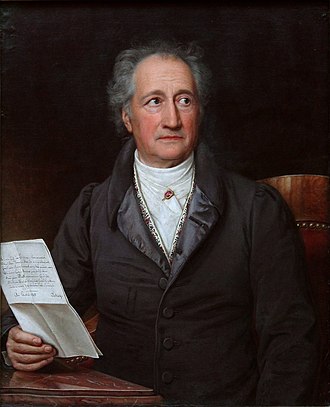
Johann Wolfgang von Goethe (28 August 1749 – 22 March 1832) was a German polymath who is widely regarded as the most influential writer in the German language. His work has had a wide-ranging influence on literary, political, Christian views, and philosophical thought in the Western world from the late 18th century to the present. A poet, playwright, novelist, scientist, statesman, theatre-director, and critic, Goethe wrote a wide range of works, including plays, poetry and aesthetic criticism, as well as treatises on botany, anatomy, and colour.
Goethe took up residence in Weimar in 1775 following the success of his first novel, The Sorrows of Young Werther (1774), and joined a thriving intellectual and cultural environment under the patronage of Duchess Anna Amalia that formed the basis of Weimar Classicism. He was ennobled by Karl August, Duke of Saxe-Weimar, in 1782. Goethe was an early participant in the Sturm und Drang literary movement. During his first ten years in Weimar, Goethe became a member of the Duke's privy council (1776–1785), sat on the war and highway commissions, oversaw the reopening of silver mines in nearby Ilmenau, and implemented a series of administrative reforms at the University of Jena. He also contributed to the planning of Weimar's botanical park and the rebuilding of its Ducal Palace.
Goethe's first major scientific work, the Metamorphosis of Plants, was published after he returned from a 1788 tour of Italy. In 1791 he was made managing director of the theatre at Weimar, and in 1794 he began a friendship with the dramatist, historian, and philosopher Friedrich Schiller, whose plays he premiered until Schiller's death in 1805. During this period, Goethe published his second novel, Wilhelm Meister's Apprenticeship; the verse epic Hermann and Dorothea, and, in 1808, the first part of his most celebrated drama, Faust. His conversations and various shared undertakings throughout the 1790s with Schiller, Johann Gottlieb Fichte, Johann Gottfried Herder, Alexander von Humboldt, Wilhelm von Humboldt, and August and Friedrich Schlegel have come to be collectively termed Weimar Classicism.
The German philosopher Arthur Schopenhauer named Wilhelm Meister's Apprenticeship one of the four greatest novels ever written, while the American philosopher and essayist Ralph Waldo Emerson selected Goethe as one of six "representative men" in his work of the same name (along with Plato, Emanuel Swedenborg, Michel de Montaigne, Napoleon, and William Shakespeare). Goethe's comments and observations form the basis of several biographical works, notably Johann Peter Eckermann's Conversations with Goethe (1836). His poems were set to music by many composers, including Wolfgang Amadeus Mozart, Ludwig van Beethoven, Franz Schubert, Hector Berlioz, Franz Liszt, Richard Wagner, and Gustav Mahler.
Life
Early life
Through his maternal grandmother, Goethe descended from the Soltan . His earliest ancestor documented in Germany is believed to be Sadok Seli Soltan (Mehmet Sadık Selim Sultan) from Seljuk Sultanate of Rum. Soltan was a Turkish officer who was captured by Count von Lechtomir (Reinhart von Württemberg) during his return to Germany from the Holy Land in 1291. By 1304 Soltan baptised and took the name Johann Soldan and married the Rebekka Dohlerin.
Goethe's grandfather, Friedrich Georg Goethe, moved from Thuringia in 1687 and changed the spelling of his surname from Göthe to Goethe. In Frankfurt, he first worked as a tailor, then opened a tavern. His son and grandchildren subsequently lived on the fortune he earned. Friedrich Georg Goethe was married twice; his first marriage was to Anna Elisabeth Lutz, the daughter of a burgher, Sebastian Lutz, with whom he had five children, including Hermann Jakob Goethe. After the death of his first wife in 1705, he married Cornelia Schellhorn, née Walther, widow of the innkeeper Johannes Schellhorn (died 1704), with whom he had four more children, including Johann Caspar Goethe, father of Johann Wolfgang von Goethe.

Goethe's father, Johann Caspar Goethe, lived with his family in a large house (today the Goethe House) in Frankfurt, then a free imperial city of the Holy Roman Empire. Though he had studied law in Leipzig and had been appointed Imperial Councillor, Johann Caspar Goethe was not involved in the city's official affairs. Johann Caspar married Goethe's mother, Catharina Elisabeth Textor, in Frankfurt on 20 August 1748, when he was 38 and she was 17. All their children, with the exception of Johann Wolfgang and his sister Cornelia Friederica Christiana, died at an early age.
The young Goethe received from his father and private tutors lessons in subjects common at the time, especially languages (Latin, Greek, Biblical Hebrew (briefly), French, Italian, and English). Goethe also received lessons in dancing, riding, and fencing. Johann Caspar, feeling frustrated in his own ambitions, was determined that his children should have every advantage he had missed.
Although Goethe's great passion was drawing, he quickly became interested in literature; Friedrich Gottlieb Klopstock and Homer were among his early favourites. He also had a devotion to the theater, and was greatly fascinated by the puppet shows that were annually arranged by occupying French soldiers at his home and which later became a recurrent theme in his literary work Wilhelm Meister's Apprenticeship.

He also took great pleasure in reading works on history and religion. Of this period, he wrote:
I had from childhood the singular habit of always learning by heart the beginnings of books, and the divisions of a work, first of the five books of Moses, and then of the Aeneid and Ovid's Metamorphoses [...] If an ever active imagination, of which that tale may bear witness, led me hither and thither, if the medley of fable and history, mythology and religion, threatened to bewilder me, I readily fled to those oriental regions, and plunged into the first books of Moses, and there, amid the scattered shepherd tribes, found myself at once in the greatest solitude and the greatest society.
Goethe also became acquainted with Frankfurt actors. Valerian Tornius wrote: Goethe – Leben, Wirken und Schaffen. In early literary attempts, Goethe showed an infatuation with Gretchen, who would later reappear in his Faust, and the adventures with whom he would describe concisely in Dichtung und Wahrheit. He adored Caritas Meixner, a wealthy Worms merchant's daughter and friend of his sister, who later married the merchant G. F. Schuler.

Legal career
Goethe studied law at Leipzig University from 1765 to 1768. He detested learning judicial rules by heart, preferring instead to attend the lessons of the university professor and poet Christian Fürchtegott Gellert. In Leipzig, Goethe fell in love with Anna Katharina Schönkopf, the daughter of a craftsman and innkeeper, writing cheerful verses about her in the Rococo genre. In 1770, he released anonymously his first collection of poems, Annette. His uncritical admiration for many contemporary poets evaporated as he developed an interest in Gotthold Ephraim Lessing and Christoph Martin Wieland. By this time, Goethe had already written a great deal, but he discarded nearly all of these works except for the comedy Die Mitschuldigen. The inn Auerbachs Keller and its legend of Johann Georg Faust's 1525 barrel ride impressed him so much that Auerbachs Keller became the only real place in his closet drama Faust Part One. Given that he was making little progress in his formal studies, Goethe was forced to return to Frankfurt at the end of August 1768.
Back in Frankfurt, Goethe became severely ill. During the year and a half that followed, marked by several relapses, relations with his father worsened. During convalescence, Goethe was nursed by his mother and sister. In April 1770, Goethe left Frankfurt to finish his studies, this time at the University of Strasbourg.
In Alsace, Goethe blossomed. No other landscape was to be described by him as affectionately as the warm, wide Rhineland. In Strasbourg, Goethe met Johann Gottfried Herder. The two became close friends, and crucially to Goethe's intellectual development, Herder kindled his interest in William Shakespeare, Ossian and in the notion of Volkspoesie (folk poetry). On 14 October 1772, Goethe hosted a gathering in his parents' home in honour of the first German "Shakespeare Day". His first acquaintance with Shakespeare's works is described as his personal awakening in the field of literature.

On a trip to the village of Sessenheim in October 1770, Goethe fell in love with Friederike Brion, but the tryst ended in August 1771. Several of Goethe's poems, like "Willkommen und Abschied", "Sesenheimer Lieder" and "Heidenröslein", date to this period.
At the end of August 1771, Goethe acquired the academic degree of the Licentiate in Law from Strasbourg and was able to establish a small legal practice in Frankfurt. Although in his academic work he had given voice to an ambition to make jurisprudence progressively more humane, his inexperience led him to proceed too vigorously in his first cases, for which he was reprimanded and lost further clientele. Within a few months, this put an early end to his law career. Around this time, Goethe became acquainted with the court of Darmstadt, where his inventiveness was praised. It was from that world that there came Johann Georg Schlosser (who later became Goethe's brother-in-law) and Johann Heinrich Merck. Goethe also pursued literary plans again; this time, his father did not object and even helped. Goethe obtained a copy of the biography of a noble highwayman from the German Peasants' War. In a couple of weeks, the biography was reworked into a colourful drama titled Götz von Berlichingen, and the work struck a chord among Goethe's contemporaries.
Since Goethe could not subsist on his income as one of the editors of a literary periodical (published by Schlosser and Merck), in May 1772, he once more took up the practice of law, this time at Wetzlar. In 1774, he wrote the book which would bring him worldwide fame, The Sorrows of Young Werther. The broad shape of the work's plot is largely based on what Goethe experienced during his time at Wetzlar with Charlotte Buff and her fiancé, Johann Christian Kestner, as well as the suicide of the Goethes' friend Karl Wilhelm Jerusalem. In the latter case, Goethe made a desperate passion of what was in reality a hearty and relaxed friendship. Despite the immense success of Werther, it did not bring Goethe much financial gain since the protection later afforded by copyright laws at that time virtually did not exist. In later years, Goethe would counter this problem by periodically authorizing "new, revised" editions of his Complete Works.

Early years in Weimar
In 1775, on the strength of his fame as the author of The Sorrows of Young Werther, Goethe was invited to the court of Karl August, Duke of Saxe-Weimar-Eisenach, who later became Grand Duke in 1815. The Duke's mother, Duchess Anna Amalia, had been the long-time regent on behalf of her son until 1775 and was one of the most important patrons of the arts in her day, making her court into a centre of the arts. Her court had hosted the renowned theatre company of Abel Seyler until a 1774 fire had destroyed Schloss Weimar. Karl August came of age when he turned eighteen in 1775, although his mother continued to be a major presence at the court. So it was that Goethe took up residence in Weimar, where he remained for the rest of his life and where, over the course of many years, he held a succession of offices, including superintendent of the ducal library. He was, moreover, the Duke's friend and chief adviser.
In 1776, Goethe formed a close relationship with Charlotte von Stein, a married woman seven years older than him. The intimate bond with her lasted for ten years, after which Goethe abruptly left for Italy without giving his companion any notice. She was emotionally distraught at the time, but they were eventually reconciled.
Aside from his official duties, Goethe was also a friend and confidant to Duke Karl August and participated in the activities of the court. For Goethe, his first ten years at Weimar could well be described as a garnering of a degree and range of experiences which perhaps could have been achieved in no other way. In 1779, Goethe took on the War Commission of the Grand Duchy of Saxe-Weimar, in addition to the Mines and Highways commissions. In 1782, when the Duchy's chancellor of the Exchequer left his office, Goethe agreed to act in his place and did so for two and a half years; this post virtually made him prime minister and the principal representative of the Duchy. Goethe was ennobled in 1782 (hence the particle "von" in his name). In that same year, Goethe moved into what would be his primary residence in Weimar for the next 50 years.
As head of the Saxe-Weimar War Commission, Goethe participated in the recruitment of mercenaries into the Prussian and British military during the American Revolution. The author Daniel Wilson claims that Goethe engaged in negotiating the forced sale of vagabonds, criminals, and political dissidents as part of these activities.
Italy
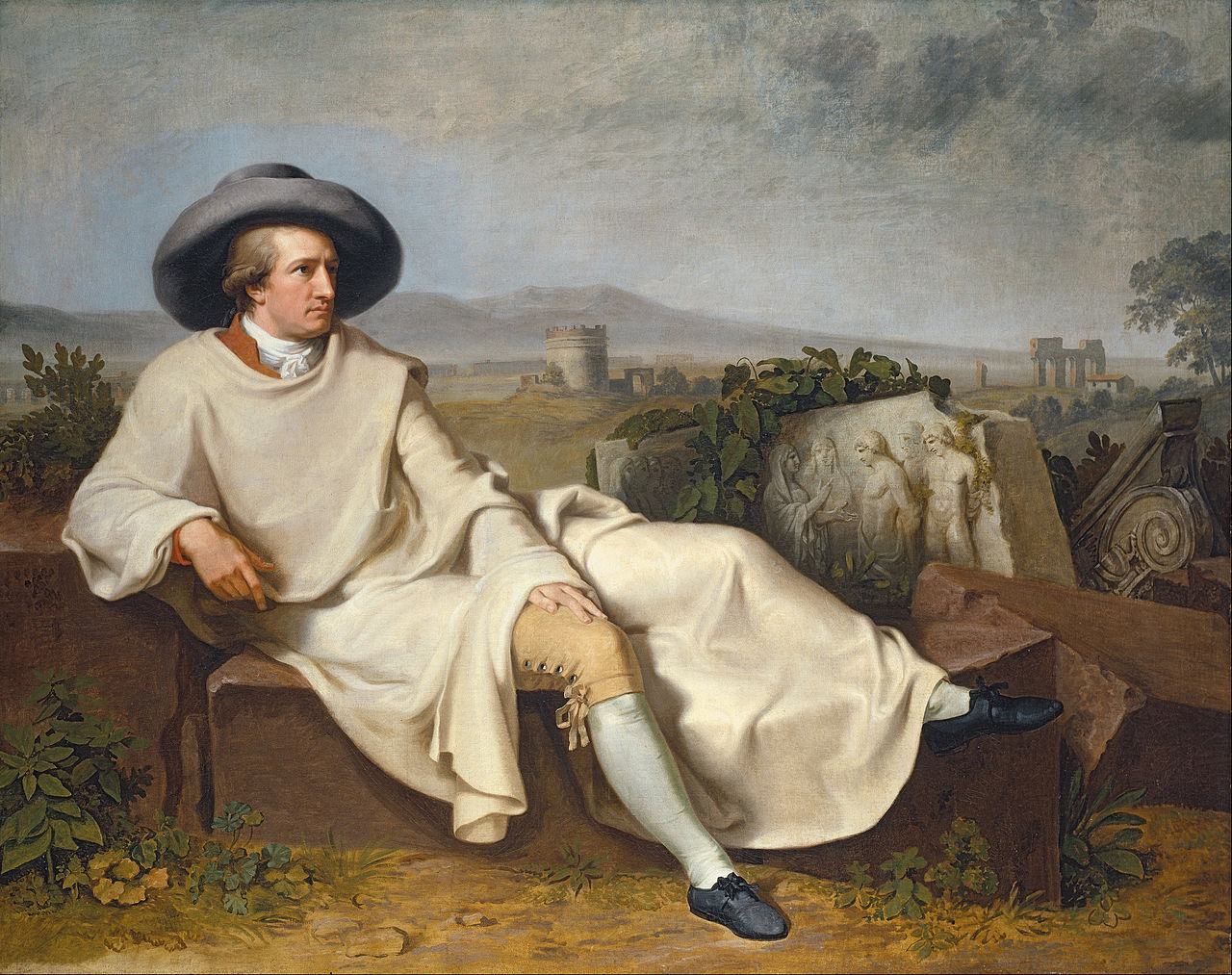
Goethe's journey to the Italian peninsula and Sicily from 1786 to 1788 was of great significance in his aesthetic and philosophical development. His father had made a similar journey, and his example was a major motivating factor for Goethe to make the trip. More importantly, however, the work of Johann Joachim Winckelmann had provoked a general renewed interest in the classical art of ancient Greece and Rome. Thus, Goethe's journey had something of the nature of a pilgrimage to it. During the course of his trip, Goethe met and befriended the artists Angelica Kauffman and Johann Heinrich Wilhelm Tischbein, as well as encountering such notable characters as Lady Hamilton and Alessandro Cagliostro.
He also journeyed to Sicily during this time, and wrote that "To have seen Italy without having seen Sicily is to not have seen Italy at all, for Sicily is the clue to everything." While in Southern Italy and Sicily, Goethe encountered, for the first time genuine Greek (as opposed to Roman) architecture, and was quite startled by its relative simplicity. Winckelmann had not recognized the distinctness of the two styles.
Goethe's diaries of this period form the basis of the non-fiction Italian Journey. Italian Journey only covers the first year of Goethe's visit. The remaining year is largely undocumented, aside from the fact that he spent much of it in Venice. This "gap in the record" has been the source of much speculation over the years.
In the decades which immediately followed its publication in 1816, Italian Journey inspired countless German youths to follow Goethe's example. This is pictured, somewhat satirically, in George Eliot's Middlemarch.
Weimar
In late 1792, Goethe took part in the Battle of Valmy against revolutionary France, assisting Duke Karl August of Saxe-Weimar-Eisenach during the failed invasion of France. Again, during the Siege of Mainz, he assisted Karl August as a military observer. His written account of these events can be found within his Complete Works.
In 1794, Friedrich Schiller wrote to Goethe offering friendship; they had previously had only a mutually wary relationship ever since first becoming acquainted in 1788. This collaborative friendship lasted until Schiller's death in 1805.
In 1806, Goethe was living in Weimar with his mistress Christiane Vulpius, the sister of Christian A. Vulpius and daughter of archivist Johann Friedrich Vulpius, and their son August von Goethe. On 13 October, Napoleon's army invaded the town. The French "spoon guards", the least disciplined soldiers, occupied Goethe's house: The "spoon guards" had broken in, they had drunk wine, made a great uproar and called for the master of the house. Goethe's secretary Riemer reports: "Although already undressed and wearing only his wide nightgown [...] he descended the stairs towards them and inquired what they wanted from him [...] His dignified figure, commanding respect, and his spiritual mien seemed to impress even them". But it was not to last long. Late at night, they burst into his bedroom with drawn bayonets. Goethe was petrified, Christiane raised a lot of noise and even tangled with them, other people who had taken refuge in Goethe's house rushed in, and so the marauders eventually withdrew again. It was Christiane who commanded and organized the defence of the house on the Frauenplan. The barricading of the kitchen and the cellar against the wild pillaging soldiery was her work. Goethe noted in his diary: "Fires, rapine, a frightful night [...] Preservation of the house through steadfastness and luck." The luck was Goethe's, the steadfastness was displayed by Christiane.
Days afterward, on 19 October 1806, Goethe legitimized their 18-year relationship by marrying Christiane in a quiet marriage service at the Jakobskirche in Weimar. They had already had several children together by this time, including their son, Julius August Walter von Goethe (1789–1830), whose wife, Ottilie von Pogwisch, cared for the elder Goethe until his death in 1832. August and Ottilie had three children: Walther Wolfgang Freiherr von Goethe (1818–1885), Wolfgang Maximilian von Goethe (1820–1883) and Alma Sedina Henriette Cornelia von Goethe (1827–1844). Christiane von Goethe died in 1816. Johann reflected, "There is nothing more charming to see than a mother with her child in her arms, and there is nothing more venerable than a mother among a number of her children."
Later life
After 1793, Goethe devoted his endeavours primarily to literature. In 1812, he travelled to Teplice and Vienna, both times meeting his admirer Ludwig van Beethoven, who had set music to Egmont two years prior in 1810. By 1820, Goethe was on amiable terms with Kaspar Maria von Sternberg.
In 1821, having recovered from a near fatal heart illness, the 72-year-old Goethe fell in love with Ulrike von Levetzow, 17 at the time. In 1823, he wanted to marry her, but because of the opposition of her mother, he never proposed. Their last meeting in Carlsbad on 5 September 1823 inspired his poem "Marienbad Elegy" which he considered one of his finest works. During that time he also developed a deep emotional bond with the Polish pianist Maria Szymanowska, 33 at the time, and she separated from her husband.
In 1821, Goethe's friend Carl Friedrich Zelter introduced him to the 12-year-old Felix Mendelssohn. Goethe, now in his seventies, was greatly impressed by the child, leading to perhaps the earliest confirmed comparison to Mozart in the following conversation between Goethe and Zelter:
"Musical prodigies [...] are probably no longer so rare; but what this little man can do in extemporizing and playing at sight borders the miraculous, and I could not have believed it possible at so early an age." "And yet you heard Mozart in his seventh year at Frankfurt?" said Zelter. "Yes", answered Goethe, "[...] but what your pupil already accomplishes, bears the same relation to the Mozart of that time that the cultivated talk of a grown-up person bears to the prattle of a child."
Mendelssohn was invited to meet Goethe on several later occasions, and set a number of Goethe's poems to music. His other compositions inspired by Goethe include the overture Calm Sea and Prosperous Voyage (Op. 27, 1828), and the cantata Die erste Walpurgisnacht (The First Walpurgis Night, Op. 60, 1832).
Heinrich Heine, on his hiking tour through Germany (the trip immortalised in his work Die Harzreise) was granted an audience with Goethe in 1824 in Weimar. Heine had been a great admirer of Goethe's in his early youth, sending him some of his earlier works with praising cover notes. The meeting is said to be of a strikingly unsuccessful nature, with Heine completely omitting the meeting in the Harzreise, and speaking flippantly of it in much later life.
Greek War of Independence and its influence on Faust Part Two
Goethe was a conservative supporter of Klemens von Metternich who did not support revolutions. For example, he supported the suppression of the Trienio Liberal. Goethe admired the Greeks; by 1818 he had collected over 100 Greek folk songs, translating seven of them. However, he was initially a skeptic of the Greek War of Independence, fearing that its success would increase the power of the Russian Empire, while simultaneously contributing to the destruction of Christians within the Ottoman Empire.
Goethe later departed from this view, sympathizing with the Greeks; he saw the Revolution as an analogue for the Crusades and as highly beneficial to the weakening of the power of the Ottoman Empire. In fact, the Greek War of Independence influenced Goethe so deeply that the death of Lord Byron after the Siege of Messolonghi caused him to resume writing Faust Part Two, which was greatly influenced by the ongoing struggles of the Greeks. Goethe also "reincarnated" Byron, symbolically, in the character of Euphorion.
Death
In 1832, Goethe died in Weimar of apparent heart failure. He is buried in the Ducal Vault at Weimar's Historical Cemetery.
Last words
The last words of Goethe are usually abridged as Mehr Licht!, that is, "more light!", although the original quote was longer.
The earliest known account was of Karl Wilhelm Müller's, which gives all of his last words: "Macht doch den zweiten Fensterladen in der Stube auch auf, damit mehr Licht hereinkomme." ("Open the second shutter in the living room so that more light comes in.")
According to his doctor Carl Vogel, his last words were, Mehr Licht! (More light!), but this is disputed as Vogel was not in the room at the moment Goethe died, something he himself says in his account: "[...] "More light" is said to have been the last words of the man, who always hated darkness in every respect, as I had left the dying room for a moment [...]"
Thomas Carlyle, in his letter to John Carlyle (2 July 1832) records that he had learned the version Macht die Fensterladen auf, damit ich mehr Licht bekomme! ("Open the shutters so I can get more light!") from Sarah Austin: "[...] Mrs. Austin wrote lately that Goethe's last words were, Macht die Fensterladen auf, damit ich mehr Licht bekomme! Glorious man! Happy man! I never think of him but with reverence and pride [...]" John Ruskin, in his Præterita, narrates a memory of him from his diary record of 25 October 1874 that Carlyle "[...] had been quoting the last words of Goethe, "Open the window, let us have more light" (this about an hour before painless death, his eyes failing him)."
Even though the context was different, these words, especially the abridged version, which turned into a dictum, are usually used as a means to illustrate the pro-Enlightenment worldview of Goethe.
Aftermath
The first production of Richard Wagner's opera Lohengrin took place in Weimar in 1850. The conductor was Franz Liszt, who chose the date 28 August in honour of Goethe, who was born on 28 August 1749.
Descendants
Goethe had five children with Christiane Vulpius. Only their eldest son, August, survived into adulthood. One child was stillborn, while the others died early. Through his son August and daughter-in-law Ottilie, Johann had three grandchildren: Walther, Wolfgang and Alma. Alma died of typhoid fever during the outbreak in Vienna, at age 16. Walther and Wolfgang neither married nor had any children. Walther's gravestone states: "With him ends Goethe's dynasty, the name will last forever," marking the end of Goethe's personal bloodline. While he has no direct descendants, his siblings do.
Literary work
The most important of Goethe's works produced before he went to Weimar were Götz von Berlichingen (1773), a tragedy that was the first work to bring him recognition, and the novel The Sorrows of Young Werther (German: Die Leiden des jungen Werthers) (1774), which gained him enormous fame as a writer in the Sturm und Drang period which marked the early phase of Romanticism. Indeed, Werther is often considered to be the "spark" which ignited the movement, and can arguably be called the world's first "best-seller". During the years at Weimar before he met Schiller in 1794, he began Wilhelm Meister's Apprenticeship and wrote the dramas Iphigenie auf Tauris (Iphigenia in Tauris), Egmont, and Torquato Tasso and the fable Reineke Fuchs.