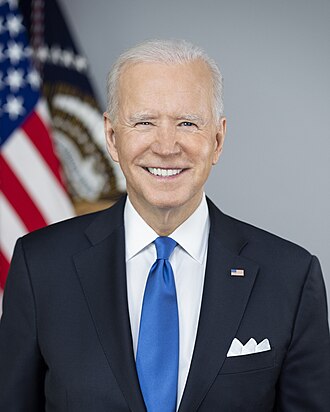
Joseph Robinette Biden Jr. (born November 20, 1942) is an American former politician who was the 46th president of the United States from 2021 to 2025. A member of the Democratic Party, he represented Delaware in the United States Senate from 1973 to 2009 and also served as the 47th vice president under President Barack Obama from 2009 to 2017.
Born in Scranton, Pennsylvania, Biden graduated from the University of Delaware in 1965 and the Syracuse University College of Law in 1968. He was elected to the New Castle County Council in 1970 and the U.S. Senate in 1972. As a senator, Biden chaired the Senate Judiciary Committee and Foreign Relations Committee. He drafted and led passage of the Violent Crime Control and Law Enforcement Act and the Violence Against Women Act. Biden oversaw six U.S. Supreme Court confirmation hearings, including contentious hearings for Robert Bork and Clarence Thomas. He opposed the Gulf War in 1991 but voted in favor of the Iraq War Resolution in 2002. Biden ran unsuccessfully for the Democratic presidential nomination in the 1988 and 2008 primaries. In 2008, Obama chose him as his running mate, and he served as a close advisor to Obama while in office. In the 2020 presidential election, Biden chose Kamala Harris as his running mate, and they defeated Republican incumbents Donald Trump and Mike Pence.
As president, Biden signed the American Rescue Plan Act in response to the COVID-19 pandemic and recession. He signed bipartisan bills on infrastructure and manufacturing. Biden proposed the Build Back Better Act, part of which was incorporated into the Inflation Reduction Act passed in 2022. He appointed Ketanji Brown Jackson to the Supreme Court of the United States. In his foreign policy, the U.S. reentered the Paris Agreement and enacted the New Atlantic Charter. Biden withdrew U.S. troops from Afghanistan pursuant to the 2020 Doha Accords negotiated by Trump, and the Taliban swiftly retook control. He responded to the Russian invasion of Ukraine by imposing sanctions on Russia and authorizing Ukrainian aid. In 2022, Biden supported Finland's and Sweden's bids to join NATO and formally approved their membership. During the Gaza war, he condemned the actions of Hamas, gave Israel strong military and diplomatic support, sent humanitarian aid to the Gaza Strip, and backed a temporary ceasefire proposal before his presidency ended.

Concerns about Biden's age and health persisted throughout his presidency. He is the first president to turn 80 years old while in office. Biden initially ran for reelection in 2024, winning the Democratic primaries and becoming the party's presumptive nominee. After his performance in the first presidential debate, intensifying scrutiny from both political parties about his age and health led him to withdraw his candidacy. During his time in office, historians and scholars ranked Biden's administration favorably, diverging from unfavorable public assessments of his tenure. Biden entered office with majority support, but his approval ratings declined significantly during his presidency, particularly over concerns about inflation and immigration. He is the oldest living former U.S. president since the second inauguration of Donald Trump in 2025, the oldest living former U.S. vice president since Dick Cheney died in 2025, and the oldest person to have served as president.
Early life and education
Joseph Robinette Biden Jr. was born on November 20, 1942, at St. Mary's Hospital in Scranton, Pennsylvania, to Catherine Eugenia "Jean" Biden (née Finnegan) and Joseph Robinette Biden Sr. He is the oldest child in a Catholic family of predominantly Irish descent. Biden has a sister, Valerie, and two brothers, James and Francis.
Joseph Sr. had been wealthy, and the family purchased a home in the affluent Long Island suburb of Garden City, New York, in 1946. After he suffered business setbacks around the time Biden was seven years old, the family lived with Jean's parents in Scranton for several years. Scranton fell into economic decline during the 1950s, and Joseph Sr. could not find steady work. Beginning in 1953, when Biden was ten, the family lived in an apartment in Claymont, Delaware, before moving to a house in nearby Mayfield, Delaware. Joseph Sr. later became a successful used-car salesman, maintaining the family in a middle-class lifestyle.

At Archmere Academy in Claymont, Biden played baseball and was a standout halfback and wide receiver on the high school football team. Though a poor student, he was class president in his junior and senior years. He graduated in 1961. At the University of Delaware in Newark, Biden briefly played freshman football and received a Bachelor of Arts degree with a double major in history and political science in 1965. To overcome a childhood stutter, he memorized lines from Ralph Waldo Emerson and William Butler Yeats.
Marriages, law school, and early career (1966–1973)
Biden married Neilia Hunter, a student at Syracuse University, on August 27, 1966, after overcoming her parents' disinclination for her to wed a Catholic. Their wedding was held in a Catholic church in Skaneateles, New York. They had three children: Joseph R. "Beau" Biden III, Robert Hunter Biden, and Naomi Christina "Amy" Biden.
Biden earned a Juris Doctor from Syracuse University College of Law in 1968. In his first year of law school, he failed a course because he plagiarized a law review article, but the failing grade was later stricken. His grades were relatively poor, and he graduated 76th in a class of 85. He was admitted to the Delaware bar in 1969.

Biden clerked at a law firm headed by prominent local Republican William Prickett in 1968 and self-identified as a Republican. He disliked incumbent Democratic Delaware governor Charles L. Terry's conservative racial politics and supported a more liberal Republican, Russell W. Peterson, who defeated Terry in 1968. Local Republicans attempted to recruit Biden, but he registered as an independent because of his distaste for Republican presidential candidate Richard Nixon.
Law practices
In 1969, Biden resumed practicing law, first as a public defender in Wilmington, Delaware. Most of his clients were African Americans from Wilmington's east side. Biden then joined a firm headed by Sid Balick, a locally active Democrat. Balick named him to the Democratic Forum, a group trying to reform and revitalize the state party, and Biden switched his registration to Democratic. He also started his own firm, Biden and Walsh. Corporate law, however, did not appeal to him, and criminal law did not pay well. He supplemented his income by managing properties.
Biden ran for the fourth district seat on the New Castle County Council in 1970 on a liberal platform that included support for public housing in the suburbs. Biden won the general election, defeating Republican Lawrence T. Messick, and took office on January 5, 1971. He served until January 1, 1973. During his time on the county council, Biden opposed large highway projects, which he argued might disrupt Wilmington neighborhoods.
Biden had not openly supported or opposed the Vietnam War until he ran for Senate and opposed Richard Nixon's conduct of the war. While studying at the University of Delaware and Syracuse University, Biden obtained five student draft deferments. Based on a physical examination, he was given a conditional medical deferment in 1968; in 2008, a spokesperson for Biden said his having had "asthma as a teenager" was the reason.
1972 U.S. Senate campaign in Delaware
Biden defeated Republican incumbent J. Caleb Boggs to become the junior U.S. senator from Delaware in 1972. He was the only Democrat willing to challenge Boggs and, with minimal campaign funds, was thought to have no chance of winning. Family members managed and staffed the campaign, which relied on meeting voters face-to-face and hand-distributing position papers, an approach made feasible by Delaware's small size. He received help from the AFL-CIO and Democratic pollster Patrick Caddell. His platform focused on the environment, withdrawal from Vietnam, civil rights, mass transit, equitable taxation, health care and public dissatisfaction with "politics as usual". A few months before the election, Biden trailed Boggs by almost thirty percentage points, but his energy, young family, and ability to connect with voters' emotions worked to his advantage, and he won with 50.5% of the vote.
Death of first wife and daughter
A few weeks after Biden was elected senator, his wife Neilia and one-year-old daughter Naomi were killed in an automobile accident in Hockessin, Delaware, on December 18, 1972. Their sons Beau (aged 3) and Hunter (aged 2) were in the car and were taken to hospital with non-life-threatening injuries. He considered resigning to care for them, but Senate Majority Leader Mike Mansfield persuaded him not to. Biden contemplated suicide and was filled with anger and religious doubt. He wrote that he "felt God had played a horrible trick" on him and had trouble focusing on work.

Second marriage
Biden met teacher Jill Tracy Jacobs in 1975 on a blind date. They married at the United Nations chapel in New York on June 17, 1977, and spent their honeymoon at Lake Balaton in the Hungarian People's Republic. Biden credits her with the renewal of his interest in politics and life.
In 1981, the couple had a daughter, Ashley Biden, who is a social worker, activist, and fashion designer. Jill helped raise her stepsons, Hunter and Beau, who were seven and eight respectively at the time of her marriage. Hunter has worked as a Washington lobbyist and investment adviser; his business dealings, personal life, and legal troubles came under significant scrutiny during his father's presidency. In December 2024, Biden pardoned Hunter following his conviction on gun and tax charges despite repeated promises that he would not do so. Beau became an Army judge-advocate in Iraq and later Delaware attorney general before dying of brain cancer in 2015.
Teaching
From 1991 to 2008, as an adjunct professor, Biden co-taught a seminar on constitutional law at Widener University School of Law.

U.S. Senate (1973–2009)
Elected to the U.S. Senate in 1972, Biden was reelected in 1978, 1984, 1990, 1996, 2002, and 2008, regularly receiving about 60% of the vote. Aged 30 when first elected, he was the seventh-youngest senator in U.S. history. He was junior senator to William Roth until Roth was defeated in 2000. He remains one of the longest-serving senators in U.S. history. For 36 years, he commuted from Washington to Wilmington via Amtrak, earning him the nickname "Amtrak Joe".
Senate activities
During his early years in the Senate, Biden focused on consumer protection and environmental issues and called for greater government accountability. In 1974, he described himself as liberal on civil rights and liberties, senior citizens' concerns, and healthcare, but conservative on other issues, including abortion and military conscription. Biden was the first U.S. senator to endorse Governor Jimmy Carter for president in the 1976 Democratic primary. Carter won the Democratic nomination and the 1976 election. Biden also worked on arms control. After Congress failed to ratify the SALT II Treaty signed in 1979 by Soviet general secretary Leonid Brezhnev and President Carter, Biden met with Soviet foreign minister Andrei Gromyko and secured changes that addressed the Senate Foreign Relations Committee's objections. He received considerable attention when he excoriated Secretary of State George Shultz at a Senate hearing for the Reagan administration's support of South Africa despite its policy of apartheid. In a congressional hearing in 1984, he objected to the Strategic Defense Initiative plan to construct autonomous systems of ICBM defense. Biden was an advocate for Delaware military installations, including Dover Air Force Base and New Castle Air National Guard Base.
In the mid-1970s, Biden was one of the Senate's strongest opponents of race-integration busing. His Delaware constituents strongly opposed it, and such opposition nationwide later led his party to mostly abandon school integration policies. In his first Senate campaign, Biden had expressed support for busing to remedy de jure segregation, as in the South, but opposed its use to remedy de facto segregation arising from racial patterns of neighborhood residency, as in Delaware; he opposed a proposed constitutional amendment banning busing entirely. Biden supported a 1976 measure forbidding the use of federal funds for transporting students beyond the school closest to them. He co-sponsored a 1977 amendment closing loopholes in that measure, which President Carter signed into law in 1978.
Biden became ranking minority member of the Senate Judiciary Committee in 1981. He was a Democratic floor manager for the successful passage of the Comprehensive Crime Control Act in 1984. His supporters praised him for modifying some of the law's worst provisions, and it was his most important legislative accomplishment to that time. In 1994, Biden helped pass the Violent Crime Control and Law Enforcement Act, which included a ban on assault weapons, and the Violence Against Women Act, which he has called his most significant legislation. The 1994 crime law was unpopular among progressives and criticized for resulting in mass incarceration; Biden later expressed regret for passing the bill.
Biden voted for a 1993 provision that deemed homosexuality incompatible with military life, thereby banning gay people from serving in the armed forces. In 1996, he voted for the Defense of Marriage Act, which prohibited the federal government from recognizing same-sex marriages, thereby barring people in such marriages from equal protection under federal law and allowing states to do the same. In 2015, the act was ruled unconstitutional in Obergefell v. Hodges.
Biden was critical of Independent Counsel Ken Starr during the 1990s Whitewater controversy and Clinton–Lewinsky scandal investigations, saying "it's going to be a cold day in hell" before another independent counsel would be granted similar powers. He voted to acquit during the impeachment of Bill Clinton. During the 2000s, Biden sponsored bankruptcy legislation sought by credit card issuers (such as MBNA, one of Delaware's largest companies). Bill Clinton vetoed the bill in 2000, but it passed in 2005 as the Bankruptcy Abuse Prevention and Consumer Protection Act, with Biden being one of only 18 Democrats to vote for it, while leading Democrats and consumer rights organizations opposed it. As a senator, Biden strongly supported increased Amtrak funding and rail security.
Brain surgeries
In February 1988, after several episodes of severe neck pain, Biden underwent surgery to correct a leaking intracranial berry aneurysm. While recuperating, he suffered a pulmonary embolism. A second aneurysm was surgically repaired in May. His recuperation kept him away from the Senate for seven months.
Senate Judiciary Committee
Biden was a longtime member of the Senate Committee on the Judiciary. He chaired it from 1987 to 1995 and was a ranking minority member from 1981 to 1987 and again from 1995 to 1997.
As chair, Biden presided over two highly contentious U.S. Supreme Court confirmation hearings. When Robert Bork was nominated in 1988, Biden reversed his approval—given in an interview the previous year—of a hypothetical Bork nomination. Conservatives were angered, but at the hearings' close Biden was praised for his fairness, humor, and courage. Rejecting the arguments of some Bork opponents, Biden framed his objections to Bork in terms of the conflict between Bork's strong originalism and the view that the U.S. Constitution provides rights to liberty and privacy beyond those explicitly enumerated in its text. Bork's nomination was rejected in the committee by a 5–9 vote and then in the full Senate, 42–58.
During Clarence Thomas's nomination hearings in 1991, Biden's questions on constitutional issues were often convoluted to the point that Thomas sometimes lost track of them, and Thomas later wrote that Biden's questions were akin to "beanballs". After the committee hearing closed, the public learned that Anita Hill had accused Thomas of making unwelcome sexual comments when they had worked together. Biden had known of some of these charges, but initially shared them only with the committee because Hill was then unwilling to testify. The committee hearing was reopened and Hill testified, but Biden did not permit testimony from other witnesses, such as a woman who had made similar charges and experts on harassment. The full Senate confirmed Thomas by a 52–48 vote, with Biden opposed. Liberal legal advocates and women's groups felt strongly that Biden had mishandled the hearings and not done enough to support Hill. In 2019, he told Hill he regretted his treatment of her, but Hill said afterward she remained unsatisfied.
Senate Foreign Relations Committee
Biden was a longtime member of the Senate Foreign Relations Committee. He became its ranking minority member in 1997, and chaired it from June 2001 to 2003 and 2007 to 2009. His positions were generally liberal internationalist. He collaborated effectively with Republicans and sometimes went against elements of his own party. During this time he met with at least 150 leaders from 60 countries and international organizations, becoming a well-known Democratic voice on foreign policy.
Biden voted against authorization for the Gulf War in 1991. He became interested in the Yugoslav Wars after hearing about Serbian abuses during the Croatian War of Independence in 1991. Once the Bosnian War broke out, Biden was among the first to call for the "lift and strike" policy. George H. W. Bush and Bill Clinton were both reluctant to implement the policy, fearing Balkan entanglement. In April 1993, Biden had a tense three-hour meeting with Serbian leader Slobodan Milošević. Biden worked on several versions of legislative language urging the U.S. toward greater involvement. He has called his role in affecting Balkan policy in the mid-1990s his "proudest moment in public life" related to foreign policy. In 1999, during the Kosovo War, Biden supported the NATO bombing of Yugoslavia. He and Senator John McCain co-sponsored the McCain-Biden Kosovo Resolution, which called on Clinton to use all necessary force, including ground troops, to confront Milošević over Yugoslav actions toward Kosovo Albanians.
Wars in Afghanistan and Iraq
Biden was a strong supporter of the War in Afghanistan, saying, "Whatever it takes, we should do it." As head of the Senate Foreign Relations Committee, he said in 2002 that Iraqi president Saddam Hussein was a threat to national security and there was no other option than to "eliminate" that threat. In October 2002, he voted in favor of the Authorization for Use of Military Force Against Iraq, approving the U.S. invasion of Iraq. As chair of the committee, he assembled witnesses to testify in favor of the authorization. They gave testimony grossly misrepresenting the intent, history, and status of Saddam and his government, and touted Iraq's fictional possession of weapons of mass destruction. Biden eventually became a critic of the war, calling his vote a "mistake" by 2005, but did not push for withdrawal. He supported the appropriations for the occupation, but argued that the war should be internationalized, that more soldiers were needed, and that the Bush administration should "level with the American people" about its cost and length.
By late 2006, Biden's stance had shifted considerably. He opposed the troop surge of 2007, saying General David Petraeus was "dead, flat wrong" in believing the surge could work. Biden, through a plan developed with Council on Foreign Relations president Leslie H. Gelb, instead advocated dividing Iraq into a loose federation of three ethnic states. In September 2007, a non-binding resolution endorsing the plan passed the Senate, but the idea failed to gain traction.
Previous presidential campaigns
1988 campaign
Biden declared his candidacy for the 1988 Democratic presidential nomination on June 9, 1987. He was considered a strong candidate because of his moderate image, his speaking ability, his high profile as chair of the Senate Judiciary Committee at the upcoming Robert Bork Supreme Court nomination hearings, and his appeal to Baby Boomers. He raised more in the first quarter of 1987 than any other candidate.
By August, Biden's campaign messaging had become confused due to staff rivalries, and in September, he was accused of plagiarizing a speech by British Labour Party leader Neil Kinnock. Biden had credited Kinnock on previous occasions, but did not on two occasions in August. Earlier that year, Biden had also used passages from a speech by Robert F. Kennedy (for which his aides took blame) and the inaugural address of John F. Kennedy. Two years earlier he had used a 1976 passage by Hubert Humphrey. Biden responded that politicians often borrow from one another without giving credit, and that one of his rivals for the nomination, Jesse Jackson, had called him to point out that Jackson had used the same material by Humphrey that Biden had used. A few days later, it was publicized that, while in law school, Biden had taken text from a Fordham Law Review article with inadequate citations. At Biden's request the Delaware Supreme Court's Board of Professional Responsibility reviewed the incident and concluded that he had violated no rules.
Biden has made several false or exaggerated claims about his early life: that he had earned three degrees in college, that he attended law school on a full scholarship, that he had graduated in the top half of his class, and that he had marched in the civil rights movement. The limited amount of other news about the presidential race amplified these disclosures, and on September 23, 1987, Biden withdrew his candidacy.
2008 campaign
After exploring running in several previous cycles, in January 2007, Biden declared his candidacy in the 2008 elections. Biden focused on the Iraq War, his record as chairman of major Senate committees, and his foreign-policy experience. Biden was noted for his one-liners during the campaign; in one debate he said of Republican candidate Rudy Giuliani, "There's only three things he mentions in a sentence: a noun, and a verb and 9/11."
Biden had difficulty raising funds, struggled to draw people to his rallies, and failed to gain traction against the high-profile candidacies of Barack Obama and Hillary Clinton. He never rose above single digits in national polls of the Democratic candidates. In the first contest on January 3, 2008, Biden placed fifth in the Iowa caucuses, garnering slightly less than one percent of the state delegates. He withdrew from the race that evening.
Despite its lack of success, Biden's 2008 campaign raised his stature in the political world. In particular, it changed the relationship between Biden and Obama. Although they had served together on the Senate Foreign Relations Committee, they had not been close: Biden resented Obama's quick rise to political stardom, while Obama viewed Biden as garrulous and patronizing. Having gotten to know each other during 2007, Obama appreciated Biden's campaign style and appeal to working-class voters, and Biden said he became convinced Obama was "the real deal".
Vice presidential campaigns
2008 campaign
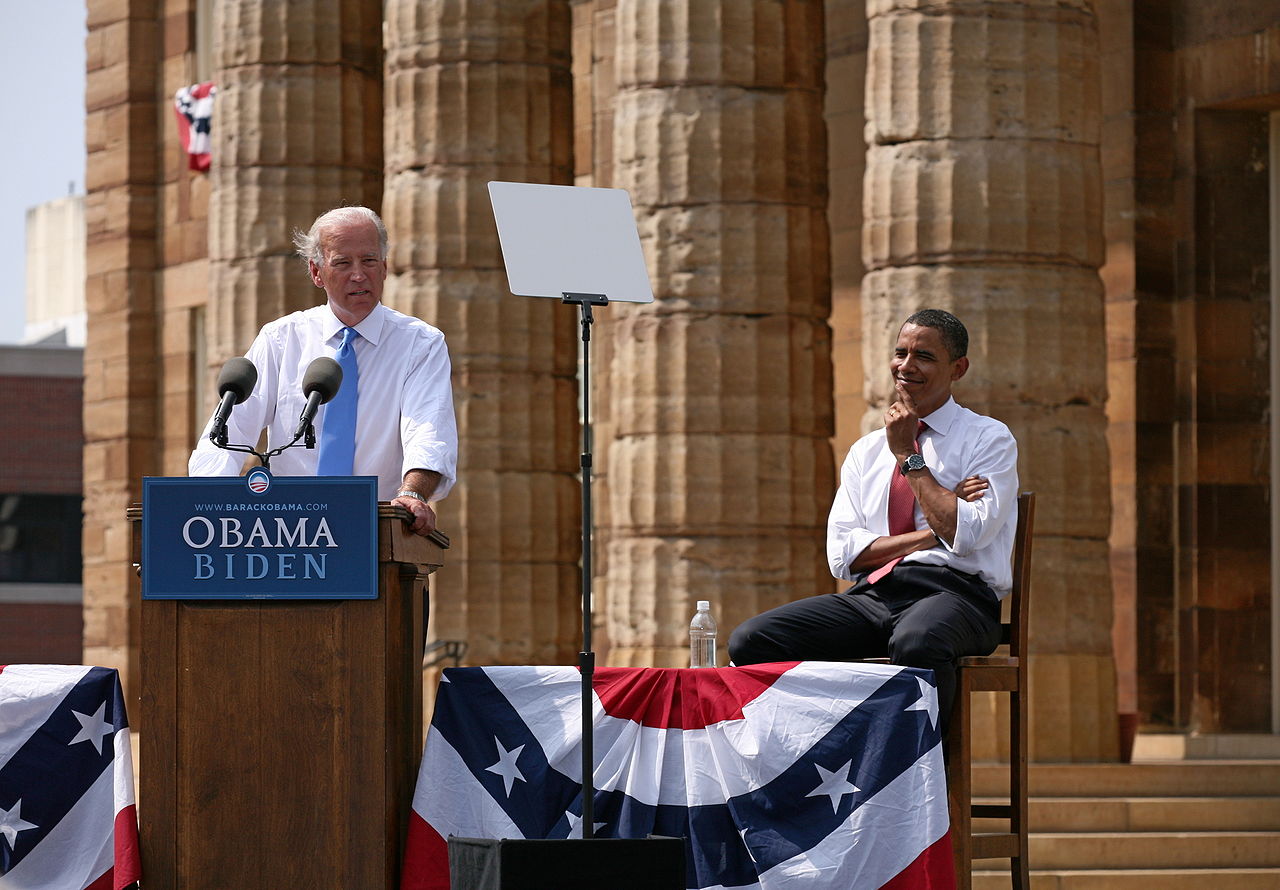
In August 2008, Obama and Biden met in secret to discuss the possibility of a place for Biden in the Obama administration, and developed a strong personal rapport. On August 22, Obama announced that Biden would be his running mate. The New York Times reported that the choice reflected a desire for someone with foreign policy and national security experience. Others pointed out Biden's appeal to middle-class and blue-collar voters. Biden was officially nominated for vice president on August 27 at the 2008 Democratic National Convention in Denver.
Biden's vice-presidential campaigning gained little media attention, as the press devoted far more coverage to the Republican nominee and then-governor of Alaska, Sarah Palin. Under instructions from the campaign, Biden kept his speeches succinct and tried to avoid offhand remarks. Privately, Biden's remarks frustrated Obama. "How many times is Biden gonna say something stupid?", he once angrily asked. Obama campaign staffers called Biden's blunders "Joe bombs" and kept Biden uninformed about strategy discussions, which irked Biden. Relations between the two campaigns became strained for a month, until Biden apologized to Obama and the two built a stronger partnership.
As the 2008 financial crisis reached a peak in September 2008, and the proposed Emergency Economic Stabilization Act of 2008 became a major factor in the campaign, Biden voted for the $700 billion Emergency Economic Stabilization Act of 2008, which passed in the Senate. On October 2, he participated in the vice-presidential debate with Palin at Washington University in St. Louis. Post-debate polls found that while Palin exceeded many voters' expectations, Biden had still won the debate overall. On November 4, Obama and Biden were elected.
As Biden was running for vice president, he was also running for reelection to the Senate, as permitted by Delaware law. Having been reelected to the Senate as well as the vice presidency, Biden made a point of not resigning from the Senate before he was sworn in for his seventh term in January 2009. He resigned from the Senate on January 15.